It runs. Right now, in this browser tab.
The console is the reference core ported to the client: field-level merge, conflict resolution that names its rule, a SHA-256 chain you verify yourself, and seat-based routing. No server, no account, no network after the first load.
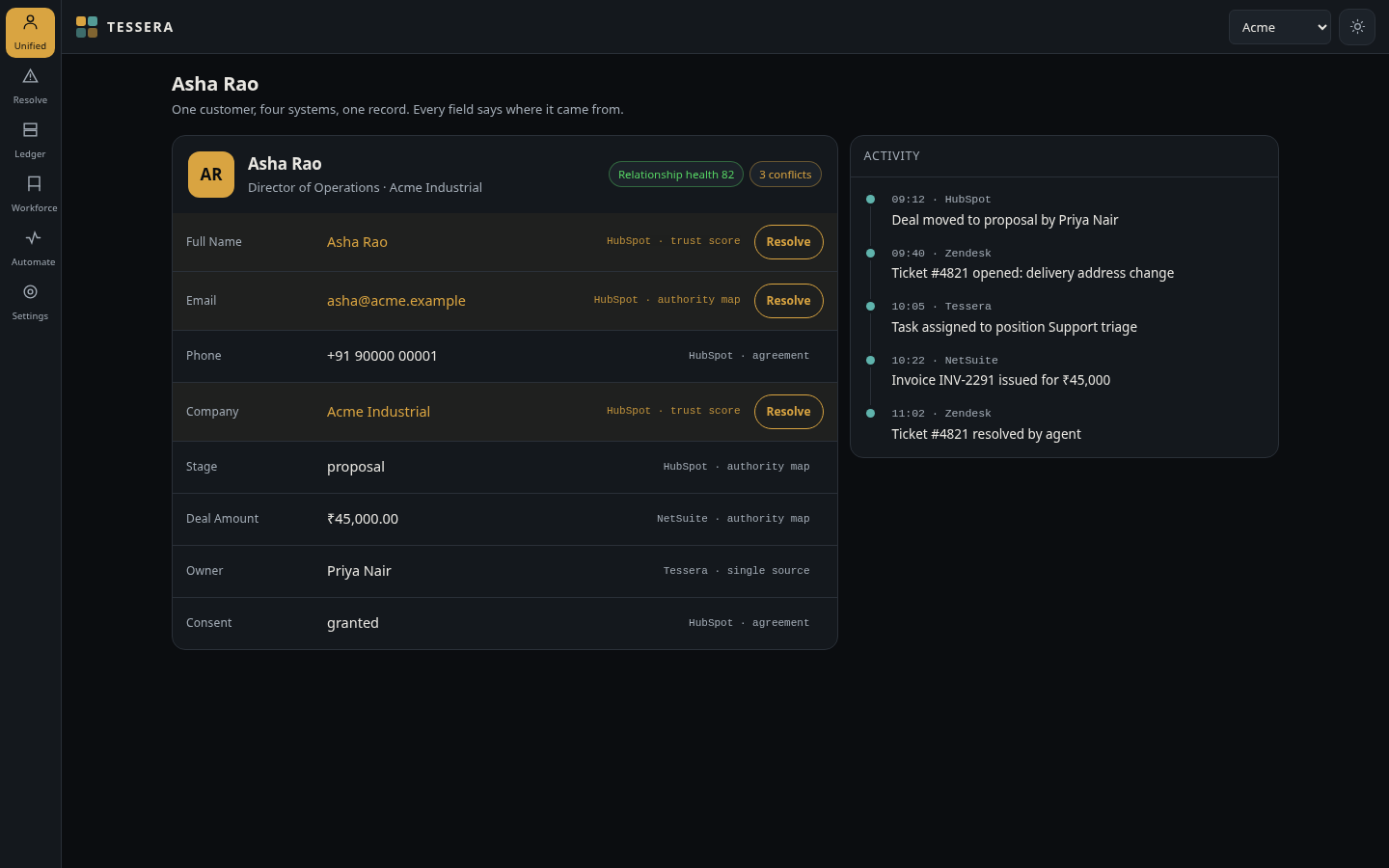
- Unified — every field names the system it came from and the rule that chose it
- Resolve — both values, both trust scores, and the deciding rule before you choose
- Ledger — verify recomputes SHA-256 in the page; a tamper button proves it works
- Workforce — work goes to a position; the router prints its arithmetic
- Automate — a playbook written by an agent cannot run until a person approves it
Installable as an app. Works offline. One 43 KB HTML file, no framework.
The problem
Four to seven systems hold a slice of the same customer. The slices disagree.
Reconciling them costs a person a morning a week, and the reconciliation is invisible to everyone else. The usual answer is a migration: move everything into one CRM, lose two years of history in the edges, and repeat the exercise in five years.
No migration
Adoption is additive. The mesh connects to what exists and produces the first result before anything is moved. The native core is one node in the mesh, not the product.
One ledger
Every action in every connected system becomes one hash-chained event. “What did each system know at time T” has exactly one answer, and it is provable.
Seats, not users
Work is assigned to a position, not a person. A human or an agent fills it. Every agent seat must declare a fallback, and every handoff carries full state, signed.
How it works
Three moves, in this order.
Connect
A node joins with a capability manifest, a versioned schema map and a per-field authority map. Nothing is copied. Nothing is migrated.
Unify
One canonical schema, ten objects, four sync modes per field. Conflicts resolve by a declared order and are logged — never silently overwritten.
Prove
Every action lands in the ledger. Bi-temporal views and git checkpoints are projections of it, and a projection that cannot be rebuilt is a defect.
Four systems, one merge, one proof.
Sources feed the mesh. The mesh merges field by field and records the rule it used. The ledger keeps every action. Work goes to seats, and a human or an agent fills them.

Architecture
Eight layers. Five are specified, three are roadmap with written entry criteria.
Federation mesh v1
Nodes, canonical schema, four connectors, deterministic routing, universal ledger, conflict resolution.
CRM core v1, optional
Reference implementation of the canonical schema. Local-first web, encrypted offline mobile.
Workforce v1 subset
Seats, occupants, tasks, handoff packets, escalation ladders, two observable autonomy tiers.
Intelligence v2
Graduated autonomy, workforce analytics with provenance, cost-aware routing.
Protocol and settlement v3
Cross-company chains, agent-to-agent transactions, a universal dispute trail.
Economic engine v3
Marketplace with provenance, outcome billing, revenue share for published org designs.
Experience v1
Design system, jargon discipline enforced by lint, migration as an interface rather than a project.
Learning v1
Bootcamp, coach, academy, documentation, changelog, community — ten artefacts, each with a criterion.
Non-negotiable
Three rules, each with a test. A rule without a test is a slogan.
No AI in the critical path
Read, write, sync, auth, search, report and notification work with every AI container switched off. The full test suite must pass at the bare profile.
Nothing is silently overwritten
A cross-system conflict resolves by a declared order and is written to the ledger with both candidate values and the rule that settled it.
History has one authority
The event ledger is the record. Bi-temporal columns, git checkpoints and graph projections are derived, and must be rebuildable from it.
The audit
The specification was audited against itself before anything was built.
The source was a 261-line build prompt. Four passes — structural, definitional, contradiction, external — found 43 defects. All 43 are closed here, by formal definition or by a numbered assumption with a named owner.
What exists: a specification, an audit register, a metric dictionary, acceptance criteria, three rendered documents, and a dependency-free reference core — the canonical schema, the hash-chained ledger, every metric, routing, conflict resolution, the connector contract, the conformance suite, four connectors, backpressure, a working mesh, projections that rebuild from the ledger a workforce layer, an HTTP surface with an OpenAPI 3.1 contract, three-layer access control, a compliance substrate and local-first sync, under 748 tests. Reviewed: 13 findings, 11 fixed.
What does not exist: the product. No connector has called a live tenant — every result comes from a recorded transport. The Postgres DDL has been parsed by Postgres’s own parser and never executed against a server. There is no hosted service and no customer has used this.
What changed since this page was written: the service does listen
(python3 -m tessera.api), the interface does render (the console, in a separate repository), and a
demo starts both halves with python3 -m tessera.demo. The sentence that used to say otherwise was
wrong, and being wrong in the modest direction is still being wrong. Every public claim and its check is in the
claim register.
What was corrected: the source document’s 30-day data-subject-request clock was a GDPR transplant and is now a per-jurisdiction configuration. Its 72-hour breach clock was right — DPDP Rules 2025, rule 7(2), requires it — and is retained.
Documentation