Twenty-four monuments, built again in code.
No photographs, no downloaded models. Every dome, bracket and lattice screen here is generated by a few thousand lines of JavaScript and lit by a physical sky. Walk around them, watch the light change, read the history.
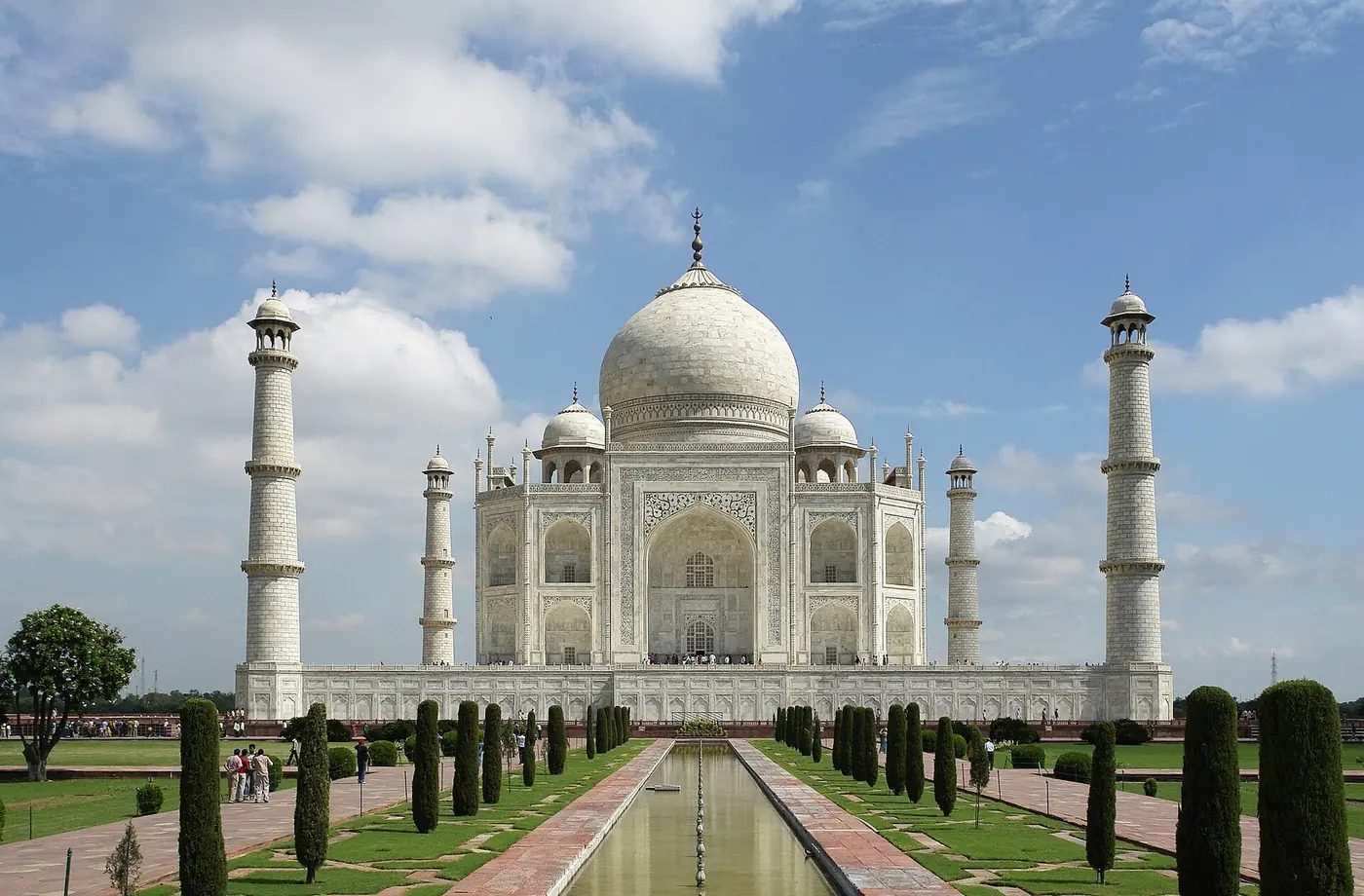
Photograph by Yann, edited by Jim Carter · CC BY-SA 4.0
via Wikimedia Commons · all credits
Why build a monument twice?
A monument is a set of decisions frozen in stone: how wide the arch, how many flutes on the shaft, how far the balcony projects. Rebuilding one in code makes those decisions visible. You can change the hour of the day, stand at the foot of the minaret, or watch a monsoon arrive over the charbagh.
Each page in this atlas is a single miniature, drawn from primitives — cylinders, boxes, lathes and arches — and merged into a handful of draw calls. The colours come from the real materials: Makrana marble, red sandstone from Dholpur, Deccan basalt, khondalite, gold leaf.
The history on every page is adapted from Wikipedia and cited in full on the credits page. The photographs are from Wikimedia Commons, each with its own licence. The models themselves are released under CC BY-NC 4.0.
Silhouette first
Proportion and profile before ornament. If you cannot recognise the building from across the room, the model has failed.
Light is the material
A physical sky, a moving sun and floodlights at dusk. Marble is a different colour at six in the morning and nine at night.
Sources in the open
Every page links its Wikipedia article, its UNESCO record and the Commons file behind its photograph, with the licence named.
24 monuments, from Sanchi Stupa to the Statue of Unity
Oldest to newest spans more than two thousand years — a Mauryan stupa and a 2018 bronze — modelled on the same terms.

Agra · Uttar Pradesh
Taj Mahal ताज महल
A white marble mausoleum on the Yamuna at Agra, built by Shah Jahan for Mumtaz Mahal and finished in 1648.
Enter the miniature
Mehrauli, Delhi · Delhi
Qutb Minar क़ुतुब मीनार
A 72.5-metre victory tower of fluted red sandstone and marble, begun by Qutb al-Din Aibak and completed under later sultans.
Enter the miniature
Jaipur · Rajasthan
Hawa Mahal हवा महल
A honeycomb screen of 953 latticed windows in red and pink sandstone, built so the women of the palace could watch the street unseen.
Enter the miniature
Hyderabad · Telangana
Charminar चारमीनार
Four grand arches and four minarets over the old city, raised in 1591 at the crossing of Hyderabad's bazaars.
Enter the miniature
Mumbai · Maharashtra
Gateway of India गेटवे ऑफ़ इंडिया
A basalt triumphal arch on the Mumbai waterfront, built to mark a royal landing and later the last exit of the Raj.
Enter the miniature
New Delhi · Delhi
India Gate इंडिया गेट
Lutyens' 42-metre war memorial arch, inscribed with the names of 74,187 soldiers of the First World War.
Enter the miniature
Mysuru · Karnataka
Mysore Palace मैसूर पैलेस
The Amba Vilas Palace: a royal residence of pink domes, arched colonnades and a gold finial, lit by a hundred thousand lamps on Sundays.
Enter the miniature
Amritsar · Punjab
Golden Temple हरमंदिर साहिब
Harmandir Sahib, the holiest gurdwara of Sikhism, set on an island in the Amrit Sarovar and clad in gold leaf.
Enter the miniature
Konark · Odisha
Konark Sun Temple कोणार्क सूर्य मंदिर
A stone chariot for the sun god, with 24 carved wheels, seven horses and a tower that once stood 61 metres high.
Enter the miniature
Sanchi · Madhya Pradesh
Sanchi Stupa साँची का स्तूप
Ashoka's hemispherical relic mound, ringed by a stone railing and four carved gateways on a hill above the plain.
Enter the miniature
Kolkata · West Bengal
Victoria Memorial विक्टोरिया मेमोरियल
A white marble domed hall on the Kolkata Maidan, the largest monument to a monarch anywhere in the world.
Enter the miniature
Madurai · Tamil Nadu
Meenakshi Temple मीनाक्षी मंदिर
Fourteen painted gopurams above the Vaigai at Madurai, a temple city dedicated to Meenakshi and Sundareswarar.
Enter the miniature
New Delhi · Delhi
Lotus Temple कमल मंदिर
Twenty-seven marble petals closed around a silent hall: the Bahá’í House of Worship, open to every faith.
Enter the miniature
Mahabalipuram · Tamil Nadu
Shore Temple तटीय मंदिर
A granite shrine of tiered towers standing where the Bay of Bengal runs up the sand at Mamallapuram.
Enter the miniature
Patan · Gujarat
Rani ki Vav रानी की वाव
A seven-storey stepwell sunk into the Gujarat plain, its walls lined with five hundred carved figures.
Enter the miniature
Amer, Jaipur · Rajasthan
Amber Fort आमेर किला
A hilltop palace of yellow sandstone above Maota Lake, its ramparts running along the Aravalli ridge.
Enter the miniature
Mumbai · Maharashtra
CSMT, Mumbai छत्रपति शिवाजी महाराज टर्मिनस
Stevens’ Victorian Gothic terminus: pointed arches, a stone dome and a clock tower over one of the busiest stations in India.
Enter the miniature
Bodh Gaya · Bihar
Mahabodhi Temple महाबोधि मंदिर
The brick tower at Bodh Gaya raised where the Buddha attained enlightenment: one of the oldest brick temples surviving in India.
Enter the miniature
Kevadia · Gujarat
Statue of Unity एकता की प्रतिमा
At 182 metres, the world’s tallest statue: Sardar Vallabhbhai Patel in bronze, facing the Narmada dam.
Enter the miniature
Khajuraho · Madhya Pradesh
Kandariya Mahadeva कंदारिया महादेव मंदिर
The tallest of the Khajuraho temples: a 31-metre mountain of sandstone covered in carved figures.
Enter the miniature
Old Goa · Goa
Basilica of Bom Jesus बॉम जीसस बासीलिका
A baroque basilica of laterite and white plaster in Old Goa, holding the relics of St Francis Xavier.
Enter the miniature
Jodhpur · Rajasthan
Mehrangarh मेहरानगढ़ किला
A fort on a 120-metre rock above Jodhpur, its walls up to 36 metres high and 21 metres thick.
Enter the miniature
Jaipur · Rajasthan
Jantar Mantar जंतर मंतर
Nineteen masonry instruments in lime plaster, built to measure the sky, among them a sundial 27 metres high.
Enter the miniature
Prabhas Patan · Gujarat
Somnath Temple सोमनाथ मंदिर
The first of the twelve Jyotirlingas, on the Gujarat shore, destroyed and rebuilt many times.
Enter the miniatureOne engine, twenty-four buildings, no assets.
Geometry from code
Each monument is a module of a few hundred lines. Primitives are transformed, merged by material and drawn in one pass — twelve thousand to ninety thousand triangles, under two dozen draw calls.
A sky that moves
Rayleigh and Mie scattering drive the sky, the sun and the moon. Clouds, rain and mist are layered on top; at dusk the floodlights come up and the stone turns amber.
History in place
Every page carries a guided tour, a history drawer and the sources behind it. Read the story of the building while you orbit it, then follow the links to Wikipedia and UNESCO.
A timeline of the atlas
From Ashoka's relic mound to Lutyens' memorial arch. Scroll the line sideways.
Facts from Wikipedia, photographs from Commons
Every history in this atlas is adapted from the English Wikipedia article on the monument, which is published under CC BY-SA 4.0. The facts, dates and figures are checked against the article and against UNESCO's World Heritage records where a site is inscribed.
The photographs are the lead images of those articles on Wikimedia Commons. Each is credited to its photographer with the licence named, and links back to the original file. The 3D models use no photographs at all — they are geometry, generated at runtime.
Reuse
Code and models: CC BY-NC 4.0 — copy, remix and publish with credit to Dr Sohil Momin; not for commercial use.
Photographs: each under its own licence (CC BY, CC BY-SA, FAL), credited on the credits page.
Text: adapted from Wikipedia under CC BY-SA 4.0.
Type: Cormorant Garamond, JetBrains Mono and Noto Sans Devanagari, all under the SIL Open Font License.