kosh
Kosh





The file workbench of the CHCE family. Split, squeeze, archive, verify and inspect — one engine, a CLI and a local web UI. Where a CHCE engine is installed, Kosh drives it across a process boundary instead of reimplementing it.
kosh engines                                 # which CHCE engines are here, and their versions
kosh scan photo.raw                          # would the engine help? answered from a sample
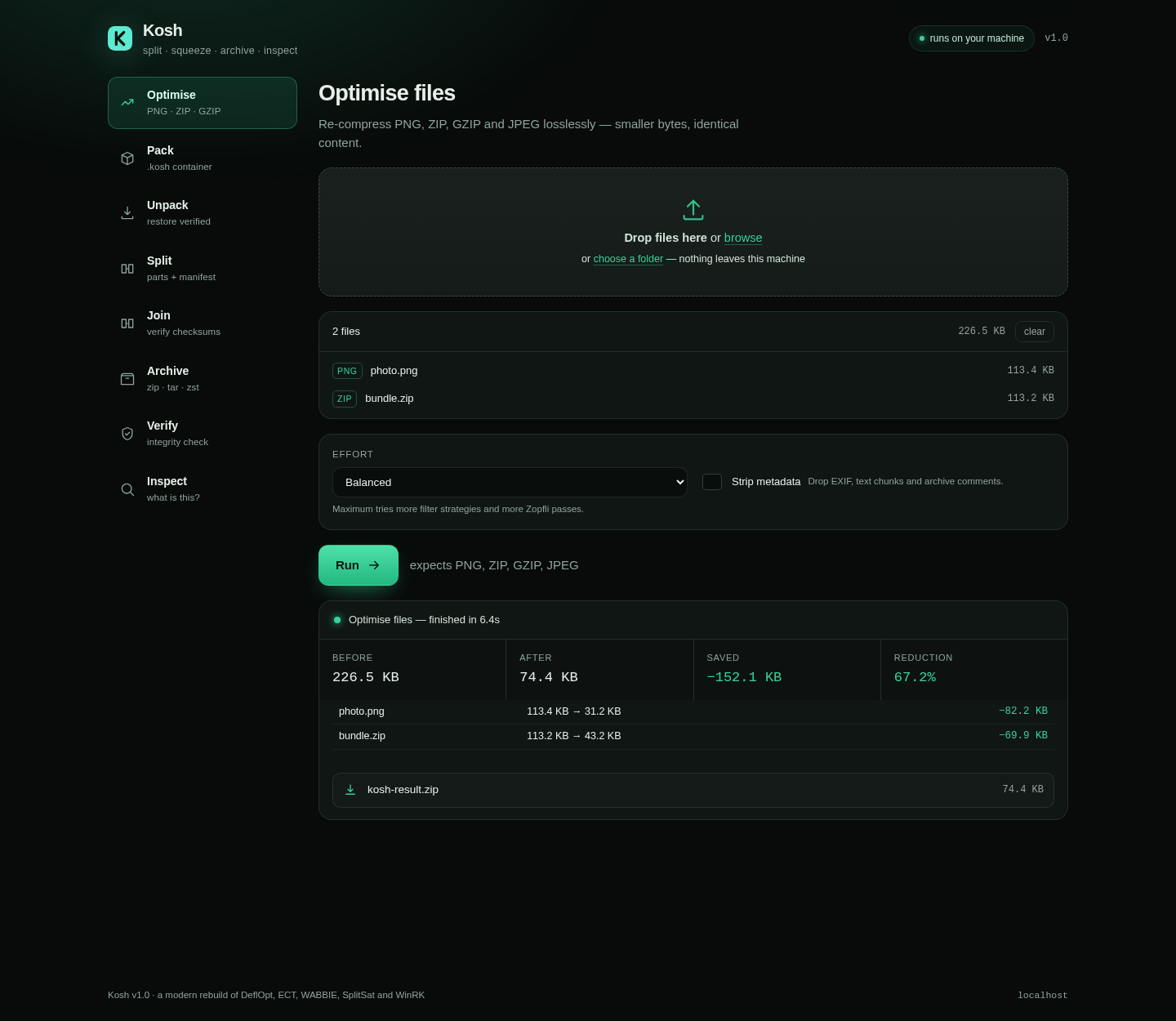
kosh optimize photos/ --level 2 --strip      # PNG/ZIP/GZIP/JPEG, losslessly smaller
kosh pack project/ -o project.kosh           # verified container
kosh split backup.img --size 700M -o parts/  # parts that prove themselves
kosh verify project.kosh                     # is it intact? (no extraction)
kosh ui                                      # the same engine in a browser
Where it sits in CHCE
CHCE (Holistic Compression Sources) is a source vault (HCS), the native engine
built from it (ziptastic), the orchestrator that chains binaries (heavenzip),
and the coordinator (compfactory). Kosh is the workbench: the thing you
point at a folder before and after the engine runs. It does not implement BWT,
rANS or PPMd, and it will not pretend to — it does container-level work that the
engine deliberately does not:
| job | who does it |
|---|---|
| Strongest possible ratio on a payload | ziptastic (.dr), driven by kosh pack --engine ziptastic |
| Chaining prebuilt binaries into a pipeline | heavenzip (.hzpkg), driven by kosh pack --engine heavenzip |
| Re-compressing what is already compressed (PNG, ZIP, GZIP) | Kosh optimize |
| Splitting, joining, archiving, verifying, inspecting | Kosh |
A CHCE stream is recognised, not decoded: kosh scan file.dr reports the magic,
version, original size and block count, and points at the decoder. Two tools that
both claim the same magic would be worse than one that defers.
What it is actually good at
Format-aware, lossless re-compression. It parses the container, throws away the redundant encoding, and rebuilds it byte-identically.
| case | before | after | cut | engine |
|---|---|---|---|---|
| PNG saved by a fast encoder | 113,356 | 31,170 | 72.5% | zopfli |
| Screenshot PNG, already level 6 | 4,344 | 3,727 | 14.2% | zopfli |
notes.txt.gz |
1,790 | 1,080 | 39.6% | zopfli |
| ZIP of text, level 1 | 5,782 | 4,998 | 13.6% | zopfli |
| JPEG with 4 KB of EXIF | 44,514 | 43,526 | 2.2% | strip |
Pixels, archive entries, names, timestamps and order survive; only redundant
encoding and (with --strip) metadata go away. Every row above is reproduced by
pytest or by kosh optimize on the file described.
Codecs, measured
kosh bench generates a fixed corpus (seed 20261111) and runs every codec on the
same bytes. This is the output, not a claim:
| file | raw | gzip -9 | xz -9 | zip -9 | kosh zstd 19 | kosh brotli 11 | kosh lzma 9 | best |
|---|---|---|---|---|---|---|---|---|
| noise.bin | 1.00 MB | 1,000,328 | 1,000,108 | 1,000,426 | 1,000,471 | 1,000,445 | 1,000,545 | xz -9 |
| prose.txt | 453.68 KB | 53,462 | 46,204 | 53,560 | 46,829 | 48,591 | 46,637 | xz -9 |
| records.csv | 634.52 KB | 167,778 | 77,252 | 167,880 | 100,429 | 63,624 | 77,687 | kosh brotli 11 |
| service.log | 2.62 MB | 267,951 | 115,948 | 268,053 | 136,998 | 109,521 | 116,386 | kosh brotli 11 |
Brotli wins on records and logs; xz wins on prose. Kosh is a container and a
codec choice, not a new entropy coder, and the table says so. The full run, with
speeds, is in docs/FINDINGS.md.
What it is not
- A better
xz. On prose it is 1.4% behind, because it is calling the same LZMA2. Useziptasticwhen the last percent matters. - Fast at maximum. Zopfli runs at roughly 20 KB/s on image data. Kosh uses it
up to 1 MB of payload, then falls back to
zlib -9and names the engine in the report. Level 3 overrides that up to 4 MB and can take a minute per image. - Lossy. It never re-encodes a photo. It removes redundant encoding, not data.
- A reader for
.dror.hzpkg. It recognises the magic and defers to the engine that owns the format. - Networked. The web UI binds to
127.0.0.1, uploads to a local session directory, and makes no outbound request.
Install
pip install -e .            # core + CLI + web UI
pip install -e ".[dev]"     # + pytest, pillow
kosh doctor                 # checks every codec with a live round-trip
Python 3.10+. Wheels on Linux, macOS and Windows: Typer, Rich, Zstandard, Brotli, Zopfli, NumPy, FastAPI, Uvicorn.
Commands
kosh optimize PATH… |
Re-compress PNG/GZIP/ZIP/JPEG losslessly. --level 1–3, --strip, --dry-run, --backup, --jobs |
kosh pack PATH… -o FILE |
Container with a table of contents and per-entry SHA-256. --codec zstd\|brotli\|lzma\|store, --engine ziptastic\|heavenzip |
kosh unpack FILE -o DIR |
Restore, verifying every entry. --only PATH |
kosh split FILE --size 700M |
Parts plus a manifest. Also --parts N |
kosh join PARTS -o FILE |
Reassemble and prove it matches the original |
kosh archive create/list/extract |
zip, tar, tar.gz, tar.zst, tar.xz, .kosh |
kosh verify FILE |
Integrity check without extraction (--quick for structure only) |
kosh info FILE |
Header, manifest digest and physical block table |
kosh scan FILE |
Real type by magic bytes, entropy, sample ratio; knows CHCE streams |
kosh bench |
Reproducible comparison against gzip -9, xz -9, zip -9 |
kosh doctor |
Installation self-check, including a round-trip |
kosh ui |
Local web interface on 127.0.0.1:8765 |
Every command takes --json.
The container
.kosh is a CHCE-family container, not a CHCE bitstream: its own magic, its
own format, documented in docs/FORMAT.md. Blocks compress
independently so packing and unpacking parallelise; the table of contents carries
a manifest digest so damaged metadata is caught before it is trusted.
Support

Free, offline, accountless — and staying that way. If it earned its keep:
| UPI (India) | drsohilboi@ybl — payee Dr. Sohil Momin, open amount, or scan the QR |
| GitHub Sponsors | github.com/sponsors/drsamonline |
| Ko-fi | ko-fi.com/matneo |
| PayPal | paypal.me/drsohilmomin |
| My books | Amazon author store |
| More apps | drsamonline.github.io |
| sohilmomin2000@gmail.com |

Nothing is gated behind it: no accounts, no tracking, no network requests.
Where to read next
docs/ORIGINALS.md |
what the five Windows tools do, and what replaced them |
docs/ARCHITECTURE.md |
how the engine is put together |
docs/FINDINGS.md |
every measured number, and what was rejected |
docs/FORMAT.md |
the container, byte by byte |
docs/ROADMAP.md |
every planned enhancement, its exit test and its open decisions |
CHANGELOG.md |
what each version changed |
Licence
MIT. See LICENSE.