Where it comes from
The idea is the central argument of The Dark Forest (2008), the second volume of Liu Cixin's Remembrance of Earth's Past trilogy, which begins with The Three-Body Problem (2006). It is fiction — a thought experiment delivered through characters — but it has escaped into serious discussion of the Fermi paradox, which is the real puzzle it addresses.
The Fermi paradox, stated simply: the galaxy is old and huge, and life should be common. So where is everyone? There is no confirmed evidence of any other technological civilisation, and no sign of one ever having visited.
The two axioms
Liu builds the argument from two premises, stated in the novel as the basis of “cosmic sociology”:
- Survival is the primary need of a civilisation.
- A civilisation grows, but the matter in the universe is finite.
From those two, plus two technical assumptions — that communication across interstellar distances is effectively impossible in real time, and that technology can grow explosively and unpredictably — you get a chain of suspicion: I cannot know whether you are hostile, I cannot verify your intentions at that distance, and I cannot risk that you will outgrow me. The only stable strategy is to hide, and if you find someone, to strike first.
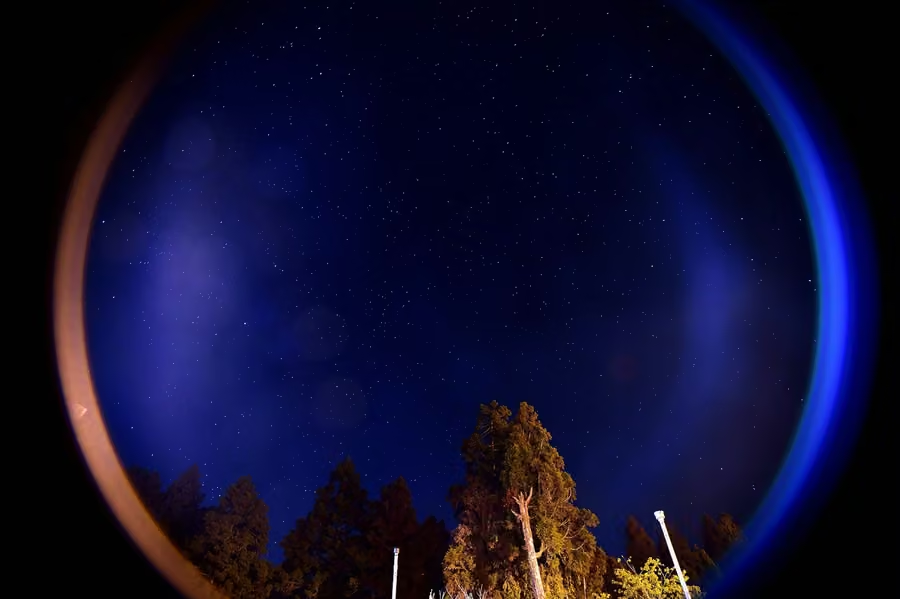
Hence the image: civilisations as hunters moving silently between trees, and any broadcast as a light in the dark.
The axioms are stipulations, not findings. “Survival is the primary need” is an assumption about motivation. Nothing in astronomy establishes it, and plenty of terrestrial evidence suggests civilisations spend resources on things other than survival.
The conclusion depends on the assumptions being universal. Dark forest logic needs every advanced civilisation to reach the same paranoid equilibrium. One species that values knowledge over caution, or one that can verify intentions, changes the outcome.
It does not fit the silence we observe. If hunters strike at any detectable civilisation, the galaxy should show the scars — no obvious remnant civilisations, no megastructures destroyed. A theory that predicts a violent universe and explains a silent one is doing two jobs at once.
We have already been noisy. Earth has leaked radio and television signals for about a century, and radar and atmospheric nuclear tests for longer. Under strict dark forest rules we should already be a target, which is a prediction the theory cannot check.
What is genuinely useful in it
The idea is a legitimate contribution to a debate that has no empirical answer yet. It forces the question of incentives into a discussion that often treats alien contact as a curiosity. It also anticipates real policy arguments about METI — actively messaging extraterrestrial intelligence — where serious scientists including Stephen Hawking argued for caution, and others argued that fear is unwarranted.
Compare the UFO files, where the same silence is explained with secrecy rather than predation. Both are unfalsifiable, and both are more interesting as anthropology than as astronomy: they tell you what the people telling them are afraid of.
The Zoo Hypothesis: the opposite strategy
If the dark forest says everyone hides, the zoo hypothesis says everyone is watching and staying out of the way. The astronomer John A. Ball proposed it in 1973 in the journal Icarus: advanced civilisations know we exist, and deliberately avoid contact so that we can develop without interference — Earth as a nature reserve, or a quarantined experiment.
It is the mirror image of Liu's argument from the same silence, and it shares the same weakness: there is no observation that would distinguish a galaxy of careful observers from an empty one. Ball knew this, and presented it as a hypothesis about motives rather than a finding.
The interesting difference is moral. Dark forest logic says the silence is safety; the zoo hypothesis says the silence is policy, which means it can change — and that a civilisation capable of enforcing a quarantine is also capable of ending it. Neither claim has evidence. Both tell you something about the person making it.
The Great Filter
The most-cited alternative is not a place but a bottleneck. The economist Robin Hanson argued in 1998 that somewhere in the chain from simple chemistry to a civilisation that colonises its galaxy there is at least one step that is very improbable — a Great Filter. If the filter is behind us, our silence is explained and our future is open. If it is ahead of us, every civilisation gets this far and then stops.
The uncomfortable property is that the same data supports both readings. Finding simple life on Mars would be bad news under this framing, because it would suggest the hard step is later; finding nothing anywhere would be, oddly, reassuring.
Like the dark forest, it is a way of organising ignorance rather than a finding. The difference is that Hanson's version does not require aliens to be hostile — only that something, somewhere, is unlikely.
The calmer alternatives
- The Great Filter — something in the chain from chemistry to radio telescopes is very unlikely, and we may already be past it.
- Rarity — complex life may be genuinely uncommon; the galaxy could be nearly empty.
- Distance and time — civilisations may overlap in time rarely, and cross the galaxy never.
- They are quiet for their own reasons — observation rather than conquest; a hypothesis with no evidence either way.
Nothing currently distinguishes these. That is the honest state of the field, and it is more interesting than any single answer presented as settled.
Sources for this page
- Wikipedia, “The Dark Forest” — publication, axioms, receptionen.wikipedia.org
- Wikipedia, “Dark forest hypothesis” — the argument and its criticismsen.wikipedia.org
- Wikipedia, “Fermi paradox” — the full set of proposed resolutionsen.wikipedia.org
- SETI Institute, on METI and the debate over broadcastingseti.org