Why it works on paper
Put a counterweight beyond geostationary orbit and hang a cable down to the equator. At 35,786 kilometres the cable is in orbital sync with the ground; above that it is held outward by centrifugal effect, below it hangs. Climbers then ascend without rockets, and the energy cost falls to roughly the theoretical minimum.
The tension is highest at geostationary altitude, where the cable must support its own weight below and the counterweight's pull above. The required specific strength — strength divided by density — is around 50 gigapascals per gram per cubic centimetre at the minimum, and designers want a safety factor of two or more.
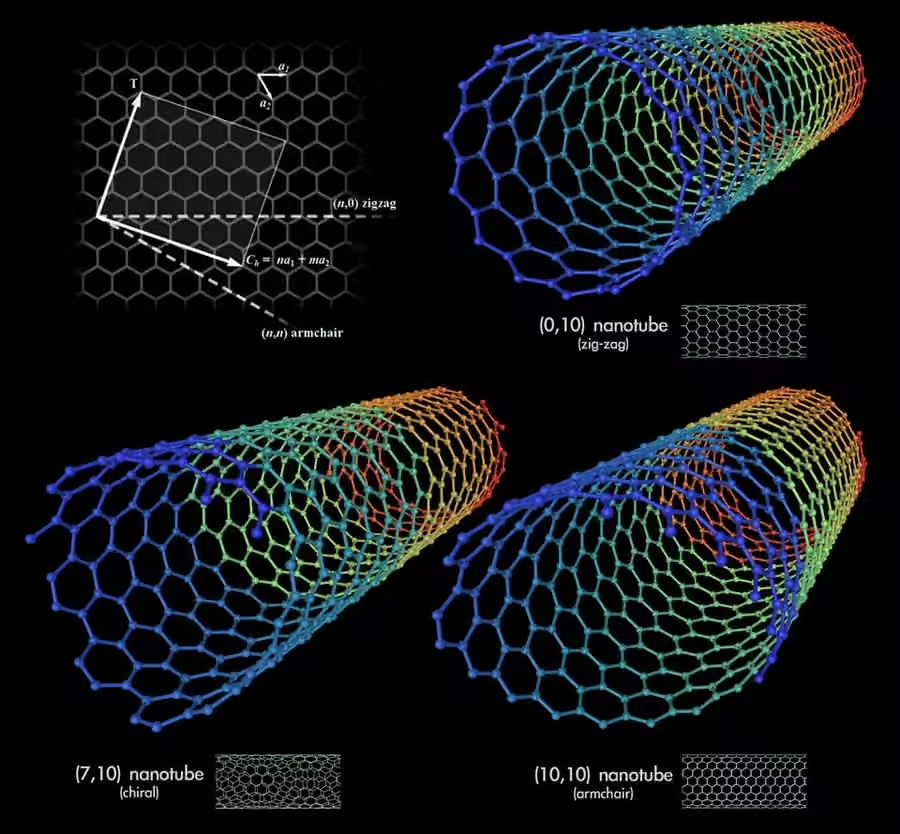
Steel is out by a factor of thirty. Kevlar and carbon fibre are out by a factor of ten. Carbon nanotubes and graphene have the theoretical numbers, which is why the idea moved from science fiction to NASA studies in the 2000s.
Where the material problem actually sits
The gap is not between theory and experiment in the usual sense; it is between a single perfect nanotube and a fibre long enough to span a continent. Measured tensile strength of macroscopic carbon-nanotube yarns is in the single-digit gigapascals, and the longest individual nanotubes are centimetres, not kilometres.
Defects dominate. A cable is a chain of billions of links, and its strength is set by its worst segment — a statistical problem that gets worse with length, which is exactly the direction the design needs to go. Graphene ribbons and boron-nitride nanotubes are candidate alternatives with the same issue.
The other engineering constraints are real but solvable in principle: avoiding low-Earth-orbit debris, surviving lightning and wind at the base, managing the climber's power supply, and the fact that the base must be on the equator, which puts it in the Pacific, in a storm belt, or in a country with the relevant politics.
Physics: fine. Nothing in the concept violates a conservation law or a material limit known to physics.
Materials: the blocking problem. No process makes a metre of fibre, let alone 100,000 kilometres, at the required strength.
Cost: estimates assume a material that does not exist; the $10 billion figures in the literature are not forecasts.
The quieter alternative is a rotating skyhook or an orbital ring, which need less extreme materials and more infrastructure — neither has been built either.
The archive labels this live debate because the argument is entirely about a materials-science question that has a definite answer, and it has not arrived.
Why it is in the archive
Because it is the standard example of a proposal that is correct in principle, impossible in practice, and constantly reported as nearly ready.
Related: hyperloop feasibility, Kardashev bottlenecks.
Sources for this page
- Wikipedia, “Space elevator” — design, materials and objectionsen.wikipedia.org
- Edwards (2003), NASA Institute for Advanced Concepts — the space elevator feasibility studywww.niac.usra.edu
- Wikipedia, “Specific strength” — the material property that decides the argumenten.wikipedia.org
- Wikipedia, “Carbon nanotube” — measured versus theoretical strengthen.wikipedia.org