The statistic, done properly
For years the number quoted everywhere was “more than 80 per cent of the ocean is unexplored and unmapped.” NOAA’s National Centers for Environmental Information has used that framing, tied to the Nippon Foundation–GEBCO Seabed 2030 project, which aims to complete a bathymetric map of the entire ocean floor by 2030.
The figure moves as the mapping proceeds. As of April 2026, NOAA Ocean Exploration put the share of the global seafloor covered by modern high-resolution multibeam sonar at 28.7 per cent — up from roughly 23 per cent a few years earlier. Which means just over seventy per cent still has no high-resolution map.
Two distinctions matter, and almost every viral post collapses them:
- Mapped is not explored. A sonar swath gives you depth, not biology, chemistry or video.
- Low-resolution mapped is not unmapped. Satellite gravimetry gives us a coarse global seafloor — enough to see mountain ranges and trenches, not enough to see a city block.
So: the deep sea is genuinely the least-known surface on Earth, and it is also genuinely being mapped at speed. Both statements are true.
What is actually down there
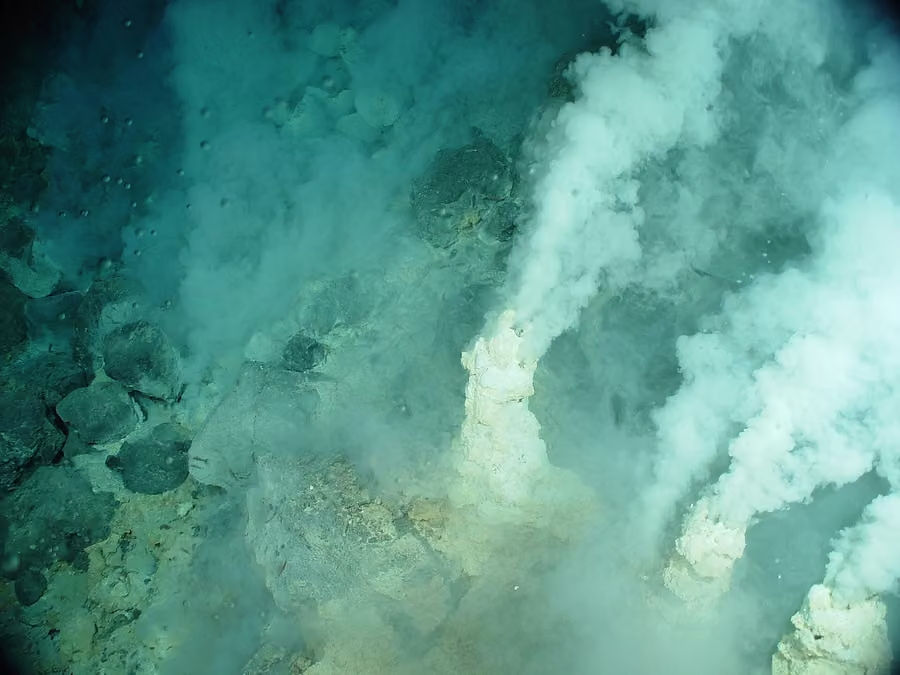
The real ocean floor outperforms most of the fiction. The Mariana Trench’s Challenger Deep is roughly 10,900 m down, where pressure is over a thousand atmospheres. Hydrothermal vents support chemosynthetic ecosystems with no sunlight at all — tube worms, vent crabs, microbes that metabolise sulphur. NOAA’s Okeanos Explorer and similar programmes regularly return with species new to science; a single seamount survey can produce dozens.
The point for this archive: the ocean makes a specific kind of claim possible. An unexplored space is not evidence of anything in it, but it is a licence to imagine — and imagination is what these theories trade in.
Real drowned cities
These are not conspiracies; they are archaeology, and they are extraordinary.
- Thonis-Heracleion, Egypt — a major port at the mouth of the Nile, submerged by subsidence and earthquake, rediscovered in 2000 with intact statues, ships and temple remains.
- Pavlopetri, Greece — a Bronze Age town off the Peloponnese, one of the oldest known submerged urban sites, with streets and building foundations still legible.
- Port Royal, Jamaica — the pirate city that sank in the 1692 earthquake, now a UNESCO-listed underwater site.
- Atlantis — the one that is not on this list. See below.
These discoveries matter because they show how the legend grows honestly: every real submerged city is a plausible seed for a “lost civilization” story, and each one that gets found makes the next claim feel more reasonable.
Atlantis in Plato’s own words
Atlantis is not a folk memory. It appears in two Platonic dialogues, Timaeus and Critias, as a thought experiment about a powerful island empire that attacked Athens and was destroyed by the gods in a single day and night. Plato says the story came from Egypt via Solon, and — crucially — he places it beyond the Pillars of Hercules, in the Atlantic, roughly 9,000 years before his own time.
No Bronze Age Atlantic island continent of that size exists; the seafloor there has been mapped in detail and has no sunken landmass. The academic consensus treats Atlantis as Plato’s political allegory. The claim survives because it is unfalsifiable in the right way: whenever a candidate site fails, the date or the location can be moved. Dozens of proposed locations now exist on five continents.
Hollow-Earth literature needs water, and it gets it by postulating interior oceans — Symmes’s inner world had seas, and Bernard’s had rivers. In the composite cosmology of the ice wall, the “underwater world” is often not beneath the sea at all but beneath the shell. The two ideas blur because both are about a place you cannot reach.
The difference is testability. Deep-sea claims can be and are checked: sonar, ROV dives, eDNA, sediment cores. Every year the searchable ocean gets smaller. Interior-ocean claims cannot be checked at all, because the model defines the interior as inaccessible.
What this page is not saying
It is not saying the ocean is fully understood. It is the opposite. The correct statement is: the seafloor is less mapped than Mars, and there is a real, funded, international effort to fix that. The existence of a gap in knowledge is not evidence for a specific thing inside the gap — it is a reason to keep looking, and to be suspicious of anyone who fills the gap with a city and charges admission.
The Bloop: the loudest thing in the ocean
In 1997, hydrophones operated by NOAA's Pacific Marine Environmental Laboratory — listening for submarine activity and earthquakes — recorded an ultra-low-frequency sound in the southern Pacific. It was loud enough that it became the most famous unidentified noise in oceanography, and it acquired a nickname: the Bloop.
The popular version added three things the data did not have. It placed the sound in the Mariana Trench — the recording was actually from the far south Pacific, thousands of kilometres away. It described a creature larger than a blue whale — the sound was consistent with many sources. And it asserted that the noise was “louder than any animal”, which was true of the recording, not of the claim.
NOAA eventually attributed the Bloop and several similar sounds to icequakes: fracturing and movement of Antarctic ice sheets, which generate exactly this kind of very-low-frequency, long-duration signal. The other famous recordings in the same family — “Train”, “Whistle”, “Slow Down” — got similar explanations, with the last of them traced to a drag event from a large iceberg.
What makes this entry worth keeping is how the myth survives the answer. The explanation is published by the agency that made the recording, and the leviathan version is still the one in the videos — because an icequake is not a story.
Sources for this page
- NOAA NCEI, “Mapping Our Planet, One Ocean at a Time” — the 80% framing and Seabed 2030ncei.noaa.gov
- World Atlas, “How Much Of The Ocean Is Still Unexplored” — 28.7% high-resolution figure, April 2026worldatlas.com
- NOAA Ocean Service, “What is the Bermuda Triangle?” — methane and environmental explanationsoceanservice.noaa.gov
- NOAA Ocean Service, “Is Atlantis real?”oceanservice.noaa.gov/facts/atlantis.html
- Seabed 2030 projectseabed2030.gebco.net