The phenomenon
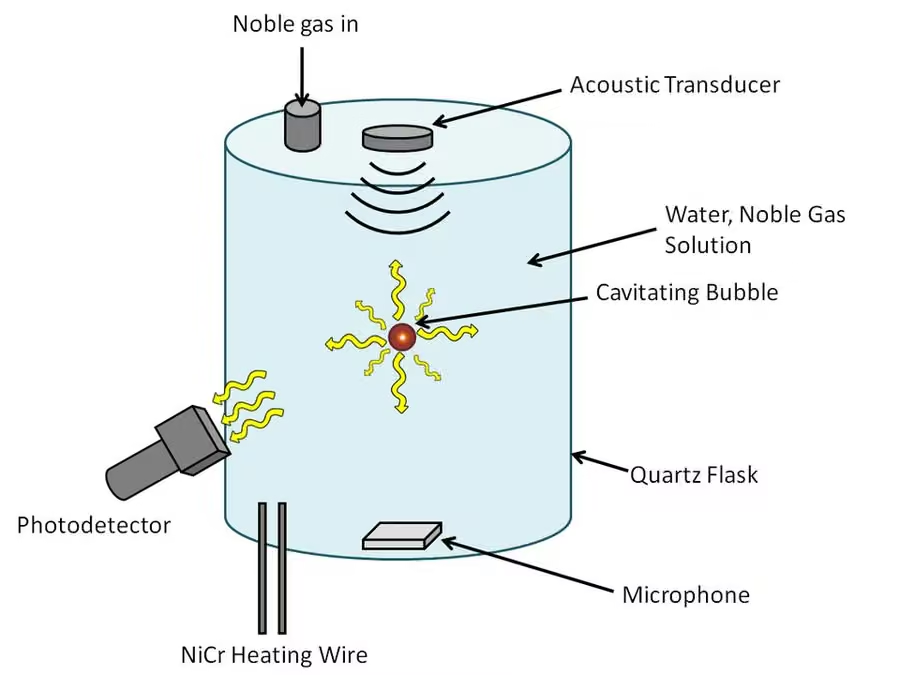
Sound waves in a liquid can trap a small gas bubble at a pressure node. As the wave compresses it, the bubble collapses violently, and for a fraction of a picosecond it emits a pulse of light. Single-bubble sonoluminescence was made stable in 1989, which is what turned a curiosity into a research field.
The flash is extremely short, the spectrum is broad and featureless, and the inferred conditions inside the collapse are extreme — thousands of kelvin at minimum, with estimates reaching much higher depending on the model.
The competing explanations
Adiabatic compression. The simplest account: the gas heats as it is crushed, and the flash is thermal emission from a hot, dense plasma.
Vaporised material. In some liquids, a little of the surrounding liquid enters the bubble and is vaporised, changing the spectrum — which is why the colour of the flash can depend on the liquid and the dissolved gas.
Micro-plasmas and shock waves. Refinements add ionisation, a shock front inside the bubble, and bremsstrahlung. Each version fits some of the data and not all of it.
Every few years, a paper or a press story suggests the bubble reaches conditions for nuclear fusion — 'sonofusion'. The 2002 Taleyarkhan claims in particular were investigated and contested, and independent replication failed.
The physics problem is scale: the energy in a collapsing bubble is tiny, and the fraction that could reach fusion conditions is smaller still. The measurements needed to settle it — temperature, density, duration — are at the limit of what can be inferred from a flash.
So the honest position is that sonoluminescence is a real, reproducible effect whose emission mechanism is still under debate, and whose most dramatic interpretation has not survived replication.
Why it is in the archive
Because it is a case where the phenomenon is not in doubt, the mechanism is genuinely unsettled, and the fringe version has attached itself to a real experiment. The archive's label reflects the real uncertainty and rejects the fusion claim.
It also sits next to turbulence as a reminder that classical fluid mechanics still contains unsolved problems — the equations are known, the solutions are not.
Sources for this page
- Wikipedia, “Sonoluminescence” — history, spectra, modelsen.wikipedia.org
- Brenner, Hilgenfeldt & Lohse (2002), review of single-bubble sonoluminescencejournals.aps.org
- Nature coverage of the sonofusion controversywww.nature.com
- American Physical Society, fluid dynamics prize lectures on bubble collapsewww.aps.org