The claim
Roy Baumeister and colleagues reported in 1998 that people who had just exerted self-control — resisting cookies, suppressing emotion, making choices — performed worse on a second demanding task. The explanation was a limited resource, 'ego depletion', and the metaphor was a muscle or a battery.
A later addition was that the resource was glucose: depleted subjects who rinsed their mouths with sugar water showed restored self-control, which was presented as evidence for a physiological fuel.
The collapse
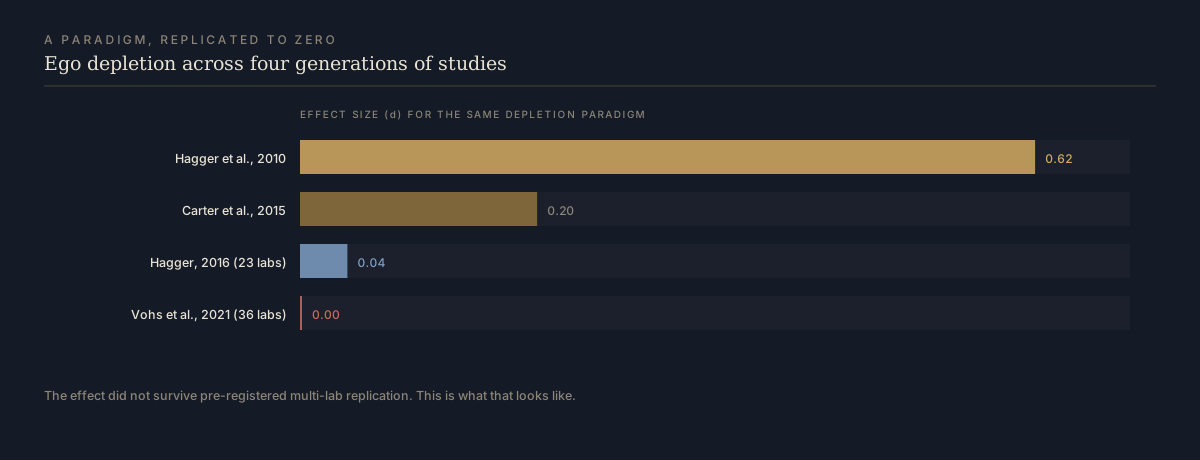
A 2016 registered replication across 23 laboratories, with over 2,000 participants and a protocol agreed with the original authors, found an effect size statistically indistinguishable from zero.
Meta-analyses corrected for publication bias shrank the effect dramatically. The glucose studies came under separate criticism: the amounts involved are far too small to matter metabolically, and mouth-rinsing effects are better explained by reward signalling than by fuel.
The theory also ran into a conceptual problem: 'self-control' was measured by dozens of different tasks that did not correlate with each other as a single resource model requires.
Debunked: ego depletion as a general, glucose-fuelled, domain-general resource that can be exhausted and replenished.
Still real: fatigue, motivation, boredom and attention all affect performance. People do perform worse on long sequences of demanding tasks — for reasons that involve motivation and strategy, not a depleting fuel tank.
Still taught: the battery metaphor appears in pop psychology, management training and self-help long after the evidence left. That lag is the reason this page exists.
Why it is in the archive
Because it is the cleanest case of a plausible-sounding theory with a memorable metaphor that did not survive preregistration — and because the correction is not 'willpower is fake'. It is that the specific mechanism was wrong.
It pairs with other replication failures in the archive, including priming and the Mozart effect.
What would change the label
A pre-registered multi-lab study with a sample large enough to detect the originally claimed effect, a manipulation check that works in every lab, and a theory that says in advance which tasks should deplete and which should not. Two such studies have run. Both returned effects indistinguishable from zero, and the second — 36 labs, over 3,500 participants — was designed by the theory's own proponents.
What survives is narrower: fatigue and motivation affect performance on long tasks, which nobody disputed. What did not survive is the specific claim that self-control draws on a depletable resource measured by a common currency. The label would move back only with a mechanism — glucose, or anything else — that predicts effect sizes rather than being invoked after them.
Sources for this page
- Wikipedia, “Ego depletion” — history and replication crisisen.wikipedia.org
- Hagger et al. (2016), Perspectives on Psychological Science — multilab replicationdoi.org
- Carter & McCullough (2014), Frontiers in Psychology — publication biasdoi.org
- Vohs et al. (2021), Psychological Science — multi-site paradigmatic testdoi.org