The two families
Genes first. The RNA world hypothesis notes that RNA can both store information and catalyse reactions. If a molecule could replicate itself and improve, Darwinian evolution starts before proteins or DNA. The problem is that RNA is hard to make prebiotically and unstable in water.
Metabolism first. An alternative starts with self-sustaining chemical cycles on mineral surfaces — proton gradients across iron-sulfide membranes, driven by geothermal energy. Replication comes later. The problem is that a cycle without a gene cannot inherit improvements.
The two locations
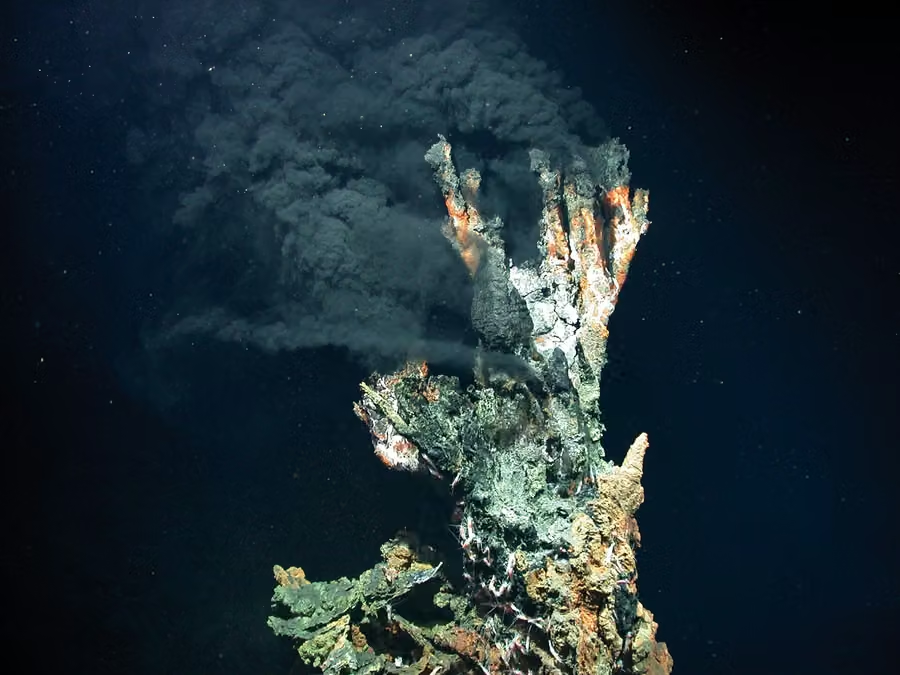
Alkaline hydrothermal vents. Natural proton gradients, mineral catalysts, and compartments in the rock. The 'inside-out' theory (Russell, Martin, Lane) argues the first cells were mineral structures, and the membrane came later.
Warm little ponds. Wet-dry cycles concentrate nucleotides, and UV and wet-dry chemistry can assemble RNA precursors. Laboratory work has produced nucleotides and short RNA chains under plausible conditions, though not self-replication.
Nucleotides can be made under prebiotic conditions — several routes, none of them the whole story, and yields are low.
RNA can be made to evolve in the lab: directed evolution experiments produce ribozymes that polymerise RNA. That shows RNA can do the job, not that it did.
Protocells can be built from fatty acids, and they can host reactions. Again: a demonstration of possibility.
Nobody has a continuous, plausible chain from simple chemistry to a self-replicating, evolving system in one pot. That is the honest gap, and it is not a small one.
Why it is a live debate rather than a mystery
Because the disagreement is productive: it has generated specific, testable chemistry, and the camps are converging on a picture in which vents supply energy and gradients, ponds supply concentration and wet-dry cycling, and the order of genes and metabolism may differ by environment.
It is also the place where the archive's labels do the most work. 'We do not know' is not the same as 'it is impossible', and the difference is exactly what the evidence supports.
Sources for this page
- Wikipedia, “Abiogenesis” — hypotheses, evidence, objectionsen.wikipedia.org
- Martin & Russell, on alkaline hydrothermal vents and the origin of cellswww.nature.com
- Sutherland (2017), the origin of life as a chemical problemwww.nature.com
- NASA Astrobiology, origins research programmesastrobiology.nasa.gov