The statement
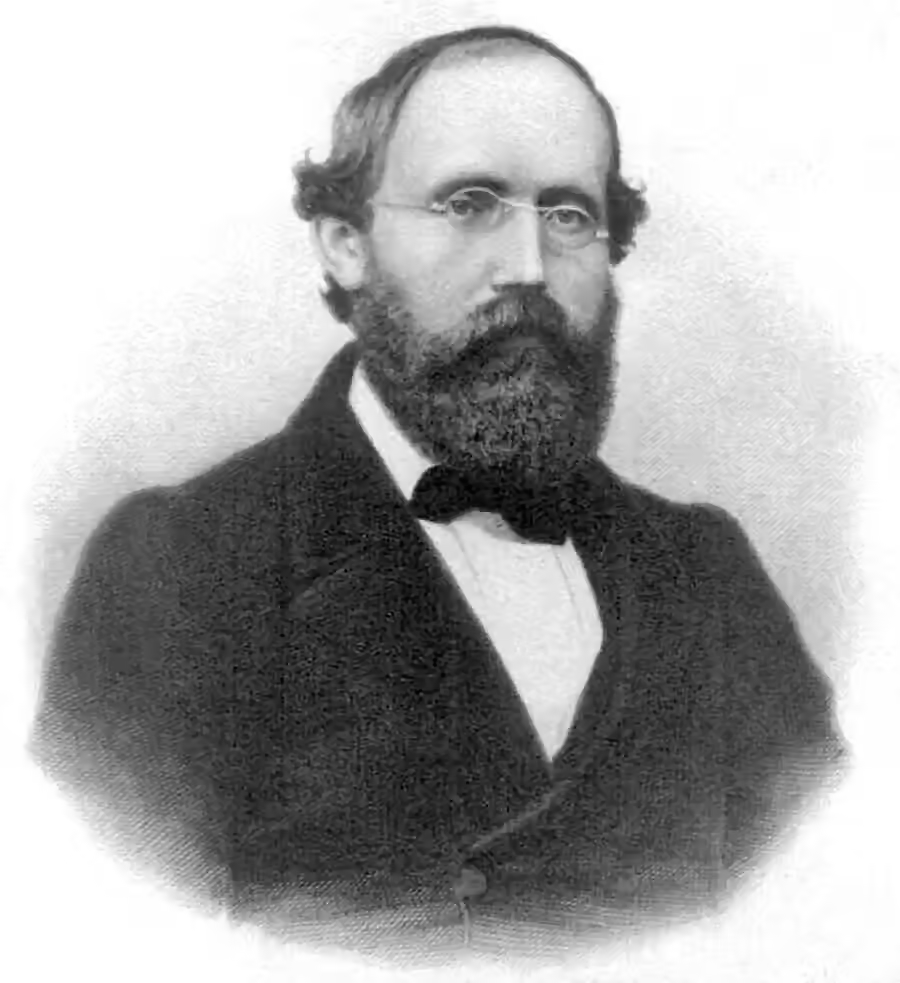
The Riemann zeta function is a sum over the integers, extended to complex numbers by analytic continuation. It has "trivial" zeros at the negative even integers, and infinitely many others. The hypothesis, proposed by Bernhard Riemann in 1859, is that every non-trivial zero has a real part of exactly one half — that they all sit on a single vertical line in the complex plane.
That sounds like an obscure fact about a function. It is not. The zeros control the error term in the prime counting function: how far the actual number of primes below x can drift from the smooth estimate. If the zeros lie on the line, the primes are about as well-behaved as they could possibly be. If any zero sits off it, the primes have a hidden irregularity, and the error grows.
Why anyone believes it
Not because it has been proved. Because it has been checked, relentlessly, and because several independent lines of reasoning expect it:
- Computation. The first 10 trillion zeros have been verified to lie on the line. This is evidence in the ordinary sense, and it is not proof: a counterexample could sit at 1040.
- Function fields. The analogous statement for curves over finite fields was proved by André Weil in the 1940s. There is a working model in which the phenomenon is true and understood.
- Random matrix theory. Hugh Montgomery and Freeman Dyson noticed in 1972 that the spacing statistics of the zeros match the eigenvalues of random Hermitian matrices — the same statistics as heavy atomic nuclei. Nobody knows why, but it is a real and testable correspondence.
- Hilbert–Pólya. If the zeros are the eigenvalues of some self-adjoint operator, the hypothesis follows from spectral theory. Nobody has found the operator.
There are no camps. This is the crucial difference between a conjecture and a controversy. Nobody publishes against the Riemann Hypothesis; the disagreement is entirely about how to prove it, not whether it is true.
It carries a million-dollar prize and a much larger consequence. It is one of the Clay Institute's Millennium Problems. A proof would immediately sharpen results across number theory — including, in conditional form, many statements about primes that are currently assumed.
Its failure would be worse than its absence. A counterexample would not just leave the question open; it would invalidate a large body of published work that assumes the hypothesis, and it would mean the primes are more erratic than anyone expects.
What has actually been proved
Real theorems exist nearby, and they show how progress in this area looks. Hardy proved in 1914 that infinitely many zeros lie on the line. Bohr and Landau showed that almost all zeros are arbitrarily close to it. Levinson and later Conrey established that a positive proportion — over 40% — of zeros are on the line. None of these is the hypothesis, and the gap between "a positive proportion" and "all" has resisted every technique for a century.
There are also relatives worth knowing: the Generalised Riemann Hypothesis extends the claim to other L-functions, and the Riemann Hypothesis itself would imply weak forms of the Goldbach and twin-prime conjectures — which is why those problems are often described as downstream of this one.
Why it is hard
The honest answer is that nobody has a mechanism. Proofs in this field usually come from a structure nobody knew existed — Weil's proof came from algebraic geometry, the prime number theorem from complex analysis. The Riemann Hypothesis is waiting for a structure, and the random-matrix match is the strongest hint that one is there.
It is also worth saying what the hypothesis does not claim. It says nothing about whether primes are "random"; it constrains the error in counting them. Popular accounts often describe it as "the primes follow a hidden pattern", which is poetry rather than mathematics.
How to read the status
If you see a claim that the Riemann Hypothesis has been proved, the correct response is to look for the verification: a proof would be a short paper with a long referee process, announced through a journal, not a preprint with a press release. The 2018 Atiyah claim is the standard cautionary example — presented at a conference, never substantiated.
Where to go next: the open problems index lists the conjectures that sit downstream, and the frontier index covers the physics-adjacent debates, which have the opposite problem — plenty of mechanisms, no data.
Sources for this page
- Clay Mathematics Institute, the Riemann Hypothesis problem statementwww.claymath.org
- Odlyzko, tables of zeros of the zeta functionwww.dtc.umn.edu
- Wikipedia, “Riemann hypothesis” — history, partial results, verification recordsen.wikipedia.org
- Wikipedia, “Riemann zeta function” — definition and analytic continuationen.wikipedia.org
- Wikipedia, “Hilbert–Pólya conjecture” — the spectral approachen.wikipedia.org