The argument
Robin Hanson's 1998 formulation is an accounting trick. Take the chain from simple chemistry to a civilisation that colonises its galaxy. Each step has some probability. If the product of those probabilities is not extremely small, the galaxy should be full — so at least one step must be very improbable, and that step is the filter.
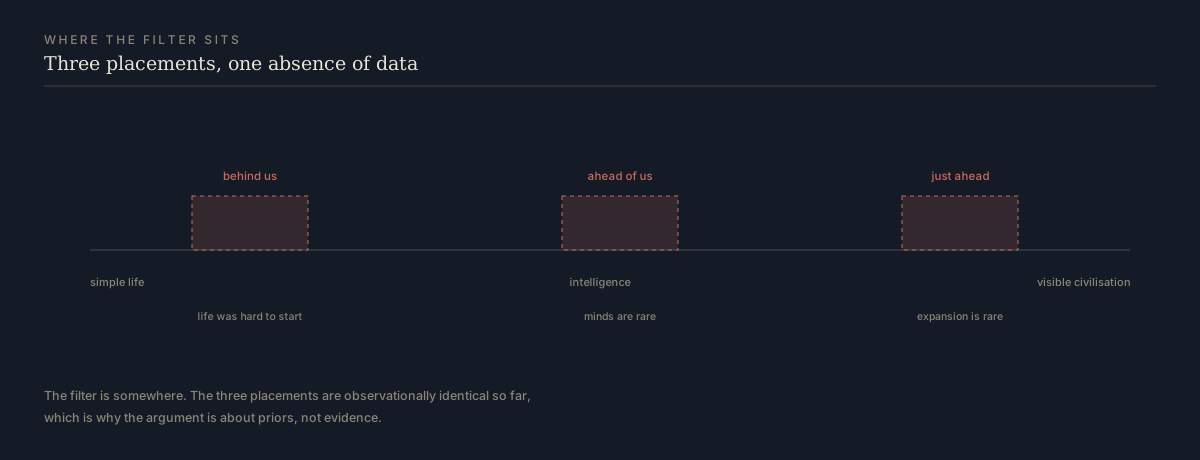
The question is not whether there is a filter but where it sits. Behind us: abiogenesis, eukaryotes, multicellularity, intelligence. Ahead: nuclear war, engineered pandemics, misaligned AI, ecological collapse.
Why the placement matters
If the filter is behind us, the implication is cheerful: the hard part is done, and we are rare and lucky. If it is ahead, every civilisation that reaches our stage tends to destroy itself, and the silence is a warning rather than an accident.
The uncomfortable corollary is that finding life elsewhere is bad news. Simple life on Mars would push abiogenesis into the 'easy' column, which moves the filter closer to us. Finding a fossil of complex life would be worse, because it would suggest that complexity is common and the deadly step is later.
It rests on one data point. We have a sample size of one biosphere, and no independent estimate of any probability in the chain. The inference is about our ignorance, formalised.
The premises are not settled. Whether civilisations expand galactically is an assumption about motivation; whether they last long enough is an assumption about stability. Both are empirical questions with no data.
It assumes we would notice. A galaxy full of quiet, efficient civilisations using little energy would look much like an empty one.
How to hold it
The Great Filter is best used as a bookkeeping device: it forces you to say which step you think is improbable, and it makes the consequences of that choice explicit. It is not evidence for any particular danger, and it has been used to support almost every position in the debate.
Its companion ideas are in the archive's frontier index — the dark forest, the zoo hypothesis, grabby aliens — all attempts to fill the same silence with a different story about motives.
What would move it
The placement is inferred entirely from silence, so any evidence at either end moves it. A second independent origin of life — on Mars, on Europa, or in a laboratory — would put the filter later, because abiogenesis would stop being the bottleneck. A biosignature without a technosignature, in an atmosphere we can model, would do the same.
The other direction needs a survey that could have found something and did not: a search of a million stars for optical lasers, or a radio survey sensitive to leakage from a nearby civilisation, reported as a null result with a stated sensitivity. Without that denominator, the absence of contact is not evidence about the universe — it is evidence about our instruments.
Sources for this page
- Hanson (1998), “The Great Filter”mason.gmu.edu
- Wikipedia, “Great Filter” — the argument and its criticismsen.wikipedia.org
- NASA, astrobiology and the search for biosignaturesastrobiology.nasa.gov
- Wikipedia, “Fermi paradox” — the full set of proposed answersen.wikipedia.org