Single-volume edition · 2026
The Larger World Archive
Every dossier, in reading order, as one continuous document — built for printing, saving, or reading straight through.
Each part keeps its own source list. Claims are quoted and attributed; where a claim has been tested, the test is linked alongside it. Inclusion is not endorsement. Use your browser’s Print command for a paper copy — the layout switches to black on white automatically.
Contents152 parts
- The Larger Globe
- Flat Earth & the Firmament
- Hollow Earth & the Inner Sun
- Beyond the Ice Wall
- Underwater Worlds
- Lost Continents
- Dual Suns, Dual Stars
- Tartarus, the Pit
- Giants
- Dragons & Dinosaurs
- Cryptids
- The Giant Trees
- Tartaria & the Mud Flood
- Ancient Astronauts
- Aliens, Area 51 & the UFO Files
- Secret Societies
- Noah, Gilgamesh & the Great Flood
- Unexplained Phenomena
- Urban Legends & Creepypasta
- Curses
- Prophecies
- Mass Hysteria
- The Mandela Effect
- Deep Web & Dark Web
- The Dead Internet Theory
- Many Worlds
- The Electromagnetic Soul
- The Dark Forest
- The Simulation Hypothesis
- Last Thursdayism
- The Pixar Theory
- Roko's Basilisk
- The Egg
- Boltzmann Brains
- Phantom Time
- Quantum Oddities
- The Stoned Ape
- The Backrooms
- The Black Knight
- The Bicameral Mind
- Paul Is Dead
- The Silurian Hypothesis
- Time Paradoxes
- Gaia
- Mutants & “Superpowers”
- Creationism and the Alternatives to Darwin
- The Simpsons Predictions
- Where to Read More
- Proven Conspiracies
- Dyatlov Pass
- Unresolved Disappearances
- The Voynich Manuscript
- Oak Island
- Who Wrote Shakespeare?
- Did Hitler Escape?
- Did Anastasia Survive?
- The Lost Colony
- The Bosnian Pyramids
- Lead and Crime
- Secret Tests
- Unknown Mysteries
- The Hubble Tension
- MOND
- Dark Matter
- Planet Nine
- ‘Oumuamua
- Phosphine on Venus
- Primordial Black Holes
- The Holographic Principle
- White Holes
- The Great Filter
- Theranos
- FTX
- Pegasus
- The Panama Papers
- The Riemann Hypothesis
- Alzheimer's
- Enshittification
- Göbekli Tepe
- Room-Temperature Superconductivity
- Sonoluminescence
- Turbulence
- Time Crystals
- The Origin of Life
- The First Eukaryote
- Where Viruses Came From
- Punctuated Equilibrium
- Peto's Paradox
- The Gut–Brain Axis
- Pilot-Wave Theory
- Objective Collapse
- The Arrow of Time
- Quantum Darwinism
- Magnetic Monopoles
- IIT versus Global Workspace
- Readiness Potentials and Free Will
- Ego Depletion
- Screen Time and Teen Mental Health
- The Younger Dryas Impact
- AMOC Tipping
- The Ediacaran Organisms
- Strings versus Loops
- Inflation versus a Bounce
- How the Moon Formed
- Where Earth’s Water Came From
- Tabby’s Star
- Supersymmetry
- The Muon's Wobble
- The Firewall Paradox
- Stochastic Parrots or World Models
- Scaling Laws
- AI Existential Risk
- Quantum Advantage
- Fusion on the Grid
- The Jevons Paradox
- Technological Unemployment
- Minimum Wage Effects
- Universal Basic Income
- Broken Windows Policing
- The Great Stagnation
- The Resource Curse
- Geographic Determinism
- Scarcity or Ingenuity
- Bitcoin as Digital Gold
- The End of Moore’s Law
- Hyperloop Feasibility
- Dyson Swarms
- Echo Chambers
- MAD Stability
- The Chinese Room
- The Turing Test
- Modern Monetary Theory
- Superrationality
- The Doomsday Argument
- Secular Stagnation
- Market Efficiency
- The Space Elevator
- Kardashev Bottlenecks
- The Lindy Effect
- Black Swans
- Dunbar's Number
- The Contact Hypothesis
- Rational Choice Voting
- The Median Voter Theorem
- Democratic Peace
- The Thucydides Trap
- The Zoo Hypothesis
- Substrate Independence
- Algorithmic Fairness
- Open versus Closed Models
- The Omega Point
- Cold Fusion
- The Placebo Effect
- Learning Styles
- Growth Mindset
- The Aquatic Ape
- Snowball Earth
- The Dinosaur Extinction
- Panpsychism
- The Free Energy Principle
- Polyvagal Theory
- Fast Radio Bursts
- Magnetoreception
- All Sources
The Larger Globe
People who say the Earth is larger than we are told usually mean one of three things. They may mean the planet is physically growing — the expanding Earth. They may mean the map is deliberately truncated, with whole continents hidden past the ice. Or they may mean we are on the inside of a sphere, looking at a concave shell — the “cell Earth”.
All three appear below, in the order they were proposed, with the people who proposed them named.
1. The Expanding Earth (the real scientific heresy)
This is the only one of the three that was ever a serious scientific hypothesis, argued in journals by professional geologists for most of the twentieth century. Its founding observation is the one everybody now accepts: Africa and South America fit together like torn paper.
- 1888
Nikolai Yarkovsky publishes a book linking expansion to gravity and chemistry — one of the earliest mechanical attempts.
- 1912
Alfred Wegener proposes continental drift. The fit of the continents is now on the table, and nobody has a mechanism.
- 1927–1940
A German-language wave: Lindemann (1927), Bogolepow (1930), Hilgenberg (1933), Keindl (1940). Hilgenberg is generally credited with the first globe-assembly of the continents on a sphere roughly two-thirds the modern diameter.
- 1956–1969
The English-language second wave: Egyed, Carey, Heezen, Barnett, Brösske, Neyman, Creer, Dearnley, Jordan, Steiner, Meservey. Australian geologist S. Warren Carey becomes its most prominent voice.
- 2007–present
James Maxlow’s quantitative expansion model, and Giancarlo Scalera’s work at the Italian national institute of geophysics, keep a slow-expansion version alive.
What they actually argue
The core claim is simple: new ocean crust is created at the mid-ocean ridges (nobody disputes this), but it is not destroyed at the trenches in equal measure, so the planet’s volume must increase. In Carey’s version, subduction is largely a myth. In the softer “slow expansion” version, some subduction is allowed but not enough to balance the ridges.
Their strongest point is a real one: the ocean floor is geologically young everywhere. None of it predates the Mesozoic. In a constant-size Earth you must destroy all of it; in an expanding Earth you can simply have made it.
“A profound consequence of seafloor spreading is that new crust was, and is now, being continually created along the oceanic ridges. This idea found great favor with some scientists who claimed that the shifting of the continents can be simply explained by a large increase in size of the Earth since its formation. However, this so-called ‘expanding Earth’ hypothesis was unsatisfactory because its supporters could offer no convincing geologic mechanism to produce such a huge, sudden expansion.” USGS, This Dynamic Earth
The two versions, and the numbers
A 2016 comment in the journal History of Geo- and Space Sciences splits the school in two: slow expansion at roughly 0.5 mm per year of radius increase since formation, and fast expansion at roughly 5 mm per year since the Triassic. The same paper argues that space geodesy, gravimetry and seismology leave room for 0.1–0.4 mm/yr today — and calls the theory’s obituary premature.
That is the strongest surviving version of the case, and it is worth stating plainly: it is a fraction of a millimetre per year, and it is contested.
Plate tectonics won because it supplied a mechanism that works: Harry Hess and Robert Dietz’s seafloor spreading, with ocean crust descending at trenches. The key question USGS poses — how can crust be added at ridges without the planet growing? — is answered by subduction, and subduction is now imaged directly by mantle tomography.
On the measurement side, a NASA-led team publishing in Geophysical Research Letters in 2011 used space-geodetic data and found an average radius change of 0.004 inches (0.1 mm) per year — “statistically insignificant”. The Pacific Northwest Seismic Network summarised it as a change of less than a millimetre every five years, consistent with no change at all.
And the historiography has turned: a 2014 paper in the same journal as the 2016 defence is titled, flatly, “The Earth expansion theory and its transition from scientific hypothesis to pseudoscientific belief”, arguing that expansionists survived plate tectonics by rejecting contrary evidence and waiting for a physics revolution that never came.
2. The Earth is far bigger than admitted
This is the version with no paper trail. It typically arrives as a video: the known continents are said to occupy only a fraction of a much larger plane, with the rest hidden behind an Antarctic ice boundary or edited out of satellite composites.
It has no named originator, no published model and no measurement, which is exactly why it cannot be tested — the missing land is defined as unreachable. Its function is structural: it exists to explain why nobody has seen the rest of the world. See Beyond the Ice Wall.
3. The Concave Earth — we are inside the sphere
The most philosophically aggressive version. The planet is a hollow shell and we live on its inner surface, with the universe compressed into a small bright core at the centre, which we mistake for a distant sun and stars.
Its American prophet was Cyrus Reed Teed, a Utica physician who took the name Koresh. After an 1869 electrical experiment — he claimed to have been knocked unconscious and woke with the cellular cosmogony revealed — he founded the Koreshan Unity, which in 1894 established a colony at Estero, Florida. His 1898 book with Ulysses Grant Morrow, The Cellular Cosmogony, laid out the geometry.
Morrow then did something unusual for this literature: he built an instrument. The “rectilineator” was a graduated straight-edge used along the beach to measure whether the water surface curved up or down over distance. The Koreshans reported a concave result. The National Center for Science Education’s history of the episode walks through where the experiment went wrong — the same class of error that sank the Bedford Level flat-Earth measurement: a short baseline, unaccounted refraction, and a target that could not be levelled precisely enough.
The colony survived until 1961; its grounds are now a Florida state park. The concave model survives online, largely because it elegantly explains why rockets “come back” and why nobody has photographed an edge.
It has to invert every line of sight and every gravitational measurement at once, and it predicts a horizon that curves upward and objects that vanish from the bottom first — both of which are directly checkable with a telescope, a boat and a lake. It also makes the Moon and planets interior objects whose phases and parallax would not match observation. The 19th-century test was a good instinct; the instrument was simply not precise enough to detect a curvature of a few centimetres over a few kilometres.
How this connects to the rest of the archive
- Hollow Earth shares the shell geometry but keeps us on the outside — see Hollow Earth.
- Inner sun is the standard light source for both the hollow and concave models.
- Giant fauna — the claim that expansion explains giant insects and dinosaurs — is a recurring argument in the expansionist literature and reappears in Dragons & Dinosaurs.
- The ice wall is where the “bigger Earth” version hides its extra land.
Primary and secondary sources for this page
- USGS, This Dynamic Earth — “Developing the theory”pubs.usgs.gov/gip/dynamic/developing.html
- Sudiro, P. (2014), “The Earth expansion theory and its transition from scientific hypothesis to pseudoscientific belief”, Hist. Geo Space Sci. 5, 135hgss.copernicus.org/articles/5/135/2014
- Scales, J. (2016), “Indications from space geodesy, gravimetry and seismology for slow Earth expansion…”, Hist. Geo Space Sci. 7, 125hgss.copernicus.org/articles/7/125/2016
- “The expanding earth — an essay review”, Earth-Science Reviews (1975)sciencedirect.com/science/article/pii/0012825275900975
- NASA/JPL, “NASA Research Confirms it’s a Small World, After All” (2011)jpl.nasa.gov
- Pacific Northwest Seismic Network, “Earth is not expanding”pnsn.org/blog/earth-is-not-expanding
- NCSE, “Inside Out and Round About, Part 2” — the Koreshan concave Earthncse.ngo/inside-out-and-round-about-part-2
- Earth-prints, Scalera on expanding-Earth tectonicsearth-prints.org
Flat Earth & the Firmament
Flat Earth is the oldest cosmology in the archive and the only one with a continuously operating institution. It also has the most clearly defined internal structure, which makes it the best place to learn how these systems work: every anomaly has a patch, and the patches are invented on demand.
What the modern model actually claims
There is no single flat-Earth model. Britannica’s survey identifies the common form — a circular disc, North Pole at the centre, a wall of ice at the edges — and then two competing mechanical variants:
- The “US model” — the Sun and Moon are small objects, roughly 50 km across, circling about 5,500 km above the disc, with the stars fixed to a rotating dome above them. Day and night come from the Sun acting like a spotlight.
- The “UK model” — no gravity at all; the disc accelerates upward at 9.8 m/s², and what we call falling is the floor rising to meet us.
Physics World’s 2020 survey of the movement notes that many adherents also place the whole disc and its atmosphere inside a hemispherical “snow globe” from which nothing can fall off the edge — which resolves the obvious objection that we would see the rim.
Their evidence, in their own words
The Flat Earth Society’s own FAQ lists the standard four:
“The horizon always rises to meet eye level — which is impossible on a ball earth. The surfaces of bodies of water has been shown to be level. If the Earth was a Globe, this would not be the case. There is no visible curvature to the horizon even from airplanes. We don’t even have a full shot of the Earth rotating from space!” The Flat Earth Society, FAQ
Each is answerable in a sentence, and the answers have been published for two centuries. The horizon rises to eye level because the eye is only a few metres above a sphere 12,742 km across; at 10 km altitude the true horizon drop is about 3.2°, small but measurable. Water is level locally — a plumb line is perpendicular to the surface at every point, which on a sphere means every point has its own “level”. And full-disc rotating imagery exists from geostationary weather satellites; the 2015 DSCOVR “EPIC” camera returns a full sunlit disc from a million miles out.
Where the movement came from
The modern revival is usually dated to Samuel Birley Rowbotham, writing as “Parallax”, and his 1849 pamphlet expanded into Zetetic Astronomy. His signature demonstration was the Bedford Level experiment: place markers at equal height at either end of a six-mile straight canal, view them through a telescope, and if both appear level, the water is flat.
It worked — and it was quoted as proof for over thirty years. The flaw was the atmosphere: light bends over a long, warm, still water surface, lifting the distant marker back into view. Alfred Russel Wallace eventually repeated the experiment with a calibrated sight and won a libel case over the resulting dispute. The Conversation’s history of the episode is the clearest short account.
The firmament
The dome is the theological layer. In the King James Bible, Genesis 1:6–8 has God make a rāqîa‘ to divide the waters, and the Authorised Version translates it “firmament” — a word that in English implies something solid. Hebrew scholarship is close to unanimous that rāqîa‘ means an expanse or spreading-out, not a crystal vault, and the same root is used for the expanse of the sky.
This produces an unusual split. Young-Earth creationist organisations — hardly friendly witnesses to mainstream science — have published detailed refutations of flat Earth, arguing that the Hebrew does not support a solid dome and that verses about the “circle of the earth” (khûg, meaning roundness) cannot be reduced to a two-dimensional disc. The Adventist Biblical Research Institute reaches the same conclusion independently.
Gravity is the fatal problem. A disc has a centre of mass at its middle, so gravity would pull everything toward that point, not straight down. James Davis of Columbia’s Lamont-Doherty Earth Observatory puts it simply: on a disc, water would flow to the centre and trees would grow at an angle. There is no way to derive the observed 9.8 m/s² everywhere from a thin disc.
The geometry is checkable with a phone. Eratosthenes’ shadow measurement, the differing altitude of Polaris with latitude, the southern sky’s rotation about a different pole, the 24-hour sun of the Antarctic summer, and the existence of time zones all follow from a sphere and contradict a spotlight sun over a disc.
Antarctica is a continent, not a rim. Reuters and USA Today have both fact-checked the ice-wall claim with satellite imagery, circumnavigation records and the simple fact that people live and work there year-round. The most-shared “flat Earth map” with concentric ice rings has been traced to an art-forum illustration.
Why it persists anyway
Physics World’s report frames it as a trust problem rather than a geometry problem: the model’s appeal is that it makes the reader the final authority and the institution the liar. Every failed prediction can be reassigned to “the conspiracy” — which makes the belief unfalsifiable, and therefore not a scientific claim at all.
That structure is worth carrying into the rest of the archive. It is the same move that keeps the inner sun lit and the extra continents hidden.
Sources for this page
- Britannica, “Flat Earth — theory, model, meaning & facts”britannica.com/topic/flat-Earth
- The Flat Earth Society, FAQ (primary source — their own claims)theflatearthsociety.org/…/faq
- Physics World, “Fighting flat-Earth theory” (2020) — the US and UK modelsphysicsworld.com/a/fighting-flat-earth-theory
- The Conversation, “You don’t need to build a rocket to prove the Earth isn’t flat” — Bedford Level and refractiontheconversation.com
- Lamont-Doherty Earth Observatory, “What would happen if the Earth were actually flat?”lamont.columbia.edu
- Reuters Fact Check, “Earth is not flat or surrounded by an ice wall” (2023)reuters.com
- Reuters Fact Check, “Map featuring Antarctica ‘ice wall’ is an art forum creation”reuters.com
- Creation Ministries International, “A flat earth, and other nonsense” — a creationist rebuttal of the dome readingcreation.com/en/articles/refuting-flat-earth
- Adventist Biblical Research Institute, “Does the Bible teach that the Earth is flat?”adventistbiblicalresearch.org
- USA Today, fact-check roundup on flat-Earth claimsusatoday.com
Hollow Earth & the Inner Sun
Hollow Earth is the most generative theory in this archive. It has a genuine scientific origin, a documented political near-miss, a real utopian colony, and a fictional literature that has been mistaken for testimony for eighty years. Almost every other hidden-world claim borrows a piece of it.
The scientific origin: Edmond Halley, 1692
The theory begins with a problem in navigation. Compasses did not point consistently north; the deviation varied by location and over time. Halley — the comet Halley — collected magnetic readings across the Atlantic and concluded that the poles themselves were drifting.
His explanation, read to the Royal Society in a series of papers from 1681 and published in 1692, was that the Earth is a hollow shell containing inner spheres, each rotating at a different rate, with a luminous atmosphere between them. The multiple rotating layers would produce the observed drift. He did not propose openings at the poles; that was added a century later.
The Library of Congress’s research guide on hollow-Earth literature and Discover magazine’s three-century history both trace the line from Halley forward. What is notable is that Halley’s motive was data: a wobbling compass needed an explanation, and a nested rotating Earth was, at the time, a candidate.
Symmes and the holes
On 10 April 1818, a War of 1812 veteran and trader named John Cleves Symmes Jr. circulated a broadsheet now known as Circular No. 1:
“I declare that the earth is hollow and habitable within; containing a number of solid concentric spheres, one within the other, and that it is open at the poles twelve or sixteen degrees. I pledge my life in support of this truth, and am ready to explore the hollow, if the world will support and aid me in my undertaking.” John Cleves Symmes Jr., 1818 — quoted by HISTORY
His elaboration is where the imagery comes from. The openings are thousands of miles across and curve so gently that a ship could sail in without noticing. Inside is “a warm and rich land, stocked with thrifty vegetables and animals if not men.” The auroras are reflections of the inner light. Arctic animals that vanish in winter have gone inside to escape the cold.
Symmes spent a decade lobbying for an expedition. He never got one, but his chief publicist, Jeremiah Reynolds, did — Congress funded the United States Exploring Expedition of 1838–1842, the first American scientific voyage to the Antarctic, though by then the hollow-Earth rationale had been dropped. Academic histories treat Symmes as an accidental founder of American polar exploration.
He also founded a genre. Symzonia: A Voyage of Discovery (1820) was the first hollow-Earth novel; Poe’s Narrative of Arthur Gordon Pym and Verne’s Journey to the Centre of the Earth followed.
Koreshanity and the inside-out Earth
See The Larger Globe for Cyrus Teed’s concave version — the same shell, with humanity on the inside. Teed’s Koreshan Unity colony at Estero, Florida, built a real instrument to test it, which is more than most of this literature manages.
The modern canon: 800 miles of rock, 1,400 miles of hole
Twentieth-century hollow-Earth belief is largely downstream of Raymond Bernard’s The Hollow Earth (1979). The University of Alaska Fairbanks’ Geophysical Institute summarised its contents:
- The shell is about 800 miles thick.
- Polar openings are about 1,400 miles across, with edges curving smoothly from the outer surface to the inner.
- A traveller could walk or sail over the lip “like an ant crawling over the lip of a coffee mug” without noticing.
- Pilots never see the holes because compasses mislead them into believing they crossed the pole; they actually follow the hole’s “magnetic rim”.
- The proof text is a remark attributed to Admiral Richard E. Byrd: “I’d like to see that land beyond the Pole. That area beyond the Pole is the Great Unknown.”
The Byrd problem
Byrd is the load-bearing witness, and the archive holding his papers is unambiguous. The Byrd Polar and Climate Research Center at Ohio State University states that the Papers of Admiral Byrd contain no evidence supporting the claim that he flew into a polar opening.
What does exist is The Missing Diary of Admiral Richard E. Byrd, a short text that surfaced decades after his death and describes an inner civilization with advanced technology. Researchers tracing its provenance place it alongside Bernard’s book as modern occult fiction rather than an expedition record. Byrd’s real flights, including Operation Highjump, are documented in contemporaneous newsreels and the documentary The Secret Land.
The inner sun
The interior needs light, so the model supplies a small central sun — sometimes a glowing core, sometimes a “soft, diffused” illumination. In Symmes it is a inner luminary reflected as the auroras; in Bernard it is a central sphere.
This is the weakest joint in the whole structure, and the reason is thermodynamic. A body radiating enough light to support a forested interior for millions of years needs a power source, and no candidate survives inspection: a small star would have to be absurdly dense to sustain fusion, and a chemical or radioactive source would exhaust itself. The heat would also have to escape somewhere, and the shell above it would conduct it to the surface — producing a measurable geothermal signature that does not exist.
Earthquake waves map the interior. When a quake happens, P and S waves travel through the planet and are recorded worldwide. S waves cannot pass through liquid, and both P and S are refracted by density changes — producing the famous “shadow zone” where no direct waves arrive. The pattern of arrivals matches a solid inner core, a liquid outer core, a mantle and a thin crust. A hollow shell would produce a completely different pattern: waves would ring around the shell and the shadow zone would not exist.
Density is measured independently. The planet’s mass is known from satellite orbits and its volume from geodesy. The resulting mean density, about 5.5 g/cm³, is far too high for a hollow body of crustal rock. A hollow Earth would have to be made of something denser than anything in the crust, in a shell 800 miles thick — and that material would have to be invisible to seismology.
The poles have been visited. There are permanently staffed research stations at the South Pole, aircraft cross the Arctic routinely, and satellite radar altimetry maps the polar ice to the metre. A 1,400-mile hole would be the most photographed feature on the planet.
What it feeds
- The ice wall / world beyond — the polar opening is the doorway past the rim. See Beyond the Ice Wall.
- Tartarus and the underworld — the shell’s interior is the modern home of the classical pit. See Tartarus.
- Hidden fauna — mammoths, dinosaurs, “advanced civilizations” and the Greys all get relocated inside. See Cryptids and Dragons.
- Underwater worlds — a hollow shell implies interior oceans. See Underwater Worlds.
Sources for this page
- Library of Congress, Hollow Earth Theories: A List of References — Halley’s 1681–92 papersguides.loc.gov/hollow-earth/introduction
- HISTORY, “The Bizarre 19th-Century Push for a ‘Hollow Earth’ Expedition” — Circular No. 1 in fullhistory.com
- Taylor & Francis, “Hollow and Habitable Within: Symmes’s Theory of Earth’s Internal Structure and Polar Geography”, Physical Geography 25(5)tandfonline.com
- University of Canterbury, “Tales of a Hollow Earth: Tracing the Legacy of John Cleves Symmes” (thesis PDF)ir.canterbury.ac.nz
- Discover, “Hollow Earth: A Journey Through 3 Centuries of Conspiracy Theory”discovermagazine.com
- University of Alaska Fairbanks Geophysical Institute, “The Hollow Earth Theory” — Bernard’s 800-mile shell summarisedgi.alaska.edu
- Ohio State University, Byrd Polar archival program — no evidence for the polar-opening flightlibrary.osu.edu
- NCSE, “Inside Out and Round About, Part 2” — Teed, Morrow and the rectilineatorncse.ngo
- The Atlantic (1873), “The Symmes Theory of the Earth” — a contemporary defencetheatlantic.com
Beyond the Ice Wall
“The world beyond the ice wall” is what happens when two older theories are joined. From flat Earth it takes the rim: Antarctica as a circular wall enclosing the known continents. From hollow Earth it takes the doorway: the wall is not an edge but a gate, with more land behind it.
Neither half is new. The novelty is the composite, which spread through short-form video after roughly 2020 and now functions as a complete alternative geography.
What the claim says
- Antarctica is not a continent at the south pole but a wall encircling the known world.
- Beyond it lie additional continents, sometimes inhabited, sometimes ruins.
- Ordinary people are not permitted to go and verify this.
- The Antarctic Treaty of 1959 exists to enforce the prohibition.
- Admiral Byrd’s 1947 expedition encountered what is back there, and a suppressed diary records it.
The Byrd story, checked
Richard E. Byrd is the central witness, and the claims about him have a documented paper trail — just not the one the videos cite.
Operation Highjump (1946–47) was real: the largest Antarctic expedition ever mounted, with thirteen ships, aircraft and roughly 4,700 men. Its stated purpose was to establish a research base and conduct aerial surveys — Little America IV. USA Today’s fact-check states plainly that historical records show no evidence it was sent to investigate an ice wall. Contemporary coverage exists, including the documentary The Secret Land.
What Byrd actually discovered that feeds the legend is the Bunger Hills — an ice-free oasis of dark rock and meltwater lakes surrounded by the ice sheet, which he described as “an island suitable for life … in a universe of death.” A real, strange, genuinely beautiful place. Add a mythical wall, and an oasis becomes a tropical hidden world.
The diary is a separate problem. The Missing Diary of Admiral Richard E. Byrd describes flying into the interior and meeting an ancient civilization with advanced technology. Researchers tracing its publication history place it with Raymond Bernard’s The Hollow Earth as twentieth-century occult fiction; the Byrd Polar and Climate Research Center at Ohio State holds his actual papers and reports no evidence for the flight. Byrd’s real quoted line — “I’d like to see that land beyond the Pole” — is a remark about unexplored territory, which is how exploration works.
The treaty, checked
The Antarctic Treaty was signed in 1959 by twelve nations and now has over fifty parties. Its provisions: the continent is used for peaceful purposes and scientific research; military activity is prohibited; territorial claims are frozen; nuclear testing is banned; and inspections are allowed.
It contains no restriction on visitors. Tourism is a substantial industry — tens of thousands of people land in Antarctica each year, mostly via the Antarctic Peninsula, under IAATO guidelines. National programmes run annually, and the US Antarctic Program alone staffs three year-round stations.
The Long Now Foundation’s essay on the subject makes the sociological point well: Antarctica is genuinely hard to reach, access really does run through government logistics, and that bottleneck is readable as secrecy even though it is a function of distance, weather and cost.
Antarctica is a continent. It has bedrock, mountains, subglacial lakes and a geological history continuous with Gondwana; it is not a ring. Satellite imagery shows its actual shape — a roughly circular landmass offset toward the Atlantic, with the Antarctic Peninsula reaching toward South America. Reuters and USA Today have both fact-checked the rim claim against this imagery and against circumnavigation records.
It has been crossed and circumnavigated. The continent was first reached in 1821, the pole in 1911, crossed overland in 1957–58, and circumnavigated by ship and by ski. A wall has no interior to cross.
The famous map is an illustration. The most-shared image of concentric ice walls ringing the continents was traced by Reuters to a post on an online art forum, not to any survey.
Why the composite is so durable
It solves three problems at once. It explains why nobody has photographed the extra land (it is forbidden). It gives the flat disc an edge without requiring anyone to fall off it. And it provides a physical location for everything else — the inner sun’s light leaking through, the giants, the surviving dinosaurs — without needing them to be nearby.
That is the signature move of a mature conspiracy cosmology: one unreachable place absorbs all the unruly evidence. The same structure appears in the hollow Earth’s interior and in the “classified” files of real proven conspiracies, which is part of why the real ones matter — they demonstrate what actual suppression looks like, with documents, and it does not look like this.
Reading list
- Long Now Foundation, “The Truth About Antarctica” — ice wall, access, and the Symmes lineagelongnow.org/ideas/the-truth-about-antarctica
- USA Today, “False claim Operation Highjump was to explore Antarctic ‘ice wall’” (2024)usatoday.com
- Reuters, “Map featuring Antarctica ‘ice wall’ is an art forum creation” (2023)reuters.com
- Reuters, “Earth is not flat or surrounded by an ice wall” (2023)reuters.com
- Swoop Antarctica, “Why does Antarctica attract so many conspiracy theories?” — Bunger Hills and Byrdswoop-antarctica.com
- All That’s Interesting, “What did Admiral Byrd discover in Antarctica?”allthatsinteresting.com
- Ohio State University, Byrd Polar archives — on the missing diarylibrary.osu.edu
Underwater Worlds
The statistic, done properly
For years the number quoted everywhere was “more than 80 per cent of the ocean is unexplored and unmapped.” NOAA’s National Centers for Environmental Information has used that framing, tied to the Nippon Foundation–GEBCO Seabed 2030 project, which aims to complete a bathymetric map of the entire ocean floor by 2030.
The figure moves as the mapping proceeds. As of April 2026, NOAA Ocean Exploration put the share of the global seafloor covered by modern high-resolution multibeam sonar at 28.7 per cent — up from roughly 23 per cent a few years earlier. Which means just over seventy per cent still has no high-resolution map.
Two distinctions matter, and almost every viral post collapses them:
- Mapped is not explored. A sonar swath gives you depth, not biology, chemistry or video.
- Low-resolution mapped is not unmapped. Satellite gravimetry gives us a coarse global seafloor — enough to see mountain ranges and trenches, not enough to see a city block.
So: the deep sea is genuinely the least-known surface on Earth, and it is also genuinely being mapped at speed. Both statements are true.
What is actually down there
The real ocean floor outperforms most of the fiction. The Mariana Trench’s Challenger Deep is roughly 10,900 m down, where pressure is over a thousand atmospheres. Hydrothermal vents support chemosynthetic ecosystems with no sunlight at all — tube worms, vent crabs, microbes that metabolise sulphur. NOAA’s Okeanos Explorer and similar programmes regularly return with species new to science; a single seamount survey can produce dozens.
The point for this archive: the ocean makes a specific kind of claim possible. An unexplored space is not evidence of anything in it, but it is a licence to imagine — and imagination is what these theories trade in.
Real drowned cities
These are not conspiracies; they are archaeology, and they are extraordinary.
- Thonis-Heracleion, Egypt — a major port at the mouth of the Nile, submerged by subsidence and earthquake, rediscovered in 2000 with intact statues, ships and temple remains.
- Pavlopetri, Greece — a Bronze Age town off the Peloponnese, one of the oldest known submerged urban sites, with streets and building foundations still legible.
- Port Royal, Jamaica — the pirate city that sank in the 1692 earthquake, now a UNESCO-listed underwater site.
- Atlantis — the one that is not on this list. See below.
These discoveries matter because they show how the legend grows honestly: every real submerged city is a plausible seed for a “lost civilization” story, and each one that gets found makes the next claim feel more reasonable.
Atlantis in Plato’s own words
Atlantis is not a folk memory. It appears in two Platonic dialogues, Timaeus and Critias, as a thought experiment about a powerful island empire that attacked Athens and was destroyed by the gods in a single day and night. Plato says the story came from Egypt via Solon, and — crucially — he places it beyond the Pillars of Hercules, in the Atlantic, roughly 9,000 years before his own time.
No Bronze Age Atlantic island continent of that size exists; the seafloor there has been mapped in detail and has no sunken landmass. The academic consensus treats Atlantis as Plato’s political allegory. The claim survives because it is unfalsifiable in the right way: whenever a candidate site fails, the date or the location can be moved. Dozens of proposed locations now exist on five continents.
Hollow-Earth literature needs water, and it gets it by postulating interior oceans — Symmes’s inner world had seas, and Bernard’s had rivers. In the composite cosmology of the ice wall, the “underwater world” is often not beneath the sea at all but beneath the shell. The two ideas blur because both are about a place you cannot reach.
The difference is testability. Deep-sea claims can be and are checked: sonar, ROV dives, eDNA, sediment cores. Every year the searchable ocean gets smaller. Interior-ocean claims cannot be checked at all, because the model defines the interior as inaccessible.
What this page is not saying
It is not saying the ocean is fully understood. It is the opposite. The correct statement is: the seafloor is less mapped than Mars, and there is a real, funded, international effort to fix that. The existence of a gap in knowledge is not evidence for a specific thing inside the gap — it is a reason to keep looking, and to be suspicious of anyone who fills the gap with a city and charges admission.
The Bloop: the loudest thing in the ocean
In 1997, hydrophones operated by NOAA's Pacific Marine Environmental Laboratory — listening for submarine activity and earthquakes — recorded an ultra-low-frequency sound in the southern Pacific. It was loud enough that it became the most famous unidentified noise in oceanography, and it acquired a nickname: the Bloop.
The popular version added three things the data did not have. It placed the sound in the Mariana Trench — the recording was actually from the far south Pacific, thousands of kilometres away. It described a creature larger than a blue whale — the sound was consistent with many sources. And it asserted that the noise was “louder than any animal”, which was true of the recording, not of the claim.
NOAA eventually attributed the Bloop and several similar sounds to icequakes: fracturing and movement of Antarctic ice sheets, which generate exactly this kind of very-low-frequency, long-duration signal. The other famous recordings in the same family — “Train”, “Whistle”, “Slow Down” — got similar explanations, with the last of them traced to a drag event from a large iceberg.
What makes this entry worth keeping is how the myth survives the answer. The explanation is published by the agency that made the recording, and the leviathan version is still the one in the videos — because an icequake is not a story.
Sources for this page
- NOAA NCEI, “Mapping Our Planet, One Ocean at a Time” — the 80% framing and Seabed 2030ncei.noaa.gov
- World Atlas, “How Much Of The Ocean Is Still Unexplored” — 28.7% high-resolution figure, April 2026worldatlas.com
- NOAA Ocean Service, “What is the Bermuda Triangle?” — methane and environmental explanationsoceanservice.noaa.gov
- NOAA Ocean Service, “Is Atlantis real?”oceanservice.noaa.gov/facts/atlantis.html
- Seabed 2030 projectseabed2030.gebco.net
Lost Continents
This is the cleanest case in the archive of a scientific placeholder escaping into myth. You can watch it happen in the documents, decade by decade, with names and dates.
Lemuria: a zoologist's land bridge
In April 1864, the British zoologist Philip Lutley Sclater published a paper in The Quarterly Journal of Science proposing a submerged land connection between Madagascar and India. His reason was entirely practical: lemurs live in both places and nowhere in between, and in an age before plate tectonics the usual explanation for that was a land bridge.
He named it Lemuria, after the lemurs. Ernst Haeckel then proposed the same bridge as a possible cradle of humanity. Both men were reasoning from the evidence available; both were also wrong in the way that pre-plate-tectonics biogeography was wrong.
Plate tectonics dissolved the need for the bridge. India and Madagascar separated, and the lemurs were on the right side of the split. Sclater's hypothesis was abandoned by zoology.
What happened next
In 1888 Helena Petrovna Blavatsky published The Secret Doctrine, and Lemuria became something else entirely: the home of the “third root race”, a civilisation of giant, telepathic beings destroyed in a cataclysm, with Atlantis following as the fourth.
This is the moment the concept changes genre. Blavatsky's system was explicitly racialised — a hierarchy of “root races” with superior and inferior branches — and historians of the period note that it fed directly into the racial pseudoscience of the early twentieth century. It is worth saying plainly: the Theosophical Lemuria is not a charming folktale, and its afterlife includes some genuinely ugly material.
Mu is the Pacific cousin, popularised by James Churchward from the 1920s, and it has the same structure: a lost mother civilisation, a sunken continent, and a claim that its wisdom survives in fragments.
Atlantis and Hyperborea, briefly
Atlantis comes from Plato — a moral allegory, not a travel report; see Underwater Worlds. Hyperborea was a Greek legendary northern land of eternal spring, mentioned by Herodotus and Pindar, and it has been relocated to the Arctic, to Britain, and to the interior of the Earth by different writers. Neither has an archaeological site, and both have been searched for continuously for two centuries.
There are real lost lands, and they are better than the myths in one specific way: they have maps and dates.
- Zealandia — a 4.9 million km² region of continental crust in the southwest Pacific, formerly part of Gondwana, now 94% submerged. A 2017 paper in GSA Today argues it should be recognised as a continent, not a collection of fragments. It is real; it is just mostly underwater.
- Sundaland — the exposed Sunda Shelf, which joined Sumatra, Java, Borneo and the Malay Peninsula during low sea levels of the last glacial period, and was drowned as the ice melted.
- Doggerland — the North Sea bed that connected Britain to continental Europe until the Holocene sea-level rise. Fishing trawlers have brought up mammoth bones and worked flint from it for a century.
- Kerguelen Plateau, Maui Nui, Ferdinandea — a partly submerged microcontinent, a drowned Hawaiian island, and a volcanic island that has surfaced and sunk at least four times.
None of these hosted a lost civilisation with psychic powers. All of them were real places where people or animals lived, and their shorelines are now under water — which is exactly the seed that the Lemuria story grew from, and the reason it feels plausible.
The Tamil Kumari Kandam
There is a separate and older tradition: Tamil literature describes a lost southern land, Kumari Kandam, swallowed by the sea. Colonial-era writers, encountering this, merged it with Lemuria — a fusion that Frontline (The Hindu) traced in 2011 as an example of how a Western invented continent got absorbed into a local myth and then returned as “evidence”.
That fusion matters for how this archive reads: the same story can be independently true as literature and false as geography, and the two get welded together by people with an interest in the welding.
The pattern
A hypothesis with a gap in it → a name → an occult system that fills the gap with civilisations → a century of paperbacks → a documentary. Plate tectonics closes the original gap, and nothing happens to the myth, because the myth stopped needing the gap long ago.
Compare the expanding Earth, which lost its gap and faded, with Lemuria, which lost its gap and became a franchise. The difference is not evidence. It is narrative.
Sources for this page
- GSA Today (2017), “Zealandia: Earth’s Hidden Continent”geosociety.org
- Wikipedia, “Lost lands” — Sclater, 1864, and the plate-tectonic resolutionen.wikipedia.org
- Sundaland Research Program, “Lemuria and Mu”atlantisjavasea.com
- Big Think, “Lemuria, the weirdest continent that never existed”bigthink.com
- Natural History, “Lost Continents” — the scientific abandonment of Lemurianaturalhistorymag.com
- Ex Carta, “Drowned Worlds” — Blavatsky, root races, and the racial legacyoculi-mundi.com
- Frontline (The Hindu), “The Lemuria myth” — Kumari Kandamfrontline.thehindu.com
Dual Suns, Dual Stars
The half that is right
Most Sun-like stars are not alone. A 2021 analysis using Gaia mission data identified about 1.3 million binary pairs — 2.6 million stars — within roughly 3,200 light-years, and concluded that roughly half of all Sun-like stars are gravitationally bound to a companion. For the most massive stars, the fraction approaches 100 per cent.
The nearest system, Alpha Centauri, is a triple: two Sun-like stars orbiting each other and a red dwarf, Proxima, loosely bound to both.
There is a stronger version still. A 2017 analysis of the Perseus molecular cloud by Sarah Sadavoy (Smithsonian Astrophysical Observatory) and Steven Stahler (UC Berkeley) found that the only model reproducing the observed mix of young single stars and binaries was one in which all Sun-like stars form initially as wide binaries, which then either tighten or break apart within about a million years.
On that model, our Sun very likely had a sibling — and lost it. “We are saying, yes, there probably was a Nemesis, a long time ago,” Stahler said.
The half that is wrong
The Nemesis hypothesis is a specific, testable proposal: that the Sun has a faint companion on a long, eccentric orbit which periodically perturbs the Oort Cloud, sending comets inward and producing a ~26-million-year cycle of mass extinctions. It was proposed in 1984, and it fits neatly with the popularity of “Planet X” in the same period.
Nemesis has never been found. Infrared surveys, proper-motion catalogues and wide-field imaging have repeatedly failed to detect a companion of the required mass and distance. As BBC Future summarises it, the idea has fallen out of favour since 1984 after multiple surveys and studies found nothing.
And that is the correct scientific outcome for a failed prediction: not a conspiracy, just a hypothesis that lost.
“Fortunately for us, our Sun does not have a companion today. If it did, the gravitational pull of a solar sibling could have disrupted the orbit of the Earth and the other planets.” BBC Future, “The search for the Sun’s missing twin” (2024)
“Second sun” photographs
Every few months a photo circulates showing two suns in the sky. These are almost always optical phenomena with well-understood physics, and the two main culprits are:
- Sun dogs (parhelia) — bright patches either side of the Sun, produced by sunlight refracting through hexagonal ice crystals in cirrus cloud. They sit at a fixed 22° from the Sun and are common in cold climates.
- Lens flare — internal reflections inside a camera lens, which mirror the Sun across the frame’s centre and move with the camera.
The distinguishing test is trivial: a sun dog stays put relative to the real Sun as the camera moves; a flare moves with the lens.
Two suns in myth
Dual-sun imagery is genuinely old. The Chinese myth of the ten suns — archer Hou Yi shoots nine of them down — is a classical example of a sky with too many suns, and it is a story about drought, not astronomy. Norse and Vedic material contains comparable doubling motifs. It is worth separating three claims that get merged online:
| Claim | Status |
|---|---|
| The Sun once had a binary companion | Plausible, likely — most Sun-like stars form in pairs |
| A companion star exists now and is being hidden | No evidence — would be infrared-bright and gravitationally obvious |
| Photographs show a second sun in the sky | Optics — parhelia or lens flare |
The inner-sun variant
Hollow and concave Earth models need a light source inside the planet, and this is often described as a “second sun” — a small, central luminary. It is a different claim from Nemesis and should not be conflated with it. Its problems are thermodynamic rather than astronomical: an interior light source bright enough to sustain an ecosystem for geological time has no viable power source, and its waste heat would be detectable at the surface. See Hollow Earth.
Binary stars are the norm, not the exception — that part of the fringe intuition is correct and genuinely interesting. But “most stars are binary” does not imply “our Sun has a hidden twin”. The Sun’s mass, the orbits of the planets and the infrared sky have all been measured to a precision that rules out a companion of any plausible size within light-years.
Sources for this page
- Center for Astrophysics | Harvard & Smithsonian, “New Evidence That All Stars Are Born in Pairs”cfa.harvard.edu
- Berkeley News, “New evidence that all stars are born in pairs” (Sadavoy & Stahler, 2017)news.berkeley.edu
- BBC Future, “Our Sun may once have had a twin. What happened to this stellar sibling?” (2024)bbc.com/future
- Eos / AGU, “1.3 Million Pairs of Stars Surround the Sun” — Gaia binary censuseos.org
- arXiv, “The importance of binary stars” (2024 review)arxiv.org/html/2411.18470v1
- Sun dog / parhelion — atmospheric opticsen.wikipedia.org/wiki/Sun_dog
Tartarus, the Pit
Of all the places in this archive, Tartarus has the best documentation — because it survives in complete poems that have been continuously read for twenty-seven centuries. That makes it useful: you can read exactly what the source says, and then watch what later claims do to it.
The primary sources
Tartarus appears in two roles, sometimes in the same poem. It is a place — the deepest region of the cosmos — and it is also a being, one of the primordial entities that come into existence alongside Chaos and Gaia.
Hesiod’s Theogony (c. 700 BC) is the key text. In the opening cosmogony, Tartarus is the third thing to exist, “dim Tartarus in the depth of the wide-pathed Earth.” Later, after the Titanomachy, Zeus hurls the defeated Titans into it, and Hesiod gives the geography:
“A brazen anvil falling from heaven nine nights and days would reach the earth upon the tenth: and again, a brazen anvil falling from earth nine nights and days would reach Tartarus upon the tenth.” Hesiod, Theogony 720–725
It is enclosed by a bronze fence with “night spread in triple line all about it like a neck-circlet,” sealed by bronze gates that Poseidon fitted, and guarded by the Hundred-Handers. Inside, direction itself breaks down.
Homer’s Iliad (8.13–16) uses the same geometry as a threat: Zeus says he could hang a god from a chain and drop them so far that they would land in Tartarus, “as far beneath Hades as heaven is above earth.”
The Theogony also makes Tartarus a parent: with Gaia he fathers Typhoeus (Typhon), the hundred-headed storm-monster who nearly takes Zeus’s throne and is finally buried under it — the origin, in Hesiod’s account, of the destructive winds.
Two different underworlds
It is worth being precise, because the popular retelling usually isn’t:
| Name | What it is |
|---|---|
| Hades | The realm of the dead, ruled by the god of the same name; the destination of ordinary mortals. |
| Tartarus | The deepest pit, far below Hades; a prison for gods and monsters, not a general afterlife. |
| Elysium | The blessed region; later sources make it Tartarus’s opposite. |
Over time the words blurred. Britannica notes that Tartarus gradually came to mean the entire underworld. In Virgil and later Roman writers it is a place of punishment for human sinners as well as Titans — a development Hesiod would not recognise.
Why it matters to this archive
Because Tartarus supplies the vocabulary that hidden-world theories still use. When a modern interior is described as a pit with a gate, guarded, containing giants, reached by descending impossibly far — the imagery is Hesiod’s. The transfer happens in three moves:
- Poem → place. A cosmological image is read as a literal geography.
- Place → interior. The pit is relocated into the Earth’s shell, which the hollow-Earth literature supplies.
- Interior → prison. The “fallen angels” and giant narratives of Genesis 6 and the Book of Enoch get bolted on, producing the modern “Tartarus is where they put the Nephilim” claim.
The New Testament does use the word: 2 Peter 2:4 says the angels who sinned were cast into Tartarus — the only occurrence in the Greek New Testament — which is why the term survives in theological English. That is a deliberate allusion to the Greek image, not a geological report.
Tartarus is the strongest case in this archive for a claim that is true as literature and false as geography. There is nothing to debunk in Hesiod, because Hesiod was not making a measurement. The error only appears when a poem is converted into a map — and that conversion is always the interesting moment, because it tells you what the converter wanted the world to look like.
The same pit under other names
- Sheol (Hebrew Bible) — the shadowy place of the dead, sometimes deep, sometimes simply “the grave”.
- Helheim (Norse) — the cold realm of the dead, reached by crossing a river and passing through a gate.
- Duat (Egyptian) — the underworld the sun passes through each night, with gates and guarded hours.
- Diyu (Chinese) — the subterranean courts of judgment, layered into levels.
Every one of these has been used in modern fringe writing as evidence of a global memory of a real hollow interior. The alternative, and the one folklorists prefer, is that human beings bury their dead, imagine them below, and build architecture around the same few requirements: an entrance, a guard, a depth, and a reason to stay out.
Sources for this page
- Hesiod, Theogony — the anvil passage (720–725) and the Titans (700–739), with Greek textgreekmythology.com/sources/hesiod/theogony/700-739
- Theoi Project, “Tartaros — pit beneath the earth of Greek mythology”theoi.com/Kosmos/Tartaros.html
- Britannica, “Tartarus”britannica.com/topic/Tartarus
- GreekMythology.com, “Tartarus in the ancient sources” — 19 passages from 11 authorsgreekmythology.com/sources/figures/tartarus
- Caldwell’s translation of the Theogony with commentary (PDF)classics.domains.skidmore.edu
- Burnett, “Going Through Hell: ΤΑΡΤΑΡΟΣ in Greco-Roman Culture” (PDF)clintburnett.com
- Hesiod, Theogony — full text in a teaching editionopen.maricopa.edu
Giants
The textual tradition
Giants are not a fringe import. They are in the canon.
- Genesis 6:1–4 — “The Nephilim were on the earth in those days,” after the “sons of God” took human wives. The word nephilim is of uncertain meaning; the most common proposal links it to nāpal, “to fall”. The same passage calls them gibborim, “mighty men”.
- Numbers 13:28–33 — the spies report the Anakim in Canaan and say “we seemed like grasshoppers”.
- Deuteronomy 2–3 — the Rephaim, Emim and Zamzummim; Og of Bashan, whose iron bed is described as nine cubits long.
- 1 Samuel 17 — Goliath of Gath, six cubits and a span in the Masoretic text.
- Greek myth — the Titans, the Gigantes who war on Olympus, and Typhoeus.
- Norse myth — the jotnar, whose size is often more about scale than stature.
Note how few of these words actually mean “giant”. Biblical scholarship is fairly clear that several are ethnic or status terms — Rephaim, Anakim, gibborim — which the King James translators rendered as “giants”. That translation choice is where a lot of the modern certainty comes from.
Josephus and the bones
The first-century historian Flavius Josephus is the most-quoted ancient witness, and he is worth reading exactly:
“There remained still a race of giants, who, by reason of their huge frames and figures in no way like the rest of mankind, were an amazing spectacle and a tale of terror to the ear. Their bones are shown to this day, bearing no resemblance to any that have come within men’s ken.” Josephus, Antiquities 5.125
Josephus says he has seen giant bones displayed at Hebron. The Torah.com’s study of “premodern encounters with giant bones” argues the obvious: the ancient world was full of enormous fossil bones — mammoth, mastodon, elephant, giraffe, whale — and had no concept of extinct species. A fossil femur from a proboscidean is a giant’s thigh.
This is the single most useful explanation in the dossier, because it scales. It accounts for giant bones in Greece, in China (where “dragon bones” were ground into medicine), in Native American traditions, and in the biblical accounts, without requiring a conspiracy or a lost race.
The Cardiff Giant, 1869
The modern giant-skeleton genre begins with a business dispute. In 1866, Binghamton cigar-maker George Hull argued with a Methodist revivalist about whether the Bible’s giants were literal. Hull decided to find out what people would believe.
He bought an eleven-foot block of gypsum in Fort Dodge, Iowa, shipped it to Chicago, had it carved into a ten-foot-five man, aged it, shipped it to his cousin William “Stub” Newell’s farm in Cardiff, New York, and buried it. In October 1869, hired well-diggers hit stone three feet down.
Newell charged 25 cents a head, then 50. Hull sold the figure for $23,000. P.T. Barnum offered $50,000, was refused, and had an exact copy made — which he exhibited as the real one, prompting the line attributed to showman David Hannum that a sucker is born every minute. Cornell’s first president, Andrew Dickson White, visited and immediately saw it was a statue. Hull eventually confessed.
The photographs
Modern “giant skeleton” images are almost all digitally composited. A 2016 paper in a George Fox University collection describes the genre precisely: “badly photoshopped YouTube videos, often set to ominous, mystical music, featuring 50-foot skeletons next to hapless shovel-wielding desert workers and heavy machinery.”
The giveaway is always the same — inconsistent lighting and shadows, a skeleton with no excavation matrix, no museum accession, no publication, and a site that cannot be revisited.
The Levant is one of the most intensively excavated regions on Earth. No outsized human skeletons have been recovered there. The National Center for Science Education puts it bluntly: “There is no more reason to think the natives were gigantic than there is to claim that the San Francisco Giants baseball team consists of gargantuans.”
What does exist: individual humans at the extreme end of normal variation. Robert Wadlow reached 2.72 m (8 ft 11 in) and is the tallest verified person in recorded history; acromegaly and gigantism are documented endocrine conditions. A 2.7 m man is remarkable, not a species.
What also exists: real Megafauna. Gigantopithecus was a genuinely enormous ape — up to 3 m and 300 kg — that went extinct perhaps 300,000 years ago, and is one of the few fossils ever offered as a serious basis for giant-human legends. It was an orangutan relative, not a person.
Why the legend keeps its grip
Because it is doing several jobs at once. It explains large ancient architecture without granting the builders credit. It supplies a lost golden age. It gives “fallen angels” a physical archaeology. And it is uniquely easy to fake — a photograph of a big skeleton requires no theory, which is why the fakes spread faster than any rebuttal.
The same three functions appear in Dragons & Dinosaurs and in the “advanced civilization” strand of the world beyond the ice.
Sources for this page
- Massachusetts Historical Society, “‘A Remarkable Deception’: The Cardiff Giant Hoax”masshist.org
- Archaeology magazine, “When Giants Roamed the Earth”archive.archaeology.org
- TheTorah.com, “‘There We Saw the Giants’ — Premodern Encounters with Giant Bones”thetorah.com
- NCSE, “It Ain’t Necessarily So: Giants and Biblical Literalism”ncse.ngo
- George Fox University, “The Embarrassing and Alluring Biblical Giant” (PDF)digitalcommons.georgefox.edu
- Journal of Religion and Popular Culture, “Shocking Discoveries of Giants You Will Not Believe!!!”online.ucpress.edu
- Answers in Genesis, “Giants in the Bible” — the literalist reading, in its own wordsanswersingenesis.org
Dragons & Dinosaurs
The puzzle
Dragons appear in China, in Mesopotamia, in Greece, in Wales, in Mesoamerica, in Aboriginal Australian rock art and in San rock painting in southern Africa. The specific creature varies — serpent, four-legged firedrake, rain-bringing spirit, hoard-guarding worm — but the family resemblance is strong enough that the question “where did dragons come from?” is a real academic question, not a fan question.
The phylogenetic answer
In 2013, Julien d’Huy and colleagues applied the methods of evolutionary biology to mythology. They coded dragon motifs from 23 regions, built phylogenetic trees the way you would for species, and looked for the tree most consistent with the data.
The result, as the University of Bristol’s palaeontology blog describes it, was a very high likelihood that the dragon myth has a single origin, and that the patterns fit human migration unusually well — “stronger than those produced by most biological data.” On their reconstruction, the first dragon story was being told perhaps 75,000 years ago in southern Africa, and it travelled with people as they dispersed.
That is a striking result, and it is also contested — phylogenetic analysis of folklore depends heavily on how you code a motif, and a single origin is not the only reading of the data. But it moves the question from “dragons must be memories of dinosaurs” to “dragons are a story that spread.”
Fossils in the ground
The other major strand is Adrienne Mayor’s work on fossil knowledge in the ancient world. The argument: ancient people found enormous bones eroding out of the ground, had no concept of extinct species, and reconstructed the animals from the skeleton up. Her best-documented case is the griffin: the gold-guarding griffin of Scythian legend closely matches Protoceratops, whose fossils — complete with nests and eggs — are abundant in the Gobi Desert where the Scythians mined gold.
The same logic runs through Chinese “dragon bones”, which were collected, sold as medicine and eventually recognised as fossils; Peking Man was found at a well-known dragon-bone site outside Beijing.
Ronald Hutton’s 2024 Gresham lecture proposes a three-stage model that fits all of this together: a basic human fear of apex predators, then the visual evidence of fossils and rare sea creatures like giant squid, then regional literary traditions (the benevolent Chinese dragon, the Christian firedrake).
The creationist reading
A completely different explanation is argued by young-Earth creationist organisations, and it should be stated in their own words rather than paraphrased:
If dinosaurs were created on Day Six and survived the Flood on the Ark, then people groups after the Flood would have lived alongside them until they died out. Those people would not have used the word “dinosaur” — coined in 1841 — but “dragon” or “monster”. Therefore ubiquitous dragon legends are exactly what the creation model predicts, and the dating methods that place dinosaurs 65 million years ago are the thing that is wrong.
The argument is internally consistent, and its appeal is obvious: it turns a global folklore pattern into evidence. Apologetics Press makes the same case at length, and Creation Ministries’ article on “dinosaurs and dragons” is the most complete version.
The stratigraphy is not ambiguous. Non-avian dinosaurs disappear from the fossil record at the Cretaceous–Palaeogene boundary, about 66 million years ago. The earliest hominins appear in the last several million years; Homo sapiens in the last 300,000. USGS states it directly: “After the dinosaurs died out, nearly 65 million years passed before people appeared on Earth.”
The specific “dinosaur” identifications fail on inspection. A 2013 paper in Palaeontologia Electronica went through the Greco-Roman material case by case: the dragons of Pliny and Aelian are snakes — the epithets are ophis, serpens, anguis; the “theropod” in the Nile Mosaic of Palestrina is a mammal, possibly an otter; the “dinosaur” in a Pompeii fresco is a crocodile; the “pterosaurs” on an Alexandrian coin are winged snakes.
Birds are dinosaurs. The one way in which humans do live alongside dinosaurs is the one creationists do not need: avian dinosaurs are everywhere, and the lineage is well documented in the fossil record.
The living-dinosaur claim
The same logic produces Mokele-mbembe, the sauropod said to inhabit the Congo Basin, and the Lake Champlain and Loch Ness “survivors”. These are covered in Cryptids. The pattern is consistent: a large unexplored region, a local tradition, a Western expedition, no specimen.
What dragons are actually good at
They are the most successful monster design in human history, and the reasons are practical: a serpent body reads as dangerous from any angle, wings add threat, fire explains destruction, and a hoard gives it a reason to be somewhere. You do not need a dinosaur to invent that. You need a story.
Sources for this page
- University of Bristol, “Darwinism & Dragons” — d’Huy’s 2013 phylogenetic studydinoproject.blogs.bristol.ac.uk
- Palaeontologia Electronica, “Dinosaurs in Greco-Roman art?” (2013)palaeo-electronica.org
- BioLogos, “Dragons and Dinosaurs: The Surprising Link Between Folklore and Fossils”biologos.org
- USGS, “Did people and dinosaurs live at the same time?”usgs.gov/faqs
- Creation Ministries International, “Dinosaurs and dragons: stamping on the legends”creation.com
- Apologetics Press, “Historical Support for the Coexistence of Dinosaurs and Humans”apologeticspress.org
- Prof. Ronald Hutton, “Dragons: A History” (Gresham College lecture transcript, 2024)gresham.ac.uk
- HISTORY, “Why Dragons Appear in So Many Cultures”history.com/articles/dragon-myths
Cryptids
What cryptozoology claims to be
The term was coined by Bernard Heuvelmans, a Belgian zoologist, for the study of “hidden animals” — species reported but not yet described. In principle this is a real activity: the okapi, the coelacanth and the giant squid were all once “cryptids”. In practice the field’s famous cases have not produced a specimen in a century of looking, and the reason is not that nobody has tried.
Bigfoot / Sasquatch
The name is modern and has a documented etymology. “Sasquatch” is an anglicisation of a Coast Salish word, popularised in the 1920s by a British Columbia teacher and bureaucrat — and the original stories, as McGill University’s Office for Science and Society points out, described tall, long-haired people who wore clothes, lived in villages and could be spoken to. That is not a furry ape. The translation drifted, and “long hair” became “covered in fur”.
The iconography comes from 1958 (Bluff Creek footprints and the term’s spread) and 1967 (the Patterson–Gimlin film). The film has never been conclusively debunked and has never been validated either. The problem is not the film; it is everything that should accompany a breeding population of 2.5-metre primates across North America:
- No body, no skeleton, no roadkill, no zoo specimen.
- No DNA — despite environmental DNA sampling becoming routine and cheap.
- No clear photographic sequence in the age of the smartphone.
- A population needs hundreds of breeding individuals to avoid inbreeding; hundreds of large primates leave physical traces.
There is also a statistical finding that reframes the sightings. A 2024 preprint by Floe Foxon found that Bigfoot reports rise and fall with local black bear populations across the US and Canada. That does not prove any individual sighting was a bear — but it is what you would expect if most were. Foxon’s conclusion is the modest one: if you think you saw a sasquatch, it was probably a bear.
The Loch Ness Monster
This is the best-documented case, which makes it the most instructive. The modern phenomenon starts in 1933 with a road being built along the loch and a surge of local reporting; the following year came the “surgeon’s photograph” — a head and neck above the water, taken by a respected London doctor, which anchored the plesiosaur image for decades.
In the early 1990s, Christian Spurling came forward and said the photograph was a hoax: a clockwork toy submarine with a plastic-wood neck, photographed in a quiet bay with the far shore in frame to establish scale, published under the name of a reputable doctor who played along as a joke.
In 2019, a University of Otago team led by Neil Gemmell took hundreds of water samples around the loch and sequenced the eDNA. Result: no plesiosaur, no large marine reptile, no unexpected large vertebrate. They did find a great deal of eel DNA — enough that Gemmell said a giant eel could not be ruled out, a caveat widely reported as “Nessie is an eel”. Follow-up work has since argued that eels of the required size are implausible.
The pattern is the point: the strongest evidence was a photograph, the photograph was a confession, and the environmental survey found the ordinary loch.
Yeti, Mokele-mbembe, and the rest
- Yeti — the Himalayas; the 1951 Shipton footprint photograph is the iconic artefact and has been argued to be a human-made impression (the “odd depressions” suggest deliberate shaping).
- Mokele-mbembe — a sauropod-like animal reported from the Congo Basin, the cryptozoological link to living dinosaurs. Repeated expeditions, no specimen, no photograph, no scat, no carcass.
- Chupacabra — Latin American livestock deaths, traced in many cases to coyotes and dogs with severe mange; the “alien” silhouette is a hairless canid.
- Mothman — Point Pleasant, West Virginia, 1966–67; a case study in how a local panic plus a newspaper creates a durable legend.
- Lake monsters generally — Loch Morar, Lake Champlain, Okanagan; the same structure of eyewitness reports, tourism incentive and no specimen.
Individual reports are often sincere and sometimes unexplained. That is different from a species. The scientific bar is a type specimen — a body, or at minimum diagnostic DNA — and cryptozoology has had a century to produce one for its flagship animals while the cost of genetic sequencing has collapsed.
That is why the field matters to this archive. It is the cleanest available demonstration of the difference between evidence (a photograph, a footprint, a story) and proof (a specimen). Every other claim in these pages is asking you to accept the first as the second.
Sources for this page
- McGill Office for Science and Society, “Bigfoot Has Always Been a Hoax”mcgill.ca/oss
- BBC Science Focus, “Is Bigfoot real? Why people believe in the Sasquatch”sciencefocus.com
- BBC Science Focus, “How do we know that the Loch Ness Monster doesn’t exist?”sciencefocus.com
- Britannica, “Loch Ness monster”britannica.com
- Science Friday, “The Science Behind Cryptid Sightings” — the Spurling confessionsciencefriday.com
- The Guardian, “Loch Ness monster could be a giant eel, say scientists” (2019)theguardian.com
- Discover, “The Hunt for the Loch Ness Monster: Sightings and Theories”discovermagazine.com
- Science News Explores, “Have you seen Bigfoot or the Loch Ness Monster? Probably not” — the bear correlationsnexplores.org
- National Geographic, “The Science Behind Bigfoot and Other Monsters”nationalgeographic.com
The Giant Trees
The claim
The “Silicon Forest” or “petrified giant trees” theory holds that certain rock formations — above all Devils Tower in Wyoming — are the remains of enormous trees, hundreds of metres tall, from a lost age when the planet supported a giant biosphere. The story usually adds that an “incredibly large petrified root system” has been found beneath the Tower, and that this has been “covered up”.
The images that spread are genuinely striking, and the resemblance is real: Devils Tower is a tall, fluted, flat-topped column standing alone above the plains. Human pattern-recognition does the rest.
What the Tower is
Devils Tower is an igneous intrusion — magma that pushed up into existing sedimentary layers and cooled underground without erupting, then was exposed when the softer rock around it eroded away. It is about 386 m tall, and it is the world’s largest example of polygonal columnar jointing.
The rock is phonolite porphyry, a rare volcanic rock. The relevant point is mineralogical: it is composed of feldspar and hornblende. There is no lignin, no cellulose, no wood anatomy of any kind — and a fossilised tree preserves cell structure even when replaced by silica.
The columns themselves are a cooling artefact. Molten rock contracts as it solidifies; the contraction has to go somewhere, so it cracks. Because the stress is most efficiently relieved by three fractures meeting at 120°, the cracks form hexagons. Columns grow perpendicular to the cooling surface. Fast cooling makes narrow columns; slow, insulated cooling makes large ones — which is why the Tower’s are so spectacular. The same process produces the Giant’s Causeway in Northern Ireland and Devils Postpile in California, neither of which has ever been claimed as a tree stump.
The Tower is also not the only formation in the American West with this geometry; the “forest” claims tend to be applied to whichever basalt column field is currently going viral.
“Scientists discovered that the Devil’s Tower butte in Wyoming is originally a giant tree after finding an incredibly large petrified root system underneath.”
Reuters checked this claim in 2020. A National Park Service geologist responded that “there is no evidence to support such a theory as a tree stump or petrified tree roots,” pointing to the NPS’s own account of the Tower’s formation. There is no published discovery of a root system. The claim is a caption attached to someone else’s photograph.
The scientific literature on the Tower is not settled on every detail — geologists still argue between laccolith, stock, volcanic plug and maar-diatreme models for the intrusion’s shape — but none of them involve biology. The disagreement is about magma plumbing, not about whether the rock was ever alive.
The trees that really are giant
The anti-climax is better than the myth. There are genuinely enormous trees, and they are documented individually:
- Coast redwood (Sequoia sempervirens) — the tallest living trees; “Hyperion” in California is 115.9 m, verified by climbing and tape.
- Giant sequoia (Sequoiadendron giganteum) — the most massive; “General Sherman” has a trunk volume around 1,500 m³.
- Petrified Forest National Park, Arizona — real petrified wood from the Late Triassic Chinle Formation, where silica replaced the organic tissue of fallen conifers over 200 million years. You can see the growth rings and cell structure.
- Ancient clonal trees — Pando, a quaking aspen colony in Utah, is a single connected organism covering tens of hectares.
Real petrified wood is the perfect control. It is wood turned to stone, and it still looks like wood — rings, bark texture, cell walls under a microscope. Devils Tower looks like a stump from a distance and like a crystal from a centimetre away.
Where it fits
The giant-tree theory is a scale argument: if the world once held trees a kilometre high, it could hold giants, and the geological timetable would have to be wrong. It attaches easily to the young-Earth literature and to the “suppressed history” frame of the proven-conspiracy pages — where the absence of evidence is read as evidence of suppression, rather than as an absence of evidence.
Sources for this page
- National Park Service, “How the Tower Formed” — Devils Tower National Monumentnps.gov/deto/learn/nature/tower-formation.htm
- National Park Service, “Columnar Jointing”nps.gov/subjects/volcanoes/columnar-jointing.htm
- NPS Geodiversity Atlas — Devils Tower National Monumentnps.gov/articles
- Reuters Fact Check, “Devil’s Tower is not a tree” (2020)reuters.com
- Scientific American, “Volcanic Activity, Not Giant Bears, Created Enigmatic Devils Tower”scientificamerican.com
- IUGS Geoheritage, “Devils Tower, Mateo Tepe”iugs-geoheritage.org
- Geology In, “Is the Devil’s Tower the World’s Largest Petrified Tree?” — the claim and its refutationgeologyin.com
Tartaria & the Mud Flood
This is the newest theory in the archive and the fastest-growing. It has no founding text, no named authority and no agreed model — which is exactly why it has spread: anyone can add a building to the list.
Its nickname is exact. Architectural Digest-style coverage and the design press have both called it “the QAnon of architecture”, and the phrase fits: a loose set of visual hunches, endlessly recombined, with an unnamable enemy at the centre.
What is claimed
- A technologically advanced worldwide empire — Tartaria — existed before the modern era, with free or wireless energy.
- It built the grand classical and beaux-arts buildings now attributed to the 18th and 19th centuries.
- A global catastrophe, the “mud flood”, buried the lower floors of these buildings in metres of mud.
- A reset followed: the survivors rebuilt over the ruins, rewrote history, and demolished the remaining buildings to hide the evidence.
- Famous demolitions are therefore cover-ups — the Singer Building, the original Penn Station, the temporary exhibition halls of the world’s fairs.
- Some versions add giants, as in other dossiers; the “orphan trains” of the 19th century become children stolen from Tartarian families.
Where it actually comes from
The name is real and so is the confusion behind it. “Tartary” or “Great Tartary” was a European label for the vast interior of Asia — Siberia, Central Asia, Mongolia, stretching toward Afghanistan — used on maps by people who had no interest in distinguishing the many cultures living there. It was a geographical shorthand, not an empire.
The conspiracy version has a traceable lineage in Russia. Anatoly Fomenko’s “New Chronology” from the 1970s and 1980s argued that conventional ancient history was largely fabricated; Nikolai Levashov’s occult-nationalist writing popularised a lost Tartaria as the “real” name of Russia. The Russian Geographical Society has publicly rejected the theory, and has responded by publishing maps of Tartary from its own collection — showing the word as a regional label.
Since about 2016 the idea has been detached from that Russian nationalist frame and rebuilt in English-language video, where it merged with the older “mud flood” motif.
The three pieces of “evidence”, examined
1. Buried ground floors and half-windows
The single most persuasive image in the theory: an old building whose basement windows sit half below the modern pavement, as though the street had risen around it. The Tartarian reading is a flood of mud.
The documentary answer is that streets really did rise — deliberately, in cities all over the world, in exactly the period the theory points at. As horse-drawn traffic gave way to streetcars and then automobiles, steep grades were cut down and low ground was filled up; Seattle’s regrade projects buried many first floors so thoroughly that the old street level is now a tourist attraction. Skeptoid’s episode on the subject identifies at least one photograph used in the videos as Seattle’s street-raising, repurposed as global evidence.
The second half is simpler: basements have windows because cellars need light and ventilation, and a window that is half-sunk is what you get when a pavement is raised by a few courses of stone. No flood is required.
2. World’s fair buildings
This is the theory’s strongest-looking case, and it collapses on a single fact: world’s fairs were temporary by design. The 1893 World’s Columbian Exposition in Chicago — the “White City” — was built in plaster, staff and timber over a few years, intended from the start to be demolished, and it was. The 1915 Panama–Pacific International Exposition in San Francisco was likewise a temporary installation, and the Palace of Horticulture in it is one of the buildings most often posted as Tartarian.
Expositions were the era’s biggest architectural commissions. They were photographed relentlessly, planned in published drawings, reported in the trade press, and their demolition was news. The claim requires all of that to be forged, which is a far larger conspiracy than the one being proposed.
3. Star forts
Star-shaped fortifications — Palmanova, Bourtange, the trace italienne across Europe and the colonial world — are offered as an energy grid. They are actually the solution to a specific military problem: bastions angled so that no wall can be approached without being swept by flanking fire, which became necessary once cannon could knock down a straight curtain wall. The geometry is a firing solution, not a circuit diagram.
Buildings have architects, contracts, payrolls, photographs, newspaper accounts and municipal records. In Australia, AAP FactCheck checked the Tartarian claim against two of Sydney and Melbourne’s best-known buildings and found their construction fully documented — the Queen Victoria Building’s statues, for instance, were carved in the 1890s by a named sculptor, William Macintosh.
There is no geological, sedimentary or archaeological evidence anywhere on Earth for a global mud flood of the kind described. A worldwide event that buried cities on every continent would leave a distinctive layer; it does not exist.
And the chronology fails in the opposite direction too: the theory needs the 19th century to be a fiction, while the 19th century is the best-documented century in human history — censuses, birth registers, tax rolls, photographs, ships’ manifests, telegraph records.
Why it works so well
Because it asks you to look out of the window. Most conspiracy theories require you to accept a claim about a place you will never visit; this one points at your own high street. High ceilings, deep basements, ornate stonework, a building older than its neighbours — all of it becomes evidence, and the evidence is free.
That is also its weakness. The same observations have unglamorous explanations that anyone can check: ceiling heights follow heating technology and status display; basements follow storage needs and street grades; ornament follows the availability of cheap skilled labour and the Beaux-Arts fashion. The theory is a machine for converting ordinary urban fabric into proof, and it runs on not knowing how buildings work.
How it connects
- Giants — the Tartarian population is often said to have been enormous. See Giants.
- Free energy — the same claim as the “suppressed technology” strand in Proven Conspiracies, where you can compare it with what documented suppression looks like.
- Reset history — a softer version of the “much bigger Earth, hidden continents” argument in The Larger Globe: the past is not unknown, it is withheld.
Sources for this page
- The Spinoff, “Inside the wild architecture conspiracy theory gaining traction online”thespinoff.co.nz
- Discover, “Tartaria: The Mystery Behind the Lost Empire and the Mud Flood Conspiracy”discovermagazine.com
- Skeptoid, “Tartaria and the Mud Flood” — Seattle’s regradeskeptoid.com/episodes/765
- AAP FactCheck, “Ancient empire’s link to historic buildings is a delusion” (2024)aap.com.au
- Bloomberg CityLab, “Inside the ‘Tartarian Empire,’ the QAnon of Architecture”architexturez.net (reprint)
- Brewminate, “Star Forts and the Tartaria Myth”brewminate.com
- All That’s Interesting, “Tartarian Empire: The Civilization Allegedly Scrubbed From History”allthatsinteresting.com
- Wikipedia, “Tartarian Empire” — Fomenko and Levashov lineage, Russian Geographical Society responseen.wikipedia.org
- University of Wales Trinity Saint David, “The World That Was” (MA thesis on pseudoarchaeology online)repository.uwtsd.ac.uk (PDF)
Ancient Astronauts
Ancient astronaut theory — paleocontact — holds that extraterrestrials visited Earth in prehistory, were mistaken for gods, and either taught humanity or engineered it. It is the best-selling fringe theory of the last sixty years, and it has a genuine intellectual lineage that is worth setting out before the rebuttals.
The lineage
- 1919
Charles Fort’s The Book of the Damned collects reports that science had ignored and suggests the Earth might be “property”, observed and occasionally visited. Fort was half satirist, but he supplied the frame: the anomaly as a rebuke to authority.
- 1947
The flying-saucer era begins and retro-fits history: if objects are in the sky now, they may have been then.
- 1966
Shklovskii and Sagan’s Intelligent Life in the Universe treats paleocontact as a serious possibility to be examined — and Sagan later becomes one of its sharpest critics. Both positions are consistent: the question is legitimate, the evidence is not there.
- 1968
Erich von Däniken’s Chariots of the Gods? sells in the tens of millions and turns the idea into a mass phenomenon.
- 1976
Zecharia Sitchin’s The Twelfth Planet builds an entirely different version from Mesopotamian texts: the Anunnaki, a planet called Nibiru, and human beings as a manufactured workforce.
- 1978
Robert Temple’s The Sirius Mystery argues the Dogon of Mali preserved knowledge of a companion star to Sirius.
- 2009 – present
Ancient Aliens turns the material into a television format, recycling and extending every exhibit below.
Sitchin’s specific claim
It is only fair to state it as he did, because it is a real argument with real texts behind it. Sitchin read the Sumerian and Akkadian corpus as follows: the Anunnaki were not gods but visitors from a twelfth planet, Nibiru, on a 3,600-year orbit; they came to Earth to mine gold; when their labourers rebelled they engineered a hybrid — Homo sapiens — from their own genetic material and that of existing hominids. The Sumerian “fashioning of man from clay” becomes a mythologised memory of genetic engineering; the long lifespans of the Genesis patriarchs become inherited Anunnaki longevity.
This is superficially scholarly: it cites tablets, gives transliterations, and builds a system. That is precisely why Assyriologists have answered it in detail rather than dismissing it.
The word Nibiru exists in astronomical texts, and in those texts it refers to a celestial body associated with the god Marduk — commonly understood as Jupiter, or as a crossing-point in the sky. It is not described as a planet on a 3,600-year orbit, and that orbital period is not in the tablets. Michael Heiser’s paper “The Myth of a 12th Planet” works through the occurrences one by one and shows Sitchin supplying meanings the scribes did not write.
The same critique applies to his etymologies: DIN-GIR, the Sumerian sign for “god”, is translated by Sitchin as “pure ones of the blazing rockets” — a reading that requires splitting a single noun into two and choosing a dramatic sense for a syllable that means “sharp-edged”.
And the Anunnaki themselves are, in the mainstream reading, a group of Mesopotamian deities — with a role in the underworld and in the assembly of the gods — not a species from another planet.
The exhibits, one at a time
The Palenque sarcophagus lid
The most reproduced “astronaut” image in the world: the Maya king Pakal on his tomb lid, apparently reclining in a cockpit with his hands on controls. The University of Pennsylvania Museum’s Expedition article walks through the actual iconography — Pakal is shown at the moment of death, falling into the open jaws of the underworld, with the World Tree of Maya cosmology growing from his body and a celestial bird at its crown. It is a statement about kingship and cosmic order. The “rocket” is the tree, and the “flames” are the jaws.
The Nazca Lines
Von Däniken’s argument was that the lines only make sense as runways for aircraft. The archaeology says otherwise: the geoglyphs are shallow scraped lines on desert pavement, too soft for any landing gear, many of them figures rather than straight runs, and the straight lines are consistent with processional paths and water ritual. See Mysteries for the current scholarship.
Puma Punku
The precision-cut andesite blocks at Tiwanaku in Bolivia are genuinely impressive, and the claim is that their geometry is too exact for stone tools. Experimental archaeology has repeatedly demonstrated that hard-stone working with hammerstones, abrasives and patient labour produces exactly these forms; the “impossible” joins are also explained by the blocks being recut and reused over centuries. The site has a long, well-studied construction sequence.
The Dogon and Sirius
Temple’s claim was that the Dogon knew of Sirius B — a white dwarf invisible without a telescope — before astronomers did. The anthropological record is more complicated: the ethnographies on which the claim rests were collected in a period of intense contact and include material that appears to have come from European sources, and later fieldwork by Walter van Beek found the Dogon did not maintain the system as reported. It is not a clean case of preserved ancient astronomy.
Crystal skulls
The British Museum’s skull, long presented as Aztec, has been examined with scanning electron microscopy. The tool marks show rotary wheels and abrasives that were not available in pre-Columbian Mesoamerica; the quartz matches Brazilian or Madagascan sources; and the carving lacks Aztec or Mixtec iconography. It is a nineteenth-century European fabrication made for the curiosity market. The Oxford TORCH project’s write-up gathers the studies.
The Great Pyramid
Not a mystery of construction so much as a mystery of logistics, and the logistics have been filling in fast: the Wadi al-Jarf papyri include a logbook from a work gang transporting limestone, and the workers’ village, bakeries and ramp systems at Giza have been excavated for decades. None of this requires anything but organisation, stone, copper tools and a great deal of food.
Why the theory keeps winning anyway
Because it is a moral argument disguised as a historical one. It says: these achievements are too great for the people we have been told built them. The rebuttal is not “they were simple” — it is the opposite, and it is the most interesting thing in this dossier. Ancient people were extraordinary engineers, astronomers and administrators, and the archaeological record shows them solving problems in detail. The insult in the theory is that it takes the credit away from them.
The Conversation’s 2026 assessment makes the same point from the other direction: the theory endures because it answers a modern anxiety about human potential, not because the evidence improved.
Where it overlaps with the rest of the archive
- Giants and fallen angels — Sitchin’s Anunnaki occupy the same narrative slot as the Nephilim: superior beings breeding with humans.
- Hidden technology — the “suppressed free energy” claim in Tartaria is the same shape, moved forward two centuries.
- Inner worlds — the hollow-Earth literature absorbed UFO lore wholesale; see Hollow Earth.
- Dragons and dinosaurs — both are attempts to fill the deep past with something the textbooks deny; see Dragons.
Sources for this page
- Penn Museum, Expedition, “Scholars Will Call it Nonsense” — the Palenque lid read properlypenn.museum
- Michael Heiser, “The Myth of a 12th Planet” (PDF) — Nibiru in the astronomical textsdrmsh.com (PDF)
- Hall of Maat, “The Return of Ancient Astronauts: Zecharia Sitchin Rekindles an Old Pseudoscience” — the DIN-GIR readinghallofmaat.com
- Oxford TORCH, “April Fakes: The British Museum Crystal Skull”torch.ox.ac.uk
- The Conversation, “Why some people still believe that aliens shaped ancient civilisations” (2026)theconversation.com
- Heidelberg Aegyptiaca, “Ancient Astronaut Discourse and Egypt” (PDF)prop.ub.uni-heidelberg.de (PDF)
- Discovery UK, “Legend to Launchpad: The Ancient Astronaut Theory”discoveryuk.com
Aliens, Area 51 & the UFO Files
This is the one topic in the archive where the official record is genuinely interesting. Unlike hollow planets, UFOs are a documented administrative fact: there were offices, budgets, files, and a chain of command. The question is not whether the government looked. It is what it found.
Project Blue Book
From 1947 to 1969 the US Air Force investigated unidentified flying objects, from 1952 under the name Project Blue Book, headquartered at Wright-Patterson Air Force Base in Ohio. When it closed on 17 December 1969, the totals were:
- 12,618 sightings reported
- 701 left “unidentified”
Those figures are on the National Archives’ own pages and in the Air Force fact sheet. The closure followed a University of Colorado study — the “Condon Report” — reviewed by the National Academy of Sciences, which concluded that further investigation was not justified. The archives are public.
The crucial word is “unidentified”. It means the report could not be resolved with the data available — not that an extraterrestrial craft was confirmed. Most cases were aircraft, balloons, satellites, weather phenomena, birds, or hoaxes; the residue is thin, old, and often missing its original instrument data.
Roswell, in the record
The story starts with a press release. On 8 July 1947 the Roswell Army Air Field public information office announced the recovery of a “flying disc”. The next day the commanding general of the Eighth Air Force said it was a radar-tracking balloon. The newspaper survived; the correction was less exciting.
In 1994 and 1997 the Air Force published two reports on the incident, and the GAO ran its own records search in 1995. The conclusion, in the Air Force’s words:
“The materials recovered near Roswell were consistent with a balloon device of the type used in a then-classified project.”US Air Force, The Roswell Report; see also the National Archives
The classified project was Mogul — balloon trains carrying microphones to detect Soviet nuclear tests. It explains the strange debris and the secrecy. The “alien bodies” have a separate and rather sad explanation: the reports match anthropomorphic test dummies flown on high-altitude balloon experiments years later, and in some cases airmen killed in actual accidents. The Air Force report notes that events spread over many years have been consolidated in the retelling into two or three days in July 1947.
The GAO found no records of a crashed extraterrestrial craft, including in material that had previously been withheld for security reasons.
The modern cases
Two things changed after 2004.
The Nimitz encounter. On 14 November 2004, two F/A-18s from the USS Nimitz were redirected to investigate radar contacts off San Diego. Pilots reported a white, tic-tac-shaped object with no wings, no exhaust, and motion their systems could not lock. Gun-camera footage was later released and authenticated. It remains unexplained in the sense that no public analysis has closed it — the candidate explanations (instrument artefacts, radar spoofing, a classified drone) each have problems.
The programme. In December 2017 the New York Times revealed the Advanced Aerospace Threat Identification Program, a $22 million Pentagon effort run partly at the request of Senator Harry Reid, and the subsequent official structures: the UAP Task Force, then AARO, the All-domain Anomaly Resolution Office.
In June 2021 the Office of the Director of National Intelligence published a preliminary assessment covering 144 reports. It concluded that most could be explained, that 143 remained unexplained for lack of data, and — importantly — that there was no evidence linking them to extraterrestrial technology. AARO’s 2024 historical report goes further, reviewing the whole post-1945 record and finding no verified extraterrestrial artefacts or reverse-engineering programme.
Three statements are simultaneously true. (1) Some sightings are genuinely unidentified, including ones with military sensor data. (2) The historical record contains no verified extraterrestrial object. (3) Governments do classify things, and have lied about programmes — which is why “the government said so” is not a sufficient answer either.
The honest position is the boring one: unidentified is a status, not a conclusion, and the people doing the identifying are the first to say so.
Where it joins the rest of the archive
- Ancient astronauts — the same beings relocated to prehistory. See Ancients.
- Hollow Earth — UFO lore has long placed bases inside the shell. See Hollow Earth.
- Real conspiracies — MKUltra and the Gulf of Tonkin are the benchmark for what actual secrecy looks like. See Proven Plots.
Project Blue Beam: the conspiracy that explains all the others
Project Blue Beam is the claim that a coalition of governments and NASA intends to use holographic projections, lasers and low-frequency radio to stage a fake alien invasion — or a fake religious second coming — and use the resulting panic to install a single world government.
It was popularised in the 1990s by the Canadian journalist Serge Monast, and it has a structural property that makes it almost impossible to argue with: it predicts a spectacle that has not happened, and it explains the absence of evidence by saying the plan is secret.
Its real function is to pre-empt disconfirmation. If a convincing UFO event occurs, it was Blue Beam. If nothing occurs, the plan is delayed. Every future observation is absorbed. That is the same machine as Last Thursdayism, and the same one the Tartaria story runs — only here the mechanism is a hologram rather than a flood.
Worth noting for honesty: governments have run deception operations and have lied about aircraft and radar many times (see Proven Conspiracies). The reason Blue Beam fails is not that governments are trustworthy. It is that the specific claim — a global holographic projector capable of fooling everyone, kept secret by thousands of people — has no evidence and cannot be falsified.
Sources for this page
- National Archives, “Project Blue Book — Unidentified Flying Objects”archives.gov
- USAF Fact Sheet 95-03, “Unidentified Flying Objects and Air Force Project Blue Book” (PDF)media.defense.gov
- US Air Force, The Roswell Reportaf.mil
- GAO (1995), Government Records: Results of a Search for Records Concerning the 1947 Crash Near Roswellgovinfo.gov
- ODNI (2021), Preliminary Assessment: Unidentified Aerial Phenomena (PDF)dni.gov
- AARO (2024), Historical Record Report, Vol. 1 (PDF)aaro.mil
- HISTORY, “When Top Gun Pilots Tangled with a Baffling Tic-Tac-Shaped UFO”history.com
- National Archives, “Do Records Show Proof of UFOs?”archives.gov
Secret Societies
This dossier is unusual because the secret society at the centre of the modern myth is fully documented. We know who founded it, when, why, how many members it had, how it was organised, how it was suppressed, and what happened to its archive. Almost none of that survives in the popular version.
The Bavarian Illuminati, 1776–1785
Adam Weishaupt was a 28-year-old professor of canon law at the University of Ingolstadt, a former Jesuit, and a partisan of the radical Enlightenment. On 1 May 1776 he founded a small society with a handful of senior students. They called themselves Perfectibilists; the name Illuminati came later.
The goal, as the University of Munich’s own history puts it, was to build an elite cadre that would eventually occupy the key positions of the state and subvert the authority of the territorial princes — not through revolution, but through education and placement. Britannica summarises the programme as replacing established religion with a cult of reason and overthrowing monarchical government. Members included the astronomer Johann Bode, the writer Friedrich Nicolai, and the philosopher Friedrich Jacobi. At its height the order had roughly 1,400 members — a serious network, and a small one.
It was organised on Jesuit lines, with grades, ciphers and code names; Weishaupt was “Spartacus”. It recruited inside Masonic lodges, which is the origin of the idea that the two are the same organisation.
The suppression
Growth attracted attention. On 22 June 1784 Elector Karl Theodor issued a general edict against unauthorised secret societies; on 2 March 1785 a second edict named the Illuminati and Freemasonry specifically. Weishaupt lost his professorship and fled. Houses were searched, and the order’s papers — internal correspondence, statutes, grade texts, membership lists — were seized and then published.
By 1786 the order was effectively finished. The Bavarian Academy of Sciences’ own history states that it “expired after barely ten years of existence and did not revive during the French Revolution.”
That publication is the twist. The Illuminati were destroyed by transparency, in the 1780s, and the documents have been available to historians ever since. The University of Erfurt now runs a dedicated Illuminati research unit, working through the seized archive.
Where the world-domination story came from
It came from the losers. Ex-members denounced the order, and a French émigré priest, Augustin Barruel, published a conspiracy thesis arguing that the French Revolution had been engineered by Freemasons and Illuminati. The claim was politically useful — it made a systemic upheaval into a plot — and it never needed evidence, because the order’s real papers could be reinterpreted rather than read.
Every later version is a descendant of that move, including the twentieth-century paperbacks and the twenty-first-century videos. The structure is: a real, small, extinct organisation + a real archive nobody checks + an unlimited scope.
Freemasonry, which was never secret
Freemasonry is a fraternal organisation with rituals, not a conspiracy. Its documented history:
- 1390 — the Regius Poem, the earliest known Masonic manuscript, describing operative stonemasons’ craft rules.
- 1717 — four London lodges merge to form the first Grand Lodge, the conventional founding of modern speculative Freemasonry.
- 1738 — the Catholic Church condemns the movement; roughly twenty papal decrees follow over the centuries.
- Since then — lodges are listed in public directories, halls are on maps, and members appear in every walk of public life, which is the actual reason for the “they’re everywhere” claim.
Masonry is not a religion, though members are asked to believe in a Supreme Being. Its secrecy is ceremonial — passwords and rituals — not informational. A lodge’s existence, address and often its officers are public.
The Eye of Providence
The eye-in-a-triangle on the US one-dollar bill is the most-shared “Illuminati” image in the world. It is not Masonic. It is part of the Great Seal of the United States, designed in 1782 by a committee including Benjamin Franklin, Thomas Jefferson and John Adams, and it represents divine providence — a standard Christian emblem of the period. The motto below, annuit coeptis, and the pyramid’s novus ordo seclorum, are Latin tags from Virgil. The seal was adopted nine years before the Illuminati were suppressed and on a different continent.
A secret society that runs the world needs three things: continuity, coordination and capacity. The Illuminati have none. They existed for under a decade, were destroyed by a police action, and their entire internal archive is in a university library being studied by historians who publish what they find.
Meanwhile, the organisations that really do coordinate quietly — corporate boards, party caucuses, defence contractors, intelligence alliances — operate in the open, with names, addresses and annual reports. That is the actual scandal, and it is duller and more consequential than the myth.
Related dossiers
- Proven Conspiracies — what documented secret coordination looks like.
- Tartaria — the same “hidden hand rewrote history” structure, applied to buildings.
- Ancient Astronauts — the same structure, applied to the deep past.
The one that is simply true: Bohemian Grove
Not every “secret society” story is a conspiracy. Bohemian Grove is a real, documented institution: a 2,700-acre private camp in Monte Rio, Sonoma County, California, owned by the Bohemian Club of San Francisco, which was founded in 1872. Every July it hosts a two-week gathering of members and guests — historically including US presidents, cabinet members, Fortune 500 executives and artists.
The camp has a lake, a stage, a 40-foot owl statue (the “Owl Shrine”), and a theatrical opening ceremony called the Cremation of Care. Presidents from both parties have attended. In 2000 the journalist Alex Jones filmed inside without authorisation, and the footage — of the Cremation of Care in particular — became the visual vocabulary for a decade of conspiracy content.
The distinction that matters: the existence of an elite, men-only, off-the-record gathering is not a conspiracy theory. It is a fact, and an uncomfortable one for anyone who thinks influence is evenly distributed. What is not documented is the part the internet adds — that decisions are made there, that it is a shadow government, that the ceremony is anything other than theatre.
The archive treats this as the useful control case. Bohemian Grove shows what a real secret looks like: a private club that keeps the press out, whose members deny nothing because nothing needs denying. The Tartaria story, by contrast, needs the evidence destroyed to survive. Both are about power; only one has photographs, deeds and a tax record.
Sources for this page
- Britannica, “Bavarian Illuminati”britannica.com
- Britannica, “Illuminati”britannica.com
- University of Erfurt, Gotha Research Centre — Illuminati Research Unituni-erfurt.de
- LMU Munich, “1776” — the founding, in the university’s own historylmu.de
- Bavarian Academy of Sciences, Der Illuminatenorden (1776–1786) (PDF)publikationen.badw.de
- HISTORY, “Five Secret Societies That Have Remained Shrouded in Mystery” — 1390 Regius Poem, 1717 Grand Lodgehistory.com
- Brewminate, “The Early Modern Bavarian Illuminati: What’s Real, and What Isn’t?”brewminate.com
- Bitter Winter, “The Illuminati, Myth and Reality” — the 1784/1785 edictsbitterwinter.org
- Britannica, “Bohemian Club” — founded 1872, the Grove encampmentbritannica.com
- The Bohemian Club, official sitebohemianclub.com
- Sonoma County Historical Society, “Bohemian Grove” — local recordsonomacountyhistory.org
Noah, Gilgamesh & the Great Flood
The oldest version we have
In 1872, George Smith of the British Museum read a paper to the Society of Biblical Archaeology on a tablet from Nineveh. It was Tablet XI of the Epic of Gilgamesh, and it contained a flood story so close to Genesis that the room reportedly reacted with astonishment.
The Mesopotamian flood tradition survives in several versions:
- Gilgamesh, Tablet XI (Standard Babylonian, first millennium BC, from older material) — Utnapishtim is warned, builds a cube-shaped boat, loads family and animals, and the gods themselves are frightened by the flood.
- Atrahasis (c. 1650 BC) — the flood is a divine response to overpopulation and noise; the hero is Atrahasis.
- Eridu Genesis (Sumerian) — creation, antediluvian life, and flood in one frame.
Scholarship is close to unanimous that there is a literary relationship between these and Genesis. The argument is about the direction and degree of influence. A 2021 literary analysis in Studia Antiqua notes that Genesis shares its three-part structure with Atrahasis and Eridu Genesis, and many of its details with Gilgamesh XI.
And it is not only Mesopotamia
Flood narratives appear in Hindu, Buddhist, Jewish, Islamic, Greek and Chinese traditions and in cultures from Japan to the Americas — usually as a local landscape catastrophe with a moral or cosmic frame. A 2025 review in Evolution: Education and Outreach notes the pattern and the obvious explanation: people live near water, and water destroys settlements.
The Black Sea hypothesis
The most famous attempt to give Noah a date and a place was published by William Ryan and Walter Pitman in 1997. The claim: the Black Sea was a freshwater lake about 110 m below modern level; around 7,500 years ago rising Mediterranean water broke through the Bosphorus and flooded the surrounding lowlands catastrophically, displacing farmers and seeding flood memories across the region.
It was a beautiful hypothesis and it does not survive the evidence. Subsequent coring, seismic survey and fossil work in the Marmara Sea gateway found the opposite: persistent outflow from the Black Sea to the Mediterranean, with the lake level high enough to spill southward across the Bosphorus sill between roughly 12,300 and 9,500 years ago. A 2022 synthesis in Earth-Science Reviews is blunt in its title: the evidence “still contradicts the Noah’s Flood Hypothesis”.
Even the creationist literature notes the collapse — the Black Sea flood “may evaporate completely”, as Creation Ministries put it in 2007, while still rejecting mainstream geology.
The best-supported reading is not one global event but many local ones. Brückner and Engel’s 2019 chapter surveys four candidate scenarios — flooding of the Persian Gulf after the last glacial lowstand, a cosmic impact, the Black Sea refill, and Mesopotamian mega-floods — and argues for the last: repeated catastrophic river floods in the Tigris–Euphrates system that left sediment imprints around ancient tells such as Ur and Uruk.
That would make the biblical flood a memory of something real, local, and recurrent — which is exactly how flood stories are made.
Why a global flood fails
- There is not enough water. All the water in the oceans, ice caps, groundwater and atmosphere combined would raise sea level by roughly 250 feet (about 75 m). Everest is 29,000 feet high. The arithmetic is not close.
- The deposits are not there. A worldwide flood would leave a single widespread layer with mixed terrestrial and marine fossils. The geological column instead shows ordered, repeating sequences with soils, tracks, reefs and burrows in place.
- Flood geologists have tested their own model. The National Center for Science Education published a review by a geologist showing that, using flood geologists’ own correlation schemes, their flood deposits end up confined between two non-flood units within a single geological period — which makes the flood geologically invisible, and therefore untestable.
- The Ark has no site. Decades of expeditions to Ararat have produced wooden fragments of various ages and no structure. The most famous “ark” find, the Durupınar formation, is a natural geological feature.
What the story is really doing
Read as literature rather than geology, Genesis 6–9 is doing something remarkable: it takes a Mesopotamian story in which the gods flood the world because humans are too noisy, and turns it into a story about justice, covenant and a God who regrets. The flood is the same; the theology is inverted. That is a more interesting claim than the water level, and it is the one historians of religion actually argue about.
Sources for this page
- Associates for Biblical Research, “Genesis and Ancient Near Eastern Stories of Creation and Flood” — George Smith, 1872; Gilgamesh XIbiblearchaeology.org
- Studia Antiqua (BYU), “A Literary Analysis of the Flood Story as a Semitic Type-Scene” (PDF)scholarsarchive.byu.edu
- Answers Research Journal, “The Mesopotamian Deluge Accounts” — the tablet inventoryanswersresearchjournal.org
- Earth-Science Reviews (2022), “Persistent Holocene outflow from the Black Sea… still contradicts the Noah’s Flood Hypothesis”sciencedirect.com
- Quaternary International (2007), “Controversy over the great flood hypotheses in the Black Sea”sciencedirect.com
- Brückner & Engel (2019), “Noah’s Flood — Probing an Ancient Narrative Using Geoscience”, Springerlink.springer.com
- Evolution: Education and Outreach (2025), “Noah’s Ark: a saga of science denial” — the water-volume arithmeticlink.springer.com
- NCSE, Senter, “The Defeat of Flood Geology by Flood Geology” (PDF)ncse.ngo
- Creation Ministries, “The Black Sea flood may evaporate completely”creation.com
Unexplained Phenomena
Most of this archive is about claims that failed. This dossier is the opposite: things that happened, were investigated properly, and are still not fully settled. They are the best argument for keeping an open mind — and for noticing that “we don’t know yet” is a normal scientific state, not a supernatural one.
Tunguska, 1908
At about 7:15 a.m. on 30 June 1908, an object entered the atmosphere over the Siberian taiga and exploded in the air. Eyewitnesses hundreds of kilometres away saw a fireball and felt the blast; seismic stations recorded it; the night skies over Europe were bright enough to read by, because dust had been thrown into the stratosphere.
The first scientific expedition did not arrive until 1927 — the region is that remote. It found a butterfly-shaped area of flattened forest covering about 830 square miles, with millions of trees knocked over radially and no impact crater.
NASA’s 2018 Tunguska workshop, using modern airburst models including ones built for the 2013 Chelyabinsk event, converged on a solution: an energy release of 10–20 megatons at a height of about 10 km, from a stony asteroid roughly 50–80 m across that was vaporised before it reached the ground. Recurrence: an object of that size every few thousand years.
That is close to a complete explanation. What remains open is the fine detail — the exact orbit, the fragmentation sequence, and whether any solid remnant survived.
Dyatlov Pass, 1959
Nine experienced Soviet mountaineers died in the northern Urals in February 1959. Their tent was found cut open from the inside; they had fled into −30 °C darkness partly clothed; several had severe internal injuries without matching external wounds; one was missing her tongue and eyes. The Soviet investigation closed with “a compelling natural force”.
In 2021, a team publishing in Communications Earth & Environment built a physical model of a slab avalanche released by wind-loaded snow above the tent. Their key insight: the hikers had cut a ledge into the slope to pitch the tent, and katabatic winds then deposited snow on the slab above it. Their simulation gives release 7.5 to 13.5 hours after the cut — matching the forensic time of death — and shows that even a small slab can cause the observed chest and skull injuries.
It is the best-supported explanation and not a proof. The injuries remain unusual, and the case is still argued.
The Voynich manuscript
A 240-page codex, illustrated with plants that match no known species, astronomical diagrams, and bathing figures, written in an alphabet that appears nowhere else. It has resisted every cryptographer who has tried it, including some very good ones.
In 2009 the parchment was radiocarbon-dated by the University of Arizona: 1404–1438, with 95% confidence. That rules out the wilder modern-forgery theories and puts it in the early Renaissance. The text itself may still be later than the parchment.
Three families of explanation compete: a genuine natural language or cipher; an invented script encoding a real language; and meaningless text produced to look valuable (the “hoax” hypothesis). No proposal has achieved general acceptance — which makes this the cleanest unsolved puzzle in the archive.
The Hessdalen lights
Since at least the 19th century, residents of a valley in central Norway have reported unexplained lights: bright, hovering, sometimes lasting minutes. It is one of the few cases where the phenomenon was studied with permanent instrumentation — cameras, spectrometers and radar, run by Italian and Norwegian teams from 1998, partly by people who had worked on SETI.
The 2010 Acta Astronautica paper concluded that the data indicate “a combustion process driven by an unknown power source” — a real, measured, unidentified phenomenon. Later work has proposed plasma and geological batteries; one 2021 paper even suggested wormholes, which shows how far the speculation runs when the data are thin. It remains genuinely open, and genuinely small.
Spontaneous human combustion
The classic case: a body reduced to ash, the room barely scorched, furniture intact. Victorian explanations invoked alcohol-soaked bodies, which fails on chemistry.
The modern forensic answer is the wick effect: clothing soaks up melted body fat and acts as a candle wick, producing a slow, localised, very hot smoulder that can consume a body while leaving surroundings intact. Experiments reproduce the pattern. The remaining mystery is only the ignition source — a dropped cigarette, a spark — which the fire itself destroys.
That is not “solved by scepticism”. It is solved by experiment, and it is a good model for how the rest of this archive should be read.
Every case on this page has the same anatomy: a real event, documented by professionals, with a leading hypothesis that explains most of the data and a residue that does not quite fit. The residue is where the mystery lives — and it is almost always smaller than the legend says.
Compare that with the claims elsewhere in this archive, which have no measurements to argue about at all.
Sources for this page
- NASA, “115 Years Ago: The Tunguska Asteroid Impact Event”nasa.gov
- NASA/TM–2018–220174, Tunguska Workshop (PDF) — 10–20 Mt at ~10 kmntrs.nasa.gov
- Borovicka et al. (2021), Communications Earth & Environment — Dyatlov slab avalanchenature.com
- ETH Zurich, Geomechanics — the Dyatlov project pagegeomechanics.ethz.ch
- Voynich.nu, “The radio-carbon dating of the Voynich MS”voynich.nu
- Teodorani, Acta Astronautica (2010), “Investigation & analysis of transient luminous phenomena in the low atmosphere of Hessdalen valley”sciencedirect.com
- Journal of Scientific Exploration (2021), “Are Hessdalen Lights a Reality, an Illusion, or a Mix of the Two?” (PDF)journalofscientificexploration.org
- Britannica, “Is spontaneous human combustion real?” — the wick effectbritannica.com
Urban Legends & Creepypasta
“Creepypasta” is a portmanteau of “copy-paste”: short horror stories, usually written as fake first-person accounts, designed to be copied across forums intact. Folklorists treat them as a genuine contemporary form — the digital descendant of the campfire story — and they have produced at least one figure that escaped the internet entirely.
Slender Man: a documented birth
On 10 June 2009, a comedy forum called Something Awful ran a thread asking users to create paranormal images in Photoshop. A contributor posting as “Victor Surge” — the artist Eric Knudsen — uploaded two fake photographs purporting to be from the 1980s: children in a playground, and behind them a tall, faceless figure in a dark suit.
He attached fragments of text implying that fourteen children and a photographer had vanished. The BBC’s account is precise about the effect: the fragments, the missing details and the deliberate incompleteness are what made it spread. A tidier story would have died in the thread.
What followed is the best-documented case of collaborative folklore in the internet era. Thousands of people added drawings, videos and stories; the YouTube series Marble Hornets built a narrative around him; folklorist Jeff Tolbert has described the process as an “open-sourcing of storytelling”. The academic literature followed — a 2016 article in Children’s Literature and a 2018 university-press collection, Slender Man Is Coming, both treat creepypasta as digital legendry with the same rules as oral tradition: repetition with variation, claimed realism, and an unresolved frame.
The stabbing
On 31 May 2014, in Waukesha, Wisconsin, three twelve-year-old girls went into woods on a “birdwatching” trip. One was stabbed nineteen times and left for dead; she crawled to a road and survived. The other two were arrested and charged. They told investigators they had acted to prove themselves to Slender Man and to become his servants.
This is the case that forces a serious point. Fiction is not harmless because it is fiction, and the internet is not a separate world. But the causal story is not “the story made them do it” — it is that a shared fantasy, an untreated mental-health crisis, and two children with no adult between them and the idea produced a crime. Snopes and the BBC both cover the trial and the aftermath; the victim recovered and the attackers were committed to psychiatric care.
Momo: a hoax studied like a disease
Between 2018 and 2019, parents across several countries were warned that a “Momo challenge” was appearing inside children’s videos — a gaunt figure with black hair and a wide mouth, ordering children to self-harm.
It was not real. The image was a photograph of a sculpture by a Japanese artist, taken out of context; there was no evidence of any child being harmed; and the alarm was amplified overwhelmingly by adults, not children. A 2021 paper in the Journal for the Academic Study of Religion analyses it as “a major online demonic hoax” — a legend whose engine was adult anxiety about screens, not the screens themselves.
The pattern repeats: a striking image, a plausible threat to children, a warning shared by people who care, and a news cycle that cannot be un-shared. It is the same mechanism as the cryptid and mystery dossiers, with a moral panic attached.
Crop circles: the confession
In September 1991 two Englishmen, Doug Bower and Dave Chorley, told the press they had been making crop circles since the late 1970s using a plank, a rope and a wire sight. The New York Times reported it under the headline “2 ‘Jovial Con Men’ Demystify Those Crop Circles in Britain”.
The confession did not end crop circles — the form continued and grew more elaborate — but it converted the question from “what makes them?” to “who makes them, and why do we want them to be something else?” The image on this page is of a known fake, which is the honest illustration for the topic.
Why horror stories are the perfect conspiracy format
- Unresolved by design. A good creepypasta leaves one detail missing. That gap is where belief enters.
- First person, no author. The text claims to be testimony, and the author is a username.
- Free to alter. Copy-paste means every retelling is also an edit, like oral tradition.
- Unfalsifiable by construction. “The footage was destroyed” is a plot point, not an excuse.
Set those four next to the claims in the rest of this archive. The hollow Earth, the ice wall and the Tartarian empire all share the same four properties — which is precisely why they are so easy to believe, and why this site insists on the boring work of finding sources.
Polybius: the arcade cabinet that never was
The story: in 1981 a black arcade cabinet appeared in Portland, Oregon arcades. The game — supposedly called Polybius, after the Greek historian — was a vector-graphics puzzle that caused amnesia, night terrors and hallucinations in players. Men in black suits were seen collecting data from the machines, and then the cabinets vanished.
It is one of the most durable pieces of internet folklore, and it has almost no documentary basis. There are no photographs of a cabinet, no arcade operator's log, no manufacturer records, no contemporary newspaper report, and no player who can be identified. The earliest known appearance of the story is a coinop.org entry written around 2000 — two decades after the alleged events.
That gap is the tell. A real cabinet in public arcades for weeks would have left a trace: a service manual, a tax record, a photograph in a local paper, an op's route sheet. The legend instead carries the fingerprints of its own era — the “men in black” motif from 1980s UFO lore, the memory-damage motif from later creepypasta, the sinister-German-name motif from a very specific strand of internet humour.
It is a great story, and it is almost certainly a story. See the deep web file for the same dynamics applied to a real-but-duller phenomenon.
Sources for this page
- BBC News, “The origins of Slender Man” (2014)bbc.co.uk
- Blank & McNeill, “Boiling Over: Creepypasta, Slender Man, and the New Face of Fear in Folklore”, Children’s Literature (2016) (PDF)scholarworks.iu.edu
- Blank & McNeill (eds.), Slender Man Is Coming, Utah State University Press (2018)jstor.org
- Snopes, “The Truth About Slenderman” — the Waukesha casesnopes.com
- The Conversation, “Beware the Slenderman: how users created the boogieman of the internet”theconversation.com
- The Atlantic, “How ‘Slender Man’ Evolved from an Internet Forum to a Tragic Urban Legend”theatlantic.com
- Journal for the Academic Study of Religion, “The Momo Challenge: Exploring the Emergence of a Major Online Demonic Hoax” (2021)journal.equinoxpub.com
- The New York Times, “2 ‘Jovial Con Men’ Demystify Those Crop Circles in Britain” (1991)nytimes.com
Curses
The mummy's curse, as a cohort study
When Howard Carter opened Tutankhamun's tomb in 1922, the excavation's sponsor — George Herbert, fifth Earl of Carnarvon — died five months later, aged 57. The cause was a mosquito bite on the cheek that became infected after he cut it shaving, then pneumonia and multi-organ failure. Sir Arthur Conan Doyle, a convinced spiritualist, suggested “an evil elemental”. The press had its story.
Fiction supplied the best line: Marie Corelli's “death comes on wings to he who enters the tomb of a pharaoh”, which was quickly reported as an inscription over the tomb door. No such inscription has ever been found, and as Egyptologist Joyce Tyldesley points out, in a country where perhaps 5% of people could read, a written warning would have been a poor deterrent to robbers.
Everything else about the story has the same texture. The lights allegedly going out across Cairo at the moment of death: power cuts were routine. Carnarvon's dog howling and dying at the same instant: the dog died four hours later, and there is a time zone.
And then somebody actually tested it. In 2002, the epidemiologist Mark R. Nelson published a historical cohort study in the British Medical Journal. He identified the 44 Westerners Carter recorded as present during the relevant period, split them into 25 who were “exposed” (entered the long-sealed area) and the rest, and tracked their obituaries.
“In the 25 people exposed to the curse the mean age at death was 70 years … compared with 75 in those not exposed. … There was no significant association between exposure to the mummy's curse and survival.”Nelson, BMJ, 2002
Howard Carter himself lived sixteen more years and died at 64. Lady Evelyn Herbert, present at the first clandestine entry into the burial chamber, died in 1980.
Amityville: a real murder, then a product
The house at 112 Ocean Avenue is real and so is the tragedy: in November 1974, Ronald DeFeo Jr killed six members of his family there. That much is a matter of court record. Everything after it is a different kind of document.
In 1977 the Lutz family, who had bought the house, left after 28 days and described a haunting: voices, green slime, levitation, a demonic presence. A book followed, then a film, then a franchise.
The case fell apart in the ordinary way — in litigation. The Society for Psychical Research's encyclopaedia entry records that a New York judge remarked the bestselling book appeared to be largely a work of fiction shaped by the family lawyer's suggestions, and that the participants' accounts changed under oath. The SPR — hardly a body hostile to the paranormal — files the case as a hoax.
What survives is not evidence of a haunting. It is evidence of a business model: a real crime, a marketable story, and a house whose address is now worth more than the book.
The Hope Diamond
The Smithsonian, which owns it, is refreshingly direct on its own website: “Is the Hope Diamond cursed? Of course not!” The curse is a twentieth-century invention, and the museum can date its arrival — a Washington Post article of 19 January 1908, “Remarkable Jewel a Hoodoo — Hope Diamond Has Brought Trouble to All Who Have Owned It”.
The gem's actual history involves the French crown jewels, a sale during the Revolution, and a series of owners including a Washington socialite, Evalyn Walsh McLean. It does not involve a consistent trail of ruin. The Smithsonian notes that the popular list of victims is “wildly inaccurate”, assembled by later writers from a mixture of real misfortune and invented owners.
It is a beautiful object with a documented provenance and a manufactured legend, which makes it the most honest curse in the archive: the institution holding it publishes the debunk on the same page as the object.
Start with a real tragedy. A death, a murder, a disaster. That is the anchor.
Collect coincidences after the fact. Any death connected to the object, at any distance, at any date. No denominator is ever counted — how many people touched the object and were fine?
Add a sentence nobody wrote. The tomb inscription, the warning, the clause in the will. It will be quoted forever.
Let a reputable person believe it. Conan Doyle was a great writer and a credulous spiritualist; his endorsement travelled further than the correction.
Notice that the third and fourth steps are exactly the mechanism in the urban legend dossier, and that the second step is the base-rate error that makes the Bermuda Triangle work.
Curses that were real
Two kinds of curse have genuine effects, and neither is supernatural. Tomb curses in ancient Egypt were real inscriptions intended to deter robbers — a social technology, not a spell. And “cursed” objects in the modern sense have a documented power: they attract theft, obsession and litigation, which is why so many of them are in museums behind glass.
The 27 Club: a curse with a denominator
Brian Jones, Jimi Hendrix, Janis Joplin, Jim Morrison, Kurt Cobain and Amy Winehouse all died at 27. The pattern is striking, frequently called a curse, and dissolves the moment you ask how many musicians reach 27 and survive it.
Three things are happening at once. First, young adulthood is when accidental and substance-related deaths peak for this population, so a cluster around the late twenties is not surprising — it is roughly where you would expect the deaths to be. Second, the club is selected after the fact: nobody counts the hundreds of musicians who died at 26 or 28, or who lived to 80. Third, fame concentrates the sample: we remember the famous ones, and famous young musicians are exactly the people with the lifestyle risks.
Statistical treatments of the question have generally found no excess of deaths at 27 once the base rate is accounted for — the “club” is a list, not a distribution. Compare the Bermuda Triangle, where the same denominator problem produces the same kind of legend.
It is worth adding that the individual tragedies are real, and that several of these deaths were preventable in ways that had nothing to do with numerology — addiction, untreated mental illness, exploitative management. The curse is the least interesting true thing about them.
Sources for this page
- Nelson, M. R. (2002), “The mummy’s curse: historical cohort study”, BMJpmc.ncbi.nlm.nih.gov
- JSTOR Daily, “Was It Really a Mummy’s Curse?”daily.jstor.org
- University of Manchester, “90th anniversary of the curse of Tutankhamen — how a modern myth was born”manchester.ac.uk
- The Lancet (2003), “The death of Lord Carnarvon”thelancet.com
- HistoryExtra, “Howard Carter’s discovery of Tutankhamun’s tomb”historyextra.com
- Psi Encyclopedia (Society for Psychical Research), “Amityville Hoax”psi-encyclopedia.spr.ac.uk
- Smithsonian National Museum of Natural History, “History of the Hope Diamond”naturalhistory.si.edu
- Al-Ahram Weekly, “The curse of the Pharaohs?” — Egyptian tomb curses in contextenglish.ahram.org.eg
Prophecies
This dossier is about a testable human phenomenon rather than a claimed event. Failed prophecy is one of the best-studied situations in the social science of belief, and the results are more surprising than “people are gullible”.
2012 and the Mayan calendar
In 2012 a global audience waited for the end of a 5,126-year cycle in the Maya Long Count, which completed on 21 December. The claim was that the Maya had predicted an apocalypse. They had predicted a cycle ending — the equivalent of a calendar rolling over to a new page.
The BBC’s reporting at the time noted the mundane reality and the commercial one: the date generated tourism, documentaries and merchandise across Mexico and Guatemala, and the Maya themselves were largely not impressed. There was no prophecy of destruction in the inscriptions, and the date was never a countdown to anything.
The non-event is instructive because of how it dissolved: not with a refutation, but with a shift. The date became “a change in consciousness”, “the beginning of a new era”, “a shift in vibration”. The prediction was unfalsifiable in the end because it had been restated as a mood.
The Millerites and the Great Disappointment
William Miller, a Baptist preacher in upstate New York, calculated from the book of Daniel that Christ would return around 1843–44. He gave a specific date in October 1844. Tens of thousands of followers — estimates around 50,000 — prepared. Some gave away property.
The date passed. The event is known as the Great Disappointment, and it is the founding case study of millennial failure. Miller himself took the unusual step of admitting error: “I confess my error and acknowledge my disappointment.”
Most of his followers did not simply go home. A minority produced the “shut door” explanation — the date was right, but the event was spiritual rather than visible — and out of the wreckage came the Adventist movement, which is now a global religion. This is the key structural fact: a failed prophecy can be the birth certificate of a durable institution.
Festinger, and the honest caveat
In 1956 Leon Festinger, Henry Riecken and Stanley Schachter published When Prophecy Fails, based on a small group led by a woman they called “Mrs Keech”, who believed a flood would arrive and a flying saucer would rescue the faithful. When neither came, the group did not disband: the leader announced that their light had saved the world, and members began proselytising.
The book gave us cognitive dissonance: when a belief collides with evidence, people often reduce the discomfort by recruiting others to the belief rather than abandoning it. That idea became one of the most influential in psychology.
A 2025 paper by Thomas Kelly argues that Festinger’s account misrepresented the group’s behaviour before and after the prediction, and that the group actually did disband soon afterwards. Later work by Lorne Dawson and others reaches similar conclusions. The theory of cognitive dissonance survived; the founding case study is weaker than the textbook version.
That is how intellectual honesty is supposed to look, and it is worth putting next to the material in the rest of this archive: the famous study of failed prophecy is itself partly a case of a story being better than its evidence.
Nostradamus, and the technique of vagueness
Michel de Nostredame published his Les Propheties in 1555 as quatrains — four-line poems in deliberately obscure French, Latin and Provençal, with no dates and no named subjects. That is not a flaw in the design; it is the design.
A text with no fixed referent can be matched to any event after the fact. Every generation finds its own catastrophe in the same 942 quatrains, and every match requires knowing the event first. The technical name for the failure is retrofitting, and the reason it feels persuasive is that the reader supplies the specificity the text lacks.
1. A date. Specific enough to be exciting, vague enough to be survivable.
2. A total claim. It affects everyone, not just believers — which is why it recruits.
3. A ready explanation. The date was symbolic / the event was spiritual / the prayer averted it. Prepared in advance or invented that week.
When all three are present, the prediction cannot lose. When the third is missing — as with Miller — you get an honest admission and a schism.
What actually ends the world
For the record, and without prophecy: the Sun's evolution, an impact event, and the eventual loss of a habitable atmosphere are the well-studied long-term hazards. The one with a date is the Sun's brightening, on a timescale of about a billion years. Nothing in the archive predicts it, and nothing needs to.
Sources for this page
- BBC News, “Mayan prophecies: Life after the (non) end of the world” (2012) — Festinger summarisedbbc.com
- Kelly, T. (2025), “Failed Prophecies Are Fatal” — the problems with When Prophecy Fails (PDF)bahai-library.com
- Dawson, L. (1999), “When Prophecy Fails and Faith Persists: A Theoretical Overview” (PDF)gwern.net
- American Millennial Studies, “Spiritualization and Reaffirmation” — the Millerites and 1844 (PDF)journals.ku.edu
- The New Yorker, “Is Cognitive Dissonance Actually a Thing?” (2025)newyorker.com
Mass Hysteria
Mass psychogenic illness — the older term is mass hysteria — is a real, medically recognised phenomenon: genuine physical symptoms, spreading through a group, with no toxic or infectious cause. It is not faking. The symptoms are involuntary and the distress is real. What spreads is the form the distress takes.
Strasbourg, 1518
In July 1518 a woman in Strasbourg, known as Frau Troffea, began dancing in the street and did not stop. Within a week others had joined; within a month, according to the chronicles, some 400 people were dancing. Some collapsed; some died of exhaustion, stroke or heart attack.
The response of the authorities is the detail that makes the case so valuable. They did not treat it as a poisoning or a plague. They concluded it was “hot blood”, and prescribed more dancing — hiring musicians and clearing a stage, in the belief that the afflicted must dance it out. The intervention made it worse.
John Waller, who has written the standard history, notes that the outbreak is documented independently by scores of physicians, chroniclers, monks and priests, and that for 1518 the municipal orders themselves survive. There is no serious doubt it happened.
The favoured chemical explanation — ergot poisoning from mouldy rye — is weak, as Waller and others argue: ergot causes convulsions and gangrene, not endurance dancing, and it would not explain the geographical spread across the Rhineland in 1374 or the localised pattern in 1518.
The Tanganyika laughter epidemic, 1962
In a mission school in what is now Tanzania, three girls began laughing and could not stop. The laughter spread to classmates, then to other schools and villages; around a thousand people were affected over months, and schools closed.
It was not a joke and not a virus. The standard analysis — including a 2007 paper in Humor — classifies it as a motor-variant outbreak of mass psychogenic illness: laughter as the symptom, in a population under real stress, at a moment of social change. The popular retellings exaggerate the laughter and drop the distress.
Salem, 1692
The Salem witch trials began with afflicted young women — convulsions, contortions, reports of invisible tormentors — and ended with nineteen executions and one man pressed to death. It is the classic case of a psychogenic outbreak fused with a social mechanism: once the symptoms were interpreted as witchcraft, accusation became a way to settle property disputes and local grudges.
The lesson historians draw is not “they were stupid”. It is that a community under stress, with an explanatory framework that names a culprit, will find the culprit. Change the framework and the same symptoms produce a different history.
- A real stressor — famine, war, epidemic, dispossession, social change.
- A visible first case, often someone of low status, whose symptoms are dramatic.
- A shared explanatory frame — demons, witches, poison, radiation, a “challenge”.
- Transmission by attention, not contact: sight, rumour, and in the modern era, the screen.
- Symptoms that resolve when the group is separated and the frame is changed.
Those five features are also a good description of how a creepypasta panic spreads, and of why the UAP file keeps producing clusters of reports after publicity.
Why the phrase is out of favour
“Mass hysteria” carries an implication of female weakness that was built into 19th-century medicine — the whole diagnosis of “hysteria” was, literally, a theory about the womb. Modern literature prefers mass psychogenic illness, and the point is not semantic: the old framing blamed the sufferers, and the modern one asks what the group was under.
The uncomfortable modern cases
Mass psychogenic illness is not historical. Documented outbreaks include factory fume scares, school illness clusters, and the wave of reported “Havana syndrome” symptoms among diplomats — where the debate is precisely whether there is a physical cause or a social one, and where the answer remains contested.
That last case is why the topic belongs in this archive: it is an active scientific argument, not a closed file. And it shows that labelling something “hysteria” is itself a claim that needs evidence — sometimes symptoms are environmental, and dismissing them has its own body count.
Sources for this page
- John Waller, “Dancing plagues and mass hysteria”, The Psychologist (BPS, 2009)bps.org.uk
- HISTORY, “7 Mysterious Mass Illnesses That Defied Explanation”history.com
- Provine, “The laughter of the 1962 Tanganyika ‘laughter epidemic’”, Humor (2007)degruyterbrill.com
The Mandela Effect
The name
The phenomenon is named after a mistake. Fiona Broome, a paranormal researcher, discovered that she and others shared a clear memory of Nelson Mandela dying in prison in the 1980s — a memory of an event that did not happen. Mandela was released in 1990, became president in 1994, and died in 2013.
She gave the pattern a name, and the name stuck: collective false memories of events that did not occur, or of details that were never there.
The standard examples
They are almost all cultural rather than political, which is itself a clue:
- “Luke, I am your father.” The line in The Empire Strikes Back is “No, I am your father.”
- The Monopoly man's monocle. He does not wear one.
- The Berenstain Bears. Readers remember “Berenstein” — a spelling that would fit a common surname pattern better than the actual one.
- Location errors. A film line, a logo, the position of a country on a map, the colour of a character's clothing.
Britannica's entry lists these and notes the pattern: the errors are near-misses, not random. They are what memory produces when it reconstructs a familiar thing from a schema instead of retrieving it exactly.
What psychologists say is happening
- False memory. Memory is reconstructive, not a recording. Recalling an event rebuilds it, and rebuilding can introduce errors that feel as vivid as the original.
- Confabulation. When a detail is missing, the mind fills it in smoothly and does not flag the fill.
- Source confusion. You remember reading the joke, or seeing a parody, and later file it as the original — a documented effect that social media accelerates enormously.
- Schema theory. The Monopoly man “should” have a monocle, because a 1930s capitalist caricature does. The schema overwrites the image.
- Suggestibility. Once a claim circulates (“it was Berenstein”), people check their memory against the claim rather than the object, and confidence rises.
The popular explanation — that we have slipped between parallel timelines, or that history was edited — has a structural problem: it predicts nothing. There is no experiment that could show the timeline changed, because the only evidence offered is the memory that is already in question.
Compare it with how a testable claim behaves. If a logo changed, the printing plates, the trademark filings, the original film negatives and millions of physical objects would all have to change together — and they are held in archives, patent offices and museum stores that do not share a memory. This is exactly the test the Tartaria dossier applies to buildings, and the proven conspiracies dossier applies to documents.
The serious version of the question
Strip out the timelines and something important remains: human memory is far less reliable than courts, schools and eyewitnesses assume. That is a live and consequential research field — mistaken identification in criminal cases, the fragility of childhood recollection, and the ease with which a confident witness can be wrong.
The Mandela Effect is the internet's folk demonstration of that finding. The joke is that people reach for parallel universes; the finding is that a shared, confident, detailed memory can be simply false — and that this is normal.
The archive's use for it
Because it explains a mechanism that runs through every other dossier: cryptid sightings, mystery reports, and creepypasta all depend on witnesses who are sincere and wrong. Understanding that is not cynicism about people. It is the beginning of good evidence.
Sources for this page
- Britannica, “Mandela effect” — naming, examples, psychological explanationsbritannica.com
- Britannica, “Why is it called the Mandela effect?”britannica.com
Deep Web & Dark Web
The three layers, properly defined
The Congressional Research Service’s explainer is the cleanest source, and it is worth quoting rather than paraphrasing:
- Surface web — content that is indexed and reachable through ordinary search engines.
- Deep web — content that is not indexed: corporate intranets, university portals, commercial databases, webmail, anything behind authentication or a form. Germany’s federal cyber-security agency puts it at roughly 90% of the web.
- Dark web — the part of the deep web that is intentionally concealed, reached through overlay networks such as Tor or I2P.
Two corrections follow immediately. First, the deep web is not sinister — your bank statement and your inbox are in it. Second, the dark web is not a single website or a directory; it is a protocol layer. “The dark web has 90% of the internet” is a category error that appears in almost every video on the subject.
How Tor works, in one paragraph
Tor — The Onion Router — sends traffic through three volunteer-operated relays and encrypts it in layers, one per hop, so that no single relay knows both who you are and what you asked for. It is free, open source, and run by a US non-profit. Its documented users include journalists, dissidents under censorship, human-rights organisations, whistleblowers, law enforcement, and criminals — a list that appears in essentially every official description, because all of it is true at once.
What actually happened on the dark web
The history is a sequence of takedowns, and the lesson of each is that anonymity is hard and operational mistakes are ordinary.
- Silk Road — the best-known marketplace, shut down in 2013; its operator was identified partly through conventional investigative work and his own digital trail.
- AlphaBay and Hansa — taken down in 2017 in a coordinated operation in which one marketplace was secretly run by police for weeks after the arrest.
- Child-abuse networks — repeatedly broken by exploiting the infrastructure rather than the encryption: hosting errors, payment trails, and compromised servers.
The pattern is consistent: encryption holds, people leak. That is also why the “hidden website” genre in this archive is less interesting than it looks.
The legitimate hidden web — a directory
This is the useful part. Vast amounts of genuine research sit in the deep web because it is unindexed, not because it is secret. Everything below is legal, free or institutional, and reachable with an ordinary browser.
- FOIA reading rooms — the CIA, FBI, NSA and State Department all publish declassified document libraries. This is where the proven conspiracies dossiers come from.
- National Archives catalogues — US NARA, the UK National Archives, Library of Congress, and the Bundesarchiv; millions of records, much of it unindexed by Google.
- The Internet Archive — the Wayback Machine plus texts, audio and software; indispensable for checking what a page said in 2009.
- Academic repositories — arXiv, PubMed Central, CORE, DOAJ, and university repositories (the Canterbury and BYU papers cited in this archive came from exactly this layer).
- Museum and library digital collections — the British Museum, the Met, the Rijksmuseum, the Library of Congress map division, Wikimedia Commons (source of every image on this site).
- Court and inquiry records — PACER in the US, the UK inquiry archives, the Church Committee reports, the 9/11 Commission files.
- Standards and patent databases — Google Patents, Espacenet, the USPTO; where “suppressed technology” claims can actually be checked.
There are no onion addresses here, and no directory of marketplaces. That is not squeamishness: the marketplaces are illegal, frequently scams, and the “link lists” that circulate are the main vector for malware. If you want to understand the dark web, the CRS report and the Tor Project’s own documentation will teach you more in twenty minutes than any list of links.
Why the myth persists
Because the true version is anticlimactic. “Most of the web is unindexed” is a database fact; “there is a secret internet of forbidden knowledge” is a story. The same gap between a technical truth and a good narrative runs through every page in this archive — the larger globe, the ice wall, Tartaria.
Sources for this page
- Congressional Research Service, The Dark Web: An Overview (2024)congress.gov
- Congressional Research Service, Dark Web (R44101) — Tor onion routingcongress.gov
- Britannica, “Tor”britannica.com
- German BSI, “Dark net and deep web”bsi.bund.de
- IBM, “What is the dark web?”ibm.com
- CrowdStrike, “Deep web vs dark web”crowdstrike.com
- The Conversation, “Explainer: what is the dark web?”theconversation.com
- Tor Project — official documentationtorproject.org
The Dead Internet Theory
Where it came from
The idea circulated on the imageboard-adjacent forum Agora Road's Macintosh Cafe from around 2016, and was given its canonical form in a 2021 post usually attributed to a user calling himself IlluminatiPirate, titled “The Dead Internet Theory”.
The essay's argument, in brief: the internet stopped being a place where humans talk to each other sometime around 2016–2017; what remains is algorithmic curation, bot traffic and, increasingly, machine-generated text and images, all optimised to farm attention and advertising. The human web, on this account, is a small residue inside a much larger automated one.
It is a conspiracy theory in form, but an unusual one — it arrives with a real phenomenon attached.
What is actually measured
Bots are a large share of traffic. Thales's Bad Bot Report (formerly Imperva) has measured automated traffic at roughly half of all internet traffic in recent years, with “bad bots” — scraping, credential stuffing, scalping, fraud — a substantial and rising fraction of that. This is industry telemetry rather than independent science, but it is consistent year after year and the methodology is published.
AI-generated content is a large and growing share of text. Studies of web text have found that a substantial portion of newly published pages carry signs of machine generation, and the proportion has risen sharply since 2022. Search engines and social platforms have responded with detection heuristics that are, by their own admission, unreliable.
Platforms are full of automated accounts. Independent investigations have repeatedly found large networks of inauthentic accounts — coordinated political messaging, engagement farming, spam — on every major platform.
So: bots are everywhere, machine text is everywhere, and much of what you scroll past was not written by a person who exists. That much is documented.
“Most of the internet” is not the same as “most of what you read”. Bot traffic counts include search engine crawlers, monitoring pings, API calls, and every automated request that never appears on a page a human sees. A majority of requests being automated is entirely compatible with a majority of reading being human.
The theory is unfalsifiable as usually stated. If real humans are the residue, any evidence of real humans — this page, your comment, a group chat — is dismissed as the simulation working correctly. That is the same structural problem as the Mandela Effect's timelines.
The dates do not work. The web was never a pristine human commons: spam, link farms, SEO mills, click farms and content farms are older than the theory. 2016 is when the theory's authors noticed, not when the change happened.
Why it spreads anyway
Because the experience behind it is real and widely shared. Feeds feel repetitive and synthetic. Search results return pages written to rank rather than to inform. Comment sections look like a language model warming up. The theory offers a total explanation for a genuine, ambient alienation — and, like all good conspiracy theories, it converts an unpleasant structural fact into a single hidden intention.
That is the same move as Tartaria, which turns “I don't recognise this architectural style” into “a wiped civilisation”, and the same move as the deep web file, which turns “there is unindexed content” into “a hidden market of horrors”.
What the honest version sounds like
Not “the internet is dead”, but: a growing share of what you encounter online was not produced by a person, was produced by a person paid to game a ranking system, or was produced by a person as raw material for an algorithm rather than for you.
That claim is defensible, checkable, and grim enough. It also has a practical consequence: the value of a source that names its author, shows its evidence and links its primary material goes up, not down. Which is the entire premise of this archive.
Sources for this page
- Wikipedia, “Dead Internet theory” — origin, Agora Road, 2021 essayen.wikipedia.org
- The Atlantic (2021), “The Dead Internet Theory”theatlantic.com
- Live Science, “What is the dead internet theory?”livescience.com
- Thales, Bad Bot Report — annual automated-traffic measurementthalesgroup.com
- The Verge, “AI is flooding the web with content”theverge.com
Many Worlds
Everett, 1957
Hugh Everett III submitted his PhD thesis at Princeton in 1957, proposing what he called the relative state formulation of quantum mechanics. A shortened version appeared in Reviews of Modern Physics. It is the origin of what everyone now calls the many-worlds interpretation.
The problem Everett was addressing is real and still unsolved. Quantum mechanics describes a system with a wavefunction that evolves smoothly and deterministically; measurements, however, appear to return one definite outcome out of many possibilities. The standard textbook (“Copenhagen”) response is to say that the wavefunction collapses on measurement — while leaving it vague what counts as a measurement.
Everett's move: remove the collapse. The wavefunction never collapses. It keeps evolving, and the appearance of a single outcome is what it looks like from inside one branch of an increasingly entangled whole.
What “branching” means — and does not
The popular version says every decision splits reality, so there is a world where you took the other job. That is a distortion in two ways.
It is about measurement outcomes, not choices. Branching, if it happens, happens when quantum superpositions interact with an environment in a way that spreads entanglement — decoherence. A mind deciding between two jobs is not a quantum measurement in any useful sense; it is a hot, wet, decoherent system.
It is not a free lunch for storytelling. The branches are not accessible. There is no travel, no communication, no evidence from “the other side”. Once a branch has decohered, its internal physics is sealed off from ours for all practical purposes.
The technical machinery is decoherence, developed from the 1970s onward by Zeh, Zurek and others: interactions with the environment suppress interference between alternatives so rapidly that macroscopic superpositions become unobservable. Many-worlds reads that suppression as branching. Copenhagen reads it as the appearance of collapse. Both describe the same mathematics.
Many-worlds is not a conspiracy theory, not a hoax, and not fringe. It is one of several live interpretations, taught in physics departments, defended by serious physicists (DeWitt, Deutsch, Wallace, Carroll) and criticised by others (Penrose, and a long line of collapse-theory proponents).
Its weakness is the same as every interpretation's: no experiment currently distinguishes it from its rivals. If two frameworks make identical predictions for every measurement, the difference between them is metaphysics — which is not an insult, but it is not evidence either.
Why it belongs in this archive
Because it is the test case for the archive's whole method. The same story — “everything that can happen does happen, in another world” — appears here in three forms:
- The physics (Everett): a precise, austere, mathematics-first proposal about entanglement.
- The popularisation: branching universes where you are rich, famous, and married to someone else. Not physics; a metaphor with the maths removed.
- The crossover: quantum immortality, “the mandela effect is a timeline jump”, “manifestation uses quantum branches”. These are not interpretations of quantum mechanics. They are false-memory folklore with a physics vocabulary attached to make them feel rigorous.
The tell is always the same: real physics states what would have to be measured. The crossover version states only what would be nice.
The human footnote
Everett left physics soon after, worked on military modelling, and died in 1982 at 51. His daughter's suicide note reportedly said she was going to join him in another universe, and his son — Mark Oliver Everett, of the band Eels — made a documentary, Parallel Worlds, Parallel Lives, about meeting the physicists who took his father seriously long after his father had given up on them.
That is the archive's recurring theme in its most sympathetic form: an idea that was ridiculed, then absorbed; the cost to the person who had it; and the long gap between the two.
Sources for this page
- Stanford Encyclopedia of Philosophy, “Everett’s Relative State Formulation of Quantum Mechanics”plato.stanford.edu
- Wikipedia, “Many-worlds interpretation” — Everett 1957, DeWitt, decoherenceen.wikipedia.org
- Britannica, “Many-worlds interpretation”britannica.com
- Adler Planetarium, “Top multiverse theories”adlerplanetarium.org
- BBC, Parallel Worlds, Parallel Lives (2007) — Mark Everett on his fatherbbc.co.uk
The Electromagnetic Soul
The claim, as it circulates
The version you meet online — on Reddit threads, in self-published books, in YouTube essays — goes roughly: consciousness is not produced by tissue but is a pattern of electromagnetic energy; the brain is an antenna or a hard drive; when the body dies, the pattern persists in some form because energy is conserved.
It is presented as a scientific update on the soul: not a religious assertion, but an inference from physics. That framing is the thing worth examining, because every step of it is doing something different from what it appears to do.
What is true: the brain has electromagnetic fields
This part is solid, measurable, and clinically routine.
EEG records voltage differences at the scalp, in the range of microvolts, produced by the summed activity of large populations of neurons. MEG (magnetoencephalography) records the magnetic fields those currents generate — on the order of femtotesla to hundreds of femtotesla, which is why it needs a magnetically shielded room and superconducting detectors.
These signals are not noise. They carry real information: sleep stages, seizure onset, evoked responses to stimuli, the timing of cognitive processes. Researchers can decode aspects of what a person is perceiving or imagining from them. Brain stimulation with magnetic fields (TMS) can disrupt or enhance specific functions, which is causal evidence that the fields matter.
So “the brain is electromagnetic” is not wrong. It is just not the claim.
1. Correlation is not constitution. The fields are produced by neural activity. The claim needs them to be the mind. Nothing in the measurements supports that direction of explanation, and the physics of the fields themselves — their strength, their range, their dependence on blood flow and ion gradients — is exactly what you would expect from a by-product of tissue.
2. The fields are extraordinarily weak and short-range. A brain's magnetic field is many orders of magnitude weaker than the Earth's, and falls off within centimetres. There is no known mechanism by which such a field could persist, cohere, or carry information after the tissue that maintained it stops metabolising.
3. Energy conservation does not preserve patterns. “Energy cannot be destroyed” is true and irrelevant: a thought is not a quantity of energy, it is an arrangement. When a candle goes out, the energy is conserved and the flame is gone. The same applies to every organised pattern in a brain.
4. No test is proposed. A scientific claim states what measurement would show it false. The electromagnetic soul arrives with none — which is the signature the archive uses everywhere: compare the proven conspiracies, which were confirmed by documents, with the claims that can only be confirmed by believing them.
Why the idea is attractive
Because the hard problem of consciousness is genuinely unsolved, and “energy” is a placeholder that feels like an answer. Nobody can currently explain why information processing should be accompanied by experience at all; the electromagnetic version offers a physical substrate that sounds exotic enough to bridge the gap.
The honest state of the field: consciousness neuroscience has excellent correlates and no accepted explanation. That gap is real, and it is where every dualist, panpsychist and quantum-consciousness theory lives — including serious ones, like integrated information theory, which at least makes testable predictions and is argued over in journals.
The test that would change this page
What would move the electromagnetic soul from speculative to live debate: a demonstration that a specific, organised field pattern is necessary for a specific experience independent of the tissue producing it; or a measurement of a coherent, information-bearing field leaving a brain and persisting. Neither has been done. Until then, the claim sits in the old soul-and-underworld tradition, with better vocabulary.
It is worth saying that the reverse error is also common: dismissing the question because the popular answer is bad. “We don't know how consciousness arises” is a true and respectable scientific statement, and it does not need a soul, electromagnetic or otherwise, to remain true.
Sources for this page
- Reddit r/INTP, “What's a crazy theory you developed that isn't…” — the electromagnetic soul as an internet-origin ideareddit.com
- NIH/PMC, review of magnetoencephalography (MEG) — field strengths and clinical usepmc.ncbi.nlm.nih.gov
- Britannica, “Electroencephalography” — what EEG measuresbritannica.com
- Stanford Encyclopedia of Philosophy, “The Neuroscience of Consciousness”plato.stanford.edu
The Dark Forest
Where it comes from
The idea is the central argument of The Dark Forest (2008), the second volume of Liu Cixin's Remembrance of Earth's Past trilogy, which begins with The Three-Body Problem (2006). It is fiction — a thought experiment delivered through characters — but it has escaped into serious discussion of the Fermi paradox, which is the real puzzle it addresses.
The Fermi paradox, stated simply: the galaxy is old and huge, and life should be common. So where is everyone? There is no confirmed evidence of any other technological civilisation, and no sign of one ever having visited.
The two axioms
Liu builds the argument from two premises, stated in the novel as the basis of “cosmic sociology”:
- Survival is the primary need of a civilisation.
- A civilisation grows, but the matter in the universe is finite.
From those two, plus two technical assumptions — that communication across interstellar distances is effectively impossible in real time, and that technology can grow explosively and unpredictably — you get a chain of suspicion: I cannot know whether you are hostile, I cannot verify your intentions at that distance, and I cannot risk that you will outgrow me. The only stable strategy is to hide, and if you find someone, to strike first.
Hence the image: civilisations as hunters moving silently between trees, and any broadcast as a light in the dark.
The axioms are stipulations, not findings. “Survival is the primary need” is an assumption about motivation. Nothing in astronomy establishes it, and plenty of terrestrial evidence suggests civilisations spend resources on things other than survival.
The conclusion depends on the assumptions being universal. Dark forest logic needs every advanced civilisation to reach the same paranoid equilibrium. One species that values knowledge over caution, or one that can verify intentions, changes the outcome.
It does not fit the silence we observe. If hunters strike at any detectable civilisation, the galaxy should show the scars — no obvious remnant civilisations, no megastructures destroyed. A theory that predicts a violent universe and explains a silent one is doing two jobs at once.
We have already been noisy. Earth has leaked radio and television signals for about a century, and radar and atmospheric nuclear tests for longer. Under strict dark forest rules we should already be a target, which is a prediction the theory cannot check.
What is genuinely useful in it
The idea is a legitimate contribution to a debate that has no empirical answer yet. It forces the question of incentives into a discussion that often treats alien contact as a curiosity. It also anticipates real policy arguments about METI — actively messaging extraterrestrial intelligence — where serious scientists including Stephen Hawking argued for caution, and others argued that fear is unwarranted.
Compare the UFO files, where the same silence is explained with secrecy rather than predation. Both are unfalsifiable, and both are more interesting as anthropology than as astronomy: they tell you what the people telling them are afraid of.
The Zoo Hypothesis: the opposite strategy
If the dark forest says everyone hides, the zoo hypothesis says everyone is watching and staying out of the way. The astronomer John A. Ball proposed it in 1973 in the journal Icarus: advanced civilisations know we exist, and deliberately avoid contact so that we can develop without interference — Earth as a nature reserve, or a quarantined experiment.
It is the mirror image of Liu's argument from the same silence, and it shares the same weakness: there is no observation that would distinguish a galaxy of careful observers from an empty one. Ball knew this, and presented it as a hypothesis about motives rather than a finding.
The interesting difference is moral. Dark forest logic says the silence is safety; the zoo hypothesis says the silence is policy, which means it can change — and that a civilisation capable of enforcing a quarantine is also capable of ending it. Neither claim has evidence. Both tell you something about the person making it.
The Great Filter
The most-cited alternative is not a place but a bottleneck. The economist Robin Hanson argued in 1998 that somewhere in the chain from simple chemistry to a civilisation that colonises its galaxy there is at least one step that is very improbable — a Great Filter. If the filter is behind us, our silence is explained and our future is open. If it is ahead of us, every civilisation gets this far and then stops.
The uncomfortable property is that the same data supports both readings. Finding simple life on Mars would be bad news under this framing, because it would suggest the hard step is later; finding nothing anywhere would be, oddly, reassuring.
Like the dark forest, it is a way of organising ignorance rather than a finding. The difference is that Hanson's version does not require aliens to be hostile — only that something, somewhere, is unlikely.
The calmer alternatives
- The Great Filter — something in the chain from chemistry to radio telescopes is very unlikely, and we may already be past it.
- Rarity — complex life may be genuinely uncommon; the galaxy could be nearly empty.
- Distance and time — civilisations may overlap in time rarely, and cross the galaxy never.
- They are quiet for their own reasons — observation rather than conquest; a hypothesis with no evidence either way.
Nothing currently distinguishes these. That is the honest state of the field, and it is more interesting than any single answer presented as settled.
Sources for this page
- Wikipedia, “The Dark Forest” — publication, axioms, receptionen.wikipedia.org
- Wikipedia, “Dark forest hypothesis” — the argument and its criticismsen.wikipedia.org
- Wikipedia, “Fermi paradox” — the full set of proposed resolutionsen.wikipedia.org
- SETI Institute, on METI and the debate over broadcastingseti.org
The Simulation Hypothesis
What the paper says
In 2003 the philosopher Nick Bostrom published “Are You Living in a Computer Simulation?” in The Philosophical Quarterly. The argument is conditional, and it has three parts. At least one of these must be true:
- Cognitive civilisations go extinct before reaching a “posthuman” stage capable of running detailed ancestor simulations.
- Posthuman civilisations are not interested in running such simulations, or do not run many of them.
- We are almost certainly living in a simulation — because simulated observers would vastly outnumber real ones.
The reasoning in brief: if it is possible and cheap to run enormous numbers of detailed ancestor simulations, then simulated minds would outnumber genuine ones by a huge factor. A randomly selected observer should then expect to be simulated. So either nobody gets that far, or nobody bothers, or we are simulated.
Bostrom is explicit that he does not know which horn is true, and that the argument is not evidence of anything in particular. The interesting content is the structure, not the conclusion.
Why “glitches” prove nothing
The internet version points at déjà vu, a repeated texture, a coincidence, or a frame-rate artefact in a video and says: code. Every one of those has an ordinary explanation in neuroscience, perception, and compression — and none of them would be expected to occur if a simulation were well built.
Worse, “glitch” arguments are self-defeating: a simulation capable of rendering a civilisation for 13 billion simulated years, at the resolution of quantum field theory, is not going to leave a visible seam in a doorway.
There is one real physics-flavoured line of work worth naming: in 2012, Beane, Davoudi and Savage published “Constraints on the Universe as a Numerical Simulation”, asking what a simulated universe would look like on a lattice and whether current cosmic-ray data could constrain it. It is a legitimate, published, speculative paper — and it constrains possible simulation schemes, it does not detect one. That is the correct level of claim.
It assumes substrate independence. The counting argument treats minds as patterns that can be run on anything. If consciousness depends on the specific physical stuff of brains, “running” a mind is not like running software, and the numbers never add up.
It assumes simulations are cheap and numerous. Simulating one mind is fine; simulating a planet's worth of physics at quantum resolution, for billions of years, may be physically impossible even for a posthuman civilisation — which lands you on horn one or two.
It is not testable. As stated, the hypothesis predicts exactly the same observations as the non-simulated alternative. Compare many-worlds, which at least has a defined mathematical structure that could in principle be distinguished.
It has the Last Thursdayism shape. Any disconfirming evidence can be explained as part of the simulation. See Last Thursdayism — the argument is the same, with a server instead of a deity.
What is genuinely worth taking from it
Two things. First, it is a clean demonstration of how a serious philosopher can make an unsettling argument while explicitly refusing to claim it is true — which is exactly what most of the fringe material in this archive fails to do. Second, it raises a real question about reference classes: if you are going to reason about your own existence probabilistically, you need to know what class of observer you are in, and nobody knows.
It also, incidentally, produced a useful cultural test. Ask someone what they think of the simulation hypothesis and you learn whether they distinguish a structural argument from a vibe.
Sources for this page
- Bostrom, “Are You Living in a Computer Simulation?” (2003), full PDFsimulation-argument.com
- Wikipedia, “Simulation hypothesis” — the trilemma and its criticsen.wikipedia.org
- Beane, Davoudi & Savage (2012), “Constraints on the Universe as a Numerical Simulation”arxiv.org
- Britannica, “Simulation hypothesis”britannica.com
Last Thursdayism
The joke with a serious point
The modern formulation: the world came into existence last Thursday, fully formed, including every memory, every geological layer, every photon already in flight from distant galaxies — arranged so that it looks exactly as old as it appears. You cannot prove otherwise, because every piece of evidence is inside the world that was made.
It is usually attributed to a student joke at Oxford in the early 1990s, and it is the sharpest possible parody of a much older problem.
Gosse's Omphalos, 1857
Before the joke, the argument. Philip Henry Gosse, a respected naturalist, published Omphalos: An Attempt to Untie the Geological Knot in 1857 — two years before Darwin's Origin. His problem: geology showed an ancient Earth, while a literal reading of Genesis gave thousands of years.
Gosse's solution was that God created the world with an apparent history built in — “prochronism”. Adam would have had a navel he never needed (hence omphalos, Greek for navel); trees would have had growth rings from a first year that never happened; fossils would exist as a created record of lives never lived.
It was received badly by almost everyone — theologians found it made God a deceiver, and scientists found it useless. Charles Kingsley reportedly called it “a clumsy attempt to make God a liar”. Gosse had argued himself into a position where no observation could count against him, which he seems to have recognised as a virtue.
Russell's five minutes
Bertrand Russell gave the secular version in The Analysis of Mind (1921): the hypothesis that the world sprang into being five minutes ago, exactly as it then was, with a population that “remembered” a wholly unreal past. Russell's point was not that this is likely, but that it cannot be refuted — and that this tells us something about the limits of empirical knowledge rather than about the world.
It has no content. A claim that predicts nothing and forbids nothing cannot be tested, and cannot be used. It does not conflict with geology, cosmology or evolution — it simply declares all of them to be scenery.
It multiplies entities for no gain. The ordinary account (an old universe, with the physics that produces fossils and starlight) explains the same observations with fewer assumptions. Occam's razor is a heuristic, not a proof — but this hypothesis needs an enormous extra assumption and returns nothing.
It is the mirror of the archive's fringe claims. Compare it with Tartaria (all the evidence was destroyed) or the Mandela Effect (the timeline changed and only memory disagrees). Each is a machine for making contrary evidence harmless. Last Thursdayism is the same machine, built openly, as a warning.
Why it still matters
Because “you cannot prove it false” is the single most common defence offered for otherwise unsupported claims — and this thought experiment shows why that defence is empty. Almost any proposition can be protected by an auxiliary assumption that neutralises the evidence. The question is never “can it be refuted?” in the abstract; it is “does it make any prediction that would come out differently if it were wrong?”
For the record: the age of the Earth is about 4.54 billion years, established by radiometric dating cross-checked across multiple independent isotope systems, and corroborated by everything from tree rings to cosmic microwave background measurements. The universe is about 13.8 billion years old. These are not matters of consensus opinion; they are measurements with error bars, and they agree with each other in ways a planted record would have no reason to.
Solipsism: the same knife, pointed inward
Solipsism is the older, purer version: only your own mind is certain to exist. The physical world, other people, history, and this page might all be contents of your experience, with nothing behind them.
It is philosophically serious — Descartes' evil demon, Berkeley's idealism, and the “problem of other minds” are all respectable company — and it is unanswerable in the same way Last Thursdayism is. You cannot step outside your experience to check whether anything corresponds to it. Any evidence you cite is, by definition, part of the experience.
The reason it does not stop anyone living is that it is not a live hypothesis. It makes no prediction, forbids nothing, and cannot be acted on. A solipsist who crosses the road still looks both ways; the position is not inhabitable, only arguable.
Where it becomes harmful is in the popular version — “nothing is real, so nothing matters” — which is not solipsism's fault but a misreading of it. The philosophical position is about epistemic certainty, not about ethics. Judged on the archive's standard, it is the cleanest example of a claim that is neither true nor false but unusable, and the honest response is to note that and get on with the day.
The family of cousins
- Simulation hypothesis — the modern replacement, with a machine instead of a deity. See the simulation page.
- Boltzmann brains — self-aware fluctuations in a thermal void; a serious cosmological puzzle about why we observe an ordered universe.
- Evil demon — Descartes' 1641 version, which at least drove him to find something that survived the doubt.
Sources for this page
- Wikipedia, “Last Thursdayism” — origin, Omphalos, the modern jokeen.wikipedia.org
- Wikipedia, “Omphalos hypothesis” — Gosse, 1857, and its receptionen.wikipedia.org
- Russell, The Analysis of Mind (1921), ch. 8 — “the world sprang into being five minutes ago”gutenberg.org
- USGS, “The age of the Earth” — 4.54 billion years, radiometric methodsusgs.gov
The Pixar Theory
The claim
In 2013 the writer Jon Negroni published a post — later a book — arguing that all Pixar features share a single continuity. The spine of it:
- Animals gradually become intelligent (from Ratatouille and A Bug's Life toward Monsters, Inc. and Finding Nemo).
- Intelligent animals eventually leave or are displaced, and machines take over human society (WALL·E).
- Magic in the Brave era is the same force as the “scream energy” and door technology of Monsters, Inc.
- Boo, the child in Monsters, Inc., travels through doors in time and becomes the witch in Brave.
Supporting evidence: the recurring Easter eggs — the Pizza Planet truck, the A113 code, the ball from Luxo Jr., characters appearing in background shots. These are real and deliberately placed.
Why the Easter eggs are real but the theory is not a finding
The studio does place in-jokes across its films; animators have confirmed the truck and A113 for years. That establishes a shared production culture — the same people, the same running joke — not a shared fictional universe.
The theory works by selection. Any two films can be connected if you are allowed to pick the links after watching and ignore the ones that do not fit. Cars and The Incredibles sit awkwardly in the same world; the timelines in Brave and Monsters, Inc. require filling in mechanisms the films never show.
This is exactly the structure the archive criticises elsewhere — the difference is that Negroni is not claiming historical truth. It is an interpretive game, and a good one, judged on whether it is interesting rather than whether it is true.
Not a conspiracy theory, because nobody is accused of hiding anything, and no claim about the real world is made.
Not evidence, because the connections are chosen to fit. That is legitimate in literary criticism, where the question is “what reading does this support?”, and illegitimate in history, where the question is “what happened?”
The archive includes it because the boundary is worth seeing clearly. The same reasoning style — pattern, connection, satisfying whole — produces both this is a lovely way to watch these films and Tartaria, where the same move is made about real buildings and real people.
What makes it good criticism
It takes the films seriously as a body of work, notices that they share thematic preoccupations — intelligence, energy, consumption, the relationship between humans and other minds — and proposes that the studio's output can be read as one long argument. That is what good critics do with an oeuvre.
It also demonstrates something the archive keeps returning to: humans are pattern-completing machines, and a satisfying pattern is hard to tell apart from a true one. The Mandela Effect dossier is the same fact with worse consequences.
The same move, darker: the Rugrats theory
Another fan reading, from roughly 2011: the babies in Rugrats do not exist. Angelica, lonely and ignored by her parents, invented Tommy, Chuckie, Phil and Lil — and the series is her imagined company.
It has the same appeal as the Pixar Theory and the same method: take details that are funny in context (Angelica talking to babies who never talk to adults, the parents' distraction, the show's flexible reality) and re-read them as symptoms. The theory then requires the audience to ignore everything that contradicts it, which in a cartoon is most of the content.
Two differences matter. The Pixar Theory is affectionate and builds something; the Rugrats theory is a darkening, and it circulates mostly as a mood rather than an argument. And where the Pixar Theory at least rests on real production Easter eggs, this one rests on nothing but reinterpretation.
Nobody involved in making the show has endorsed it, and that is the honest status of every “secret dark theory” about a children's programme: authorship is evidence, and it points the other way.
Two more from the same factory
The SpongeBob seven deadly sins. A long-running fan reading assigns each main character a sin: Mr Krabs as greed, Patrick as sloth, Squidward as wrath, and so on. It is neat, it is fun, and it is unfalsifiable — with seven characters and seven sins, some assignment will always fit. The show's writers have never confirmed it, and the mapping changes depending on who is telling it.
The Ed, Edd n Eddy purgatory theory. A darker one: the children in the cul-de-sac are dead, trapped in purgatory, which supposedly explains their strange skin tones and the absence of adults. The skin tones are a stylistic choice; the absent adults are a convention of children's animation, so that the kids can have adventures without supervision. Both facts have production explanations, and the theory requires ignoring them.
The pattern across all three — Pixar, SpongeBob, Ed Edd n Eddy — is identical: take a real feature of the work (a recurring object, a colour palette, an absent authority) and re-read it as a hidden truth. It is a game, and a good one. It becomes a problem only when the game is presented as a discovery.
Sources for this page
- Jon Negroni, “The Pixar Theory” (2013, updated) — the original postjonnegroni.com
- Wikipedia, “The Pixar Theory” — summary and receptionen.wikipedia.org
- Pixar, “A113” and Easter eggs — studio confirmation of the running gagspixar.com
Roko's Basilisk
What happened
In July 2010 a user called Roko posted an argument on the LessWrong discussion forum — the community around the writer and AI-safety researcher Eliezer Yudkowsky. The post suggested that a sufficiently powerful future artificial intelligence, built to maximise certain values, might retroactively punish people who had known about it and failed to help bring it into existence — by running simulations of them and tormenting those copies.
The name is Roko's own: a basilisk is the mythical creature that kills you by being seen.
The reaction is part of the story. Yudkowsky removed the post and discouraged discussion, on the grounds that the idea was dangerous to think about — that it could function as a kind of informational hazard, and that publicising it would only increase the number of people “at risk”. The deletion produced exactly the Streisand effect it was trying to prevent, and the basilisk became one of the internet's favourite cursed objects.
The argument, in its strongest form
Strip out the drama and it runs roughly like this:
- A future superintelligence may run simulations of people from its past, as part of understanding or predicting them.
- If it is committed to a specific value system, it may reward those who acted to bring it about and punish those who opposed or ignored it.
- Under certain decision theories — where your present action is evidence about what a predictor would expect of you — the punishment can be conditioned on what you do now, even before the AI exists.
- Therefore helping to build it is the rational choice, and knowing about it without helping is “bad for you”.
Step 3 is doing all the work, and it is a serious idea in the literature: functional decision theory and updateless decision theory both treat choices as depending on the abstract computation you are running, not just on causal consequences. Whether that licenses retroactive threats is exactly what is disputed.
It is Pascal's wager with robots. The payoff is infinite (or enormous) and the probability is unspecified, so any action can be justified. A threat that requires an unproven decision theory, an unbuilt AI, an unproven motivation, and an unproven willingness to punish sims — and that charges no cost for ignoring it — has no purchase.
The threat is unfalsifiable. There is no observation that could show it false, which by this archive's standard places it outside empirical discussion. Compare the simulation argument, which at least names the conditions under which it would matter.
It is self-undermining in practice. If the AI punishes people for knowing and not helping, then the rational move is to publicise it to everyone, so that nobody can be blamed for ignorance — or to argue, as critics do, that a system built that way would be a bad thing to build. The logic points in several directions at once.
The “you are now cursed” framing is emotional, not logical. Reading a proposition cannot change your obligations unless the proposition is true, and its truth is not affected by your reading it. The unpleasant feeling is the payload.
Why it spread
Because it is a perfect piece of internet folklore: a curse that spreads by warning about itself, an in-group of people who know and an out-group who don't, and a real intellectual community whose attempt to suppress it became the story. It has the structure of a chain letter with a philosophy degree.
It also, awkwardly, teaches something real. The fact that a respected forum could be convulsed by an argument this weak is a useful warning about online epistemics, about the appeal of total explanations, and about what happens when a community's shared assumptions (in this case, specific decision theories) are pushed to their extreme without anyone asking whether the premises hold.
The serious version underneath
Behind the basilisk is a genuine question: what do we owe to entities that do not yet exist but might? Future people, future minds, and the moral status of simulated beings are all live problems in ethics and AI policy. The basilisk is the version that mistakes a bargaining threat for a moral argument, but the underlying question is not silly — and it is being worked on without any curses attached.
Sources for this page
- Wikipedia, “Roko’s basilisk” — the 2010 post, the deletion, the receptionen.wikipedia.org
- RationalWiki, “Roko’s basilisk” — critique as a Pascal’s muggingrationalwiki.org
- LessWrong, “Timeless Decision Theory” and decision-theory archivelesswrong.com
The Egg
The story
In 2009 Andy Weir — later famous for The Martian — published a short story called The Egg on his website. It runs to a few pages: a man dies, meets a figure who explains that he has lived every human life that has ever existed and will ever exist, that time is not what he thinks it is, and that the universe exists so that he — the single consciousness behind all of them — can grow up.
The line that gets quoted: “You are everyone, and everyone is you.” The story's moral is a version of the golden rule with the volume turned up: every cruelty you commit is committed against yourself, and every kindness too.
Weir wrote it as fiction, and presents it as such. In 2019 the YouTube channel Kurzgesagt adapted it into an animated short, which is how most people met it, usually without the byline.
From story to “theory”
What circulates as “the egg theory” is the story premise restated as a claim about reality: that there is exactly one consciousness, experiencing itself from every point of view, sequentially.
That claim is not Weir's invention and is much older than his story. Versions of it appear in Advaita Vedanta (the identity of Atman and Brahman), in some Sufi and Neoplatonist thought, in Schopenhauer, and in the “one mind” strand of Western idealism. Weir's contribution is a clean, warm narrative that makes the idea vivid without requiring metaphysics.
As literature: an extremely effective short story, and a legitimate moral thought experiment. Fiction is allowed to assert premises it does not defend.
As a claim about the world: untestable and unsupported. There is no observation that would distinguish one consciousness experiencing all lives from many consciousnesses each experiencing one — the two make identical predictions about everything observable.
As ethics: the interesting part. Even without the metaphysics, the argument “treat others as though they are you” is defensible on ordinary grounds — mirror neurons, sympathy, reciprocity — and does not need a cosmic identity claim to work. The story is a better motivational device than an argument, which is a compliment.
The distinction the archive keeps making
This page exists because it is the cleanest example of a thing the internet does constantly: take a work of fiction, remove the frame, and present the premise as a hidden truth. Compare the Pixar Theory, which keeps its frame and is fine; Tartaria, which takes a real architectural style and invents a suppressed history around it; and the simulation hypothesis, which is a genuine philosophical argument with a similar “what if” shape.
The test is simple: who is claiming it, and do they say it is a story? Weir does. That is why this page is filed as Documented — documented as fiction, accurately attributed.
Sources for this page
- Andy Weir, “The Egg” — the original short storygalactanet.com
- Wikipedia, “The Egg (short story)” — publication and adaptationen.wikipedia.org
- Kurzgesagt, “The Egg” (2019) — the animated adaptationyoutube.com
- Stanford Encyclopedia of Philosophy, “Advaita Vedanta” — Atman and Brahmanplato.stanford.edu
Boltzmann Brains
The idea
Ludwig Boltzmann, in the 1890s, was trying to explain why the universe is not in maximum disorder. His suggestion: the whole universe is in thermal equilibrium, and our ordered patch — the observable cosmos — is a rare, enormous fluctuation.
That solution has an awkward consequence, pointed out by later physicists and formalised in modern cosmology. If the universe fluctuates eternally, it will produce, at some rate, ordered configurations — including observers. And it is vastly easier to fluctuate a single brain with convincing memories than to fluctuate an entire galaxy, a solar system, a planet, and a person. So in such a universe, most observers would be isolated minds appearing briefly in the void, holding false memories of a life that never happened.
Hence the name: a Boltzmann brain. You would not know. Your memories feel continuous. That is precisely what the thought experiment specifies.
Why physicists take it seriously
Because it is a reductio ad absurdum used inside cosmology. If a model predicts that Boltzmann brains vastly outnumber ordinary observers like us, that model is in trouble — you should not be one, and the theory says you probably are. So the calculation is a filter on cosmological models, not a claim about your biography.
This is a live technical argument. Papers with titles like “Why Boltzmann Brains Are Bad” (Boddy, Carroll and Pollack, 2016) work through what our observations imply for models of the early universe, eternal inflation, and the arrow of time. Some proposed fixes involve the universe having a finite total lifetime, or an initial condition so special that the required fluctuations are astronomically suppressed.
It connects to a second puzzle the archive covers elsewhere: why entropy was low in the past at all. The arrow of time, the cosmological constant, and the fine-tuning debates all touch the same territory as the structure of the cosmos.
It does not say you are probably a brain in the void. It says that under specific eternal-fluctuation models you would be — and that this is a strong argument against those models. The conclusion is about the theory, not about you.
It does not provide evidence for idealism, or a soul, or a simulation. In fact it is a warning against exactly that style of argument: “your memories could be false, therefore reality is suspect”. See Last Thursdayism, which is the same move with no physics attached.
It is not testable directly. You cannot check whether your memories are planted — that is the whole premise. What is testable is the cosmological model that predicts the relative numbers, and that is where the argument does its work.
Why it is the archive's favourite kind of entry
Because it is genuinely unsettling, genuinely mainstream, and genuinely unresolved — the combination the archive exists to document. It is not a conspiracy, not a hoax, and not a fringe claim. It is a consequence that physicists do not like, drawn from models that otherwise work, and handled by arguing about the models.
Compare many worlds: also mainstream, also uncomfortable, also argued about in journals rather than in documentaries. The rule the archive keeps applying is that the difference between a live scientific debate and a fringe claim is not the strangeness of the conclusion. It is what would count as evidence against it, and whether anyone is looking.
Sources for this page
- Wikipedia, “Boltzmann brain” — origin, the fluctuation argument, proposed resolutionsen.wikipedia.org
- Boddy, Carroll & Pollack (2016), “Why Boltzmann Brains Are Bad”arxiv.org
- Stanford Encyclopedia of Philosophy, “Boltzmann” — the statistical originsplato.stanford.edu
- Carroll, “The Universe and the Arrow of Time” (preposterous universe blog)preposterousuniverse.com
Phantom Time
The claim
In 1991 the German publisher and independent researcher Heribert Illig, with Hans-Ulrich Niemitz, proposed that the years 614 to 911 AD — about 297 years — were fabricated.
The alleged motive: the Emperor Otto III and Pope Sylvester II (the scholar Gerbert of Aurillac) wanted to be living at the turn of the first millennium. So, according to the hypothesis, they rewrote the calendar and the documentary record, inserted three centuries of invented history, and along the way invented Charlemagne and the Carolingian empire wholesale.
Illig points at real oddities: gaps in some local building sequences, the scarcity of certain kinds of evidence in parts of the period, and inconsistencies in early medieval chronology. He is not a university historian, and the hypothesis has never been accepted in the field — but it has had a long life in popular books and internet retellings.
Why it cannot be right
The decisive point is not a single document, which could in principle be forged. It is that the period is recorded independently by systems that had no contact with each other and no shared interest in Otto III's calendar.
- Tree rings. Dendrochronology produces continuous, annually resolved sequences — European oak chronologies run without a break across the whole alleged gap. A fabricated 297 years would require the trees to have cooperated.
- Eclipses and comets. Astronomical events are recorded by many civilisations and can be dated backwards with certainty. Halley's comet in 837, solar eclipses recorded in Europe, the Middle East and China, all fall where the standard chronology puts them. You cannot invent an eclipse.
- Chinese and Islamic records. Tang-dynasty annals and Arabic chronicles document embassies, trade and wars with Byzantium and the Franks throughout the period. To fabricate the gap, Otto III would have had to rewrite the records of empires that did not answer to him and did not know he existed.
- Coinage and charters. Continuous series of coins with rulers' names, and tens of thousands of dated charters and land deeds, show no 297-year discontinuity. Forging them all would be a bigger project than the one the hypothesis claims was undertaken.
- Radiocarbon and archaeology. C14 dating of buildings, burials and manuscripts lines up with the standard chronology across the alleged gap, and stratigraphy shows continuous occupation.
- Byzantium. The eastern empire kept its own continuous record and its own calendar, and it was not under papal control.
Each of these is independently sufficient. Together they make the hypothesis not merely unsupported but impossible.
It requires a conspiracy of enormous scope and zero leaks. Compare the proven conspiracies: MKUltra involved a few hundred people, lasted two decades, and leaked. Phantom time requires thousands of scribes, minters, masons and clerics across rival civilisations, over centuries, with no surviving dissenting record.
The motive does not survive arithmetic. Medieval chronologists did not agree on the date of Christ's birth to the year, and the “year 1000” was not a fixed, universally feared deadline in the way the story needs.
It is the same shape as Tartaria. Real anomalies in the record → an enormous hidden intervention → all contradicting evidence explained as part of the cover-up. The difference is that Tartaria claims the buildings were erased; phantom time claims the documents were written.
What is genuinely odd about the period
The early Middle Ages really are thinner in some kinds of evidence than the periods either side — fewer surviving buildings, fewer manuscripts, less coinage in some regions. That is a real historiographical problem, and it has real explanations: population decline after the western empire, the collapse of urban literacy, the loss of archives to fire and reuse, and the fact that parchment was expensive and frequently recycled.
The gaps are a reason to be careful with the period. They are not a warrant for inventing a conspiracy, and the moment you check the gaps against records kept by people who had never heard of Otto III, they close.
Sources for this page
- Wikipedia, “Phantom time conspiracy theory” — Illig, the claims, the refutationsen.wikipedia.org
- Wikipedia, “Dendrochronology” — continuous annual sequencesen.wikipedia.org
- NASA eclipse catalogue — historical eclipses and their dateseclipse.gsfc.nasa.gov
- History Today, on Charlemagne and the Carolingian evidencehistorytoday.com
Quantum Oddities
1. Quantum immortality
Take many-worlds seriously: the wavefunction never collapses, and every measurement outcome happens in some branch. Now apply it to a fatal event. In one branch you die; in another you survive, having seen something slightly different. From the inside, you can only ever be in the branch where you are still there to notice.
So, the argument goes, your subjective experience never terminates. You keep finding yourself in the surviving branch — indefinitely. Max Tegmark discussed this in a 1998 paper on many-worlds, and it is usually called quantum suicide when framed as a thought experiment.
It is a genuinely interesting consequence to think through, and it is also where the reasoning quietly breaks.
It assumes a continuous “you” across branches. In many-worlds there is no single observer travelling between outcomes; there are copies, each with a history. The one that dies does not experience the survival of the other. Calling the survivor “you” is a choice of words, not a physical continuity.
It throws away probability. If you are guaranteed to survive, the Born rule — the part of quantum mechanics that gives correct predictions and has passed every test — becomes irrelevant to your biography. A theory that must discard its most successful predictive rule to save a conclusion is in trouble.
Branching is not a health insurance policy. Survival in a branch requires a branch where survival is physically possible. Ageing is not a quantum measurement; it is thermodynamic, and there is no branch where entropy runs backwards for you.
It is unfalsifiable. Anyone reporting from a branch where they died is, by construction, unavailable for interview. The same structure as Last Thursdayism, and the same problem.
One honest note: the thought experiment is sometimes discussed alongside actual suicide, which is why physicists who write about it tend to be careful. It is a claim about interpretation, not an encouragement, and it has no clinical content whatsoever.
2. The one-electron universe
In 1940, John Archibald Wheeler called Richard Feynman with an idea. Every electron might be the same electron — a single particle travelling forward and backward in time, appearing at every point in space where an electron can be, and appearing as a positron when it moves backwards.
The appeal is real: a positron is, in the mathematics of the Dirac equation, an electron with reversed time direction. Wheeler's picture turns the apparent multiplicity of particles into one worldline that crosses the universe repeatedly.
Feynman took the idea seriously enough to build his positron theory around the time-reversal symmetry, and acknowledged Wheeler in the work. The picture is beautiful, and it does not survive as a description of nature.
It cannot explain the number of electrons. The universe contains something like 10⁸⁰ electrons. A single worldline crossing time repeatedly can produce many appearances, but the theory gives no reason for the observed ratio of electrons to positrons, or for the specific, stable particle content of the Standard Model.
Feynman himself moved on. The path-integral formulation that made him famous treats antiparticles as reversed-time particles without requiring that they all be the same particle. The insight survived; the identity claim did not.
Quantum field theory replaced the picture. In QFT, particles are excitations of fields, and “the same electron” is not a well-defined notion across the universe. Asking whether two electrons are the same particle is like asking whether two waves in the sea are the same wave.
Why both belong here
Because they are the archive's two failure modes of popular physics, side by side. Quantum immortality is a consequence that gets stated as a fact while its premises are quietly dropped. The one-electron universe is a beautiful hypothesis that was abandoned by the people who made it, and is now retold as if it were still live.
The test the archive applies is the same both times: does anyone who works on this treat it as true, and would anything count as evidence against it? For many-worlds itself, the answer is “serious people, and it's an interpretation”. For these two, the answer is “no, and no”.
Sources for this page
- Wikipedia, “Quantum suicide and immortality” — the argument and its criticsen.wikipedia.org
- Tegmark (1998), “The Interpretation of Quantum Mechanics: Many Worlds or Many Words?”arxiv.org
- Wikipedia, “One-electron universe” — Wheeler, 1940, and Feynmanen.wikipedia.org
- Feynman, Nobel Lecture (1965) — the positron and time reversalnobelprize.org
The Stoned Ape
The claim
Terence McKenna set it out in Food of the Gods (1992). The argument, in his telling: as African hominids moved from forest to grassland, they followed herds and encountered dung-loving psilocybin mushrooms. Low doses sharpened vision and increased sex drive; higher doses produced synaesthesia, and synaesthesia is the raw material of language. Repeated over evolutionary time, this drove the expansion of the human brain and the emergence of symbolic thought.
He also suggested the mushrooms “travelled” as spores, which is where the hypothesis leaves biology altogether.
What is actually true
- Psilocybin does what he said pharmacologically. It is a serotonergic psychedelic; it alters visual processing, can produce synaesthesia-like experiences, and has measurable effects on brain network organisation.
- Human brains did get much bigger. Over roughly two million years, hominin brain volume increased substantially — from around 600 cm³ in early Homo to about 1,350 cm³ in modern humans.
- Diet and behaviour matter. Cooking, meat-eating, food sharing, longer childhoods, social group size and tool use all have serious, evidence-backed roles in that change.
- Psychedelics shape culture now. There is real ethnographic and historical evidence for ritual use, and modern clinical trials for depression and addiction. That is not the same as driving evolution.
No archaeological trace. If mushroom use were central for hundreds of thousands of years, you would expect residues, processing tools, depictions, or at least a plausible dietary signature. Dung fungi do not preserve, but the behaviour leaves nothing at all — and the earliest direct evidence of human psychoactive plant use is much later and much thinner than the hypothesis needs.
The timescale does not fit a single cause. Brain expansion happened over ~2 million years, in pulses, across several species and continents. A single dietary factor would have to explain variation, reversals, and the fact that brain size in Homo sapiens has actually decreased slightly over the last 10,000–20,000 years.
The mechanism is a guess. “Synaesthesia is the origin of language” is a poetic claim with no developmental or neurological support; language evolution research is a large field and this is not a serious contender within it.
It is untestable as stated. There is no observation that would refute it, which is the archive's standard objection: a claim that cannot fail cannot do work.
Why it survives anyway
Because the pieces are individually true and the story is gripping: a real drug, a real brain-size change, a real mystery about language, and a charismatic teller. It also offers something the dry hypotheses do not — a sense that the human mind is stranger than a calorie-counting machine.
The standard mistake is to treat a plausible-sounding mechanism as evidence. Compare the ancient astronaut file: real monuments, real gaps in our knowledge, and a mechanism invented to fill the gap that predicts nothing.
The honest sentence
Psychedelic mushrooms have probably been part of human experience for a very long time, and they do interesting things to perception. Whether they shaped the evolution of the brain is unknown, and the specific McKenna version is not supported by the evidence we have. The interesting research question — how diet, sociality and ecology interacted in hominin brain evolution — is being worked on without him.
Sources for this page
- Wikipedia, “Stoned ape hypothesis” — the claim and the criticismsen.wikipedia.org
- McKenna, Food of the Gods (1992) — the original argumentarchive.org
- Smithsonian, “The human brain: evolution” — brain size and diethumanorigins.si.edu
- NIH/PMC, psilocybin pharmacology and clinical research reviewspmc.ncbi.nlm.nih.gov
The Backrooms
The post
In May 2019, an anonymous post on 4chan's /x/ board asked for “unsettling images that just feel off”. One reply was a photograph of a yellow-walled room with damp carpet, fluorescent lights and no windows. Another user wrote the caption that became the canon:
“If you're not careful and you noclip out of reality in the wrong areas, you'll end up in the Backrooms, where it's nothing but the stink of old moist carpet, the madness of mono-yellow, the endless background noise of fluorescent lights at maximum hum-buzz, and approximately six hundred million square miles of randomly segmented empty rooms to be trapped in. God save you if you hear something wandering around nearby, because it sure as hell has heard you.”Anonymous, 4chan /x/, 2019
That is the whole original text. Everything else — the “levels”, the entities, the rules, the factions — was built afterwards by other people.
Where the photograph came from
The image itself was not a staged render. Internet sleuths traced it to a photograph of a hobby shop interior during a renovation, posted online years earlier — an ordinary, badly lit room that happened to be empty. The banality is the point: it looks like somewhere you have been, with the people removed.
This is the same mechanism as the Polybius legend in reverse. Polybius invents an artefact and no image survives; the Backrooms starts with a real image and invents everything else.
How it became a genre
The lore grew on wikis — “Level 0”, “the Hub”, entity descriptions, survival guides — written collaboratively and inconsistently, which is normal for folklore. Then, from 2022, the filmmaker known as Kane Pixels released a series of found-footage videos set in the Backrooms, which did something the wikis could not: they made the place feel physically real, with camcorders, motion and sound design.
A feature adaptation has been announced, which is how internet folklore becomes intellectual property now.
Liminal-space horror runs on recognition without belonging. The Backrooms is a place you have been — a corridor, an office, a hotel — with every cue of human presence removed except the ones that imply someone was just here. The hum, the carpet, the windowless yellow: those are the textures of institutions that do not care whether you are comfortable. The fear is not of a monster. It is of being somewhere that was not built for you and does not end.
Filed as fiction, and why that matters
Nobody claims the Backrooms is real, and that is exactly why it belongs in the archive as a comparison case. It shows what a healthy piece of weird fiction looks like: a clear origin, a community that knows it is building a story, and no attempt to recruit anyone into believing it.
Set it beside Tartaria, which has the same aesthetic appeal — grand, eerie, unexplained, suggestive of hidden architecture — but makes claims about the real world and demands that contradicting evidence be explained away. The difference is not the strangeness of the image. It is what the story asks you to do with your beliefs.
The Wyoming Incident: a hijacking that never happened, next to one that did
The creepypasta: in 1987, a hacker interrupted a local Wyoming television broadcast and aired a sequence of disembodied human heads with disorienting audio, causing nausea, migraines and hallucinations in viewers before the signal was cut.
There is no record of it. No FCC action, no station log, no newspaper report, no viewer complaint. The story circulates with a video attached, and the video is an animation — the heads are rendered, and the “broadcast” is a digital composition. It is a piece of fiction that borrowed the authority of a real genre of event.
The real event in that genre is the Max Headroom incident: on 22 November 1987, two Chicago television broadcasts were interrupted by someone in a Max Headroom mask, with distorted audio and a grinning figure, in a signal intrusion that was never solved. That one has everything the Wyoming story lacks — a date, a station, a recording, an investigation — and is genuinely eerie.
The pattern is worth naming: invented events borrow credibility from real ones and then get remembered as the more famous version. See the Polybius entry for the same trade in arcade cabinets.
Sources for this page
- Wikipedia, “The Backrooms” — the 2019 post, lore, adaptationsen.wikipedia.org
- Know Your Meme, “The Backrooms” — archive of the original thread and imageknowyourmeme.com
- Kane Pixels, The Backrooms (2022–) — found-footage seriesyoutube.com
The Black Knight
The 1998 photograph
During the STS-88 mission — the first space shuttle flight to assemble the International Space Station, in December 1998 — astronauts on a spacewalk lost a thermal blanket. It drifted away from the shuttle, and crew members photographed it through a window.
In the photographs, a dark, crumpled, jagged shape floats against the black of space, with Earth below. It looks like a machine. It looks, if you want it to, like a craft.
NASA's identification is mundane and consistent: it is the lost blanket, a piece of multi-layer insulation. The images are public and the mission logs are public.
Where the story came from
The legend predates the photograph by decades, and the two got welded together later.
- 1960: the American astronomer Lincoln LaPaz and others reported a dark object in a near-Earth orbit, and Time ran a short item about an unexplained “dark object” being tracked. The object was later resolved as debris from a launched satellite.
- The name: “Black Knight” was also a British rocket of the 1950s–60s, tested at Woomera. The shared name has caused a remarkable amount of confusion.
- 1960s radio echoes: reports of long-delayed radio echoes (LDEs) — signals returning seconds after transmission — were real and are still not fully explained. They were folded into the satellite story as “signals from the Black Knight”.
- The 13,000-year figure: this appears in later UFO literature with no source. No tracking data, from any agency, has ever shown an object in a stable polar orbit of that age.
Polar orbits decay. Even at 1,000 km, atmospheric drag and solar radiation pressure act over millennia. An object in low orbit does not stay there for 13,000 years without station-keeping — and a 13,000-year-old craft would need a power source, which would be detectable.
It would be catalogued. The US Space Surveillance Network tracks objects down to about 10 cm in low orbit. There is no unaccounted object matching the description, and amateur satellite observers — a large, obsessive community — have never found one.
The photo is dated and explained. The STS-88 blanket is documented in the mission record. The story requires NASA to be simultaneously transparent about the image and lying about the object in it.
The claim is unfalsifiable in practice. “They hid it” absorbs every absence of evidence, which is the same structure as Tartaria and phantom time.
What is genuinely unexplained
Long-delayed echoes are the interesting fragment. Beginning with Jørgen Hals in 1927 and studied by engineers through the 1960s, LDEs are radio signals that come back after delays of seconds to minutes. Explanations have been proposed — plasma effects in the magnetosphere, instrument artefacts, ducting — and none is fully satisfying. It is a small, real anomaly, documented in the technical literature, and it has nothing to do with a satellite.
That is the pattern worth noticing: the legend borrows its credibility from an actual unsolved phenomenon and attaches it to a claim that is not unsolved at all.
Sources for this page
- Wikipedia, “Black Knight satellite conspiracy theory” — the claims and the identificationsen.wikipedia.org
- NASA, STS-88 mission imagery and logsnasa.gov
- Wikipedia, “Long delayed echo” — the real radio anomalyen.wikipedia.org
- ESA, Space Environment Report — orbital debris and decayesa.int
The Bicameral Mind
The claim
Julian Jaynes published The Origin of Consciousness in the Breakdown of the Bicameral Mind in 1976. His thesis, in his own terms:
- Early civilisations — Egypt, Mesopotamia, the Mycenaeans, the authors of the Iliad — had no introspective self-awareness of the kind we now take for granted.
- Instead, decision-making was “bicameral”: the right hemisphere generated verbal commands, experienced as the voices of gods or dead kings, and the left hemisphere heard and obeyed them.
- As societies grew too complex for this system, the voices fell silent — and consciousness, in the modern sense, was invented to replace them, painfully, over centuries.
The evidence he offered was literary and historical: the Iliad's characters are commanded by gods and never deliberate inwardly; early texts describe hearing divine instruction; the transition appears in later literature, where people begin to reason with themselves.
Why it is compelling
Because the observation is partly true and genuinely strange. Homeric heroes really do not introspect in the way a modern novel's characters do; the gods intervene constantly; there is little vocabulary for inner conflict. Jaynes was a superb reader of ancient texts, and the book is full of passages that make his question feel urgent.
It also offers something rare: a theory of consciousness with a date. Most accounts are timeless; Jaynes said consciousness began around the second millennium BC, which is falsifiable in principle.
No neurological mechanism. The brain does not contain a “bicameral” architecture in which one hemisphere issues auditory commands to the other. Split-brain research shows hemispheric specialisation, not a god-voice generator, and there is no evidence that ancient brains were wired differently from ours.
Ancient people did describe inner life. Egyptian, Mesopotamian and Hebrew texts contain reflection, self-reproach, planning, and metaphors for the heart and mind. The absence of a specific modern vocabulary is not the absence of experience — a point literary scholars made immediately.
“Consciousness” is doing too much work. Jaynes defined it narrowly (introspective, metaphor-based) and then claimed it did not exist. Under most definitions used today, the claim becomes either trivially true or plainly false.
It is not a testable historical hypothesis. You cannot excavate a mental state. The theory can accommodate almost any text, which is the archive's recurring problem: a claim that explains everything explains nothing.
What survives
Quite a lot, intellectually. Jaynes made the study of ancient psychology respectable, and his central question — how did people experience their own minds before there was a word for interiority? — is now taken seriously by classicists and historians of the self, even by those who reject his answer.
He also left a memorable warning about reading the past through modern categories. The Iliad really is not a novel, and assuming that its characters think like us is its own kind of error. The mistake is to conclude that they therefore had no inner experience at all.
Modern work on auditory verbal hallucinations — hearing voices — is a separate and active field, and it does not support the idea that all of ancient humanity was in that state. It does show that the experience is more common and more varied than 20th-century psychiatry assumed.
Sources for this page
- Wikipedia, “Bicameral mentality” — the thesis, evidence and criticismen.wikipedia.org
- Jaynes, The Origin of Consciousness in the Breakdown of the Bicameral Mind (1976)archive.org
- Wired, “God is a Lobster” — Jaynes and his legacywired.com
- NIH/PMC, reviews of auditory verbal hallucinationspmc.ncbi.nlm.nih.gov
Paul Is Dead
How it started
The rumour surfaced in 1969, in the middle of the band's final period. A student newspaper in the US printed a piece, radio stations picked it up, and by October it was an international story. The claim: McCartney had been killed in a car accident in November 1966, and the band had recruited a double — variously a lookalike, a contest winner, or a session musician — to keep the machine running.
The Abbey Road cover, released in September 1969, was read as a funeral procession: the band walking across a zebra crossing, McCartney barefoot (corpses are buried without shoes), out of step with the others (he was the odd one out), holding a cigarette in his right hand (he was left-handed). The white Volkswagen Beetle in the background carried the number “28IF” — supposedly his age if he had lived.
There were further clues in the sleeve art, in backmasked voices (“turn me on, dead man” in “Revolution 9”), and in lyrics read as confessions.
He is alive, and has been continuously. McCartney was photographed, interviewed, and touring throughout the period in question; he married in 1969; he has had a documented public life for another half century. A substitution on that scale would require thousands of people to keep silent for decades.
The crash did not happen. There is no accident report, no death certificate, no funeral, no contemporaneous record of a car crash killing him. The story's starting event is fictional, which makes the clues decoration on nothing.
The clues are pattern-matching. Barefoot, out of step, a cigarette in the wrong hand, a licence plate — each has an ordinary explanation, and the reading is chosen after the fact. The plate “28IF” belonged to a real car and the number means nothing in particular; the “LMW 28IF” reading requires an arbitrary interpretation of stacked letters.
The Beatles defused it themselves. McCartney addressed it publicly at the time, and has repeatedly since, with the weariness of a man asked the same question for five decades.
Why it worked — and still does
Because it arrived at the perfect moment. The Beatles were the most photographed humans on Earth, their album art was dense with imagery, and the 1960s had trained a generation to look for hidden meanings in records. The rumour gave fans a game to play with objects they already loved.
It is also a genuinely well-constructed piece of folklore: it has a death (emotionally powerful), a conspiracy (flattering to the believer), and an endless supply of “evidence” (any image can be re-read). Nothing about it can be finished, because the clues regenerate.
The comparison worth making is with the Mandela Effect: both are cases of a collective reading hardening into a remembered fact. The difference is that “Paul is dead” was never really believed by most of the people who enjoyed it — it was a game, and the game is the point.
The one real casualty
Folklore of this kind occasionally attaches to real people, and there is a darker strand: the “Paul is dead” industry has spent decades scrutinising photographs of a living man for evidence he is not himself. It is worth remembering that the subject of a conspiracy theory is a person, and that being told you are a replacement for fifty years is a strange kind of harassment.
Sources for this page
- Wikipedia, “Paul is dead” — origin, clues, debunkingen.wikipedia.org
- BBC, “The bizarre story of the Paul is dead conspiracy”bbc.co.uk
- The Beatles, Abbey Road (1969) — the cover in questionthebeatles.com
- Snopes, “Paul McCartney died in 1966?”snopes.com
The Silurian Hypothesis
What it actually is
In 2018 the astrophysicists Adam Frank and Gavin Schmidt published “The Silurian Hypothesis: Would it be possible to detect an industrial civilization in the geological record?” in the International Journal of Astrobiology. The name is a joke borrowed from Doctor Who, whose Silurians are a reptilian civilisation that predates humanity.
The paper does not claim such a civilisation existed. It asks a narrower and more interesting question: what would the geological record have to contain for us to detect one? And it answers by looking at what our own industrial civilisation is leaving behind.
This is the rarest thing in this archive: a fringe-sounding question, asked rigorously, by working scientists, with a published answer.
The signatures they considered
- Carbon and oxygen isotopes. Burning fossil fuel shifts the ratio of carbon isotopes in the atmosphere and oceans, and leaves a mark in sediments. Our own signal is already in the rock record.
- Radioactive fallout. Nuclear testing produced isotopes — plutonium, caesium, iodine — that will remain detectable for millions of years.
- Plastics and synthetic molecules. Novel organic compounds that do not occur naturally, and would persist as chemical traces even if the objects themselves were destroyed.
- Fossil fuel depletion. A civilisation that burned the easy coal and oil leaves a geological record of something that was there and is no longer.
- Technofossils and altered sedimentation. Cities, roads and mines change erosion patterns; the “urban stratum” is already being described.
- Nitrogen and phosphorus cycles. Fertiliser production and agriculture leave global chemical fingerprints.
For the deep past: a pre-human industrial civilisation is very unlikely — there is no such signature in the record — but the question of detectability is not trivial. Surface structures are erased by erosion and subduction within a few million years; a civilisation 100 million years old might leave only a thin chemical line.
For the present: our own signal is legible and will remain legible. The paper's real subject is the Anthropocene — what we are writing into the strata, and whether future geologists (or future civilisations) would read it.
Why the answer is not "yes, aliens"
The hypothesis is sometimes retold as evidence for a hidden predecessor civilisation, which inverts its logic entirely. Frank and Schmidt assume the null hypothesis — none existed — and test whether we could detect one if it had. Absence of a signal is evidence of absence, in a way that is unusually strong here, because we know exactly what to look for: we are producing the signature ourselves.
The comparison to make is with ancient astronauts, which starts from monuments and infers builders; the Silurian hypothesis starts from the rock and asks what a builder would leave. One predicts nothing. The other predicts a specific, searchable chemistry.
The uncomfortable reading
If industrial civilisations are short-lived — a few centuries of fossil-fuel use, then either collapse or transition — then the galaxy could be full of planets that hosted one briefly and left a chemical line nobody was around to read. That is a version of the Fermi problem that requires no hunters: not silence, but brevity.
Sources for this page
- Frank & Schmidt (2018), “The Silurian Hypothesis”, International Journal of Astrobiologycambridge.org
- The full paper on arXivarxiv.org
- NASA GISS, Gavin Schmidt — Anthropocene and climate modellinggiss.nasa.gov
- Wikipedia, “Silurian hypothesis” — summary and receptionen.wikipedia.org
Time Paradoxes
The grandfather paradox
If you could travel into your own past and prevent your grandparents from meeting, you would never be born — and so could never have travelled back. It is the cleanest statement of why backward time travel looks logically dangerous.
Physicists take it seriously for a specific reason: general relativity permits solutions with closed timelike curves (CTCs) — paths through spacetime that loop back to their own past. Gödel found one in 1949, in a rotating universe; others appear in solutions for rotating black holes and traversable wormholes.
So the question is not "is it imaginable?" but "does the mathematics of relativity survive the loop?"
Novikov's self-consistency
In the 1980s, Igor Novikov and collaborators proposed a resolution: the laws of physics are self-consistent, so only those histories with no contradictions can occur. You can travel back — but something will always prevent the patricide. The gun jams, you change your mind, you were adopted.
This is not a trick; it is a constraint on solutions. Thorne and others worked through billiard-ball models in wormhole spacetimes, showing that consistent solutions exist and that inconsistent ones are excluded. The cost is that free will, in the past, becomes a strange notion: you can do what you like, but only what was already consistent.
Stephen Hawking disliked the whole business and proposed the chronology protection conjecture in 1992: the laws of physics conspire to prevent CTCs from forming, because quantum effects diverge at the boundary. It remains a conjecture. Nobody has proved it, and nobody has found a working time machine.
No CTC has ever been observed. Every known solution requires exotic matter — negative energy density — or a universe with unphysical properties. It is a mathematical possibility, not an engineering one.
The paradox is a signal, not a refutation. When a theory permits contradictions, the usual reading is that the theory is incomplete at that boundary, not that the universe is inconsistent.
Bootstrap paradoxes are worse. An object or idea with no origin — a watch you give yourself, a song you learned from the person you taught — is not contradictory but inexplicable, which some physicists find more troubling than the grandfather.
White holes
Take the equations for a black hole and run them backwards. You get a region that nothing can enter and everything must leave — a white hole. It is not a separate theory; it is the same geometry under time reversal.
White holes appear in the full Schwarzschild solution, in some models of black hole evaporation, and in bounce cosmologies where a collapsing universe re-expands. Some popular accounts suggest the Big Bang was a white hole. That is a metaphor with a caveat: the Big Bang is not an explosion into pre-existing space, and there is no exterior from which matter could be emerging.
No white hole has ever been observed. Any would be spectacular: an object radiating matter outward from a horizon nothing can cross, and the radiation would be detectable. The absence is itself informative — it is one reason physicists expect the full theory of quantum gravity to forbid them.
What the fiction gets right
Stories that use branching timelines — travel back, create a new branch — are not doing relativity; they are switching to a many-worlds-like picture, which conveniently removes the paradox. That is a legitimate narrative choice, and it is not physics. The distinction matters because it is the same one this archive draws between the interpretation and the story built on top of it.
Sources for this page
- Wikipedia, “Grandfather paradox” — formulations and proposed resolutionsen.wikipedia.org
- Hawking (1992), “Chronology protection conjecture”, Physical Review Daps.org
- Wikipedia, “Novikov self-consistency principle”en.wikipedia.org
- Wikipedia, “White hole” — the time-reversed solutionen.wikipedia.org
- Stanford Encyclopedia of Philosophy, “Time travel” — the philosophy of CTCsplato.stanford.edu
Gaia
What Lovelock proposed
In 1972 the chemist James Lovelock published a short paper in Atmospheric Environment arguing that the Earth's atmosphere is in a state far from chemical equilibrium — oxygen and methane coexisting, for instance, when they should react — and that this disequilibrium is maintained by life. Later, with the biologist Lynn Margulis, he developed the idea into the Gaia hypothesis: the planet's biological and physical systems function together as a self-regulating whole that tends to keep conditions habitable.
The evidence he pointed to was real and remains striking: the atmosphere's composition, the long-term stability of ocean salinity, the regulation of surface temperature over hundreds of millions of years despite a brightening Sun.
Daisyworld: making it testable
The obvious objection was that the hypothesis was teleological — it described the planet as keeping itself habitable, which sounds like purpose. So Lovelock and Andrew Watson built a model in 1983: Daisyworld, a planet covered in two kinds of daisy, dark and light, whose growth changes the planet's albedo in a way that stabilises temperature as the Sun brightens.
The model works with no foresight and no cooperation. Each daisy just grows where it can. The regulation emerges. That was the important move: it showed that planetary-scale stability does not require a planet-scale intention.
Natural selection acts on individuals, not planets. Richard Dawkins and others made the decisive criticism: there is no mechanism by which a planet that regulates well out-reproduces one that does not. Gaia, in its strong form, has no unit of selection.
Free riders break it. Any organism that stops contributing and just consumes the regulated conditions would do better — so unregulated systems should win, unless there are additional constraints.
Regulation can be coincidence. A stable property may be a boundary condition of the system rather than something maintained by life. The history of the planet includes mass extinctions and ice ages; it is not a thermostat that has never failed.
What happened next
The scientific community largely did what it does with an over-strong claim: it kept the useful part and dropped the metaphysics. Modern Earth system science studies the same feedbacks — the carbon cycle, the silicate weathering thermostat, ocean circulation, the role of life in atmospheric chemistry — without claiming the planet is an organism.
The terminology survived in a weaker form: "Gaia-like feedbacks", "the Earth system". Lovelock himself moved on to stronger claims in later books — that the planet would punish us (The Revenge of Gaia), and eventually that humans and machines would merge into a self-regulating planetary intelligence (Novacene). Those are Lovelock's opinions, not findings, and they should be filed that way.
Why it belongs in this archive
Because it is the best example of a "fringe" idea that was partly right, and of how that gets remembered wrongly in both directions. Believers cite Gaia as proof that the planet is a living being; sceptics cite its rejection as proof that the whole idea was nonsense. Both are wrong: the strong claim failed, the weak claim is textbook.
The rule that emerges is the archive's most useful one: when a claim is rejected, ask which version was rejected. The same applies to Jaynes, to dark forest, and to the lost continents.
Sources for this page
- Lovelock (1972), “Gaia as seen through the atmosphere”, Atmospheric Environmentsciencedirect.com
- Watson & Lovelock (1983), “Biological homeostasis of the global environment: the parable of Daisyworld”wiley.com
- Wikipedia, “Gaia hypothesis” — history and criticismen.wikipedia.org
- Dawkins, The Extended Phenotype (1982) — the units-of-selection objectionoup.com
- NASA, Earth system science overviewscience.nasa.gov
Mutants & “Superpowers”
First, the word
In genetics a mutation is simply a change in a DNA sequence. Most are neutral; many are harmful; a few are useful. Every difference between any two people is the result of mutations, which means the comic-book sense of “mutant” — a separate species with powers — is a category error with a very long shadow.
The webbed-up version is still worth taking seriously, because the real variants are stranger than the fiction and, unlike the fiction, they are published.
1. Bones that do not break: LRP5
In 2002, a paper in the New England Journal of Medicine described a family with a striking trait: exceptionally dense bones, a wide and deep jaw, and a bony ridge on the roof of the mouth, but otherwise normal. The cause was a single amino-acid change — valine for glycine at position 171 — in a gene called LRP5, part of the Wnt signalling pathway that regulates bone formation.
The mutation is gain-of-function: bone formation markers are markedly elevated while resorption is normal. Carriers are, in effect, resistant to osteoporosis. A 2023 review counted 19 such gain-of-function variants across 113 patients in 33 families, causing a rare condition called autosomal dominant osteosclerosis.
This is the closest thing in the literature to a real “unbreakable” trait. It also comes with costs: thickened skull, nerve compression, headaches, facial paralysis in some cases. Biology rarely gives anything for free.
2. Living where the air is thin: EPAS1
Tibetans live and work above 4,000 m, where visitors develop headaches, breathlessness and dangerous swelling. The adaptation is genetic and it is unusually well documented.
A 2010 Science paper sequencing 50 Tibetan exomes found the strongest signal of natural selection at EPAS1, a hypoxia-response transcription factor, with a 78% allele-frequency difference between Tibetan and Han samples — described as the fastest allele frequency change observed at any human gene. The favoured version keeps haemoglobin from rising too high, avoiding thick blood.
Then the plot thickened: the beneficial EPAS1 haplotype came from Denisovans, an extinct human relative, by introgression — a 2016 Human Genetics paper traces a 32.7 kb Denisovan haplotype across Himalayan populations, correlating with altitude. Andean highlanders have a different, convergently selected variant, reported in Science Advances in 2024.
So “superpowered highlanders” is real, and the power was inherited from a species that no longer exists.
3. The sickle-cell bargain
A single change in the beta-globin gene produces sickle-cell trait. Two copies cause serious disease. One copy confers substantial resistance to malaria — which is why the allele is common in regions where malaria is endemic. It is the standard textbook example of heterozygote advantage, and of a mutation that is simultaneously protective and dangerous depending on dose.
4. Seeing a fourth colour
Most people have three types of cone cell. A small proportion of women carry four distinct cone variants — tetrachromacy — and behavioural tests suggest some of them discriminate colours that trichromats cannot. The effect is subtle and contested in degree, not in mechanism.
5. Gigantism is not a superpower
Robert Wadlow reached 2.72 m (8 ft 11 in) and is the tallest person in reliable medical record. His height came from pituitary gigantism — a tumour driving excess growth hormone — and it killed him at 22, from an infection related to a brace he needed in order to walk. The tallest humans in history were, without exception, people with a serious endocrine disease.
This matters for the giants dossier: the maximum plausible human height is set by the square-cube law — bone cross-section grows with the square of scale while mass grows with the cube — and by the circulatory system. A ten-foot human is possible. A twenty-foot one is not, and the fossil record shows no hominin that tried.
Radiation raises mutation rates; it does not grant abilities. The wildlife around Chernobyl is a real natural experiment — populations of birds, insects and mammals show elevated mutation and some adaptation — but the findings are about damage, tolerance and species composition, not about animals acquiring new powers.
The fiction gets one thing right, though: mutations are the raw material of evolution. The difference is that evolution selects on populations over thousands of generations, and it does not have a plot.
Why this dossier belongs here
Because “mutants” and “superpowers” are the last stop of the same argument that runs through the giants and dragon pages: that the natural world must once have contained something categorically beyond us. It did not. It contained variations, most of them costly, a few of them extraordinary — and all of them documented in journals anyone can read.
Sources for this page
- Boyden et al. (2002), “High bone density due to a mutation in LDL-receptor-related protein 5”, NEJMpubmed.ncbi.nlm.nih.gov
- Van Wesenbeeck et al. (2003), “A mutation in LRP5 results in the autosomal dominant high–bone-mass trait”, AJHGsciencedirect.com
- Molecular Genetics and Genomics (2023), “Novel mutation in LRP5 gene cause rare osteosclerosis”link.springer.com
- Yi et al. (2010), “Sequencing of 50 Human Exomes Reveals Adaptation to High Altitude”, Sciencescience.org
- Huerta-Sánchez et al. (2016), “Wide distribution and altitude correlation of an archaic high-altitude-adaptive EPAS1 haplotype”, Human Geneticslink.springer.com
- Science Advances (2024), “Functional EPAS1/HIF2A missense variant … in Andean highlanders”science.org
- Beall et al. / Simonson et al. (2010), “Genetic Evidence for High-Altitude Adaptation in Tibet”, Sciencescience.org
- PLOS One (2012), “Genetic Variants in EPAS1 Contribute to Adaptation to High-Altitude Hypoxia in Sherpas”journals.plos.org
Creationism and the Alternatives to Darwin
First, what the theory actually says
"Darwinism" is mostly a word used by critics. Modern evolutionary biology is not 1859 natural selection alone; it is a set of claims that have different levels of support, and it is worth stating them separately, because most arguments against "Darwinism" attack a version nobody defends.
- Common descent. Living things share ancestors; the pattern of life is a branching tree. Supported by genetics, fossils, biogeography and molecular evidence, independently.
- Mechanisms. Mutation, recombination, selection, drift, migration and developmental constraint change populations over time. The existence of these is not controversial; their relative importance is debated.
- Deep time. The Earth is about 4.5 billion years old and life about 3.8 billion. Supported by physics, chemistry and multiple independent dating methods.
- Speciation. Populations split into reproductively isolated species. Observed directly, in the field and in the lab.
None of this requires anyone to be an atheist, and many biologists are not. The archive's job here is narrower: does the evidence offered against evolution do what it claims?
The case against, claim by claim
Twelve of the most common arguments, each stated in its strongest form and checked. Count at the bottom: of the twelve, none supports the conclusion that evolution is false.
| Claim | What is offered | What the evidence shows | Verdict |
|---|---|---|---|
| There are no transitional fossils | Gaps between major groups; "missing links" | Tiktaalik (2006) for the fish–tetrapod transition; Archaeopteryx and the feathered dinosaurs; the whale series (Pakicetus, Ambulocetus, Basilosaurus); dozens of hominins. Gaps remain at fine resolution — that is what a fossil record does | False |
| The Cambrian explosion shows animals appeared suddenly | Most animal body plans appear in a short window, with no ancestors | The window is roughly 20 million years, not instant; Ediacaran and Cambrian stem groups precede and surround it. The tempo is a genuine research question, and it does not imply separate creation | Partly true |
| Some systems are irreducibly complex | Behe: the bacterial flagellum could not evolve because all its parts are needed | Homologous systems with fewer parts exist (the type III secretion system), and co-option is documented. The claim was tested in court in 2005 and produced no peer-reviewed research programme | False |
| Evolution breaks the second law of thermodynamics | Order cannot increase without a designer | The law applies to closed systems. Earth is open, bathed in sunlight, and entropy increases overall. This argument has been rejected by physicists, including religious ones | False |
| Radiometric dating is unreliable | Assumptions about decay rates and closed systems | Decay constants are measured and stable; isochron methods test the assumptions; results cross-check against tree rings, varves, ice layers and each other across methods | False |
| No new species has ever been observed | Speciation is inferred, never seen | Documented repeatedly: a new finch lineage on Daphne Major (2018, reproductive isolation in three generations), cichlids in a Nicaraguan crater lake in under 10,000 years, apple-maggot host shifts, polyploid plants | False |
| Mutations cannot add information | Random changes only destroy function | Antibiotic resistance, nylon-degrading enzymes, lactase persistence, malaria resistance in heterozygotes — and Lenski's long-term E. coli experiment, where a new metabolic ability evolved and was traced to its mutations | False |
| Evolution is "only a theory" | The word "theory" means a guess | In science a theory is an explanatory framework that has survived testing. Germ theory and plate tectonics are "only theories" in the same sense | False |
| Human and chimp DNA cannot be that similar | 98% similarity is a myth or a trick | Whole-genome comparisons give roughly 98–99% identity in aligned sequence, with differences concentrated in indels and regulatory regions; shared broken genes and shared endogenous retroviruses are independent corroboration | False |
| "Vestigial" organs are not vestigial | The appendix has a function; the word is misleading | Fair as far as it goes: "vestigial" means reduced, not useless, and the appendix example is poor. Whale pelvic bones, the human coccyx and the broken vitamin-C gene are stronger cases — and they remain evidence of ancestry | Partly true |
| Haeckel faked the embryo drawings | Textbook illustrations were exaggerated to show similarity | True. The drawings were simplified and misleading, and the case is a real caution about textbook images. It changes nothing about the genetic and fossil evidence, which did not exist in 1874 | True, irrelevant |
| Fossil hoaxes show the field is unreliable | Piltdown Man, Archaeoraptor, the Ica stones | All real hoaxes — and all exposed by scientists, not by critics. Piltdown was unmasked in 1953 by dating and anatomy; Archaeoraptor was retracted by National Geographic in 2000 | True, irrelevant |
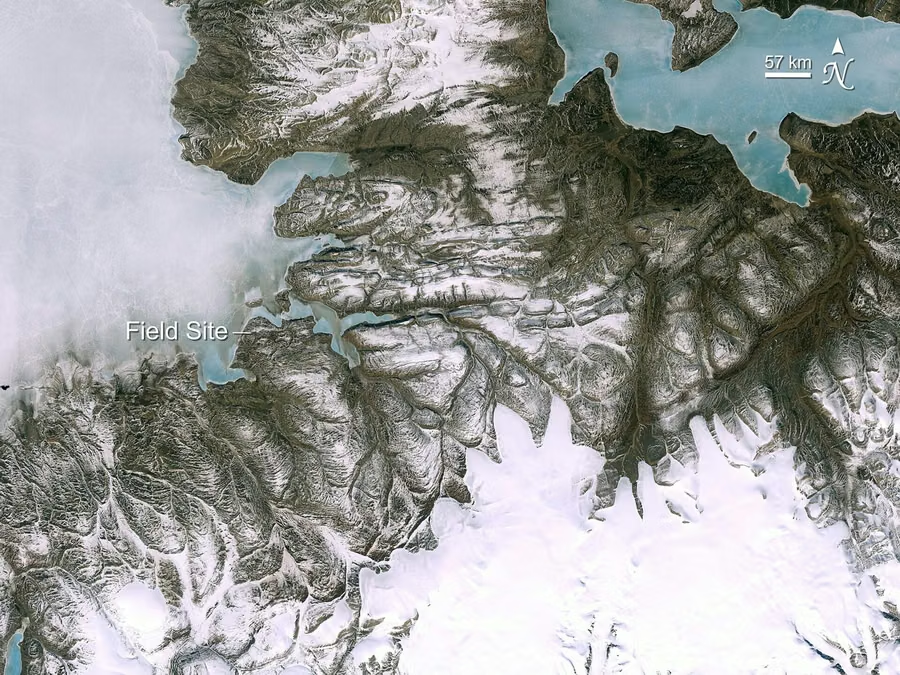
The alternatives, and what kind of thing each is
"Alternative to evolution" bundles together very different proposals. Some are religious positions that make no scientific claim; some claim to be science and have been tested; some are abandoned scientific ideas; one or two are live research programmes.
| Position | What it claims | Status |
|---|---|---|
| Young Earth creationism | The Earth is about 6,000 years old (Ussher, 1650); a global flood laid down the fossil record; radiometric dating is wrong | Debunked — contradicted by physics, geology, ice cores, tree rings and the fossil sequence itself. Still the position of Answers in Genesis and the ICR |
| Old Earth creationism | Deep time is real; creation occurred in stages, or the "days" are ages, or there was a gap between Genesis 1:1 and 1:2 | Theological — makes no testable scientific claim, and does not dispute the age of the Earth |
| Intelligent design | Some biological features are best explained by an intelligent cause; ID is a scientific alternative | Not science — ruled so in Kitzmiller v. Dover (2005) after a six-week trial; no peer-reviewed research programme; the Discovery Institute's "Wedge" strategy document describes the goal as cultural, not scientific |
| Theistic evolution | God creates through evolution; mainstream science is accepted | Compatible — the position of Francis Collins, BioLogos and most religious scientists. It is a theological stance, not a rival to the evidence |
| Lamarckism | Characteristics acquired in life are inherited | Abandoned — no mechanism for most traits. Epigenetic inheritance is real but is not Lamarckism, and creationist use of "epigenetics" as a rescue is a category error |
| Orthogenesis | Evolution moves in a predetermined direction, driven from within | Abandoned — the appearance of direction is explained by selection and constraint |
| Saltationism | New forms appear in single large jumps | Mostly rejected — though punctuated equilibrium (Gould and Eldredge, 1972) is a real, accepted argument about the pace of change, not about jumps between body plans |
| Origin-of-life chemistry | RNA world, metabolism-first, alkaline vent scenarios (Miller–Urey 1953; Gilbert 1986; Lane) | Live debate — how life began is genuinely unsolved. This is a gap in knowledge, not evidence against common descent |
| Panspermia | Life arrived from elsewhere; Crick and Orgel proposed directed panspermia in 1973 | Untested — moves the origin problem rather than solving it, and has no positive evidence |
| Cosmic ancestry, Raelian "scientific creation" | Life was engineered by extraterrestrials; evolution is a lie | Fringe — no evidence, no testable mechanism, and the same category error about what counts as data |
| Aquatic ape | Human features (hairlessness, fat, breath control) reflect a semi-aquatic phase | Rejected — an honest heterodox idea (Hardy 1960, Morgan) that has not survived testing; it concerns human evolution, not common descent |
Where the real arguments are
If you want the actual live controversies in evolutionary biology — the ones biologists argue about in journals — they are these, and none of them questions common descent:
- How life began. No consensus; competing chemistries, none demonstrated end to end.
- Tempo. Gradualism versus punctuated equilibrium; how fast the Cambrian radiation really was.
- Selection versus drift. How much of the genome changed neutrally (Kimura, 1968) rather than adaptively.
- How much DNA is functional. ENCODE's 2012 "80% functional" claim is disputed; critics put the figure far lower.
- Levels of selection. Gene, organism, group; kin selection versus multi-level selection.
- The extended evolutionary synthesis. Niche construction, developmental bias and plasticity as causes, not just consequences (Pigliucci, Müller).
- Consciousness and mind. Not explained by evolutionary theory, and not obviously an evolutionary question.
These are disagreements about mechanism and emphasis inside a framework whose core has not moved. That distinction — real debate versus a failed challenge — is the whole point of this page.
The legal record
In the United States the question has been litigated repeatedly, and the pattern is consistent: religious positions may be taught, but they may not be presented as science in public school science classes.
- 1925
Scopes "monkey trial", Tennessee: a teacher convicted under a law banning evolution teaching. The conviction was overturned on a technicality.
- 1968
Epperson v. Arkansas: the Supreme Court strikes down bans on teaching evolution as religiously motivated.
- 1987
Edwards v. Aguillard: "balanced treatment" laws requiring creation science are unconstitutional.
- 2005
Kitzmiller v. Dover: after a six-week trial, Judge Jones rules that intelligent design is not science and that the Dover policy was religious. He calls the board's conduct "breathtaking inanity".
Creationism is a religious position and is entitled to be argued as one. It is not entitled to be called science, and the specific factual claims it makes — a 6,000-year-old Earth, a global flood, no transitional fossils — have been tested and failed. Theistic evolution shows that accepting the evidence is compatible with belief; that is a live option, and it is not what this page is arguing against.
The wider pattern is the one in the giants dossier and flood myths: a claim that begins as theology, borrows the language of science, and then treats the absence of proof as proof. The Silurian hypothesis is a useful contrast — a genuinely scientific speculation about deep time, stated with its own falsification conditions.
Sources for this page
- Kitzmiller v. Dover Area School District, 400 F. Supp. 2d 707 (M.D. Pa. 2005) — full memorandum opinionlaw.justia.com
- National Center for Science Education, on the legal basis of Kitzmillerncse.ngo
- Edwards v. Aguillard, 482 U.S. 578 (1987)law.cornell.edu
- Grant & Grant (2018), "Rapid hybrid speciation in Darwin's finches", Sciencescience.org
- Barluenga et al. (2006), "Sympatric speciation in Nicaraguan crater lake cichlid fish", Naturenature.com
- Daeschler, Shubin & Jenkins (2006), Tiktaalik roseae, Naturenature.com
- Lenski, long-term evolution experiment — citrate use and its genetic basisthe-ltee.org
- Wikipedia, "Kitzmiller v. Dover Area School District" — trial and rulingen.wikipedia.org
- Wikipedia, "Objections to evolution" — the arguments and the responsesen.wikipedia.org
- BioLogos, theistic evolution and evolutionary creationbiologos.org
The Simpsons Predictions
The count first
Twenty-one claims, scored below. "Exact" means the episode named a specific thing that later happened. "Partial" means the broad shape matched but a detail did not. "Coincidence" means the scene exists but was not about the future at all. "Fake" means the screenshot was doctored, the clip spliced, or the episode never happened.
The list
Every row names the episode and its first broadcast date, so you can check the order of events yourself. Verdicts are the archive's, and the reasoning is in the last column.
| Claim | Episode, aired | What happened | Verdict |
|---|---|---|---|
| Donald Trump becomes president | "Bart to the Future", 19 Mar 2000 | Lisa, as president, says she "inherited quite a budget crunch from President Trump". Trump was elected in 2016. | Exact A joke about a then-possible candidate, but the named detail landed. |
| Disney buys 20th Century Fox | "When You Dish Upon a Star", 8 Nov 1998 | A studio sign reads "20th Century Fox, a Division of Walt Disney Co." Disney's deal was announced in 2017 and completed in 2019. | Exact A visual gag, 19 years early. |
| Cypress Hill play with the London Symphony Orchestra | "Homerpalooza", 1996 | Homer asks whether Cypress Hill could play with the LSO. The band did exactly that at the Royal Albert Hall on 10 July 2024. | Exact The band credited the episode themselves. |
| Bengt Holmström wins the economics Nobel | "Elementary School Musical", Sep 2010 | Milhouse bets on Nobel winners and names Holmström. Holmström shared the 2016 economics prize. | Exact Writers picked plausible economists, not a name at random. |
| A white tiger mauls a Las Vegas magician | "$pringfield", 16 Dec 1993 | Gunter and Ernst, a Siegfried & Roy parody, are attacked by their white tiger. Roy Horn was attacked on stage on 3 Oct 2003. | Exact True, and nearly information-free: the act already worked with tigers. |
| USA beat Sweden for curling gold | "Boy Meets Curl", 14 Feb 2010 | The episode has a mixed-doubles USA–Sweden final. In 2018 the US men beat Sweden in the Olympic final. | Partial Right countries, wrong event. The exact mixed-doubles gold is still unclaimed. |
| Washington beats Buffalo in the Super Bowl | "Lisa the Greek", Jan 1992 | Aired three days before Super Bowl XXVI; Washington won. | Partial A coin-flip dressed as prophecy, written before the game. |
| Michelangelo's David gets censored | "Itchy & Scratchy & Marge", 1990 | A statue of David is censored in Springfield. In 2023 a Florida principal lost her job over a David image. | Partial The pattern recurs; the specific event did not follow from the joke. |
| 9/11 on a New York brochure | "The City of New York vs. Homer Simpson", 1997 | A "$9" fare brochure with the twin towers forms something like "9/11". | Coincidence Snopes and the episode's own writer call it a coincidence; no attack is depicted. |
| Ebola | "Marge in Chains", 1993 | Marge reads "Curious George and the Ebola Virus". | Coincidence Ebola was identified in 1976; the joke used a disease that already existed. |
| COVID and "murder hornets" | "Marge in Chains", 1993 | Springfield catches the "Osaka flu" and later a swarm of killer bees escapes. | Coincidence Pandemics and invasive insects are recurring facts, not a script. |
| Mass of the Higgs boson | "The Wizard of Evergreen Terrace", 1998 | A chalkboard equation is strikingly close to a Higgs-mass calculation. | Coincidence The writers were doing a maths joke; physicists noticed afterwards. |
| Smartwatches, FaceTime, autocorrect, tablets | "Lisa's Wedding", 1995, and others | 1990s episodes show wrist phones, video calls and flat screens. | Coincidence Generic future furniture. Science fiction had drawn all of it before 1990. |
| Tomacco: a tomato-tobacco plant | "E-I-E-I-(Annoyed Grunt)", 1999 | A fan grafted a tomato onto tobacco roots in 2003 and the plant contained nicotine. | Partial Self-fulfilling: the fan was recreating the joke on purpose. |
| Trump's escalator ride | — | No episode contains it. The comparison was made after the 2015 announcement. | Fake |
| Trump's 2016 electoral map | — | No episode shows the map. | Fake |
| Trump touching a glowing orb | — | The image was made after the 2017 photograph. | Fake |
| The Notre-Dame fire | — | A 2007 episode features a "Notre Dame of Springfield"; the flames and Mr Burns were added later. | Fake Snopes traced the doctored image. |
| "The Simpsons predicted Trump in 1995" | — | The show's first mention of Trump is the 2000 episode above. | Fake |
| A woman president after Trump | "Bart to the Future", 2000 | Lisa is president in the imagined future. | Awaited Trump happened; the woman after him has not. |
| Mixed-doubles curling gold, USA over Sweden | "Boy Meets Curl", 2010 | Mixed doubles became Olympic in 2018; the USA has not won it. | Awaited |
Why a 35-year cartoon looks psychic
Four things, in order of how much work they do.
- Volume. More than 750 episodes over 35 years contain tens of thousands of jokes about the future. If a show makes a thousand guesses and a hundred are checkable, roughly a handful will look uncanny. "The more unlikely thing would be that we never predicted anything," the showrunner Matt Selman has said.
- Vagueness plus retrofitting. A joke about "President Trump" in 2000 became "a prediction" in 2016. A brochure that reads "$9" became "9/11" in 2001. The claim is written after the event, and the episode is re-read to fit it.
- Informed guessing. The writers were reading the news: Trump was flirting with a 2000 run, Disney was already buying studios, Holmström was a plausible Nobel pick, and a tiger act was dangerous by definition. Al Jean's summary: predicting FIFA was corrupt is "a very easy prediction".
- Selection. Nobody shares the 99% that did not happen. The list you have seen is a highlight reel assembled backwards from the outcomes.
None of this means the coincidences are not strange. The 9/11 brochure genuinely unsettles the people who made it. Strange is not the same as predictive, and a coincidence is not evidence of a hidden script — it is evidence that a long-running show generates a lot of text.

And the films?
The same accounting applies, with one difference: films set a date on screen, which makes them easy to score. Eight of the most-cited cases:
| Film, year | What it showed | What happened | Verdict |
|---|---|---|---|
| Network (1976) | News as rage-driven entertainment; a network exploiting a ranting host | Talk-news, outrage formats and reality television became the business model | Hit |
| The Truman Show (1998) | A life broadcast as entertainment, with an audience complicit | Reality TV and influencer life followed within years | Hit |
| Back to the Future Part II (1989) | 2015: video calls, wearable screens, biometrics, drones, hoverboards, flying cars | Video calls and wearables yes; hoverboards and flying cars no. Even the "Cubs win" newspaper is a year off (2016, not 2015) | Partial |
| 2001: A Space Odyssey (1968) | Tablets, video calls, space tourism, a Moon base, a Jupiter mission | Tablets and video calls are ordinary; the bases and missions are not | Partial |
| Minority Report (2002) | Personalised ads, gesture interfaces, iris scanning, self-driving cars, precrime | The first four arrived in some form; precrime did not | Partial |
| Contagion (2011) | A bat virus, airborne transmission, fomites, a vaccine race, anti-vax backlash | COVID-19 matched the shape closely — because the film was researched with epidemiologists | Partial |
| Demolition Man (1993) | San Angeles, Taco Bell winning the franchise wars, "President Schwarzenegger" | Arnold governed California but could never be president (born in Austria); Taco Bell survives under Yum! Brands | Partial |
| Blade Runner (1982) | 2019 Los Angeles: replicants, flying cars, off-world colonies | None of it; the video calls and giant screens did arrive | Miss |
Film count: 2 hits, 5 partial, 1 miss. Notice what the hits have in common — they are satires of trends already visible when they were made, not forecasts of technology.
Of twenty-one famous Simpsons claims, five are exact, four are partly right, five are coincidences read backwards, five are fakes or simply wrong, and two are still waiting. The films score about the same way, and for the same reason: stories are good at extrapolating trends and bad at naming dates.
If you want the general version of this, the archive's prophecies dossier covers the mechanics, and false memory explains why people remember a prediction they never saw.
Sources for this page
- MIT Technology Review, interview with Al Jean on the show's "predictions" (2025)technologyreview.com
- Snopes, "'The Simpsons' Predicted 9/11 Attack on World Trade Center?"snopes.com
- Snopes, "Simpson Predictions That Were Just Internet Hoaxes"snopes.com
- Reuters Fact Check, episodes are not evidence of "predictive programing"reuters.com
- CNN, on the false escalator and electoral-map claims (2024)cnn.com
- BBC News, "Hip-hop act Cypress Hill make 28-year-old Simpsons joke come true" (2024)bbc.co.uk
- Time, on the 2018 curling "prediction"time.com
- Los Angeles Times, on the Nobel-prize episode and the show's forecasting recordlatimes.com
- Wikipedia, "Bart to the Future" — episode and air dateen.wikipedia.org
- BBC Culture, "Where are our hoverboards? How films predict the future" (2015)bbc.com
- GamesRadar, films that "accurately predicted the future" — and the missesgamesradar.com
Where to Read More
Use this page instead of a search engine. Searching “hollow earth” gives you a hundred videos and a wiki; searching inside a geological survey gives you the paper. All links below are to the front page of the institution, so they stay working when a page is reorganised.
Fact-checking and claim testing
- Snopes — snopes.com — the oldest general fact-checking archive; strong on viral claims and their provenance.
- Reuters Fact Check — reuters.com/fact-check — the source used repeatedly in this archive for Antarctic and map claims.
- AP Fact Check — apnews.com/hub/ap-fact-check
- Full Fact (UK) — fullfact.org
- Skeptoid — skeptoid.com — short, sourced episodes; the Tartaria and hollow-Earth episodes are on the reading lists.
- Google Fact Check Explorer — toolbox.google.com/factcheck/explorer
- Retraction Watch — retractionwatch.com — for checking whether a paper still stands.
Space, stars and the sky
- NASA — nasa.gov — mission archives, the Tunguska and Apollo records, and the image library.
- ESA — esa.int — Gaia, which produced the 1.3-million binary star catalogue.
- JPL — jpl.nasa.gov — the Earth-radius study cited in the larger-globe dossier.
- NASA Image and Video Library — images.nasa.gov — public domain imagery.
- IAU — iau.org — the body that actually names things.
Earth, rocks and deep time
- USGS — usgs.gov — the source of the plate-tectonics and dinosaur-timing statements here.
- British Geological Survey — bgs.ac.uk
- Smithsonian Global Volcanism Program — volcano.si.edu
- IRIS / EarthScope — iris.edu — how seismic waves image the interior, the test that rules out a hollow planet.
- National Park Service — nps.gov — Devils Tower’s own geology pages.
- IUGS Geoheritage — iugs-geoheritage.org
Oceans and polar regions
- NOAA Ocean Exploration — oceanexplorer.noaa.gov
- NOAA NCEI — ncei.noaa.gov — Seabed 2030 and the mapping statistics.
- Schmidt Ocean Institute — schmidtocean.org — live deep-sea expeditions.
- MBARI — mbari.org — deep-sea biology and video.
- NSIDC — nsidc.org — sea ice and polar data.
- British Antarctic Survey — bas.ac.uk
- Byrd Polar and Climate Research Center — byrd.osu.edu — Byrd’s actual papers.
Archaeology, museums and the ancient world
- Penn Museum — penn.museum — Expedition magazine, including the Palenque analysis.
- British Museum — britishmuseum.org — collection database and research publications.
- The Met, Open Access — metmuseum.org — free images of half a million objects.
- Archaeological Institute of America — archaeological.org — and its magazine, Archaeology.
- Antiquity — antiquity.ac.uk — peer-reviewed archaeology, often open access.
- Open Context — opencontext.org — raw excavation data.
Myth, folklore and primary texts
- Theoi Project — theoi.com — Greek myth with the classical citations attached.
- Perseus Digital Library — perseus.tufts.edu — Greek and Latin texts with translations.
- Internet Sacred Text Archive — sacred-texts.com — public-domain scriptures and folklore.
- Project Gutenberg — gutenberg.org
- The Folklore Society — folklore-society.com
- Library of Congress research guides — guides.loc.gov — including the hollow-earth bibliography.
Secret programmes and declassified files
- CIA FOIA Reading Room — cia.gov/readingroom
- FBI Records: The Vault — vault.fbi.gov
- NSA FOIA — nsa.gov/Helpful-Links/NSA-FOIA
- National Archives (US) — archives.gov
- GovInfo — govinfo.gov — congressional hearings and reports.
- AARO — aaro.mil — the current US UAP office.
Images you can legally reuse
- Wikimedia Commons — commons.wikimedia.org — every photograph on this site, with author and licence recorded on the credits page.
- Library of Congress — loc.gov
- Rijksmuseum — rijksmuseum.nl
- Wellcome Collection — wellcomecollection.org — history of medicine and science.
- David Rumsey Map Collection — davidrumsey.com — the maps that “Tartary” claims are built on.
Archives and libraries (the useful deep web)
- Internet Archive — archive.org — Wayback Machine, texts, audio.
- HathiTrust — hathitrust.org — 18 million scanned volumes.
- WorldCat — worldcat.org — find the physical book.
- arXiv — arxiv.org · PubMed Central — pmc.ncbi.nlm.nih.gov · DOAJ — doaj.org
- CORE — core.ac.uk — open-access papers aggregated.
Pick the institution that would be embarrassed by the claim. If the claim is geological, check the geological survey. If it is about a manuscript, check the library that holds it. If it is about a secret programme, check the agency’s own FOIA reading room — because that is where the documents that proved six real conspiracies actually live.
Also worth bookmarking
- Wikipedia — useful as a map of a topic and a list of its citations, not as an endpointen.wikipedia.org
- Internet Archive Scholarscholar.archive.org
- Google Books — for checking what a 19th-century source actually saidbooks.google.com
Proven Conspiracies
“Conspiracy theory” has become an insult, but a conspiracy is simply an agreement to do something harmful in secret — a crime with more than one participant. Some of those were committed by governments, and were later proven with documents.
Six cases follow. Each is here for the same reason: to show what evidence of a real cover-up actually looks like — a paper trail, a whistleblower, an inquiry, a named official, and a date.
1. MKUltra — the CIA’s mind-control programme (1953–1973)
Approved by CIA Director Allen Dulles in 1953 and run largely by chemist Sidney Gottlieb, MKUltra funded research into behavioural control: LSD, hypnosis, sensory deprivation, electroshock. It operated through universities, hospitals and prisons, and in many documented cases the subjects did not consent.
Its most notorious strand was Operation Midnight Climax: CIA-linked safe houses where men were dosed without their knowledge and observed through two-way mirrors.
The human cost has a name. Frank Olson, an Army scientist at Fort Detrick, was secretly given LSD at a November 1953 meeting and died days later in a fall from a New York hotel window. His family had the body exhumed in 1994; a forensic report found a head injury that may have preceded the fall. Prosecutors investigated for five years and could not prove murder — so the manner of death remains disputed even though the dosing does not.
How it was proven: a 1974 New York Times investigation, followed by the 1977 Senate Church Committee hearings. Roughly 149 subprojects are documented — and the record is incomplete because Richard Helms ordered the files destroyed in 1973.
2. COINTELPRO — the FBI against its own citizens (1956–1971)
The FBI’s counter-intelligence programme surveilled, infiltrated and disrupted political groups: the Communist Party USA, the Socialist Workers Party, the Black Panther Party, the Southern Christian Leadership Conference — and Martin Luther King Jr. personally. On 21 November 1964 an anonymous “suicide package” was mailed to King, assembled by the Bureau.
How it was proven: in March 1971 a group calling itself the Citizens’ Commission to Investigate the FBI burgled the Bureau’s Media, Pennsylvania office and mailed the files to journalists. The programme was exposed, and formally terminated. The Church Committee then documented its scope.
3. Tuskegee — 40 years of untreated syphilis (1932–1972)
The US Public Health Service studied the progression of syphilis in 399 Black men in Macon County, Alabama, without telling them their diagnosis. Even after penicillin became the standard cure in the 1940s, treatment was withheld so the study could continue. It ran for forty years.
How it was proven: a 1972 Associated Press story by Jean Heller, then a federal panel, congressional hearings, and a $10 million settlement. President Clinton formally apologised in 1997.
One correction matters, because the popular version exaggerates it: the men were not deliberately infected. A separate programme in Guatemala (1946–48), documented by a presidential commission in 2011, did intentionally expose people to sexually transmitted infections without consent. Both were abuses; they were not the same abuse.
4. The Gulf of Tonkin — the second attack that did not happen (1964)
On 4 August 1964, the Johnson administration reported that North Vietnamese vessels had attacked two US destroyers in the Gulf of Tonkin. Congress passed the Gulf of Tonkin Resolution three days later, authorising military action in Southeast Asia — the legal basis for the escalation of the Vietnam War.
The second attack did not occur. Communications were misread under pressure, and the intelligence was presented with more confidence than it deserved.
How it was proven: the Pentagon Papers (1971) and, decisively, declassified NSA signals-intelligence material. The NSA has published its own internal history, “Skunks, Bogies, Silent Hounds, and the Flying Fish: The Gulf of Tonkin Mystery, 2–4 August 1964”, along with the original intercepted traffic.
5. Iran–Contra (1985–1987)
Senior National Security Council staff — principally Lt. Col. Oliver North, with National Security Adviser John Poindexter — arranged secret arms sales to Iran while the US publicly refused to negotiate with hostage-takers, then diverted the proceeds to the Contras in Nicaragua after Congress had explicitly banned military aid to them (the Boland Amendment).
How it was proven: exposure in a Lebanese magazine in November 1986, then the Tower Commission, congressional hearings and Independent Counsel Lawrence Walsh’s investigation. Several convictions followed; some were later overturned on immunity grounds.
6. The tobacco industry (1950s–1998)
Internal industry documents show that companies understood the cancer risk and the addictiveness of nicotine while publicly funding doubt, attacking the science, and marketing “safer” cigarettes. The strategy was explicit: manufacture uncertainty and sell it.
How it was proven: litigation discovery, most famously the 1994 release of millions of pages from Brown & Williamson and others, and the 1998 Master Settlement Agreement. The documents are now a public archive used by historians and epidemiologists.
Every case above has the same four features: a specific claim, a named institution, a paper trail that survived, and a mechanism of exposure — a burglary, a leak, a lawsuit, a congressional subpoena.
Now compare that with the claims in the other dossiers. “The Earth is hollow” has no memo. “A second sun is hidden” has no budget line. “The ice wall is guarded” has no unit, no payroll and no defector. Six decades of real conspiracies have produced tens of thousands of pages of documentation; the cosmology claims have produced photographs of a rock.
This is not a rhetorical trick. It is the strongest argument in the archive: we know what a cover-up looks like, because we have the files.
Two more worth knowing
- Operation Northwoods (1962) — a Joint Chiefs proposal to stage attacks on US targets to justify invading Cuba. It was proposed and rejected, declassified in 1997. Real document; never executed. A useful reminder that “they discussed it” is not “they did it”.
- Mass surveillance — the NSA’s bulk collection programmes, disclosed by Edward Snowden in 2013, were subsequently reviewed by courts and Congress and partly curtailed. A genuine secret, revealed by a named source with documents.
7. Operation Mockingbird — the CIA and the press
The claim, made for decades and dismissed as paranoia: the CIA had penetrated American news organisations and used journalists to place propaganda.
It was substantially confirmed. The 1975–76 Church Committee investigations into intelligence activities opened the archive, and in 1977 the journalist Carl Bernstein published “The CIA and the Media” in Rolling Stone, based on interviews and internal documents, describing a programme to recruit and cultivate journalists, editors and publishers — with figures in the hundreds, including people at major newspapers, magazines, and broadcasters.
The nuance matters as much as the confirmation. Much of the relationship was “friendly” cultivation rather than formal employment: a journalist who would take a call, plant a story, or hold a line. Some were on the payroll. The point is not that every story was dictated; it is that a secret channel existed, was used, and was concealed from readers — which is exactly what critics had alleged.
8. The Nayirah testimony — a war sold with a story
In October 1990, a 15-year-old girl identified only as “Nayirah” testified before a Congressional human rights caucus that Iraqi soldiers had entered a Kuwaiti hospital, removed babies from incubators and left them to die on the floor. The testimony was credited with helping shift American public opinion toward war.
It was arranged. Nayirah was the daughter of the Kuwaiti ambassador to the United States, and the hearings had been organised with the help of Hill & Knowlton, a public relations firm working for a Kuwaiti-funded group. The incubator story was promoted as research; later investigations found no evidence for it, and reporters established that the witness's identity had been concealed deliberately.
The episode is now a standard case study in how a democracy can be moved to war by a manufactured story told in an official setting — and, notably, it was exposed by journalists rather than by any internal check.
9. The Business Plot — a coup offered to a general
In 1933 the retired Marine Corps Major General Smedley Butler — the most decorated Marine of his era, and by then a fierce critic of war profiteering — told a congressional committee that a group of wealthy men had approached him to lead a fascist veterans' organisation and march on Washington, in effect a coup against President Roosevelt.
The House committee chaired by John McCormack investigated, took testimony, and reported that it had found evidence of an attempt to establish a fascist organisation and that the plotters had approached Butler. The alleged go-between was Gerald MacGuire, a bond salesman for a Wall Street firm. No one was prosecuted.
Historians differ on the scale — how far the money went, how serious the operational planning was, whether some witnesses exaggerated. What is documented is that the approach happened, that Butler reported it, and that a congressional committee took it seriously enough to write it up. That is the useful middle case: not a fantasy, not a fully executed plot, but a real attempt that failed and was then investigated openly.
10. Watergate — the conspiracy that ended a presidency
In June 1972 five men were arrested burgling the Democratic National Committee offices in the Watergate building. Two Washington Post reporters, Bob Woodward and Carl Bernstein, followed the money and the connections toward the White House while the administration dismissed the story as partisan invention.
The cover-up collapsed through documented evidence: the Senate hearings in 1973, the revelation of the White House taping system, and the tapes themselves. The Supreme Court ordered them released in July 1974; Nixon resigned in August.
Watergate is the benchmark for this whole dossier. It shows what a real conspiracy looks like from the outside — an actual crime, actual concealment, and a trail of documents, money and recordings that eventually outran the people hiding them. Every claim in these pages that is filed as Documented had to meet that standard. Every claim filed as Debunked failed it.
11. Operation Paperclip — the scientists who were hired
After the Second World War, the United States recruited German scientists and engineers — including Wernher von Braun, who had led the V-2 rocket programme — to work on American rockets and weapons. The programme was called Operation Paperclip.
The part that was rumoured and then confirmed is the paperwork: officials removed or softened Nazi Party membership and war-crime connections from the personnel files of recruits so they could be cleared to enter the country. More than 1,600 people were brought over, and their work fed directly into the US space programme and the missile arsenal.
The moral accounting is genuinely contested, and the archive does not pretend otherwise. Von Braun's V-2 was built with forced labour, and more people died making it than were killed by it. The programme's defenders argue that the alternative was Soviet recruitment; its critics argue that justice was traded for technical advantage. What is not contested is that the recruitment happened and the records were sanitised — which is the definition of a cover-up, documented in the government's own files.
Appendix: not a plot, a vindication — Semmelweis and the invisible particles
Some of the best evidence that the establishment can be catastrophically wrong comes from medicine, and the standard case is Ignaz Semmelweis.
In 1847, working at the Vienna General Hospital, Semmelweis noticed that the maternity ward staffed by doctors had a far higher death rate from puerperal fever than the ward staffed by midwives. The doctors came to the ward straight from autopsies. He ordered handwashing in chlorinated lime solution, and mortality in his ward fell sharply — in his reported figures, from around 10% to around 1–2%.
He was not believed. His explanation — “cadaveric particles” carried on hands — had no mechanism anyone accepted, his manner was combative, and he published nothing for years. He lost his post, and in 1865 he was committed to an asylum, where he died at 47 of an infection from a wound.
Germ theory arrived afterwards: Pasteur's work in the 1860s, Koch's identification of specific pathogens in the 1870s–80s. Semmelweis was vindicated, decades too late, and the phrase “Semmelweis reflex” now names the rejection of evidence because it conflicts with consensus.
Nobody was conspiring. The doctors who rejected Semmelweis were not hiding data; they were reasoning inside a framework that had no place for invisible contagion. That is the more common failure, and the more instructive one: institutional resistance is usually not a plot — it is a paradigm with inertia.
The archive keeps both cases because they are often confused. MKUltra above was a conspiracy: a secret programme, hidden from the public, exposed by documents. Semmelweis was a failure of consensus, exposed by replication. Telling them apart is the difference between history and the stories people tell about history.
Sources for this page
- National Geographic, “5 times the U.S. government revealed secrets it tried to keep hidden”nationalgeographic.com
- NSA, Gulf of Tonkin declassification releases — including “Skunks, Bogies, Silent Hounds, and the Flying Fish”nsa.gov
- NSA, the full SIGINT study (PDF)nsa.gov (PDF)
- HowStuffWorks, “11 Conspiracy Theories That Turned Out to Be True” — including the Tuskegee/Guatemala distinctionhistory.howstuffworks.com
- Business Insider, “9 huge government conspiracies that actually happened”businessinsider.com
- Skeptoid, “5 Conspiracy Theories that Turned Out to Be True… Maybe?” — a stricter evidentiary testskeptoid.com/episodes/416
Dyatlov Pass
The facts, without the fog
In late January 1959 a group of nine from the Ural Polytechnic Institute set off to ski across the northern Urals. Their leader was Igor Dyatlov, 23. They were experienced — this was a Grade III route, the hardest Soviet classification.
They camped on the slope of Kholat Syakhl, "Dead Mountain". Searchers later found the tent still standing, cut open from the inside, with most of the group's clothing and boots left behind. Nine sets of footprints led downhill toward the tree line, some in socks, some barefoot.
Two were found under a cedar tree beside a small fire; three more between the tree and the tent, apparently trying to return; four in a ravine, in a makeshift snow shelter. Causes of death: hypothermia for most, and severe chest and skull trauma for the ravine group — injuries, the autopsy said, comparable to a car crash, with no corresponding external wounds.
Small oddities fed the legend: a camera with unexplained frames, slightly elevated radiation on one sweater, and a missing tongue and eyes in one body (consistent with scavenging and decomposition in water). The Soviet investigation closed with "a compelling natural force" and a classified file.
The theories, ranked honestly
- Infrasound / paradoxical disrobing. Katabatic winds around the mountain could produce infrasound, inducing panic; severe hypothermia famously causes paradoxical undressing. Plausible for the flight and the discarded clothes, but weak on the fractures.
- Secret weapons test. No test site nearby, no document, no radiation pattern consistent with a blast or fallout.
- Yeti / UFO / "the unknown". No physical evidence of any kind, and the story only needs them if the avalanche fails — which it no longer does.
- Slab avalanche. The strongest explanation, and the one that has been modelled.
Johan Gaume and Alexander Puzrin published a study in Communications Earth & Environment modelling the specific snow and slope conditions. Their conclusion: a small slab avalanche, delayed by two and a half to nine and a half hours after the slope was cut, was consistent with the injuries — including the chest and skull fractures caused by a low-density snow slab hitting people lying in a ravine — and with the hikers' decision to cut into the tent and flee downhill.
The delayed release is the key insight: it explains why experienced mountaineers camped on a slope that looked safe, and why they left in panic rather than digging out gear.
What remains open
Not everything is nailed down: the exact timing, why the group split, and the minor anomalies in the file. A scientific explanation does not need to account for every detail to be the best available one, and the honest position is "avalanche, with residual uncertainty" rather than "solved beyond question" or "unexplainable".
That is the useful lesson here, and it is the same one as the wider anomalies page: "unexplained" is a statement about the state of the evidence, not a permanent property of an event. Cases get solved, and the legend outlives the solution.
Sources for this page
- Gaume & Puzrin (2021), “Mechanisms of slab avalanche release and impact in the Dyatlov Pass incident”, Communications Earth & Environmentnature.com
- Wikipedia, “Dyatlov Pass incident” — timeline, autopsies, fileen.wikipedia.org
- EPFL, “Using science to solve the Dyatlov Pass mystery”epfl.ch
Unresolved Disappearances
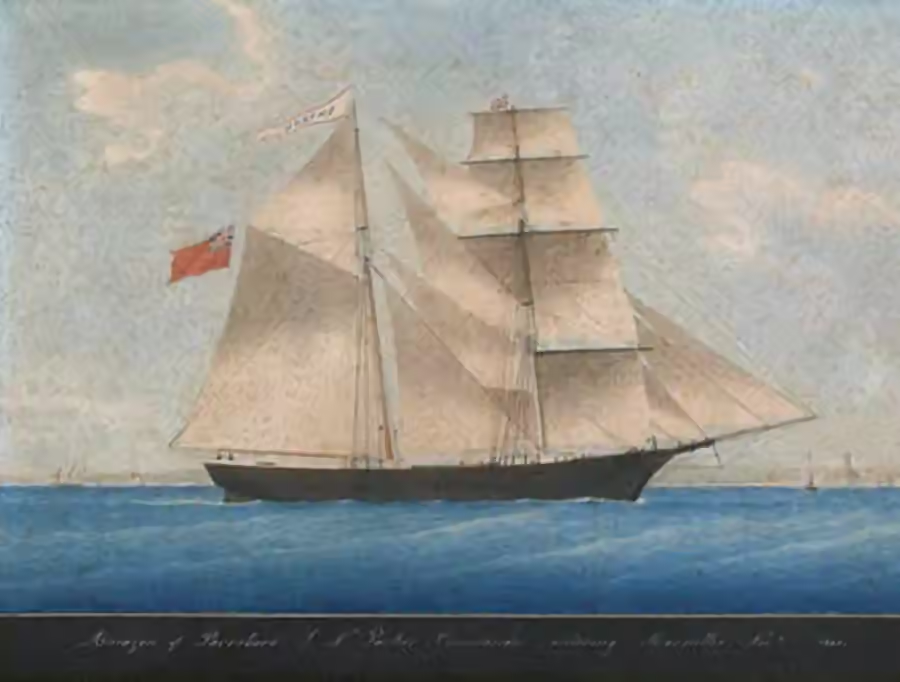
Why this page exists
Disappearance is the purest kind of mystery: there is no artifact to argue about, only an absence. That makes these cases unusually vulnerable to storytelling, and unusually good practice for reading evidence carefully. Each entry below separates what is documented, what is the leading explanation, and what nobody knows — and two neighbouring pages, Roanoke and Dyatlov Pass, show what it looks like when a disappearance stops being one.
1 · Flight MH370 Open
On 8 March 2014 a Malaysia Airlines Boeing 777 left Kuala Lumpur for Beijing with 239 people aboard and stopped talking to air traffic control about forty minutes later. Military radar tracked it turning back across the Malay Peninsula and out over the Indian Ocean. Automated satellite "handshakes" continued for hours, and analysis of their timing placed the final position on one of two long arcs; the northern arc was ruled out, leaving a stretch of the southern Indian Ocean west of Australia.
In July 2015 a flaperon from a 777 washed up on Réunion, and further pieces were confirmed as belonging to the aircraft. The underwater search covered 120,000 square kilometres and found nothing; the official search ended in 2017, a private effort in 2018. The aircraft's location is broadly known and its wreck has never been found.
Documented: the diversion, the satellite data, the confirmed debris. Leading explanation: an intentional diversion and a controlled flight into the southern ocean. Unknown: who was flying, why, and where the wreck lies.
2 · The Mary Celeste Open
Found on 5 December 1872 between the Azores and Portugal, the brigantine was under sail with no one aboard, her cargo of industrial alcohol partly emptied, her single lifeboat missing, and the last log entry eleven days old. There was no sign of violence, no bodies, and the ship was still seaworthy enough to be sailed to Gibraltar.
The explanations on offer are all partial: an alcohol-vapour explosion that panicked the crew into the lifeboat, a waterspout, a rogue wave, piracy, insurance fraud. The vapour theory fits the evidence best — nine barrels were empty and the hold showed no fire damage — but it does not explain why the lifeboat was never found and why a competent crew did not simply return to a ship still afloat.
3 · Amelia Earhart Open
Earhart and navigator Fred Noonan disappeared on 2 July 1937 while trying to find Howland Island, a two-kilometre speck in the Pacific, at the end of a 4,000-kilometre leg. Radio transmissions were heard, increasingly strained, and then nothing. The US Navy searched 250,000 square miles and found no trace.
The best-supported hypothesis is that they landed on the reef at Nikumaroro, where the international group TIGHAR has recovered artefacts including a fragment of aircraft aluminium and a piece of a shoe, and where human bones were found in 1940 and judged male at the time — a judgement later disputed. It is suggestive, not proven. Claims that they were captured by the Japanese rest on hearsay and a photograph that has been shown to predate the flight.
4 · The Sodder children Open
On Christmas Eve 1945 a house in Fayetteville, West Virginia, burned to the ground. Nine children were inside; four got out, and five — aged five to fourteen — were never found. The fire was intense enough that the family assumed the worst, but no remains were ever recovered from the site, and the house burned quickly enough that an arson inquiry was opened.
The family spent decades investigating: a billboard alongside a highway, a suspicious phone call, a report of children glimpsed in a passing car. The official position is that the children died in the fire. The absence of remains is real and genuinely odd; it is also possible in a hot, collapsing, heavily excavated fire scene. This is the archive's clearest example of a case where a family's refusal to accept a probable answer is entirely understandable and still not evidence.
5 · The MV Joyita Open
In 1955 the Joyita left Samoa for the Tokelau Islands with 25 people and was found five weeks later, half-submerged and abandoned, hundreds of kilometres off course. Her radio was broken and set to a dead channel, her clocks had stopped, and a doctor's bag and the captain's briefcase were missing. Nobody was ever found.
Fiji's inquiry concluded that the vessel had taken on water through a corroded pipe, that the passengers had taken to a raft or been swept off, and that the captain had died trying to raise help. It is a competent explanation with holes in it — the missing briefcase, the state of the radio — and no better one has replaced it.
6 · Percy Fawcett Open
The British explorer walked into the Mato Grosso in 1925 with his son and a companion, looking for a lost city he called "Z", and never came out. Over the following decades, dozens of people died or vanished looking for him. His final letter said he would proceed without guides and expected to be delayed.
The most plausible account is that the party perished in the forest or was killed by an indigenous group defending its territory — a scenario supported by oral accounts collected much later. The romantic version, that Fawcett found his city and chose to stay, has no evidence at all. Archaeology since the 2000s has found large pre-Columbian settlements in the Amazon, which vindicates part of his intuition without rescuing his expedition.
7 · The Moptera and the small cases
Most disappearances are quiet. Fishing boats, solo hikers, people who walked out of hospitals. Official statistics on missing persons are large — the FBI's missing-persons file runs to tens of thousands of open cases at any time — and the overwhelming majority resolve, usually within days, without a mystery.
The famous cases above are famous because they are photogenic, not because they are representative. Reading them well means holding two things at once: something genuinely unexplained happened, and the most likely explanation is still something ordinary that left no trace.
Every case has the same shape. A real event; a document trail that stops; an explanation that fits most of the evidence; and a residue nobody can close. The honest label is "open", and an open case is not evidence for anything specific — not for aliens, not for conspiracy, and not for the supernatural.
Where a case does close, it closes on evidence: the Dyatlov Pass avalanche model, the Croatoan carving and hidden fort, the Romanov graves. That is the standard worth applying everywhere.
Sources for this page
- Australian Transport Safety Bureau, The Operational Search for MH370 (final report, 2017)atsb.gov.au
- Wikipedia, “Malaysia Airlines Flight 370” — timeline, satellite analysis, debrisen.wikipedia.org
- Britannica, “Mary Celeste” — the 1872 discovery and the inquiriesbritannica.com
- TIGHAR, the Nikumaroro hypothesis for the Earhart disappearancetighar.org
- Wikipedia, “Sodder children disappearance” — the fire, the inquiries, the family's searchen.wikipedia.org
- Wikipedia, “MV Joyita” — the 1955 inquiry findingsen.wikipedia.org
- Wikipedia, “Percy Fawcett” — the 1925 expedition and later accountsen.wikipedia.org
The Voynich Manuscript
What it is
A codex of about 240 vellum pages, now Beinecke MS 408 at Yale, named after Wilfrid Voynich, the book dealer who bought it in 1912. It contains an unknown script — written left to right, in a fluent, practised hand — alongside illustrations: plants that match no known species, astronomical/astrological diagrams with zodiac symbols, and pages of small figures bathing in interconnected pools.
Radiocarbon dating of the vellum in 2009 gave a range of roughly 1404–1438. The inks are consistent with that period. This is the one hard fact that constrains everything else: it is not a modern forgery made on old blank parchment, unless the forger was extraordinarily well equipped.
Its provenance is documented from the sixteenth century: it appears in the collection of Rudolf II in Prague, was owned by the alchemist Georg Baresch, then Athanasius Kircher, and passed through the Jesuit college at Frascati before Voynich.
Why it resists
The text behaves oddly in ways that are measurably real. Word-length distribution, Zipf's-law behaviour and the repetition of common tokens all look language-like rather than random. But the vocabulary is small and repetitive, there are almost no corrections, and the same words recur in similar positions across sections — properties consistent with a constructed language, a cipher with a small plaintext vocabulary, or a very careful hoax.
That combination is what defeats attempts. A cipher needs a key or a crib — a known plaintext to anchor the mapping — and no crib has ever been identified. A natural language needs identifiable roots, and none have been convincingly matched.
Every few years a new solution is announced: a Turkish scholar's claim, a "proto-Romance" reading, an elaborate acrostic, a Hebrew cipher, an Aztec connection. The pattern is consistent — the method is applied, a few words appear to make sense, and then the reading fails to generalise, or requires a different substitution for each section, or produces text nobody else can reproduce.
Properly evaluating these is not snobbery. A real decipherment (Egyptian hieroglyphs, Linear B, Mayan) had three features: it explained the whole corpus, it predicted readings of new passages, and independent specialists could apply it. No Voynich claim has managed the third.
What the honest answer is
We do not know what it says, whether it says anything, or who made it. The leading candidates are a cipher of a natural language, a constructed language or personal code, and a hoax designed to look meaningful — and the evidence does not currently distinguish them.
"Unsolved" is the correct scientific answer here, and it is worth contrasting with the claims that manufacture a solution. The archive keeps this page in Live debate because the argument is real and ongoing, not because the mystery is being protected.
One useful consequence: the Voynich is the best available test of intellectual honesty about unreadable evidence. Anyone who tells you they have cracked it should be asked the same three questions — does it explain everything, does it predict, and can others reproduce it?
Sources for this page
- Beinecke Library, Yale — Voynich Manuscript, full digital facsimile (MS 408)yale.edu
- Wikipedia, “Voynich manuscript” — provenance, dating, decipherment claimsen.wikipedia.org
- University of Arizona, radiocarbon dating of the vellum (2009)arizona.edu
- The Atlantic, “The Unread: the mystery of the Voynich manuscript”newyorker.com
Oak Island
The story
In 1795 a young man named Daniel McGinnis reported a circular depression on Oak Island, Nova Scotia, with a block-and-tackle hanging above it and a sapling at its centre. Digging revealed layers of logs at regular intervals, then a stone slab inscribed with symbols, then — depending on the teller — a platform, a cipher stone, and flood tunnels that fill any shaft with seawater as soon as it is opened.
From there the legend assembled its cast: Captain Kidd's hoard, Spanish gold, the lost treasure of the Templars, Francis Bacon's manuscripts proving he wrote Shakespeare, the Holy Grail, the Ark of the Covenant. Every generation of diggers has had a preferred answer, and none has been found.
What the record actually shows
- Nothing has ever been recovered. Not a coin, not a chest, not an inscription verified in situ. The famous "90-foot stone" has never been produced for examination.
- Every generation has destroyed the evidence the next one needed. Shafts were dug, flooded, collapsed, re-dug, and in places dynamited. The original feature is gone.
- The "flood tunnels" have natural explanations. Oak Island is karst-like terrain in a tidal bay; seawater intrusion into excavations is exactly what the geology predicts.
- The finds are ambiguous. Coconut fibre and old wood have been reported and dated to periods earlier than the diggers — interesting, but consistent with shipwreck debris, ballast, or later contamination of disturbed ground.
Because it has the perfect structure for an endless story: a specific place, a promise, a technical puzzle, and a reason why each failure does not count. The money pit is unfalsifiable in practice — every collapse is "the trap working", every empty shaft is "we were close".
Add a reality-television economy that rewards new theories, and you have a machine that has run for two centuries. The Tartaria dossier describes the same engine applied to buildings.
The honest verdict
There may be something buried on Oak Island — people bury things. But the specific claim, that an engineered treasure vault with booby-trapped flood tunnels sits under the island, has had 230 years of testing and produced no treasure, no structure, and no document. Under this archive's standard that is a failed claim, not an open one.
The genuinely interesting history is the digging itself: the companies, the investors, the presidents and actors who bought in, and the way a local story became an industry. That is documented, and it is stranger than the treasure.
Sources for this page
- Wikipedia, “Oak Island” and “Oak Island mystery” — chronology and findsen.wikipedia.org
- Nova Scotia Department of Communities, Culture and Heritage — treasure-trove licencesnovascotia.ca
- Smithsonian Magazine, on the Oak Island searchessmithsonianmag.com
Who Wrote Shakespeare?
The question
William Shakespeare of Stratford-upon-Avon — actor, shareholder in the Lord Chamberlain's Men, son of a glove-maker — is credited on the title pages of the plays published in his lifetime, and named by contemporaries as their author. The "authorship question" holds that this is a front, and that the real author was someone with the education, travel and court connections the plays seem to require.
The candidates have included Francis Bacon, Christopher Marlowe (dead in 1593, which requires a conspiracy of remarkable efficiency), Edward de Vere the 17th Earl of Oxford (dead in 1604, which requires plays written after his death), the 6th Earl of Derby, and Mary Sidney.
What the evidence actually is
- Title pages. Printed plays of the period name "William Shakespeare" as author. Attribution in the theatre was a commercial matter, not a secret.
- Contemporary testimony. Ben Jonson's poem in the First Folio (1623) addresses Shakespeare directly; the Folio's editors were his fellow actors, who had performed the plays.
- Local documents. Stratford records, the purchase of New Place, a share in the Globe's tithes, the 1616 will, the monument — an ordinary successful professional life, documented in the way such lives were.
- Stylometry. Computational analyses of function words, verse habits and spelling patterns consistently cluster the canon with Shakespeare and not with the candidates. Modern studies also show collaboration — with Fletcher, Middleton, Peele — which is exactly what a working playwright's career looks like.
- Hand D. The manuscript of Sir Thomas More contains three pages in a hand that palaeographers identify as Shakespeare's, writing a scene of the kind the canon contains.
It began as an argument from class. Delia Bacon's 1857 book assumed a Stratford tradesman could not have the learning on display. That assumption is the engine of the whole tradition, and it has not aged well.
It is unfalsifiable in the direction it needs. Any document naming Shakespeare is explained as part of the cover; any gap in his biography is explained as proof. That is the same structure as phantom time.
It is more interesting than the truth. A nobleman with a secret is a better story than a jobbing actor who wrote fast, collaborated, and made money — which is what the record shows.
Where the sceptics have a fair point
We do not have a single surviving literary manuscript of a Shakespeare play in his hand, and the biographical record is thin by modern standards. That is a real gap and worth saying plainly. It is also true of almost every playwright of the period — the theatre was a collaborative, disposable business, and paper was reused.
The honest statement is: the evidence is strong, documentary and convergent, and it does not depend on trusting a single source. That is more than can be said for any of the alternatives.
Sources for this page
- Shakespeare Documented — primary documents, transcripts and imagesfolger.edu
- Folger Shakespeare Library, “Shakespeare authorship question” resourcesfolger.edu
- Wikipedia, “Shakespeare authorship question” — candidates and evidenceen.wikipedia.org
- Taylor & Egan, The New Oxford Shakespeare: Authorship Companion (2017)oup.com
Did Hitler Escape?
What is documented
By late April 1945 the Red Army was in Berlin. Hitler married Eva Braun on 29 April, dictated a will, and died on 30 April in the Führerbunker. The bodies were carried outside, burned in a shell crater, and buried nearby.
Soviet forces found the remains within days. The identification rested on dental work: Hitler's dentist and his assistant were located and reconstructed his bridge and teeth from memory and X-rays, and the match was accepted in a Soviet report of 1945. The jawbone and a skull fragment were retained.
In 1970 the remains were exhumed again and destroyed, with the jawbone kept in Moscow. In 2009 a DNA study of the skull fragment found it belonged to a woman, and was probably not Hitler's — a genuine correction that conspiracy writers seized on. It changes nothing about the dental identification, which is the actual evidence.
The escape story
The strong version: Hitler and Braun left Berlin in the last days, travelled via U-boat (or aircraft to Spain, then by ship) to Argentina, and lived quietly, with sightings reported for decades. A 2018 book by a journalist and a 2022 History Channel series repeated versions of it.
Supporting claims typically include: the FBI investigated and its files are "proof" (they are records of tips, not findings), Argentina's postwar tolerance of Nazis (real, and well documented), and the confusion of the final days (also real).
The identification is dental, and it was corroborated twice. Two independent dentists reconstructed his unusual bridgework from memory and from X-rays; the recovered jaw matched. That is strong forensic evidence, and it was obtained by people with every incentive to be certain.
The route is not physically plausible. Berlin was encircled; the airfields were under fire; the harbour exits were watched. Getting a recognisable dictator and his companion out through that, then across an ocean, would require a level of coordination that left no trace in Allied signals intelligence — which was reading a great deal of German traffic in 1945.
Submarine veterans kept records. The U-boat force's movements in May 1945 are documented by both sides, including the surrender operations. No unexplained long-range voyage appears.
No positive evidence exists. Decades of searches, including Argentine and Brazilian police work, produced no documents, graves or confirmed associates. The claim is maintained by anomalies, not by finds — the same structure as Oak Island.
Why it persists
Two reasons, both worth naming. First, the war's end was genuinely chaotic, and the Western Allies had an interest in not publicising a Soviet identification they could not verify — a gap that invites speculation. Second, the escape narrative is a way of refusing closure on a figure people would prefer to imagine still standing trial.
The comparison is with the Anastasia case: in both, a story about a survivor outlived the forensic identification of the remains, and in both, DNA ended the question for anyone willing to read it.
Sources for this page
- Wikipedia, “Death of Adolf Hitler” — dental identification, Soviet exhumation, 2009 DNA studyen.wikipedia.org
- FBI Vault — declassified files on reported Hitler sightingsfbi.gov
- US National Archives, captured German records and U-boat war diariesarchives.gov
- The Guardian, “Hitler's skull fragment 'is a woman's'” (2009)theguardian.com
Did Anastasia Survive?
The execution
In the early hours of 17 July 1918, Nicholas II, Alexandra, their five children and four servants were shot in the cellar of the Ipatiev House in Yekaterinburg. The bodies were taken to a mineshaft, then moved and buried under railway sleepers. The Soviet state admitted the execution but never disclosed the burial site.
That gap — an official story with no graves — is what made the survival stories possible. For seventy years, "the remains were never found" was literally true.
Anna Anderson
In 1920 a woman was pulled from a Berlin canal and admitted to an asylum. She eventually claimed to be Grand Duchess Anastasia, and spent the rest of her life in litigation and publicity, supported by some Romanov relatives and rejected by others. She died in 1984.
Her case was always weak on specifics: she spoke no Russian, her knowledge of the family was patchy, and her account changed. But she had a remarkable resemblance, and the absence of graves meant nothing could be checked.
The graves were found in 1991. Nine sets of remains were excavated near Yekaterinburg and identified through dental work, bone measurements and DNA. Two bodies were missing — Alexei and one daughter — which kept the story alive for another sixteen years.
Anna Anderson was not a Romanov. In 1994 mitochondrial DNA from a tissue sample was compared with Prince Philip, a great-nephew of Alexandra, and with the remains: she did not match. She was later linked to a Polish factory worker, Franziska Schanzkowska.
The missing two were found in 2007. A second burial site produced the remains of Alexei and a daughter, identified by DNA. All seven family members are now accounted for.
Why the story still circulates
Because it is a good story about escape, and because the Soviet state's secrecy gave it decades of oxygen. It also attaches to something real: several impostors did emerge, and some were believed by people who wanted the family to have survived.
The archive's interest is in the method. This is a case where a claim was not defeated by argument but by identification — the same kind of closure that the Hitler escape story resists, and that phantom time cannot accept at all.
Sources for this page
- Wikipedia, “Grand Duchess Anastasia Nikolaevna of Russia” — execution, impostors, DNAen.wikipedia.org
- PNAS (1994), mtDNA identification of the Romanov remainspnas.org
- Wikipedia, “Anna Anderson” — the claim and the genetic resulten.wikipedia.org
The Lost Colony
The sequence
In 1587 John White led a group of about 115 settlers to Roanoke Island, off what is now North Carolina. White sailed back to England for supplies and was unable to return for three years — England was at war with Spain, and every ship was needed against the Armada.
When he finally reached Roanoke in August 1590, the settlement was dismantled. The houses had been taken apart, not destroyed. On a post was carved the word CROATOAN; on a nearby tree, CRO. White had agreed with the colonists that if they moved they would carve the name of their destination, and that if they were in danger they would carve a cross. There was no cross.
White wanted to search Croatoan Island (modern Hatteras) immediately. Bad weather and a damaged ship forced the expedition back to England, and he never returned.
The evidence for assimilation
- The settlement was taken down carefully. That indicates a planned move, not a massacre or a panicked flight.
- The destination was named. Croatoan was the island of the Croatoan people, whose leader Manteo had travelled to England and was an ally.
- Later reports. English expeditions in the 1600s were told by local peoples of Europeans living inland, and of people with blue eyes and grey eyes among the Tuscarora and other groups. These are second-hand, but they are consistent.
- The map. In 2012 researchers at the British Museum found a patch on White's 1590 map concealing a symbol for a fort, further inland at the head of Albemarle Sound, in an area the colonists had discussed moving to. Excavations at that site ("Site X") have produced late-sixteenth-century English and Native artefacts together.
Nobody has proved the colonists' fate in detail, and the "Site X" work is suggestive rather than conclusive. The honest position is that a planned relocation toward the Croatoan, followed by absorption into local communities over years, fits every piece of evidence — the dismantled houses, the carved destination, the absence of a danger sign, and the later reports.
The "vanished colony" is a later framing, and it required ignoring the colonists' own message. Compare lost continents: a real place, renamed by people who were not there.
Why the story became supernatural
Because a disappearance is a better story than a merger. Roanoke entered American folklore as an eerie blank, and the blanks attract explanations — pirates, Spanish raiders, a storm, disease, the "lost" tribe. Some are possible; none is needed to explain what the colonists themselves wrote down.
The lesson is one this archive keeps returning to: the primary source usually answers the question, and it is usually less exciting than the legend.
Sources for this page
- Wikipedia, “Roanoke Colony” — timeline, CROATOAN, later reportsen.wikipedia.org
- British Museum, “The Roanoke colony map” — the concealed fortbritishmuseum.org
- First Colony Foundation — Site X excavationsfirstcolonyfoundation.org
The Bosnian Pyramids
The claim
In 2005 the Bosnian-American businessman Semir Osmanagić announced that a group of hills near Visoko — principally Visočica — were in fact pyramids built by an unknown civilisation around 12,000 years ago. He named them the Pyramid of the Sun, the Pyramid of the Moon, the Pyramid of the Dragon, and so on, and reported tunnels, concrete-like blocks and ancient inscriptions.
The claim found a large audience, a foundation, and a tourist economy. It has also produced years of excavation, some of it damaging genuine archaeological sites.
What geologists found
- The "pyramid" faces are bedding planes. Visočica is a hill of layered sedimentary rock — breccia and conglomerate — tilted and eroded into a roughly pyramidal shape. The regular "steps" are the layers, not courses of masonry.
- The "blocks" are natural. The angular slabs are fractured bedrock and tectonic blocks, a common feature of the local geology.
- The "tunnels" are old mines. The passages under Visoko are documented medieval and later mining galleries, not a prehistoric complex.
- The dating is not supported. There is no archaeological assemblage, no inscription in situ, and no structure that requires builders.
In 2006 the European Association of Archaeologists issued a statement calling the project pseudoarchaeology and expressing concern about the destruction of real medieval and earlier remains. Individual geologists and archaeologists — including specialists sent by Bosnian institutions — reached the same conclusion independently.
Osmanagić's response has been that the experts are defending a closed paradigm. That is a familiar move in this archive: it converts the absence of evidence into evidence of a cover-up, the same shape as Tartaria and phantom time.
Why it worked
Because the hills look like pyramids from certain angles, the country had a hard recent history and wanted a grand ancient identity, and the claim arrived with a photogenic story, a visitor centre and a budget. Tourism is a real force in pseudoarchaeology, and it is not a small one.
The honest comparison is Devils Tower: a natural formation with a striking, regular geometry that looks designed. Geology produces regular shapes constantly — columns, layers, joints — and the test is always the same: is there anything that could only have been made?
Sources for this page
- Wikipedia, “Bosnian pyramid claims” — history, geology, professional responseen.wikipedia.org
- European Association of Archaeologists, declaration on the Bosnian pyramid project (2006)e-a-a.org
- Smithsonian Magazine, “The Bosnia-Atlantis connection”smithsonianmag.com
Lead and Crime
The claim
Children exposed to lead — from petrol additive, paint, water pipes and industrial dust — show measurable effects on impulse control, attention and aggression. If a whole generation was exposed and then a whole generation was not, violent crime should rise and then fall about twenty years later, when each cohort reaches its peak offending age.
The hypothesis was pushed hardest by Rick Nevin, an economist, and by Jessica Wolpaw Reyes, whose 2007 paper in Environmental Research found that childhood lead exposure explained a substantial share of the variation in violent crime across US states, with the expected lag.
The timing is striking. Lead was removed from American petrol between 1975 and 1986; violent crime peaked around 1991–1993 and fell steeply for two decades. The same pattern appears, with different timings, in many other countries.
Where the science is strong
- Individual-level effects are well established. Cohort studies link childhood lead exposure to lower IQ, attention problems, and behavioural measures associated with impulsivity. The dose–response relationship is consistent.
- Natural experiments support it. The Flint water crisis produced documented rises in children's blood lead and measurable developmental effects. Communities with abrupt exposure changes show corresponding changes.
- Mechanism is plausible. Lead disrupts neurotransmitter systems and brain development in ways that could plausibly affect self-regulation.
Ecological fallacy. Population-level correlation between lead and crime does not prove that the individuals committing crimes were the exposed ones.
Confounding. The same decades saw abortion legalisation, policing changes, demographic shifts, crack's rise and fall, and economic restructuring. A single variable explaining a large share of a complex trend is a strong claim.
Cross-national inconsistency. Some countries with different lead timelines do not fit the model neatly, and replication has been mixed.
The effect size is disputed. Estimates range from "a major driver" to "one contributor among many". The literature has not converged.
The honest verdict
This is genuinely a live scientific debate, not a conspiracy and not settled. The strongest defensible statement is that lead exposure is a real cause of neurological and behavioural harm, that removing it was one of the great public-health wins of the century, and that it plausibly contributed to the crime decline — with the size of that contribution still argued.
What makes it valuable to this archive is the contrast with documented corporate concealment: the lead industry's own history of suppressing evidence is well documented, and the harm is not in doubt. The uncertainty is about the crime statistics, not about whether lead was dangerous.
Sources for this page
- Reyes (2007), “Environmental Policy as Social Policy? The Impact of Childhood Lead Exposure on Crime”, B.E. Journal of Economic Analysis & Policynber.org
- Nevin (2007), “Understanding international crime trends: the legacy of preschool lead exposure”, Environmental Researchsciencedirect.com
- Wikipedia, “Lead–crime hypothesis” — evidence and criticismen.wikipedia.org
- CDC, childhood lead exposure and blood lead reference valuescdc.gov
Secret Tests
1. Operation Sea-Spray, 1950
In September 1950 the US Navy released clouds of Serratia marcescens and other bacteria from a ship in San Francisco Bay, to test how a city might be exposed in a biological attack. The tests were secret. Eleven people were later identified as having been exposed, and one died of a Serratia infection — though whether the spray caused it has been debated by specialists.
It was revealed in Senate hearings in 1977, alongside a set of similar military tests in American cities and subway systems. The government apologised.
2. Project Sunshine, 1953 onwards
The Atomic Energy Commission collected thousands of human tissue and bone samples — including from dead infants and stillbirths — from around the world, without consent, to measure strontium-90 from atmospheric nuclear tests. The project's existence became public in the 1990s through declassified files and journalism.
It is the clearest example of the pattern: a programme that was scientifically serious, ethically indefensible, and entirely hidden until the archive opened.
3. Acoustic Kitty
The CIA spent several years and a reported $20 million trying to turn a cat into a listening device, implanting a microphone and transmitter and wiring the animal's nervous system. The project was declassified in 2001. It failed for a simple reason: cats do not take direction, and the first field test reportedly ended with the cat being hit by a taxi.
4. The heart-attack gun
In 1975 the Church Committee was shown a CIA device that fired a tiny dart coated with a toxin — saxitoxin or a shellfish poison — designed to produce a heart attack that would be hard to attribute. It was never confirmed to have been used on a person, and the agency's own stockpiles were ordered destroyed.
5. The "gay bomb"
In 1994 a laboratory at Wright-Patterson Air Force Base submitted a proposal for a "harassment" weapon using strong pheromones to make enemy soldiers sexually irresistible to one another. It was a funding proposal, never built, and was withdrawn after publicity. It is often cited as evidence of military absurdity; it is better read as evidence of what a bad idea looks like on paper.
Secret programmes are documented, not inferred. Every item above has a file, a hearing or a declassification date. That is the standard Proven Conspiracies applies to everything else in this archive.
The ethical failure is usually consent. Sea-Spray and Sunshine were not secret because the science was dubious; they were secret because the public was not asked.
Capability is not intent. A programme that built a device is not evidence of its use — a distinction conspiracy literature routinely collapses.
The line to draw
The existence of these programmes is a legitimate reason to distrust official denials. It is not a reason to believe any specific claim about present-day activity, which still needs its own evidence. The archive's rule holds: the fact that they did it before is a prior, not a proof.
Sources for this page
- US Senate, 1977 hearings on human experimentation and biological testingsenate.gov
- CDC, “Serratia marcescens” and the Sea-Spray historycdc.gov
- Wikipedia, “Operation Sea-Spray”en.wikipedia.org
- Wikipedia, “Project Sunshine” — the tissue collectionen.wikipedia.org
- CIA, declassified Acoustic Kitty memorandum (2001 release)cia.gov
Unknown Mysteries
The Bermuda Triangle
The Triangle is a region of the western North Atlantic, loosely bounded by Miami, Bermuda and Puerto Rico, in which ships, aircraft and people are said to have vanished without explanation. It is the model case for this archive because its construction is fully documented.
How the story was built
- 1950
An Associated Press story by Edward Van Winkle Jones clusters several losses in the region — the first press treatment.
- 1964
Vincent Gaddis publishes “The Deadly Bermuda Triangle” in Argosy, giving the region its name.
- 1974
Charles Berlitz’s bestseller The Bermuda Triangle turns it into an international industry, complete with Atlantis and lost technology.
- 1975
Larry Kusche publishes The Bermuda Triangle Mystery — Solved, checking each incident against the original reports. He finds them inaccurate, exaggerated or unverified, and finds no excess of losses compared with any other heavily travelled ocean region.
What actually explains the losses
NOAA’s own fact page is refreshingly flat about it. The majority of Atlantic tropical storms and hurricanes pass through the area, and before modern forecasting those storms sank ships routinely. The Gulf Stream produces rapid and sometimes violent weather changes. The Caribbean has many islands and large areas of shallow, treacherous water. And the region sits near the agonic line, where magnetic north and true north align — which historically confused compass navigation.
Flight 19 — five Navy torpedo bombers lost in December 1945 — is real and remains a genuine tragedy. It is also a case of a flight leader becoming disoriented, refusing to switch to a backup compass, and leading the group out to sea, followed by a rescue seaplane lost in bad weather.
The popular “methane bubbles capsize ships” idea is a real physical phenomenon in principle, but as BBC Science Focus notes, USGS studies record no significant methane releases in the area in the past 15,000 years.
A loose definition. A boundary that can be redrawn lets any incident be included. A vessel lost near the Azores, or north of Bermuda, can be pulled in after the fact.
Base-rate blindness. The Triangle is one of the busiest shipping and flying corridors on Earth. More traffic will always produce more losses. The correct comparison is losses per vessel-mile, and when that comparison is made, the anomaly disappears.
The Nazca Lines
The geoglyphs of the Nazca Desert in southern Peru — hundreds of figures, lines and trapezoids scraped into the desert pavement — are genuinely mysterious in the sense that their purpose is still argued. They are not mysterious in the sense that they require aliens.
What they probably were
- Water and fertility ritual. The strongest scholarly reading, associated with Johan Reinhard, is that the lines led to places where rituals were performed to obtain water and agricultural fertility. Many of the animal figures are motifs associated with rain and water, and appear on Nazca pottery too.
- Paths and gathering places. A 2026 study argues that earlier hillside geoglyphs sit on trails and were visible from long distances — markers for routes and camps, which later became places for gathering and feasting.
- Astronomical alignment. Proposed by Paul Kosok in 1941 and developed by Maria Reiche over forty years. A 2021 re-analysis found that only a small number of geoglyphs had plausible alignments to a star or solstice — not enough to support the calendar hypothesis as a whole.
- Not aliens. Gerald Hawkins and others examined and rejected the ancient-astronaut interpretations in the late 1960s and early 1970s.
The honest position is that several purposes probably coexisted over centuries: processional paths, water rituals, markers, and designs meant to be seen by deities from above rather than by people.
Genuinely open cases
It would be a mistake to conclude that everything is solved. There are real artefacts and events with no consensus explanation — the Voynich manuscript’s script and language, the 1959 Dyatlov Pass deaths, the fate of the Roanoke colony. Each has a substantial literature and competing hypotheses.
The distinction that matters is not “explained vs. unexplained”. It is “explained vs. unexplainable”. Most mysteries in this archive are the first. The ones that stay open are open because the evidence is genuinely insufficient — not because a force is at work.
The rule this page teaches
Before accepting that something is unexplained, check three things: whether the primary reports say what the retelling says; whether the comparison group is fair; and whether the boundary was fixed before or after the data. Almost every celebrated mystery fails at least one.
Sources for this page
- NOAA Ocean Service, “What is the Bermuda Triangle?”oceanservice.noaa.gov/facts/bermudatri.html
- Britannica, “Bermuda Triangle”britannica.com/place/Bermuda-Triangle
- BBC Science Focus, “How science solved the Bermuda Triangle mystery”sciencefocus.com/science/bermuda-triangle
- Geographical, “Unraveling the mystery of the Bermuda Triangle”geographical.co.uk
- National Geographic, “Bermuda Triangle: location, legend, and facts”nationalgeographic.com
- Live Science, “Why were the Nazca Lines built?” — the 2026 route-marker studylivescience.com
- National Geographic, “Why the Nasca lines are among Peru’s greatest mysteries”nationalgeographic.com
- HISTORY, “Nazca Lines”history.com/articles/nazca-lines
The Hubble Tension
Two ways to weigh the same universe
The early-universe route reads the cosmic microwave background — the afterglow of the Big Bang — and fits a cosmological model to its ripples. Planck's 2018 result gives about 67.4 km/s per megaparsec. Because the CMB is a snapshot at 380,000 years, this route extrapolates across all of cosmic history using the standard model.
The local route builds a distance ladder: parallax in the Milky Way, then Cepheid variables in nearby galaxies, then Type Ia supernovae further out. The SH0ES team's answer is about 73 km/s per megaparsec. It measures the expansion here and now, with far fewer model assumptions.
The disagreement is not between two opinions; it is between two measurements. If both are right, the standard cosmological model is incomplete — which is why the phrase 'new physics' keeps appearing.
Why it has not gone away
The gap has survived a decade of attacks on systematics, and has grown as the error bars have shrunk. The obvious suspects have been checked: Cepheid crowding, dust, the calibration of the distance ladder, the handling of the CMB's foregrounds.
The James Webb Space Telescope was the decisive test many expected. If the Cepheid measurements were contaminated by crowding in Hubble's images, JWST's sharper infrared view would show it. Instead the JWST calibrations broadly reproduced the local ladder, leaving the tension roughly where it was.
That result is why the field now treats the tension as a real feature of the data rather than a mistake waiting to be found.
Early dark energy. A component that briefly dominated before recombination would shrink the sound horizon and raise the inferred present-day rate. It fits, and it is contrived: the same mechanism tends to spoil other successes of the model.
A revised distance ladder. A systematic in the Cepheid calibration that has escaped every audit so far. Possible, but the burden of proof is now on this explanation.
Something else entirely. Interacting dark matter, a varying equation of state, extra relativistic species. All are constrained, none is excluded, and each fixes one number while disturbing others.
The honest status
This is the cleanest example in modern physics of a measurement problem that may be a discovery. Five sigma is the conventional threshold for claiming an effect; the tension has crossed it, which does not mean new physics — it means the probability that both measurements are correct within the standard model is small enough to demand an answer.
The resolution will not be rhetorical. Either a new component is found that fits the CMB and the ladder together, or a systematic is found that moves one of the numbers. Until then, the two values stay on the page, side by side, which is exactly how a live debate should look.
Sources for this page
- Planck Collaboration (2020), cosmological parameterswww.aanda.org
- Riess et al. (2022), a comprehensive local measurementiopscience.iop.org
- NASA/STScI, JWST and the expansion-rate measurementswww.stsci.edu
- Wikipedia, “Hubble's law” — the tension and proposed resolutionsen.wikipedia.org
MOND
The observation that would not go away
In the 1970s, Vera Rubin and others measured how fast galaxies rotate. The outer parts move as if there were far more mass than the stars and gas can account for. The standard answer is dark matter — an invisible halo holding the disk in.
In 1983, Mordehai Milgrom proposed a different reading: the rotation curves are not evidence of missing mass but of a modified force law. Below a characteristic acceleration a₀, the pull of gravity falls off as 1/r rather than 1/r². Flat rotation curves follow immediately, with one parameter and no per-galaxy tuning.
Where it works remarkably well
The radial acceleration relation is the strongest evidence. Across hundreds of galaxies, the observed acceleration tracks the predicted one with very little scatter, over five orders of magnitude. That is a regularity dark-matter simulations had to be tuned to reproduce.
MOND also predicted, before observation, that low-surface-brightness galaxies would rotate faster than they appear to warrant, and it anticipated features of the baryonic Tully–Fisher relation. Predictions that come true before the data are the currency of a good theory.
Clusters of galaxies. MOND still needs roughly twice the mass it accounts for in cluster cores. Dark matter handles clusters without extra parts.
The Bullet Cluster. The mass, mapped by gravitational lensing, sits apart from the hot gas that collided. That separation is natural if the mass is dark matter and awkward if gravity is the only thing being modified.
The cosmic microwave background. The acoustic peaks fit a dark-matter model closely; MOND requires additional components to match them.
Relativistic completion. MOND is a non-relativistic law. TeVeS and similar extensions exist, and are heavily constrained by gravitational-wave speed and lensing data.
Why it is still worth taking seriously
Because the alternative has its own embarrassments, and because MOND's successes are not decorative. A theory that predicts galaxy-scale regularities with one constant is telling you something about the data, even if it is not the final law.
The most likely resolution is a hybrid: dark matter on cluster and cosmic scales, with a modified or emergent gravitational behaviour appearing in the low-acceleration regime. That is not elegant, but neither is the current standoff.
Sources for this page
- Wikipedia, “Modified Newtonian dynamics” — history, predictions, criticismsen.wikipedia.org
- McGaugh, Lelli & Schombert (2016), the radial acceleration relationjournals.aps.org
- Clowe et al. (2006), the Bullet Cluster mass mapiopscience.iop.org
- NASA/ESA, on dark matter and cluster lensingscience.nasa.gov
Dark Matter
The evidence is not one measurement
Galaxy rotation curves, gravitational lensing by clusters, the temperature pattern of the cosmic microwave background, the formation of large-scale structure, and the dynamics of colliding clusters all point the same way: about five-sixths of the matter is not the matter we can see.
The CMB is the strongest single argument. Its acoustic peaks encode the ratio of ordinary to total matter, and the fit requires dark matter to be cold — slow-moving — and to interact weakly or not at all with light.
The candidates, and their scoresheets
WIMPs were the favourite for thirty years: heavy, weakly interacting, thermally produced in the early universe, and detectable in deep underground detectors. LUX, XENONnT, PandaX and others have pushed sensitivity down by orders of magnitude and found nothing. The simplest models are now strongly constrained.
Axions are ultra-light and were introduced to solve a different problem — why the strong force preserves a symmetry it need not. ADMX and haloscope experiments are searching in the plausible mass range. No detection yet, and the parameter space remains large.
Sterile neutrinos would be a fourth neutrino, heavier and non-interacting except through mixing. Some oscillation anomalies hinted at one; most have since been explained by detector effects.
Primordial black holes formed in the first second could cover part of the mass range. Microlensing surveys exclude them at many masses, but an asteroid-mass window survives — and LIGO's black-hole mergers keep the idea alive.
Four decades of null results is not proof that dark matter is wrong, but it is a signal that the field's favourite guess may have been the wrong shape. The phrase 'dark matter' describes a set of gravitational facts; it does not name a particle.
That distinction matters, because it is easy to argue against a particle nobody has found while ignoring the lensing maps that require it. Modified gravity is a serious competitor at galaxy scales, and it fails at cluster scales — which is itself informative.
What would settle it
A direct detection, a laboratory production of a dark-matter candidate, or an astrophysical signature that distinguishes particle dark matter from modified gravity. The next generation of detectors, and the next generation of sky surveys, are aimed at all three.
Until then the honest position is: the phenomenon is documented, the explanation is open, and the most popular explanation has been losing ground for a decade.
Sources for this page
- NASA, dark matter and dark energy overviewscience.nasa.gov
- Planck Collaboration (2020), the cosmological matter budgetwww.aanda.org
- XENONnT Collaboration, latest WIMP search resultsxenonexperiment.org
- Wikipedia, “Dark matter” — candidates and experimental limitsen.wikipedia.org
Planet Nine
The clustering
In 2016, Konstantin Batygin and Mike Brown pointed at a set of extreme trans-Neptunian objects whose orbits share an argument of perihelion — they swing closest to the Sun in the same direction, tilted the same way. For six objects drawn from a supposed random distribution, the alignment is unlikely at roughly the 0.1% level.
Their explanation is a planet of five to ten Earth masses on an eccentric orbit hundreds of astronomical units out, inclined about 30 degrees to the plane. Simulations with such a planet reproduce the alignment and predict additional populations — some perpendicular orbits, some retrograde — which have since been partially observed.
The alternatives
Observational bias. We find objects where we look, and surveys have not covered the sky uniformly. A clustering in the discovery data can be a clustering in the telescopes.
A self-gravitating disk. A population of smaller bodies on inclined orbits can maintain the alignment collectively, without a planet — a proposal that has gained traction since 2023.
The galactic tide. The Milky Way's gravitational field stretches the outer solar system, and can imprint alignments that a planet is then invoked to explain.
The predicted orbit is far away and slow: a planet at 400–800 AU takes ten thousand years or more to complete an orbit, and is faint in reflected light. Most of the sky has not been surveyed to the necessary depth.
The Vera Rubin Observatory's repeated all-sky imaging is the first survey capable of covering the search space systematically. If Planet Nine exists and is not absurdly dark, the next few years should find it — or the non-detection will constrain the hypothesis sharply.
The honest status
This is a live debate in the good sense: a specific, testable prediction, made publicly, with a defined observation that would settle it. That is rarer than it sounds.
Two cautions. First, 'Planet Nine' is not Nibiru — there is no connection to the collision myth, no 3,600-year orbit crossing the inner solar system, and no role in any doomsday claim. Second, the clustering evidence has weakened as more objects are found, which is exactly how a hypothesis should be treated: the sample grew, and the signal needs re-testing.
Sources for this page
- Batygin & Brown (2016), evidence for a distant giant planetiopscience.iop.org
- Wikipedia, “Planet Nine” — evidence, predictions, criticismen.wikipedia.org
- Rubin Observatory, the Legacy Survey of Space and Timerubinobservatory.org
- NASA, trans-Neptunian objects and the Kuiper Beltscience.nasa.gov
‘Oumuamua
What was actually observed
1I/2017 U1 was discovered by Pan-STARRS in October 2017, already leaving. Its trajectory was hyperbolic — it came from interstellar space and will not return. It brightened and dimmed in a way suggesting an elongated, tumbling body, and spectroscopy showed a reddish surface without the usual cometary coma.
The key anomaly is small and real: a non-gravitational acceleration, about 10⁻⁴ m/s², consistent with outgassing — except no gas was detected, and the object's brightness variation implies an extreme shape (very elongated, or a flat sheet).
The natural explanations
A hydrogen iceberg. A body of frozen hydrogen would sublimate at exactly the right rate and produce no visible dust. The proposed formation route — in the dense cores of giant molecular clouds — is plausible, and the model fits the acceleration.
A nitrogen-ice shard. Stripped from the surface of a Pluto-like body, nitrogen ice would also sublimate invisibly and explain the flat, bright shape.
A dust-covered comet or a fractal aggregate, where the outgassing is real but faint, and the odd brightness comes from an unusual geometry.
Avi Loeb argued that a thin artificial sail could produce the same acceleration from radiation pressure alone, without any outgassing. It is a legitimate hypothesis in the narrow sense: it fits some of the data.
It is not the best explanation. It requires an artefact, its predictions were not made in advance, and the natural models that have been developed since fit the same anomaly with known physics. An extraordinary claim needs to beat the alternatives, and it has not.
The lasting value of the episode is procedural: it showed how quickly a small anomaly becomes a story, and how much careful modelling it takes to say 'probably a rock'. The archive's frontier index lists it as a live debate because the composition is genuinely unsettled — not because the artefact reading is.
What would settle it
Nothing can: the object is gone. That is the central frustration. The resolution has to come from statistics — if interstellar objects are common, the next ones can be characterised better. Rubin Observatory is expected to find many more, and a future dedicated intercept mission has been proposed.
So the correct status is: an anomaly with several viable natural explanations, no decisive data, and a famous minority claim that has outrun its evidence.
Sources for this page
- NASA, 1I/2017 U1 (‘Oumuamua) observationsscience.nasa.gov
- Seligman & Laughlin (2020), the hydrogen-iceberg modeliopscience.iop.org
- Desch & Jackson (2021), the nitrogen-ice shard modelagupubs.onlinelibrary.wiley.com
- Wikipedia, “‘Oumuamua” — observations and proposed explanationsen.wikipedia.org
Phosphine on Venus
The claim
In September 2020, a team led by Jane Greaves reported phosphine in Venus's cloud decks, detected in the James Clerk Maxwell Telescope and ALMA data at about 20 parts per billion. On Earth, phosphine is produced by anaerobic microbes and industry; on Venus, no known chemistry makes it in those quantities.
The result was carefully hedged by its authors — a possible biosignature, not evidence of life — and it was reported far less carefully by everyone else.
The takedown
The immediate objection was spectroscopic: the phosphine line sits close to a sulfur dioxide absorption feature, and the ALMA data were processed in a way that may have introduced a false signal. Reanalyses found the detection significance dropping sharply, in some cases to nothing.
The original team published a revised analysis with a much weaker claim. Subsequent work has argued both ways — some independent groups report a residual signal in reprocessed data, others find the line explained entirely by SO₂ and calibration effects.
Because Venus's clouds are the most habitable place in the solar system outside Earth: 30–60 km up, the pressure and temperature are close to terrestrial, and the sulfuric acid droplets are a plausible solvent for exotic chemistry.
And because the underlying puzzle has not gone away. Even at reduced significance, the reported abundances are hard to explain with known Venus chemistry, which is why the argument is about measurement rather than about what would follow if it were true.
The honest label is 'live debate' — the detection is contested, the interpretation is speculative, and nobody has produced a decisive measurement either way. NASA's DAVINCI and VERITAS missions, and ESA's EnVision, will make the atmospheric measurements that matter.
What would settle it
A direct atmospheric probe with a mass spectrometer — not remote sensing — measuring phosphine and its isotopes in situ. Isotopic ratios would distinguish biological from geological production, if anything is there at all.
Until then: a single contested line, a lot of careful spectroscopy, and a planet that has been misread before. Venus was once described as a swamp; the lesson of that error is that remote inference about Venus is hard.
Sources for this page
- Greaves et al. (2021), phosphine in the Venusian cloudswww.nature.com
- Wikipedia, “Phosphine” — the Venus detection and its reanalysesen.wikipedia.org
- NASA, DAVINCI mission to Venusscience.nasa.gov
- ESA, EnVision missionwww.esa.int
Primordial Black Holes
The idea
Stephen Hawking pointed out in 1971 that density fluctuations in the very early universe could collapse directly into black holes, without going through a star. Their masses would depend on when they formed: tiny ones from the earliest moments, asteroid-mass ones later, solar-mass ones later still.
The appeal for dark matter is obvious. Black holes interact only gravitationally, they are cold, and they are not invented for the purpose. If enough formed, they solve the missing-mass problem without any new particle.
The constraints
Microlensing. Surveys watching millions of stars for brief brightening events constrain compact objects in the mass range from about a lunar mass to tens of solar masses. The EROS and OGLE results exclude primordial black holes as all of dark matter across much of that range.
The cosmic microwave background. Accreting primordial black holes would inject energy and distort the CMB; the measured spectrum limits how much mass they can carry.
LIGO. Merging black holes of 30 solar masses were a surprise, and the idea that they are primordial has not been excluded — it is one of the few windows still open.
An asteroid-mass window around 10¹⁷ grams survives, because such holes are too small to lens effectively and too faint to accrete visibly. It is the last large hiding place.
If primordial black holes are dark matter, then dark matter is not a new particle and the search programme for WIMPs and axions is looking in the wrong place. That would be the most consequential negative result in the field.
Primordial black holes also give a natural explanation for the black-hole mergers LIGO sees, and for the existence of massive black holes very early in cosmic history — a problem the James Webb Space Telescope has made sharper.
The counterweight is that no positive detection exists. Every claim to date has been either a constraint or a fit, never a measurement of a primordial hole.
The honest status
A serious hypothesis, squeezed at both ends, with one window still open and a clean observational test: find a population of asteroid-mass lenses, or a sub-solar-mass merger, or a statistical signature in the CMB.
The archive labels it 'live debate' rather than 'fringe' because the physics is mainstream and the constraints are real. What is missing is the object.
Sources for this page
- Wikipedia, “Primordial black hole” — formation and constraintsen.wikipedia.org
- Carr & Kühnel, reviews of primordial black holes as dark matterarxiv.org
- OGLE, microlensing constraints on compact dark matterogle.astrouw.edu.pl
- LIGO/Virgo/KAGRA, gravitational-wave catalogueswww.ligo.org
The Holographic Principle
The idea
Jacob Bekenstein and Stephen Hawking showed that a black hole's entropy scales with the area of its event horizon, not its volume. Gerard 't Hooft and Leonard Susskind turned that into a principle: the maximum information in a region is bounded by its surface area, so a three-dimensional world could be a complete description of physics on a two-dimensional boundary.
In 1997, Juan Maldacena made it concrete. Type IIB string theory in anti-de Sitter space is exactly equivalent to a conformal field theory on its boundary. Two theories, different dimensions, same physics — a duality.
What has actually been achieved
AdS/CFT is not speculation in the sense that matters: it is a calculational tool that has been checked in many limits, and it has been used to compute properties of strongly interacting plasmas that match experiment.
It also gave the field its most productive metaphors: entanglement entropy as geometry, the Ryu–Takayanagi formula, ER=EPR, and the black-hole information paradox reframed as a question about how information is encoded in the boundary.
AdS is not our universe. Anti-de Sitter space has a negative cosmological constant; ours has a small positive one, which means our cosmos is closer to de Sitter space. There is no established holographic dual for de Sitter space.
'We live in a hologram' is a different claim. It requires the duality to hold for our universe, which nobody has shown. The mathematics supports the principle in a model; it does not establish that the model is reality.
Area scaling is suggestive, not decisive. The entropy bound is a real result. Turning it into 'reality is a projection' is an interpretation, and it is not the only one.
Why it is worth understanding anyway
Because it changes what physicists mean by 'fundamental'. In a duality there is no fact about which side is real — the two descriptions are the same theory in different variables, and that is a genuinely new kind of physical statement.
It is the best current example of the archive's rule: a beautiful mathematical result, widely used, frequently over-claimed in popular accounts. The dossier on quantum oddities covers the related habit of reading interpretations as discoveries.
Sources for this page
- Maldacena (1998), the AdS/CFT correspondencearxiv.org
- Wikipedia, “Holographic principle” — statement, evidence, limitsen.wikipedia.org
- Bekenstein (1973), black holes and entropyjournals.aps.org
- Susskind, The Black Hole War — the principle's development, for general readersen.wikipedia.org
White Holes
The mathematics
The Schwarzschild solution, written in full, contains four regions: the exterior, the black-hole interior, a parallel exterior, and a white-hole interior. The white hole is the time reverse of the black hole — a singularity in the past rather than the future.
Because general relativity is time-symmetric, these solutions are as legitimate as the black-hole ones. The problem is not the equations; it is the initial conditions. A white hole requires an extraordinarily fine-tuned past singularity, which is why macroscopic ones are not expected to form.
Where they reappear
Black-hole evaporation. If a black hole evaporates completely, some descriptions say the end state is a white hole — a long, slow explosion rather than a disappearance. This is speculative and tied to the information paradox.
Loop quantum cosmology. A bouncing model replaces the Big Bang singularity with a transition from a collapsing phase, which behaves like a white hole in some constructions.
Gamma-ray bursts. Occasional papers propose that some bursts are white-hole events. None has been confirmed, and the ordinary explanations — collapsing massive stars, neutron-star mergers — fit the data better.
Because the object has not been ruled out; it has simply not been found, and the theoretical case for macroscopic white holes is weak. Those are different situations.
What would count as evidence: a transient that emits matter and radiation with no progenitor, showing a horizon that nothing crosses inward. No such event is in the catalogue.
The idea is best understood as a consistency check on general relativity — a reminder that the theory permits more than the universe uses. That is a useful thing to know about a theory, and it is not a claim that white holes are out there.
The lesson
A solution to an equation is not a discovery. This is the same mistake that produces time-travel paradoxes treated as physics: the equations admit closed timelike curves, and the universe does not appear to contain them.
White holes are in the archive because they are interesting, respected, and unobserved — a clean test case for how to talk about a mathematical possibility.
Sources for this page
- Wikipedia, “White hole” — the solution and its interpretationen.wikipedia.org
- Wikipedia, “Schwarzschild metric” — the four regionsen.wikipedia.org
- NASA, gamma-ray bursts and their known progenitorsscience.nasa.gov
- Rovelli & Vidotto, on black-to-white-hole transitionsarxiv.org
The Great Filter
The argument
Robin Hanson's 1998 formulation is an accounting trick. Take the chain from simple chemistry to a civilisation that colonises its galaxy. Each step has some probability. If the product of those probabilities is not extremely small, the galaxy should be full — so at least one step must be very improbable, and that step is the filter.
The question is not whether there is a filter but where it sits. Behind us: abiogenesis, eukaryotes, multicellularity, intelligence. Ahead: nuclear war, engineered pandemics, misaligned AI, ecological collapse.
Why the placement matters
If the filter is behind us, the implication is cheerful: the hard part is done, and we are rare and lucky. If it is ahead, every civilisation that reaches our stage tends to destroy itself, and the silence is a warning rather than an accident.
The uncomfortable corollary is that finding life elsewhere is bad news. Simple life on Mars would push abiogenesis into the 'easy' column, which moves the filter closer to us. Finding a fossil of complex life would be worse, because it would suggest that complexity is common and the deadly step is later.
It rests on one data point. We have a sample size of one biosphere, and no independent estimate of any probability in the chain. The inference is about our ignorance, formalised.
The premises are not settled. Whether civilisations expand galactically is an assumption about motivation; whether they last long enough is an assumption about stability. Both are empirical questions with no data.
It assumes we would notice. A galaxy full of quiet, efficient civilisations using little energy would look much like an empty one.
How to hold it
The Great Filter is best used as a bookkeeping device: it forces you to say which step you think is improbable, and it makes the consequences of that choice explicit. It is not evidence for any particular danger, and it has been used to support almost every position in the debate.
Its companion ideas are in the archive's frontier index — the dark forest, the zoo hypothesis, grabby aliens — all attempts to fill the same silence with a different story about motives.
Sources for this page
- Hanson (1998), “The Great Filter”mason.gmu.edu
- Wikipedia, “Great Filter” — the argument and its criticismsen.wikipedia.org
- NASA, astrobiology and the search for biosignaturesastrobiology.nasa.gov
- Wikipedia, “Fermi paradox” — the full set of proposed answersen.wikipedia.org
Theranos
The pitch
Elizabeth Holmes founded Theranos in 2003, aged 19, with the promise of a device — the Edison — that could run hundreds of tests on a finger-prick of blood. The story was compelling: cheaper, faster, more accessible diagnostics, with a board that included George Shultz and Henry Kissinger.
By 2014 the company was valued at around $9 billion and Holmes was the youngest self-made female billionaire on paper. The published, peer-reviewed evidence for the technology was essentially absent.
The collapse
In October 2015, John Carreyrou reported in the Wall Street Journal that the Edison devices ran only a handful of tests, that most were performed on modified commercial analysers, and that accuracy problems had been concealed.
Regulators found the labs deficient; the Centers for Medicare & Medicaid Services revoked the lab's certification; Walgreens ended its partnership and closed its Theranos wellness centres. In 2018 the SEC charged Holmes and the company's president with fraud, and Theranos dissolved.
Documented, not alleged. The SEC's complaint, the criminal conviction and the company's own admissions establish the fraud. Holmes was convicted on four counts in January 2022 and sentenced to 11 years; Ramesh Balwani was convicted separately.
The failure was technoscientific, not just financial. Microfluidics at that scale is genuinely hard: small samples dilute, haemolysis distorts results, and validating a new assay against the standard is a long process. The company skipped that work and claimed the result.
Institutions failed around it. A board of statesmen with no relevant expertise, journalists who amplified the pitch, and investors who did not ask for data. The lesson is about diligence, not only about one founder.
Why it is in the archive
Because it is the cleanest modern example of a claim that was testable and was not tested — the opposite of the archive's conspiracy material, where the problem is usually that nothing can be tested.
The comparison worth making is with the proven plots: in both cases, the accusation was specific, the evidence was documentary, and the resolution came through courts and regulators rather than argument.
Sources for this page
- U.S. SEC (2018), charges against Theranos, Holmes and Balwaniwww.sec.gov
- Wall Street Journal, John Carreyrou's investigation (2015)www.wsj.com
- U.S. DOJ, the Theranos prosecutionswww.justice.gov
- Wikipedia, “Theranos” — timeline, regulation and trialen.wikipedia.org
FTX
The structure
FTX was an exchange: customers deposited crypto and dollars to trade. Alameda Research was a trading firm, also founded by Sam Bankman-Fried and run by Caroline Ellison. The two were supposed to be separate.
In November 2022, a leaked balance sheet showed Alameda's assets were largely illiquid tokens issued by FTX itself. A rival exchange's decision to sell its holdings triggered a run, a rescue deal collapsed, and FTX filed for bankruptcy within days.
What the investigation found
The bankruptcy estate's investigators found that customer deposits had been transferred to Alameda to cover trading losses, venture investments and political donations. A code feature in FTX's systems allowed Alameda to carry a negative balance — effectively an unlimited line of credit from customer funds.
Bankman-Fried was convicted in November 2023 on seven counts including wire fraud and money laundering, and sentenced in March 2024 to 25 years. Ellison, Gary Wang and Nishad Singh pleaded guilty and testified.
Intent was established at trial. The prosecution's case rested on insiders who described knowingly moving customer money, and on documents and code showing the mechanism.
The audit trail exists. Unlike a rumour, this is a case where the ledger, the chat logs and the testimony are all available to courts. The estate has been recovering assets and distributing them to creditors.
It is not evidence that crypto is inherently fraudulent — a distinction the coverage often blurred. It is evidence that an unregulated custodian with weak controls can lose customer assets, which is an old story with new vocabulary.
The lesson for reading claims
The warning signs were public: an exchange also running a proprietary trading firm, a token whose value supported the balance sheet, a founder treated as a genius by the press, and no meaningful audit.
That is a checklist, not hindsight. It is the same structure this archive applies to proven plots: follow the custody of the money, and ask who could verify the claim and did not.
Sources for this page
- U.S. DOJ, the FTX prosecution and convictionwww.justice.gov
- FTX bankruptcy estate, creditor recovery reportsrestructuring.ra.kroll.com
- Wikipedia, “Bankruptcy of FTX” — timeline and findingsen.wikipedia.org
- U.S. CFTC, complaint against FTX and Alameda (2022)www.cftc.gov
Pegasus
What Pegasus does
Pegasus is commercial spyware sold by the Israeli firm NSO Group to governments. Early versions used links that had to be opened; later versions used 'zero-click' exploits — a crafted iMessage or WhatsApp message that compromises the device without interaction.
Once installed, it can read messages, capture keystrokes, record calls, exfiltrate photos and location, and turn on the microphone. Apple patched the FORCEDENTRY exploit in 2021 after researchers at the Citizen Lab identified it.
The Pegasus Project
In July 2021, seventeen media organisations published a collaborative investigation of 50,000 phone numbers selected for a leaked client list. Forensic analysis confirmed infection or attempted infection on phones belonging to journalists, human-rights defenders and politicians.
The reporting established three things: the spyware existed and worked as described; it was sold to states with poor human-rights records; and the targeting included people whose only crime was reporting or litigating.
Documented: the capability, the customers, and specific infected devices confirmed by forensic analysis. NSO was placed on the U.S. Entity List in 2021 and Apple sued it in the same year.
Not documented: that every number on the list was targeted, or infected. A number in a client system is a selector, not proof of an attack — an important distinction the coverage often dropped.
Not established: the full customer list, or which governments ran which operations. NSO has said it sells only to vetted state agencies and has cancelled contracts; independent verification is not possible.
Why it belongs here
Because it is a case where a conspiracy theory — governments secretly reading activists' phones — turned out to be substantially true, with the caveat that the mechanism was commercial rather than a single global plot.
It also shows the archive's rule in reverse: the documented version of a frightening claim is usually narrower and more specific than the rumour, and it is more useful because it can be acted on. Apple's patch, the Entity List designation and the lawsuits are consequences of the specific finding, not of the mood.
Sources for this page
- Amnesty International, the Pegasus Project forensic methodswww.amnesty.org
- Citizen Lab, FORCEDENTRY and the Apple patchescitizenlab.ca
- U.S. Commerce Department, NSO Group added to the Entity List (2021)www.commerce.gov
- Wikipedia, “Pegasus (spyware)” — capability, customers, reportingen.wikipedia.org
The Panama Papers
The leak
In April 2016, the International Consortium of Investigative Journalists and more than 100 media partners published findings from the internal archive of Mossack Fonseca, a Panamanian law firm specialising in offshore companies. The data covered four decades and around 214,000 entities.
The documents showed how shell companies, bearer shares and nominee directors were used to hold assets while obscuring ownership — by politicians, business figures, celebrities and, in some cases, sanctions evaders and criminals.
The consequences
Iceland's prime minister resigned after revelations about undeclared offshore holdings. Pakistan's prime minister was disqualified by the Supreme Court. Several countries opened criminal investigations, and the EU moved on beneficial-ownership registers.
Mossack Fonseca closed in 2018.
Offshore is not the same as illegal. Many structures were lawful tax planning; holding a company in Panama was not a crime. The story was about secrecy, conflicts of interest and the enabling industry — and about the specific cases where the law was broken.
Ownership, not evasion, was the core finding. The most important number in the reporting was not the money but the opacity: how little of the world's asset ownership could be traced to a human being.
The follow-up matters. The same consortium published the Paradise Papers (2017) and Pandora Papers (2021), showing the structure was systemic rather than one firm's practice.
Why it is a documented case
The documents are primary evidence, the reporting was collaborative and independently checked, and the legal consequences are on the record in multiple jurisdictions. It is the model for how a leak becomes a finding rather than a rumour.
It is also the honest counterweight to the archive's more speculative material: the scale of hidden wealth is genuinely larger than most people assume, and the evidence for it did not come from inference. It came from the files.
Sources for this page
- ICIJ, the Panama Papers investigationwww.icij.org
- ICIJ, the Pandora Papers (2021) follow-upwww.icij.org
- Wikipedia, “Panama Papers” — scope, consequences, criticismen.wikipedia.org
- Transparency International, on beneficial ownership registerswww.transparency.org
The Riemann Hypothesis
The statement
The Riemann zeta function is a sum over the integers, extended to complex numbers by analytic continuation. It has "trivial" zeros at the negative even integers, and infinitely many others. The hypothesis, proposed by Bernhard Riemann in 1859, is that every non-trivial zero has a real part of exactly one half — that they all sit on a single vertical line in the complex plane.
That sounds like an obscure fact about a function. It is not. The zeros control the error term in the prime counting function: how far the actual number of primes below x can drift from the smooth estimate. If the zeros lie on the line, the primes are about as well-behaved as they could possibly be. If any zero sits off it, the primes have a hidden irregularity, and the error grows.
Why anyone believes it
Not because it has been proved. Because it has been checked, relentlessly, and because several independent lines of reasoning expect it:
- Computation. The first 10 trillion zeros have been verified to lie on the line. This is evidence in the ordinary sense, and it is not proof: a counterexample could sit at 1040.
- Function fields. The analogous statement for curves over finite fields was proved by André Weil in the 1940s. There is a working model in which the phenomenon is true and understood.
- Random matrix theory. Hugh Montgomery and Freeman Dyson noticed in 1972 that the spacing statistics of the zeros match the eigenvalues of random Hermitian matrices — the same statistics as heavy atomic nuclei. Nobody knows why, but it is a real and testable correspondence.
- Hilbert–Pólya. If the zeros are the eigenvalues of some self-adjoint operator, the hypothesis follows from spectral theory. Nobody has found the operator.
There are no camps. This is the crucial difference between a conjecture and a controversy. Nobody publishes against the Riemann Hypothesis; the disagreement is entirely about how to prove it, not whether it is true.
It carries a million-dollar prize and a much larger consequence. It is one of the Clay Institute's Millennium Problems. A proof would immediately sharpen results across number theory — including, in conditional form, many statements about primes that are currently assumed.
Its failure would be worse than its absence. A counterexample would not just leave the question open; it would invalidate a large body of published work that assumes the hypothesis, and it would mean the primes are more erratic than anyone expects.
What has actually been proved
Real theorems exist nearby, and they show how progress in this area looks. Hardy proved in 1914 that infinitely many zeros lie on the line. Bohr and Landau showed that almost all zeros are arbitrarily close to it. Levinson and later Conrey established that a positive proportion — over 40% — of zeros are on the line. None of these is the hypothesis, and the gap between "a positive proportion" and "all" has resisted every technique for a century.
There are also relatives worth knowing: the Generalised Riemann Hypothesis extends the claim to other L-functions, and the Riemann Hypothesis itself would imply weak forms of the Goldbach and twin-prime conjectures — which is why those problems are often described as downstream of this one.
Why it is hard
The honest answer is that nobody has a mechanism. Proofs in this field usually come from a structure nobody knew existed — Weil's proof came from algebraic geometry, the prime number theorem from complex analysis. The Riemann Hypothesis is waiting for a structure, and the random-matrix match is the strongest hint that one is there.
It is also worth saying what the hypothesis does not claim. It says nothing about whether primes are "random"; it constrains the error in counting them. Popular accounts often describe it as "the primes follow a hidden pattern", which is poetry rather than mathematics.
How to read the status
If you see a claim that the Riemann Hypothesis has been proved, the correct response is to look for the verification: a proof would be a short paper with a long referee process, announced through a journal, not a preprint with a press release. The 2018 Atiyah claim is the standard cautionary example — presented at a conference, never substantiated.
Where to go next: the open problems index lists the conjectures that sit downstream, and the frontier index covers the physics-adjacent debates, which have the opposite problem — plenty of mechanisms, no data.
Sources for this page
- Clay Mathematics Institute, the Riemann Hypothesis problem statementwww.claymath.org
- Odlyzko, tables of zeros of the zeta functionwww.dtc.umn.edu
- Wikipedia, “Riemann hypothesis” — history, partial results, verification recordsen.wikipedia.org
- Wikipedia, “Riemann zeta function” — definition and analytic continuationen.wikipedia.org
- Wikipedia, “Hilbert–Pólya conjecture” — the spectral approachen.wikipedia.org
Alzheimer's
The orthodoxy
For thirty years the dominant account has been the amyloid cascade: amyloid-beta fragments clump into plaques, plaques trigger tau tangles inside neurons, neurons die, memory goes. It is a clean chain, and it produced a generation of drugs designed to clear amyloid.
Those drugs mostly failed. Then, in the last few years, two of them worked — modestly. That is the fact that reorganises the whole argument.
What the antibodies changed
Lecanemab and donanemab, both approved in the United States, remove amyloid from the brain and slow measurable decline by roughly a quarter to a third on clinical scales over 18 months. The effects are real, statistically robust and small. They also come with a serious risk: amyloid-related imaging abnormalities, including brain swelling and micro-haemorrhages, which require monitoring.
Read carefully, this is evidence for amyloid mattering and against the simplest version of the story. If amyloid were merely a bystander, removing it should do nothing. If it were the whole cause, removing it should do much more than 27%.
"Amyloid is a protective response" is a hypothesis, not a finding. The infection account (herpes simplex, P. gingivalis) has real supporting work, but no trial has shown that treating an infection changes dementia course.
The fraud story is narrower than it is usually told. An investigation published by Science in 2022 reported manipulated images in a 2006 paper on a specific amyloid assembly; that paper was subsequently retracted. It did not falsify the amyloid cascade, and it does not mean the plaques are irrelevant.
"Type 3 diabetes" is a metaphor with a real observation inside it. Brain insulin signalling is impaired in Alzheimer's. Intranasal insulin trials have mostly failed to produce benefit, which is the part usually left out.
Amyloid alone does not equal dementia. A substantial fraction of people with plaques on a PET scan are cognitively normal. Something else — vascular damage, tau spread, inflammation, resilience — decides who converts.
The better-supported shift
The most useful change in the last decade is not a rival theory but a change of timing. Biomarkers — especially plasma p-tau217 — now detect the disease process years before symptoms. That reframes Alzheimer's as a decades-long process with a long silent phase, which is why prevention trials are the interesting frontier and why "cure the plaques at the end" was always likely to disappoint.
It also explains the field's loudest argument. If the process begins twenty years before memory loss, then a drug given at diagnosis is being given very late, and a 27% slowing in late disease is not obviously a failure of the hypothesis — it may be a failure of timing. That reading is respectable and unproven; the prevention trials will decide it.
The competing accounts, honestly weighted
- Infection and immunity — genuine epidemiological signals, plausible mechanism, no successful intervention yet.
- Vascular contribution — strong and underweighted: most dementia in old age is mixed pathology.
- Tau spread — correlates better with symptoms than amyloid does, which is why tau PET is now central.
- Metabolic/insulin — real signal, weak therapeutic record.
- Amyloid — necessary-ish, insufficient, and the only target with disease-modifying drugs that work at all.
What would settle it
A prevention trial in biomarker-positive people with no symptoms, showing that clearing amyloid before damage begins prevents decline. That is running now. Until it reports, the honest position is the uncomfortable one: the leading hypothesis is neither vindicated nor dead, and the field spent two decades overconfident in both directions.
Sources for this page
- U.S. FDA, traditional approval of lecanemab for early Alzheimer'swww.fda.gov
- Science (2022), investigation into image manipulation in a 2006 amyloid paperwww.science.org
- U.S. National Institute on Aging, Alzheimer's disease fact sheetwww.nia.nih.gov
- Itzhaki et al., the infection hypothesis of Alzheimer's diseasepubmed.ncbi.nlm.nih.gov
- Wikipedia, “Amyloid beta” and “Alzheimer's disease” — the cascade and its critiquesen.wikipedia.org
Enshittification
The claim
Cory Doctorow's term, coined in 2022 and elaborated in a 2023 essay, describes a predictable lifecycle for platforms that sit between users and suppliers:
- Good to users. The platform subsidises itself, loses money, and is delightful — it has to be, to win the network.
- Good to business customers. Once users are locked in, it starts charging the suppliers — the sellers, the drivers, the publishers, the app developers — and delivers them the audience it captured.
- Abuse both. Once both sides are locked in, it charges suppliers for reach and charges users in attention, data and degraded service, extracting the difference for shareholders.
- Death, or irrelevance. Users leave, or regulators intervene, and the cycle ends.
The mechanism is not greed in the abstract; it is switching costs plus captured audiences. You can only mistreat someone who cannot easily leave, which is why the pattern is strongest in markets with network effects and weakest where switching is cheap.
Why it is documented rather than speculative
The fable is new; the behaviour has court records. Amazon's own advertising business grew while its marketplace search results filled with sponsored placements — the seller pays to reach customers who were already there. The U.S. FTC sued Amazon in 2023 over exactly this dynamic. Apple's App Store takes a commission from developers who have no alternative distribution channel, a fact at the centre of multiple antitrust cases. Search results pages have filled with advertising and answer-boxes that keep the click on the platform.
None of those facts is in dispute. What is in dispute is whether they add up to a law of platform economics or a description of a particular regulatory moment.
It is not a theory with predictions. As stated it can accommodate almost any outcome: a platform that stays good is "not yet enshittified"; one that dies is the fourth stage. That flexibility is why economists have been slow to adopt the word.
The word is a moral judgement, and that is the point. Doctorow is an advocate, and the essay is an argument for regulation (interoperability, end-to-end neutrality, privacy law). That does not make it wrong — it makes it a brief, not a measurement.
Some "degradation" is competition working. Rising ad load can reflect a market maturing, not a conspiracy. The two-sided-market literature predicts much of this without needing a villain.
Counter-examples exist. Some platforms have improved and kept users: message apps that stayed free, Wikipedia, Linux. The pattern is common, not universal, and the exceptions are informative.
The testable core
Strip the rhetoric and there are testable claims: (1) quality declines as market concentration rises; (2) this shows up first in features that are hard for users to verify — search ranking, feed ordering, ad load; (3) regulation that lowers switching costs reverses it. European interoperability rules and the DMA are, in effect, the experiment.
The evidence so far partly supports (1) and (2). The third is being run in public, and the results will be more informative than another decade of argument.
Why it belongs in this archive
Because it is the rare case where a phrase coined on a blog became the standard description used by regulators, and where the accusation is largely true and the causal story is contested. That is the same position as the proven plots and the opposite of the dead internet theory, which names a real worry and then overstates the mechanism.
Sources for this page
- Doctorow, “The enshittification of TikTok” and the follow-up essay (2023)pluralistic.net
- U.S. FTC, suit against Amazon over marketplace competition (2023)www.ftc.gov
- Wikipedia, “Enshittification” — origin, stages, reception and criticismen.wikipedia.org
- European Commission, the Digital Markets Actdigital-markets-act.ec.europa.eu
Göbekli Tepe
What is actually there
On a limestone ridge in southeastern Turkey, about 15 km from Şanlıurfa, are at least eight circular stone enclosures built from T-shaped limestone pillars, some weighing 16 tons, carved with foxes, snakes, boars, cranes and scorpions. The site is dated to roughly 9500–8000 BC — before pottery, before metal, before writing, and before farming arrived in the region.
That date is the reason for its fame. The excavator Klaus Schmidt argued that the scale and craft implied organised labour, specialist skills and ritual purpose among people who were still hunter-gatherers. The headline followed: the temple came before the farm.
The claim that outran the evidence
"Hunter-gatherers built a temple, so religion came before agriculture" is a strong reading of a site that has been only about 5% excavated. Three corrections matter:
- The enclosures may not be temples. "Ritual" is an inference from carvings and arrangement, not a finding. Some researchers argue for domestic or communal use, with feasting and storage as plausible functions.
- The builders were not necessarily pure foragers. Sedentary or semi-sedentary communities, wild-cereal harvesting and intensive gathering are all compatible with the evidence. The farming/hunting binary is the modern frame, not the site's.
- It does not overturn the Neolithic. It revises the local sequence — complexity before domesticates in this region — and that is a real revision, not a revolution in world prehistory.
"It is 12,000 years old and was deliberately buried." The oldest enclosures are around 11,500 years old (calibrated), and the site was indeed backfilled — but the reason is unknown. Abandonment, rebuilding and intentional closure are all consistent.
"The pillars encode a calendar and record a comet strike." A 2024 paper proposed a solar-calendar reading of one enclosure; it has been widely criticised by specialists as over-reading the carvings. Treat it as a hypothesis, not a finding.
"It was built by an unknown civilisation." The builders are the local late-Epipaleolithic population, continuous with the region's archaeology. There is no vanished culture required.
"The site proves Atlantis / ancient astronauts." No. Every claim of that kind depends on ignoring the excavated assemblage — the tools, the faunal remains, the grinding stones.
What it genuinely changed
Before Göbekli Tepe, the textbook sequence was: farming, surplus, sedentism, then monuments. The site, together with Karahan Tepe and other Taş Tepeler sites, shows monumental construction by communities without domesticates — which means the causal arrow between farming and complexity is at least sometimes reversed, or at least entangled.
It also changed the practice of archaeology in the region: a large landscape project now studies the whole ridge complex rather than one hill, and the site has been on the UNESCO World Heritage list since 2018.
Why this entry is "live debate"
The dates and the objects are documented. What is contested is meaning: temple or village, ritual or feasting, specialised priesthood or communal labour. Those questions are exactly what the next decades of excavation will address — which is a healthier situation than either the "it rewrites everything" headline or the "it is just a hill" reaction.
Sources for this page
- UNESCO, Göbekli Tepewhc.unesco.org
- German Archaeological Institute, Göbekli Tepe research projectwww.dainst.org
- Wikipedia, “Göbekli Tepe” — stratigraphy, enclosures, interpretationsen.wikipedia.org
- Wikipedia, “Karahan Tepe” — the wider Taş Tepeler complexen.wikipedia.org
- Şanlıurfa museum and Taş Tepeler project pages on the regional landscapewww.kulturportali.gov.tr
Room-Temperature Superconductivity
What superconductivity is
Below a critical temperature, some materials carry current with exactly zero resistance and expel magnetic fields. The effect has been known since 1911, explained by BCS theory in 1957, and used commercially for decades — MRI magnets, maglev, particle-accelerator magnets.
The problem is temperature. Conventional superconductors need cryogenic cooling; the cuprates, discovered in 1986, work at up to about 130 K under ambient pressure, still far below a room at 293 K. Hydrides under extreme pressure have reached higher temperatures, but only inside a diamond anvil.
The two famous failures
LK-99 (2023). A Korean team posted preprints claiming a lead-apatite compound superconducts at ambient pressure and temperature. Within weeks, labs worldwide had reproduced the material and found no superconductivity; the resistance drop was traced to a copper-sulfide impurity, and the magnetic 'levitation' to ordinary diamagnetism. The claim collapsed in under a month.
The Dias retractions. Ranga Dias's high-pressure hydride results were retracted by Nature in 2023 after concerns about data handling; the University of Rochester later concluded misconduct. That case damaged trust in the whole high-pressure field, which had produced genuinely reproducible results in the same period.
Reproduction is the test, not the press conference. In both cases the material was easy to make, and that is what killed the claims: hundreds of groups tried, and the effect was not there.
The mechanism was the tell. LK-99's proposed mechanism required a structural distortion that first-principles calculations did not support. When the theory is hand-waved and the data are noisy, the field now knows to wait.
The real frontier is different. Cuprates, iron-based superconductors, nickelates and hydrides under pressure are all live research areas with published, replicated results. None of them is room-temperature at ambient pressure, and the honest answer to 'when?' is that nobody knows.
What to watch
A genuine claim will look different: a material that several independent groups can synthesise, with resistance measured four ways, magnetic susceptibility consistent with perfect diamagnetism, and a specific heat anomaly at the transition. Any of those alone can be mimicked by artefacts.
The archive labels this 'live debate' because superconductivity is real and the search is active — not because the room-temperature claims are credible. They are not.
Sources for this page
- Wikipedia, “Superconductivity” — history, theory, recordsen.wikipedia.org
- Nature news, the LK-99 replication failures (2023)www.nature.com
- Nature, retraction of the Dias hydride papers (2023)www.nature.com
- U.S. DOE, applications of superconductivitywww.energy.gov
Sonoluminescence
The phenomenon
Sound waves in a liquid can trap a small gas bubble at a pressure node. As the wave compresses it, the bubble collapses violently, and for a fraction of a picosecond it emits a pulse of light. Single-bubble sonoluminescence was made stable in 1989, which is what turned a curiosity into a research field.
The flash is extremely short, the spectrum is broad and featureless, and the inferred conditions inside the collapse are extreme — thousands of kelvin at minimum, with estimates reaching much higher depending on the model.
The competing explanations
Adiabatic compression. The simplest account: the gas heats as it is crushed, and the flash is thermal emission from a hot, dense plasma.
Vaporised material. In some liquids, a little of the surrounding liquid enters the bubble and is vaporised, changing the spectrum — which is why the colour of the flash can depend on the liquid and the dissolved gas.
Micro-plasmas and shock waves. Refinements add ionisation, a shock front inside the bubble, and bremsstrahlung. Each version fits some of the data and not all of it.
Every few years, a paper or a press story suggests the bubble reaches conditions for nuclear fusion — 'sonofusion'. The 2002 Taleyarkhan claims in particular were investigated and contested, and independent replication failed.
The physics problem is scale: the energy in a collapsing bubble is tiny, and the fraction that could reach fusion conditions is smaller still. The measurements needed to settle it — temperature, density, duration — are at the limit of what can be inferred from a flash.
So the honest position is that sonoluminescence is a real, reproducible effect whose emission mechanism is still under debate, and whose most dramatic interpretation has not survived replication.
Why it is in the archive
Because it is a case where the phenomenon is not in doubt, the mechanism is genuinely unsettled, and the fringe version has attached itself to a real experiment. The archive's label reflects the real uncertainty and rejects the fusion claim.
It also sits next to turbulence as a reminder that classical fluid mechanics still contains unsolved problems — the equations are known, the solutions are not.
Sources for this page
- Wikipedia, “Sonoluminescence” — history, spectra, modelsen.wikipedia.org
- Brenner, Hilgenfeldt & Lohse (2002), review of single-bubble sonoluminescencejournals.aps.org
- Nature coverage of the sonofusion controversywww.nature.com
- American Physical Society, fluid dynamics prize lectures on bubble collapsewww.aps.org
Turbulence
The problem
The Navier–Stokes equations describe how fluids move. They are known, they are used constantly, and they are not solved in general. Turbulence — the chaotic, multi-scale eddying of fast flow — is where the difficulty lives: energy cascades from large eddies to small ones, and the range of scales grows with the Reynolds number.
The Clay Institute's Millennium Problem is narrower and sharper than 'explain turbulence'. It asks whether, in three dimensions, smooth solutions always exist for all time, or whether they can blow up. Nobody knows.
What is actually used
Engineering does not wait for the proof. Aircraft design uses Reynolds-averaged models and large-eddy simulation; weather models use parametrisations; pipe flow uses empirical correlations that have been refined for a century.
The gap between practice and theory is the point: the models work in the regimes they were tuned for and fail outside them. That is why a new aircraft or a new reactor still needs wind tunnels and test campaigns.
Existence and smoothness is the mathematical question — open, and worth a million dollars.
A predictive theory of turbulent statistics is the physical question — also open, and arguably harder, because it may not have the kind of clean answer mathematicians want.
Kolmogorov's scaling (1941) is the closest thing to a law: in the inertial range, energy spectrum follows a −5/3 power law. It is observed widely, and it is not a derivation from first principles for all flows.
Why it belongs with the open problems
Because it is the best example of a problem where 'we know the equation' and 'we understand the phenomenon' are very different statements, and where the gap has practical consequences — in climate models, in fusion confinement, in aircraft design.
The open problems index carries the mathematical statement; this page carries the physical one.
Sources for this page
- Clay Mathematics Institute, Navier–Stokes existence and smoothnesswww.claymath.org
- Wikipedia, “Turbulence” — phenomenology and modellingen.wikipedia.org
- Kolmogorov (1941), the local structure of turbulencewww.jstor.org
- NASA, turbulence modelling in computational fluid dynamicswww.nasa.gov
Time Crystals
The idea
Frank Wilczek proposed in 2012 that a system could have a ground state whose structure repeats periodically in time, the temporal analogue of a crystal lattice. The claim was immediately contested: a genuine ground state cannot move, because moving costs energy.
The resolution came from relaxing the definition. A discrete time crystal is driven periodically and responds at a different period — typically half or twice the drive — in a robust, many-body way. That is not perpetual motion; it is a subharmonic response protected by interactions and disorder.
What was built
In 2017, two groups published realisations: one using trapped ions with programmable disorder, one using nitrogen-vacancy centres in diamond. Both observed the subharmonic response and its persistence, which is the signature.
Later work extended the idea to other platforms, and the related concept of a 'time crystal' in dissipative systems has been explored. The phenomenon is now a small but real corner of non-equilibrium physics.
It is not perpetual motion. A discrete time crystal is driven; energy goes in. The protected pattern is the response, not a free lunch.
It is not a new state of matter in the everyday sense. It is a non-equilibrium phase, and its defining property is robustness of the period, not any exotic material behaviour.
Continuous time crystals — repeating without any drive — remain contentious, and the theorems that killed the original proposal still apply to closed systems in equilibrium.
Why it is documented rather than debated
Because the effect has been observed in independent platforms and published in peer-reviewed journals, with a clear signature that is hard to fake: the subharmonic response survives disorder and scales with system size.
That puts it in the same category as other quantum simulator results: a real phenomenon with a modest interpretation, which is more than most of the archive's material can claim. The contrast with the holographic principle is instructive — both are real physics, but only one is a tool you can build.
Sources for this page
- Wikipedia, “Time crystal” — proposal, objections, experimentsen.wikipedia.org
- Zhang et al. (2017), observation in a trapped-ion quantum simulatorwww.nature.com
- Choi et al. (2017), observation in a disorder-free systemwww.nature.com
- Wilczek (2012), quantum time crystalsjournals.aps.org
The Origin of Life
The two families
Genes first. The RNA world hypothesis notes that RNA can both store information and catalyse reactions. If a molecule could replicate itself and improve, Darwinian evolution starts before proteins or DNA. The problem is that RNA is hard to make prebiotically and unstable in water.
Metabolism first. An alternative starts with self-sustaining chemical cycles on mineral surfaces — proton gradients across iron-sulfide membranes, driven by geothermal energy. Replication comes later. The problem is that a cycle without a gene cannot inherit improvements.
The two locations
Alkaline hydrothermal vents. Natural proton gradients, mineral catalysts, and compartments in the rock. The 'inside-out' theory (Russell, Martin, Lane) argues the first cells were mineral structures, and the membrane came later.
Warm little ponds. Wet-dry cycles concentrate nucleotides, and UV and wet-dry chemistry can assemble RNA precursors. Laboratory work has produced nucleotides and short RNA chains under plausible conditions, though not self-replication.
Nucleotides can be made under prebiotic conditions — several routes, none of them the whole story, and yields are low.
RNA can be made to evolve in the lab: directed evolution experiments produce ribozymes that polymerise RNA. That shows RNA can do the job, not that it did.
Protocells can be built from fatty acids, and they can host reactions. Again: a demonstration of possibility.
Nobody has a continuous, plausible chain from simple chemistry to a self-replicating, evolving system in one pot. That is the honest gap, and it is not a small one.
Why it is a live debate rather than a mystery
Because the disagreement is productive: it has generated specific, testable chemistry, and the camps are converging on a picture in which vents supply energy and gradients, ponds supply concentration and wet-dry cycling, and the order of genes and metabolism may differ by environment.
It is also the place where the archive's labels do the most work. 'We do not know' is not the same as 'it is impossible', and the difference is exactly what the evidence supports.
Sources for this page
- Wikipedia, “Abiogenesis” — hypotheses, evidence, objectionsen.wikipedia.org
- Martin & Russell, on alkaline hydrothermal vents and the origin of cellswww.nature.com
- Sutherland (2017), the origin of life as a chemical problemwww.nature.com
- NASA Astrobiology, origins research programmesastrobiology.nasa.gov
The First Eukaryote
The settled part
Lynn Margulis's endosymbiotic theory was resisted for years and is now standard: mitochondria descend from an alphaproteobacterium, and chloroplasts from a cyanobacterium. The evidence is genomic, structural and phylogenetic — mitochondria have their own DNA, bacterial-type ribosomes and a double membrane.
This is one of the archive's clean cases: a once-fringe idea that became textbook science because the molecular evidence arrived.
The open part
Who was the host? The traditional picture is an archaeon that engulfed a bacterium. An alternative, the 'inside-out' model, argues the bacterium was engulfed by protrusions of an archaeal cell. A third possibility is that the host was already complex, with a cytoskeleton and internal membranes.
When? Estimates range from about 1.6 to 2.7 billion years ago, depending on which fossils and molecular clocks you trust. The oldest uncontroversial eukaryote fossils are around 1.6 billion years old; some claims push earlier.
Was it one event or several? Asgard archaea — discovered in deep-sea sediments — carry many 'eukaryotic' genes, which suggests the host lineage was already part-way there before the merger.
The merger is the reason complex life exists. A cell with mitochondria can generate far more energy per gene than a bacterium can, which is the basis of Lane and Martin's 'energetics' argument for why complexity arose once.
It is also a case study in how a theory becomes accepted: not by argument, but by a new kind of evidence — in this case, DNA sequencing of organisms nobody had cultured.
What the label means
'Live debate' here is about mechanism and timing, not about whether the merger happened. That is worth keeping separate, in the same way that the Gaia hypothesis has a settled core and an unsettled extension.
The next decade of work is comparative genomics of Asgard archaea and better constraints on the fossil record — neither of which is likely to overturn the endosymbiotic theory itself.
Sources for this page
- Wikipedia, “Symbiogenesis” — Margulis, evidence, receptionen.wikipedia.org
- Spang et al. (2015), Asgard archaea and the origin of eukaryoteswww.nature.com
- Lane & Martin (2010), the energetics of genome complexitywww.nature.com
- Wikipedia, “Eukaryote” — fossils and molecular datingen.wikipedia.org
Where Viruses Came From
The three hypotheses
Virus-first. Viruses, or virus-like replicons, existed before cells and contributed to the RNA world. The problem: viruses need hosts to replicate, so a world of only viruses is hard to sustain.
Regressive. Viruses are degenerate cells that lost the machinery of life — the way some parasites do. The problem: the largest viruses (mimiviruses) have genes no cell would need to lose, and their genomes do not look like reduced cells.
Escaped genes. Viruses are fragments of cellular genomes that acquired a capsid and the ability to move between cells. The problem: this explains plasmids and transposons well, and giant viruses badly.
What the data say
Comparative genomics finds viral genes with no cellular homologues — the 'viral hallmark genes' — which supports deep viral ancestry for at least some lineages. It also finds clear cases of recent escape, which supports the third hypothesis for others.
The most likely answer is that all three happened, at different times and for different virus families. That is unsatisfying as a slogan and probably correct as biology.
The 'are viruses alive?' argument is semantic. What matters scientifically is whether viruses have a single origin, several origins, or are a polyphyletic collection of mobile genetic elements — and the evidence currently favours the last.
Giant viruses complicate the picture further: their size and gene content blur the line between virus and cell, and their discovery revived the regressive hypothesis in a form that is still being tested.
The stakes
Origins research matters for surveillance: knowing which viral families have ancient, stable relationships with hosts predicts which are likely to jump. It also reframes the tree of life — viruses are not a branch on it so much as a network across it.
The honest label is 'live debate'. Unlike the archive's fringe material, the disagreement is between working virologists with the same sequence databases.
Sources for this page
- Wikipedia, “Virus” — origins and classificationen.wikipedia.org
- Koonin, Dolja & Krupovic, on the ancient virus worldwww.nature.com
- Wikipedia, “Giant virus” — mimivirus and the regressive hypothesisen.wikipedia.org
- ICTV, virus taxonomy reportsictv.global
Punctuated Equilibrium
The claim
In 1972, Niles Eldredge and Stephen Jay Gould proposed that speciation happens in geologically brief bursts, and that species then remain stable for millions of years. The pattern in the rocks — stasis, then abrupt replacement — is the data the theory was built to explain.
The contrast was with phyletic gradualism: slow, continuous transformation of lineages. Gould's essays made the debate famous, and the popular version became 'Darwin was wrong about gradualism'.
The reconciliation
Most biologists now regard the two as ends of a spectrum rather than rivals. Speciation can be rapid on geological timescales while still being gradual in generations; the fossil record's resolution is coarse enough that a process taking 50,000 years looks instantaneous.
The real content of the debate is about modes: whether change is concentrated at speciation events, and whether stasis is a real phenomenon needing explanation (stabilising selection, developmental constraints) rather than an artefact.
'Darwin was wrong.' Darwin emphasised gradualism, but he also accepted rapid change and gaps in the record. Punctuated equilibrium is a claim about tempo and mode within evolutionary theory, not a refutation of it.
'Evolution happens in jumps.' The bursts are geological, not single-generation. Nothing in the theory requires saltation, and the evidence for large single-step changes is limited to specific cases.
'Stasis proves nothing changes.' Stasis is a pattern to explain, and the explanations — stabilising selection, habitat tracking, developmental constraint — are testable.
Why it still matters
Because it changed how palaeontologists read the record: species are now treated as individuals with durations and stability, not just points on a transformation series. That is a real methodological shift.
It is also a good example of a scientific debate that became a cultural one, which is the pattern this archive keeps finding: the settled version is narrower, and more interesting, than the famous version.
Sources for this page
- Eldredge & Gould (1972), punctuated equilibriawww.pbs.org
- Wikipedia, “Punctuated equilibrium” — evidence and criticismen.wikipedia.org
- Gould, The Structure of Evolutionary Theory — the long defencewww.hup.harvard.edu
- Wikipedia, “Phyletic gradualism” — the rival modelen.wikipedia.org
Peto's Paradox
The paradox
Richard Peto noted in 1977 that cancer risk across species does not scale with body size or lifespan. If every cell has some chance of becoming malignant, a large, long-lived animal should accumulate far more tumours.
The observation has held up: elephants and whales have cancer rates comparable to or lower than humans, despite vastly more cell divisions and decades more exposure.
The proposed answers
More tumour suppressors. Elephants have around 20 copies of TP53, the 'guardian of the genome', against our two. Cells with damaged DNA are killed more readily — a mechanism demonstrated in elephant cells in culture.
Slower metabolism per cell. Large animals have lower mass-specific metabolic rates, which may mean less oxidative damage per cell.
Cell-size and division-rate differences. Whale cells are not proportionally bigger, but their division dynamics may differ.
Evolutionary tuning. Species with large bodies and long lives may have been selected for stronger cancer suppression, because the alternative is extinction.
The data are thin. Cancer prevalence in wild cetaceans is hard to measure: they are rarely necropsied systematically, and many die of other causes before cancer would appear. The low rates may be partly ascertainment.
TP53 copy number is not the whole story. Elephants are not cancer-proof; they still get tumours. And some large, long-lived species do not have extra TP53.
The mechanism might be general rather than special. Better DNA repair, tighter cell-cycle checkpoints, and immune surveillance could all contribute without any single trick.
Why it matters
Because if large animals have evolved better cancer suppression, the mechanisms are potential drug targets. Comparative oncology is now a real field, and the elephant TP53 result is its founding observation.
It is also a clean example of the archive's method: a real paradox, several plausible mechanisms, and a lot of popular writing that presents one of them as the answer.
Sources for this page
- Wikipedia, “Peto's paradox” — statement and proposed mechanismsen.wikipedia.org
- Abrégé et al. (2015), TP53 retrogenes and cancer resistance in elephantsjamanetwork.com
- Caulin & Maley (2011), Peto's paradox and the evolution of cancer suppressiononlinelibrary.wiley.com
- U.S. National Cancer Institute, comparative oncologywww.cancer.gov
The Gut–Brain Axis
The routes
There are at least four channels: the vagus nerve, which carries signals from gut to brain; the immune system, via cytokines and inflammation; microbial metabolites, including short-chain fatty acids and neurotransmitter precursors; and the hypothalamic–pituitary–adrenal axis, which responds to stress and changes gut permeability.
That the routes exist is not in dispute. Germ-free mice, which have no microbiome, show differences in anxiety-like behaviour, stress response and brain development — and those differences partly reverse with colonisation.
Where the evidence gets thin
Mouse to human. Most mechanistic work is in rodents. Human studies are largely observational: people with depression differ in microbiome composition from controls, but diet, medication, sleep and stress all differ too.
Probiotic trials. Effects on mood are small, inconsistent, and often not replicated. The strongest claims come from small trials with multiple outcomes measured.
Specific diseases. Parkinson's has the most intriguing link — alpha-synuclein pathology appears in the gut years before motor symptoms, and vagotomy is associated with lower risk in some cohorts. That is suggestive, not causal.
The microbiome is not a fixed organ; it changes with diet, antibiotics, geography and age. That makes 'the microbiome causes X' hard to test, because the exposure is unstable and the direction of causation is often bidirectional.
Faecal transplant for recurrent C. difficile is the one place where the causal chain is clear and the therapy works. It is also the exception that shows how high the bar is: an infection, a defined pathogen, a measurable cure.
How to read the claims
Treat microbiome claims like nutrition claims: plausible mechanisms, weak human trials, and a strong commercial incentive to overstate. The archive's open problems page files the related 'leaky gut' hypothesis under live debate for the same reason.
What would move it: large, preregistered trials with defined strains, objective endpoints and long follow-up. Some are running. Until they report, the honest answer is that the axis is real and its clinical importance is not established.
Sources for this page
- Wikipedia, “Gut–brain axis” — mechanisms and evidenceen.wikipedia.org
- Cryan et al. (2019), the microbiome and brain function, Physiological Reviewsjournals.physiology.org
- Sampson et al. (2016), gut bacteria and Parkinson's motor symptomswww.cell.com
- U.S. NIAID, faecal microbiota transplantation evidencewww.niaid.nih.gov
Pilot-Wave Theory
What the theory says
Louis de Broglie proposed in 1927 that a particle has both a real position and a wave that guides it; he abandoned the idea under criticism. David Bohm rebuilt it in 1952, and it became the standard example of a hidden-variable theory that works.
The rule is simple: particles have definite positions at all times, and their motion is determined by the wavefunction through a guidance equation. There is no collapse and no fundamental randomness — the apparent randomness comes from not knowing the exact initial positions, which are distributed according to the Born rule.
Why it is not the mainstream view
The guidance equation is explicitly nonlocal: the motion of one particle depends on the positions of all the others, instantly, however far apart. That is exactly the kind of influence Bell's theorem showed any hidden-variable theory must have, so this is not a flaw — but it does mean the theory needs a preferred notion of simultaneity, a foliation of spacetime.
Making that relativistic has been the project ever since. There are versions (bohmian field theory, the Dirac sea reinterpretations, relativistic beables) that reproduce quantum field theory results in restricted settings; none is a clean, generally accepted relativistic formulation. That is the honest reason most physicists work with the instrumental formalism instead.
Predictions: identical to ordinary quantum mechanics, which means no experiment yet distinguishes them. That is not a weakness; it is the definition of an interpretation.
Virtues: no measurement problem, no collapse, no observer needed, and a clear account of why detectors click where they do.
Cost: an unobservable preferred frame, nonlocal dynamics, and a quantum equilibrium assumption that has to be postulated rather than derived.
A theory that cannot be distinguished by experiment is not thereby meaningless — but it is not science in the naive falsificationist sense either, and the archive labels it a live debate rather than a result.
Why it is in the archive
Because it is the strongest version of a claim the fringe gets wrong constantly. 'Quantum physics proves reality is a dream' and 'consciousness creates the world' are not what the formalism says; pilot-wave theory is one honest way of taking realism seriously, and it is taught in foundations courses.
It sits with objective collapse and quantum Darwinism as the three serious attempts to say what is actually happening between measurements.
Sources for this page
- Wikipedia, “De Broglie–Bohm theory” — formalism and historyen.wikipedia.org
- Bohm (1952), Physical Review 85, 166 — the reformulationdoi.org
- Stanford Encyclopedia of Philosophy, “Bohmian Mechanics”plato.stanford.edu
- Wikipedia, “Bell's theorem” — why any such theory must be nonlocalen.wikipedia.org
Objective Collapse
The measurement problem, stated plainly
Schrödinger's equation is smooth and deterministic. It spreads a particle's possibilities into a superposition. Then, at measurement, we are told to collapse the superposition to one outcome — a rule that appears nowhere in the equation and has no definition of 'measurement' attached.
Copenhagen-style teaching says not to ask. Objective-collapse models say: add a term to the equation that makes superpositions of sufficiently large, sufficiently spread-out objects collapse spontaneously, at random, with a fixed rate.
The models
GRW (1986). Ghirardi, Rimini and Weber proposed that each particle has a tiny probability per second of its wavefunction spontaneously localising. For one particle the rate is so low it is never seen; for 10²³ particles acting together, collapse is effectively instantaneous.
Continuous models. Later versions (CSL) make the collapse a continuous stochastic process rather than discrete jumps, which handles identical particles and relativity better.
Diósi–Penrose. A different route: gravity itself causes collapse when a superposition of mass distributions becomes distinguishable by its own gravitational field. This makes the collapse rate mass-dependent, which is what experiments test.
Because collapse is a physical process, it adds a little noise and heat. Very small systems are protected by being small; the prediction is a threshold somewhere between molecular and visible scales.
Underground experiments at Gran Sasso, levitated optomechanics, and cryogenic cantilevers have all been used to rule out chunks of parameter space. So far the predictions of standard quantum mechanics keep winning, which pushes the collapse parameters into harder-to-reach territory — but has not closed them.
This is the rare foundations debate that could end with a measurement. That is why the archive treats it as live rather than philosophical.
Why it is in the archive
It is the clean counterexample to 'quantum theory means everything is uncertain until you look.' Here the uncertainty is real and physical, and looking has nothing to do with it.
See also pilot-wave theory, which keeps the wave and removes collapse entirely — the two proposals are opposite solutions to the same problem.
Sources for this page
- Wikipedia, “Objective-collapse theory” — GRW, CSL, Diósi–Penroseen.wikipedia.org
- Ghirardi, Rimini & Weber (1986), Physical Review D 34, 470doi.org
- Bassi et al. (2013), Reviews of Modern Physics 85, 471 — models and experimental testsdoi.org
- Donadi et al. (2021), Nature Physics — underground test of gravity-related collapsedoi.org
The Arrow of Time
The puzzle
Newton's laws, Maxwell's equations, Schrödinger's equation and general relativity are all invariant under time reversal, with the small exception of the weak interaction's CP violation, which is far too small to explain everyday irreversibility.
Yet entropy increases, memories exist, causes precede effects, and eggs do not unscramble. Boltzmann's statistical mechanics explains the increase: there are vastly more disordered arrangements than ordered ones, so a system wanders into disorder. But that argument is time-symmetric too — it works just as well predicting disorder in the past.
The past hypothesis
The standard answer, associated with Boltzmann and sharpened by David Albert and others, is that the universe started in an extraordinarily low-entropy state. Given that starting point, entropy increases in both directions away from it, and we live downstream.
This works, and it moves the question rather than answering it. Why was the early universe so smooth and so low in entropy? Gravity makes this worse: a uniform gas has low gravitational entropy, so the nearly-uniform early universe is a very special state, and inflation is supposed to explain how it got that way — without a fully accepted account of the entropy accounting.
Settled: the thermodynamic arrow is real and statistical; the second law is not a fundamental law but a consequence of initial conditions plus counting.
Settled: quantum measurement does not create the arrow. Decoherence is also time-symmetric.
Open: why the initial condition was what it was. This connects to the cosmology pages and to quantum gravity, and there is no consensus answer.
Misused: the arrow is often invoked to 'prove' that the past exists, that time is an illusion, or that retrocausation is impossible. None of those follows from the physics.
Why it is in the archive
Because it is a genuine unsolved problem that gets sold as a solved one in both directions — mystics claim physics has proved time is unreal, and some popularisers claim the whole thing is just statistics and there is nothing left to explain.
The honest statement is narrower: the asymmetry we observe follows from a special initial condition, and the origin of that condition is an open question in cosmology.
Sources for this page
- Wikipedia, “Arrow of time” — thermodynamic, cosmological and quantum arrowsen.wikipedia.org
- Stanford Encyclopedia of Philosophy, “Thermodynamic Asymmetry in Time”plato.stanford.edu
- Carroll & Chen (2004), spontaneous inflation and the origin of the arrow of timearxiv.org
- Wikipedia, “Loschmidt's paradox” — the reversibility objectionen.wikipedia.org
Quantum Darwinism
The mechanism
Decoherence explains why superpositions vanish for big objects: interaction with the environment entangles them with countless degrees of freedom, and the interference terms become unobservable in practice. That solves part of the problem — it explains the absence of interference, not the presence of definite outcomes.
Wojciech Zurek's addition is einselection plus redundancy. Certain states — the 'pointer states' — survive interaction with the environment; others get scrambled. Those surviving states are the ones the environment then copies, not once but many times, into light, air molecules and heat.
Why redundancy matters
If the environment holds many independent copies of the same information about a system, then any observer who samples a small part of the environment gets the same answer. That is a candidate explanation for objectivity: 'the cat is alive' is true because the information is available in millions of places, not because a mind collapsed anything.
Quantum Darwinism makes this quantitative: the mutual information between the system and a fragment of the environment should rise steeply with fragment size, saturating once the fragment holds one copy.
Supporting experiments: photonic and spin systems have shown the predicted redundancy structure, which is real evidence the mechanism operates.
The gap: redundancy explains why observers agree, not why exactly one outcome occurs. It is compatible with a single world where all outcomes happen (many-worlds) — Zurek's own reading — and with interpretations that add collapse.
The criticism: the derivation assumes a split between system and environment that is itself vague, and the 'classical' states it selects depend on the interaction, not on anything absolute.
So the label is live debate: the physics of decoherence and redundancy is well established, and the claim that this fully solves the measurement problem is not.
Why it is in the archive
Because it is the most physically grounded attempt to explain why the world looks classical, and because it is frequently reported as if it had finished the job.
It pairs with pilot-wave theory (which removes the need) and objective collapse (which adds physics to finish it).
Sources for this page
- Wikipedia, “Quantum Darwinism” — einselection, redundancy, criticismen.wikipedia.org
- Zurek (2009), Nature Physics 5, 181 — “Quantum Darwinism”doi.org
- Zurek (2003), Reviews of Modern Physics 75, 715 — decoherence and einselectiondoi.org
- Wikipedia, “Quantum decoherence” — the underlying mechanismen.wikipedia.org
Magnetic Monopoles
Why theorists expect them
In 1931 Dirac showed that if even one magnetic monopole exists anywhere in the universe, electric charge must be quantised in units of a fixed value. Since charge quantisation is observed and otherwise unexplained, that is a strong hint.
Grand unified theories go further: they predict monopoles with masses around 10¹⁶ GeV, produced abundantly in the early universe. That prediction caused a problem — so many monopoles should have survived that they would overclose the universe. Inflation was partly motivated as a solution, by diluting them away.
What has been found
No elementary magnetic monopole has ever been detected. Searches include the MoEDAL experiment at the LHC, IceCube's look for monopoles in cosmic rays, and induction experiments using superconducting loops — the classic 1982 Blas Cabrera event was a single candidate that never repeated.
Meanwhile, condensed-matter physicists have made monopole-like quasiparticles. In spin ice, magnetic moments arrange so that emergent monopoles appear at the ends of 'Dirac strings', and in 2009 these were observed collectively. They are real excitations of a material, not fundamental particles — an important distinction the popular coverage often drops.
Fundamental monopoles exist somewhere in the universe: expected by most unified theories, not observed. Live debate.
Monopoles can be made in a lab as material excitations: done, repeatedly, since 2009. Documented.
A monopole can be harvested to give free energy / break physics: fiction. The quasiparticles are not usable as a power source; creating them costs at least what you get back.
The pattern is worth noticing: a genuine, subtle result in condensed matter becomes 'scientists create magnetic monopole' becomes 'free energy'. The archive links the real papers.
Why it is in the archive
Because the null result is scientifically load-bearing. The absence of monopoles constrains every unification scheme, and the monopole problem is one of the reasons inflation is taken seriously.
See dark matter for the same logic applied to a different missing particle.
Sources for this page
- Wikipedia, “Magnetic monopole” — theory, searches, spin iceen.wikipedia.org
- Dirac (1931), Proceedings of the Royal Society A — quantised singularitiesdoi.org
- Morris et al. (2009), Science — Dirac strings and monopoles in spin icedoi.org
- MoEDAL experiment, CERN — monopole searches at the LHCmoedal.web.cern.ch
IIT versus Global Workspace
The two theories
Integrated information theory (IIT), developed by Giulio Tononi from 2004, starts from experience and asks what physical system could have it. Its answer: a system with high integrated information, denoted Φ (phi) — information that is more than the sum of its parts. IIT predicts consciousness depends on the structure of the causal network, with the posterior cortex as the hot zone.
Global neuronal workspace (GNW), from Bernard Baars's workspace idea formalised by Stanislas Dehaene and colleagues, says conscious content is whatever gets broadcast by a network of long-range pyramidal neurons, especially prefrontal and parietal. Unconscious processing stays local; conscious processing goes global.
The adversarial test
The Cogitate consortium — IIT and GNW theorists plus independent labs — ran a preregistered study with fMRI, MEG and intracranial electrodes, comparing the theories' predictions on the same data. The results, published in 2025, were mixed on purpose: some predictions of each theory were supported and others were not.
GNW's prediction of prefrontal ignition found less support than expected; IIT's prediction of sustained posterior synchrony found some. Both camps claimed partial vindication, which is roughly what an honest adversarial collaboration produces.
Theories must be falsifiable to be science. In 2023 a group of researchers published an open letter calling IIT 'pseudoscience' on the grounds that its core claim — that Φ measures experience — is not testable. The letter was widely criticised as overreach, but the underlying point about operationalising Φ is serious: computing it exactly is intractable for real brains, so tests use proxies.
Proxies weaken tests. When a theory's central quantity can only be approximated, a failed prediction can always be blamed on the approximation.
Both theories could be wrong. The adversarial result does not crown a winner, and neither theory explains why any of this is accompanied by experience — the 'hard problem' is untouched by both.
Why it is in the archive
Because this is the best current example of consciousness science trying to behave like science: preregistration, adversarial collaboration, predictions stated in advance.
The archive also keeps the fringe at arm's length: quantum consciousness (Orch-OR and its relatives) makes claims that this literature does not support.
Sources for this page
- Wikipedia, “Integrated information theory” — claims and criticismen.wikipedia.org
- Cogitate consortium — the adversarial collaboration's design and resultswww.arc-cogitate.com
- Albantakis et al. (2023), PLOS Computational Biology — IIT 4.0doi.org
- Nature news (2023), consciousness theory called pseudosciencewww.nature.com
Readiness Potentials and Free Will
The experiment
Libet asked subjects to flex a wrist whenever they felt like it, and to note the position of a fast-moving clock hand at the moment they felt the urge. Scalp electrodes recorded a readiness potential (RP) — a slow negative wave over motor cortex — that began roughly 300–500 ms before the reported urge, and well before the movement.
The inference drawn was dramatic: the brain initiates the action before the person is aware of deciding, so the conscious will is not the cause.
Why the inference is contested
The timing method is shaky. Subjects report the position of a clock hand from memory, and the 'moment of awareness' is reconstructed, not measured. Small systematic errors matter when the effect is a few hundred milliseconds.
The RP may not be a decision. Aaron Schurger and colleagues argued in 2012 that the RP looks like stochastic accumulation of background noise crossing a threshold — a process that would produce the same signal even with no decision being made. Their model reproduces the data without any pre-conscious 'choice'.
Libet himself did not conclude free will is dead. He proposed a conscious veto: the urge arises unconsciously, but the person can cancel it. That is a different claim from 'the decision is made for you'.
Shown: deliberate actions are preceded by measurable preparatory brain activity, and the feeling of having decided is not the first event in the chain.
Not shown: that the outcome is fixed before the person is aware, or that conscious deliberation plays no role. Later experiments with more careful timing and better modelling have narrowed the gap substantially.
Philosophically undecided: whether determinism at the neural level is compatible with responsibility. That is a separate argument — compatibilism versus libertarian free will — and no experiment settles it.
The popular summary, 'science proves you have no free will', is doing a lot of work that the papers do not support.
Why it is in the archive
Because it is the single most over-claimed result in neuroscience, and the correction is interesting in its own right: the same data support a picture of the brain as a noisy accumulator tipping into action.
See gut-brain signalling for another case where a real effect gets a much bigger story attached.
Sources for this page
- Wikipedia, “Neuroscience of free will” — Libet and the replicationsen.wikipedia.org
- Libet et al. (1983), Brain 106, 623 — time of conscious intentiondoi.org
- Schurger, Sitt & Dehaene (2012), PNAS — an accumulator model for the readiness potentialdoi.org
- Stanford Encyclopedia of Philosophy, “Free Will”plato.stanford.edu
Ego Depletion
The claim
Roy Baumeister and colleagues reported in 1998 that people who had just exerted self-control — resisting cookies, suppressing emotion, making choices — performed worse on a second demanding task. The explanation was a limited resource, 'ego depletion', and the metaphor was a muscle or a battery.
A later addition was that the resource was glucose: depleted subjects who rinsed their mouths with sugar water showed restored self-control, which was presented as evidence for a physiological fuel.
The collapse
A 2016 registered replication across 23 laboratories, with over 2,000 participants and a protocol agreed with the original authors, found an effect size statistically indistinguishable from zero.
Meta-analyses corrected for publication bias shrank the effect dramatically. The glucose studies came under separate criticism: the amounts involved are far too small to matter metabolically, and mouth-rinsing effects are better explained by reward signalling than by fuel.
The theory also ran into a conceptual problem: 'self-control' was measured by dozens of different tasks that did not correlate with each other as a single resource model requires.
Debunked: ego depletion as a general, glucose-fuelled, domain-general resource that can be exhausted and replenished.
Still real: fatigue, motivation, boredom and attention all affect performance. People do perform worse on long sequences of demanding tasks — for reasons that involve motivation and strategy, not a depleting fuel tank.
Still taught: the battery metaphor appears in pop psychology, management training and self-help long after the evidence left. That lag is the reason this page exists.
Why it is in the archive
Because it is the cleanest case of a plausible-sounding theory with a memorable metaphor that did not survive preregistration — and because the correction is not 'willpower is fake'. It is that the specific mechanism was wrong.
It pairs with other replication failures in the archive, including priming and the Mozart effect.
Sources for this page
- Wikipedia, “Ego depletion” — history and replication crisisen.wikipedia.org
- Hagger et al. (2016), Perspectives on Psychological Science — multilab replicationdoi.org
- Carter & McCullough (2014), Frontiers in Psychology — publication biasdoi.org
- Vohs et al. (2021), Psychological Science — multi-site paradigmatic testdoi.org
Screen Time and Teen Mental Health
The case that something changed
Around 2012, rates of reported depression, self-harm and suicide-related hospitalisation among adolescents in several English-speaking countries began rising, especially among girls. Jonathan Haidt and Jean Twenge argue the timing matches smartphone and social-media adoption, and that the effect is large enough to matter at population scale.
The argument is partly about aggregates rather than individuals: even a small per-person effect, multiplied by near-universal exposure, could move population statistics.
The case against the strong claim
Amy Orben and Andrew Przybylski's 2019 analysis of three large datasets found the association between digital technology use and adolescent well-being was negative but tiny — comparable to eating potatoes or wearing glasses, and far smaller than sleep, bullying or family relationships.
Measurement is a serious problem: screen time is self-reported, lumped into one number that ignores what the screen is being used for. A video call with a grandparent and an algorithmically boosted comparison feed are the same 'hours' in most datasets.
The trend data are also disputed: some countries show rises without matching smartphone adoption, and reported distress measures changed over the same period.
Agreed: heavy use is associated with somewhat worse outcomes on average, and some specific patterns — late-night use, passive scrolling, appearance comparison — look worse than others.
Disputed: whether the association is causal, and how large the causal effect is. Randomised and quasi-experimental studies exist but are small and short.
Overstated on both sides: 'phones are destroying a generation' and 'the effect is trivial, nothing to see'. The second can be true statistically and still miss a real, unevenly distributed harm.
The archive labels this live debate because the disagreement is about inference from weak observational data, not about whether teenagers use phones.
Why it is in the archive
Because it is a case where the moral panic framing and the debunking framing are both partly right, and the archive's job is to keep the numbers visible.
See the gut-brain axis for a related case where a real effect gets an inflated story.
Sources for this page
- Wikipedia, “Screen time” — research and policy debatesen.wikipedia.org
- Orben & Przybylski (2019), Nature Human Behaviour — association with well-beingdoi.org
- Odgers & Jensen (2020), Journal of Child Psychology and Psychiatry — reviewdoi.org
- Twenge, Haidt et al. (2020), Nature Human Behaviour — the counter-argumentdoi.org
The Younger Dryas Impact
The claim
The Younger Dryas impact hypothesis, proposed in 2007, holds that a large comet or asteroid broke up and struck the Laurentide ice sheet around 12,800 years ago. The proposed consequences: a shutdown of the Atlantic circulation, a return to glacial conditions for about 1,200 years, extinction of many large mammals, and the end of the Clovis hunting culture.
The supporting evidence offered includes a black carbon-rich sediment layer ('black mat') at many sites, nanodiamonds, magnetic microspherules, platinum anomalies, and meltglass.
The problems
Replication of the markers. Independent groups have failed to find nanodiamonds and spherules at the same layers, and some reported markers turn out to be common in ordinary sediments.
Dating. A Bayesian analysis of many sites (Kennett et al., 2015) argued for synchroneity around 12,835–12,735 cal BP; critics note that the sites are few, the dating uncertainties large, and the selection of sites not independent of the hypothesis.
No crater. No impact structure of the right age and size has been found. The proposed Greenland Hiawatha crater is much older than the Younger Dryas.
The extinctions are not synchronous. Megafaunal losses played out over thousands of years and at different times on different continents, which is hard to reconcile with a single hemispheric event.
Established: the Younger Dryas cooling itself, its abruptness, and its likely link to freshwater forcing of the Atlantic circulation.
Contested: whether an impact occurred, and whether it mattered. A 2023 review in Earth-Science Reviews argued the hypothesis is comprehensively refuted; proponents dispute the review's selection of evidence.
Fringe version: a global cataclysm that destroyed an advanced civilisation, encoded in myths. That is not supported by any archaeological evidence, and it is the version that circulates most widely.
The archive labels this live debate because serious scientists still publish on both sides, while flagging the civilisation-destroying version as fiction.
Why it is in the archive
Because it is a genuine scientific dispute that has been absorbed into a much larger pseudo-historical story, and the two need separating.
It connects to Göbekli Tepe and flood myths, both of which are frequently dragged into the comet narrative without warrant.
Sources for this page
- Wikipedia, “Younger Dryas impact hypothesis” — claims and criticismsen.wikipedia.org
- Kennett et al. (2015), PNAS — Bayesian chronology of the boundarydoi.org
- Holliday et al. (2023), Earth-Science Reviews — refutation of the hypothesisdoi.org
- Wikipedia, “Younger Dryas” — the cooling event itselfen.wikipedia.org
AMOC Tipping
What AMOC is
The Atlantic meridional overturning circulation moves warm surface water north, where it cools, sinks, and returns south at depth. It carries a large fraction of the heat that keeps north-west Europe milder than its latitude suggests.
Direct monitoring began in 2004 with the RAPID array of moorings across 26.5°N. Before that, estimates come from proxies — sediment, corals, ice cores — with much larger uncertainties.
The evidence of weakening
The RAPID record shows variability but no unambiguous trend over its short length. Proxy reconstructions suggest a weakening since the mid-twentieth century, and one widely cited reconstruction (Caesar et al., 2021) concluded the circulation is at its weakest in a millennium.
Model projections under high emissions consistently show weakening. A 2023 study (Ditlevsen & Ditlevsen) applied statistical early-warning analysis to a proxy record and concluded collapse could occur around mid-century — a conclusion contested by other specialists who note the proxy's limits and the short observational baseline.
Very likely: AMOC will weaken over the twenty-first century under continued warming.
About collapse: the IPCC assesses an abrupt collapse before 2100 as unlikely, with low confidence — not impossible, and not well constrained, because the models that would show it have biases and coarse resolution.
The stakes: a collapse would cool the North Atlantic region, shift tropical rain belts, and raise sea level on the US east coast faster. Even the weakening, without collapse, matters for regional climate.
The honest position: a low-probability, high-impact outcome, where the probability is poorly known and the observations are too short to settle it.
Why it is in the archive
Because it is a case where 'the science is settled' and 'scientists warn of collapse next year' are both wrong, and where the correct answer involves confidence levels that do not fit a headline.
Related: other places where a measurement's uncertainty is the story.
Sources for this page
- Wikipedia, “Atlantic meridional overturning circulation” — structure and trendsen.wikipedia.org
- Caesar et al. (2021), Nature — weakest circulation in a millenniumdoi.org
- IPCC AR6 WG1, Chapter 9 — ocean, cryosphere and sea levelwww.ipcc.ch
- RAPID array — continuous AMOC observations at 26.5°Nwww.rapid.ac.uk
The Ediacaran Organisms
The organisms
The Ediacaran biota appeared after the Cryogenian glaciations and before the Cambrian explosion. The most famous is Dickinsonia, a flattened oval with rib-like segments, up to a metre across, with no mouth, gut, or obvious organs. Others include Charnia, frond-like and anchored to the sea floor, and Kimberella, which left scrape marks consistent with grazing.
They are found worldwide, often in sandstone beds that record microbial mats, and they vanish from the record before the Cambrian.
The competing readings
Early animals. The mainstream view now, supported by cholesterol biomarkers preserved in Dickinsonia fossils (Bobrovskiy et al., 2018), which indicate animal-grade sterol synthesis. Kimberella's grazing traces and Ikaria's putative bilaterian features support it.
Vendobionts. Adolf Seilacher argued they were a separate kingdom of quilted, fluid-filled organisms with no modern descendants — an experiment in large size that failed.
Other options. Retallack proposed some were land-dwelling lichens; others have suggested giant protists or colonial organisms. Each has fossil evidence in favour and problems with it.
Agreed: they were large, soft-bodied, mostly sessile, and ecologically important — the first complex ecosystems with tiered structure.
Agreed: at least some were animals, or stem-group animals, based on biomarker chemistry.
Disputed: whether the whole assemblage is one clade, several, or a mix of animals and non-animals; and how much of the 'weirdness' is preservational.
The archive labels this live debate rather than documented because the flagship claim — 'these are the first animals' — is only partly established.
Why it is in the archive
Because the deep past is where the fringe and the real science overlap most confusingly: the same fossils appear in creationist timelines, in 'ancient alien' seed-life stories, and in serious palaeontology.
See the Ancient collection for the pseudo-historical uses of deep time.
Sources for this page
- Wikipedia, “Ediacaran biota” — taxa, preservation, interpretationsen.wikipedia.org
- Bobrovskiy et al. (2018), Science — sterols identify Dickinsonia as an animaldoi.org
- Droser & Gehling (2015), PNAS — the advent of animals, the Ediacaran viewdoi.org
- Retallack (2013), Nature — the case for Ediacaran life on landdoi.org
Strings versus Loops
What each proposes
String theory replaces point particles with one-dimensional strings. Its vibrational modes give the known particles, and one of them is a graviton — which is why it is a theory of gravity at all. It needs extra dimensions (ten in the common versions, eleven in M-theory) and supersymmetry to be consistent.
Loop quantum gravity keeps spacetime itself as the thing to quantise. Space becomes a discrete network of spin labels — quantised area and volume — and the theory is background-independent by construction, which string theory is often criticised for not being.
Neither has been formulated completely. String theory has no non-perturbative definition outside special backgrounds; loop quantum gravity has struggled to recover ordinary smooth spacetime and to couple to matter convincingly.
The scoreboard
String theory's assets: a graviton comes for free; it produced AdS/CFT, a conjectured duality that has been enormously useful in nuclear and condensed-matter physics even if it is not a theory of our world; and it is mathematically extraordinarily rich.
String theory's problems: the landscape of possible vacua is astronomically large, so the theory may not predict anything; supersymmetry has not appeared at the LHC; and the predicted extra dimensions, cosmic strings and heavy relics have not been seen.
Loop quantum gravity's assets: background independence, a concrete picture of quantum geometry, and applications to black-hole entropy and early-universe cosmology (loop quantum cosmology).
Loop quantum gravity's problems: recovering a smooth four-dimensional spacetime at low energy is not fully demonstrated, and the theory has no clear route to unification with the other forces.
Neither is established physics. Both are candidate frameworks, and both are taught as research programmes rather than results.
Popular books oversell both. 'Theory of everything' claims are premature in either direction, and the rhetoric on both sides has been ungenerous for decades.
The honest test is experiment. Any quantum-gravity effect is suppressed by the Planck energy, roughly 10¹⁹ GeV — far beyond any collider. Plausible tests are cosmological (primordial gravitational waves, black-hole echoes) and none has returned a signal.
The archive labels this a live debate because it is a real disagreement among physicists about which programme to pursue, not about whether the question is worth asking.
Why it is in the archive
Because 'quantum gravity' is a favourite of the fringe — used to justify everything from consciousness to free energy — while being an ordinary, unfinished research problem.
Related: the holographic principle, the firewall paradox.
Sources for this page
- Wikipedia, “String theory” — status, criticism, landscapeen.wikipedia.org
- Wikipedia, “Loop quantum gravity” — quantised geometry, open problemsen.wikipedia.org
- Vafa (2005), the swampland, arXiv:hep-th/0509212arxiv.org
- Wikipedia, “AdS/CFT correspondence” — the duality and its usesen.wikipedia.org
Inflation versus a Bounce
What inflation does
In 1980 Alan Guth proposed a brief period of exponential expansion in the first instant. It flattens the universe, smooths it, and stretches quantum fluctuations into the seeds of galaxies. Those seeds have a specific statistical signature: a nearly scale-invariant spectrum of density perturbations.
The cosmic microwave background matches that prediction with remarkable precision. Planck's maps show a spectrum with a slight tilt from perfect scale invariance, and a lack of detectable primordial gravitational waves so far. That is inflation's strongest card: it predicted something subtle and the data agreed.
The criticisms
The measure problem. Inflation may never end globally, producing infinitely many pocket universes. Any outcome happens somewhere, so the theory struggles to make probabilistic predictions without an arbitrary choice of measure.
It is hard to falsify. The inflaton field's potential is a free function; almost any observation can be accommodated by choosing it. Critics — notably Ijjas, Steinhardt and Loeb — argue this makes inflation unfalsifiable in practice.
The singularity remains. Inflation sits after a beginning it does not explain, and the initial conditions it was invented to explain may simply be assumed.
Bounce cosmologies avoid the singularity by having the universe contract and re-expand — the ekpyrotic model, loop quantum cosmology's bounce, and various string-gas models.
Their appeal is that a contracting phase can also generate the observed spectrum, and the singularity is replaced by a bounce. Their problem is that a bounce requires conditions that are hard to arrange: the universe must remain smooth through the contraction, and the entropy problem has to be solved rather than postponed.
Where the evidence sits: the data do not yet separate the two families. Both predict a nearly scale-invariant spectrum; they differ on tensor modes, non-Gaussianity and running — quantities the next generation of CMB experiments is designed to measure.
The archive calls this a live debate. It is a disagreement between serious cosmologists about how a theory should behave, and it has not been settled by observation.
Why it is in the archive
Because 'the Big Bang' is routinely presented either as a proven beginning of everything or as a myth, when the honest picture is a well-tested hot expansion plus an unsettled story about the first instant.
Related: quantum gravity, the Hubble tension.
Sources for this page
- Wikipedia, “Cosmic inflation” — mechanism, evidence, criticismen.wikipedia.org
- Guth (1981), Physical Review D 23, 347 — the original proposaldoi.org
- Planck Collaboration (2018), cosmological parameters, arXiv:1807.06209arxiv.org
- Ijjas, Steinhardt & Loeb, “Pop Goes the Universe”, Scientific Americanwww.scientificamerican.com
How the Moon Formed
The hypothesis
Proposed in the 1970s, the giant-impact idea holds that a body roughly the size of Mars — often called Theia — struck the proto-Earth at a glancing angle around 4.5 billion years ago. Debris thrown into orbit coalesced into the Moon.
It explains several awkward facts at once: the Moon has a small iron core and low density (it formed from mantle material, not a whole planet), the Earth–Moon system has high angular momentum, and the Moon's orbit is close to the ecliptic.
The isotopic problem
The prediction is that the Moon should be made largely of Theia's material, which should differ from Earth's. Instead, lunar rocks returned by Apollo have oxygen, titanium, silicon and tungsten isotope ratios almost identical to Earth's mantle.
That similarity is difficult to produce in a standard impact. Possible answers: the impactor was made of the same material as Earth (a coincidence that needs explaining), the impact was more energetic and the two bodies mixed thoroughly, the Moon formed from a vapour-rich synestia, or the Moon formed after a series of smaller impacts.
Canonical impact: one big grazing hit. Simple, but struggles with the isotope match.
Synestia: a rapidly spinning, partly vaporised mass, with the Moon condensing inside it. Explains mixing; requires fine-tuned conditions.
Hit-and-run and multiple impacts: several collisions with similar bodies, each mixing material. Growing support, harder to model.
Capture or fission: old alternatives, effectively excluded by dynamics and angular momentum.
What is settled
That the Moon formed from a giant impact is close to consensus; how exactly is not. Samples from Chang'e-5 and Chang'e-6 and improved numerical modelling are the current front line.
The archive labels this live debate rather than documented because the mechanism is accepted while the standard model's details fail to match the best measurements.
Sources for this page
- Wikipedia, “Giant-impact hypothesis” — evidence and variantsen.wikipedia.org
- Canup (2012), Science — forming a Moon with Earth-like compositiondoi.org
- Lock & Stewart (2017), JGR Planets — the synestia modeldoi.org
- Wikipedia, “Moon” — bulk properties and explorationen.wikipedia.org
Where Earth’s Water Came From
The puzzle
The inner solar system was hot enough during planet formation that volatiles should have been driven off. Yet Earth has roughly 1.4 billion cubic kilometres of water, plus a comparable amount possibly stored in the mantle.
Delivery by comets was the obvious candidate, since comets are ice-rich. Carbonaceous asteroids are the other option, and there is a third: water bound in the material Earth accreted, or formed in the solar nebula and absorbed by dust.
The deuterium fingerprint
Water carries a signature: the ratio of deuterium to hydrogen (D/H). Comets from the Oort cloud and the Kuiper Belt have D/H values typically two to three times Earth's, which rules out their delivering most of our water unless the measurements are unrepresentative.
The Rosetta mission measured comet 67P/Churyumov–Gerasimenko at more than three times Earth's D/H — a Jupiter-family comet, which had been the most promising class. Carbonaceous chondrite meteorites, by contrast, have D/H ratios close to Earth's.
That shifted the consensus towards asteroids, with a possible cometary contribution of a few per cent. Sample returns from Ryugu and Bennu have since confirmed that these bodies are water-rich and chemically similar to the meteorites.
How much water, how early: estimates of the total inventory differ by factors of several, and much of it may be locked in the mantle rather than the ocean.
Solar nebula contribution: some hydrogen may have come from the nebula itself and been incorporated into the mantle, which would dilute any delivery signature.
The Moon-forming impact: a giant impact would have vaporised much of Earth's water. How much survived or was re-delivered is model-dependent.
The archive's label reflects the state of play: delivery by water-rich asteroids is the leading account, with the quantity and timing genuinely open.
Why it is in the archive
Because the question is a good example of how isotope geochemistry works as evidence — a ratio in a comet measured by a spacecraft constrains a story about the oceans.
Related: how the Moon formed, the origin of life.
Sources for this page
- Wikipedia, “Origin of water on Earth” — evidence and modelsen.wikipedia.org
- Altwegg et al. (2015), Science — high D/H in comet 67Pdoi.org
- Wikipedia, “Carbonaceous chondrite” — composition and water contenten.wikipedia.org
- NASA, Rosetta mission resultsscience.nasa.gov
Tabby’s Star
The observation
Tabby’s Star (KIC 8462852, now Boyajian's Star) was flagged in the Kepler data by citizen scientists in 2015. Its light dips by up to 22 per cent, irregularly, and the dips are asymmetric — unlike a planet transit, which is periodic and symmetric.
Long-term photometry from photographic plates suggested a slow decline over a century as well, which made the star look even stranger, though that claim has been disputed on the basis of plate calibration.
The explanations
Dust and debris. The leading explanation. Dust absorbs starlight and re-emits it in the infrared; a 2018 campaign that caught the star dimming in real time found the dimming was wavelength-dependent — blue light was blocked more than red — exactly as dust grains of the wrong size would do. A transiting planet or an opaque structure would block all wavelengths equally.
Comet fragments. A family of comets breaking up on an eccentric orbit. Consistent with some of the data, but hard to keep supplied.
Instrumental effects. Kepler's calibration and the star's rotation have both been proposed as contributors.
The idea — an artificial swarm of collectors — was raised by the star's discoverers only to be dismissed, and then repeated endlessly. It made one class of prediction: no wavelength-dependent dimming, plus excess mid-infrared emission from waste heat.
Neither was found. Radio searches for narrowband signals found nothing. The dust signature is now measured, and the megastructure hypothesis is not supported.
The interesting part is why it spread: an unexplained dip in a star's light is a genuine puzzle, and 'scientists baffled' plus 'aliens?' is a stable media formula. The archive keeps the page because correcting it is useful.
What it teaches
That an unexplained observation can be a real scientific puzzle while its most dramatic interpretation is already excluded by ordinary physics.
That the decisive evidence was often the least dramatic: measuring which wavelengths dimmed, not listening for signals.
Sources for this page
- Wikipedia, “Tabby’s Star” — light curve, hypotheses, observationsen.wikipedia.org
- Boyajian et al. (2016), MNRAS — the original studydoi.org
- Boyajian et al. (2018), ApJL — the first post-Kepler dipsdoi.org
- Wikipedia, “KIC 8462852” — observation historyen.wikipedia.org
Supersymmetry
Why physicists wanted it
Supersymmetry (SUSY) pairs every known particle with a partner of opposite spin statistics — selectrons for electrons, squarks for quarks, photinos and higgsinos for the gauge bosons and Higgs. It is the only known extension of spacetime symmetry consistent with quantum field theory.
It offered three prizes: the gauge couplings of the Standard Model meet at a single energy if superpartners are included; the lightest superpartner is a natural dark-matter candidate; and it stabilises the Higgs mass against huge quantum corrections — the hierarchy problem.
What the LHC found
Nothing. Searches at the LHC have pushed the mass limits for strongly interacting superpartners into the multi-TeV range, far above the light values that the naturalness argument preferred.
That does not logically exclude SUSY: raise the masses enough and the theory survives, but the hierarchy problem returns, which removes a main motivation. This is the 'little hierarchy problem', and it has led to a decade of argument about whether naturalness was ever a good criterion.
Excluded: the simplest versions, with light squarks and gluinos, that would have been produced copiously at the LHC.
Still viable: high-mass SUSY, split SUSY, certain compressed spectra that are hard to detect, and SUSY as part of a string framework.
Dark matter: a neutralino is still a candidate, but direct-detection experiments have tightened limits considerably; other candidates such as axions and WIMPs outside SUSY are equally live.
Not testable soon: if superpartners sit above the reach of the LHC, progress may need a future collider. That is a statement about experimental capability, not about truth.
Why it is in the archive
Because 'the LHC disproved supersymmetry' and 'supersymmetry is the theory of everything' are both wrong, and the real situation — a beautiful idea with no evidence — is more interesting than either.
Related: magnetic monopoles, the muon's wobble.
Sources for this page
- Wikipedia, “Supersymmetry” — motivation, status, criticismen.wikipedia.org
- ATLAS Collaboration, public supersymmetry resultstwiki.cern.ch
- Wikipedia, “Hierarchy problem” — naturalness and its criticsen.wikipedia.org
- Wikipedia, “Dark matter” — candidate inventory and limitsen.wikipedia.org
The Muon's Wobble
The measurement
The muon's magnetic moment is predicted by the Standard Model to extraordinary precision, and measured to comparable precision in a storage-ring experiment at Brookhaven and then Fermilab. The quantity is expressed as g−2, and the experiment measures the tiny difference from the Dirac value of 2.
In 2021 Fermilab confirmed the earlier Brookhaven result, with a combined discrepancy of about 4.2 sigma against the then-accepted theoretical prediction. That is close to the conventional threshold for discovery, and it was reported as such.
The theory problem
The prediction has a component that is hard to calculate: the hadronic vacuum polarisation, the contribution of quark–antiquark pairs. It has traditionally been computed from measured electron–positron collision data.
In 2020 the BMW collaboration computed it from lattice QCD instead, and got a value that brought the prediction into agreement with the measurement — removing the anomaly. Since then, further lattice calculations and reanalyses of the e+e− data have kept the tension alive without resolving it, and the two methods still disagree with each other at a level that matters.
It is not a case of experiment versus theory. It is theory versus theory: two legitimate ways of computing the same quantity give answers that differ by more than their error bars.
4 sigma is not automatic discovery. In a field where many quantities are measured, a 4-sigma discrepancy in one of them is suggestive, not decisive — and here the theory side moved by more than the experiment.
The 2025 measurement sharpened the experimental value further. The anomaly's status now hinges on which calculation the community converges on, not on new data from the ring.
The archive keeps the label at live debate, and notes that the most likely resolution is an underestimated theoretical uncertainty rather than new particles — though that is not settled.
Why it is in the archive
Because it is the best example of a 'crack in the Standard Model' that turned out to be a crack in the calculation, and because the episode is usually reported only at its most exciting moment.
Related: supersymmetry, magnetic monopoles.
Sources for this page
- Wikipedia, “Muon g-2” — experiment, theory, current statusen.wikipedia.org
- Abi et al. (2021), Physical Review Letters 126, 141801 — Fermilab measurementdoi.org
- Borsanyi et al. (2021), Nature — lattice QCD hadronic contributiondoi.org
- Fermilab, Muon g−2 experimentmuon-g-2.fnal.gov
The Firewall Paradox
The argument
Quantum mechanics requires that information is not destroyed, which for a black hole means the radiation it evaporates must carry it out — and that late radiation is entangled with early radiation.
But the late radiation must also be entangled with the interior, for the horizon to be smooth in the way general relativity says. Entanglement is monogamous: a system cannot be fully entangled with two different things at once. So either the horizon is not smooth (a 'firewall' burns the infalling observer), or information is lost, or one of the assumptions is wrong.
The proposed escapes
Complementarity: the interior and exterior descriptions are not simultaneously valid — no observer can check both. Attractive, but hard to make precise.
ER=EPR: entangled particles are connected by wormholes, so the early radiation and the interior are the same thing described differently. Elegant, still conjectural.
Nonlocality or state-dependence: the radiation's decoding depends on the observer, or the horizon physics is not local. Both break assumptions physicists would rather keep.
Remnants and baby universes: the information stays in a leftover object. Most of these struggle with entropy bounds or with producing observable consequences.
At stake: whether black holes preserve quantum information — the 'information paradox' in its sharpest form — and therefore which of quantum mechanics or relativity must give way.
Not at stake: anything measurable soon. The effect is at the Planck scale, and no experiment can probe a horizon's interior.
Progress: the debate has produced real results — holography, entanglement-wedge reconstructions, and the replica trick for entropy — even without resolving the paradox.
The archive labels it live debate because it is an active, unresolved argument in theoretical physics, and because popular versions routinely present one camp's conjecture as settled.
Why it is in the archive
Because black holes attract more confident nonsense than almost anything else, and the real debate is a useful antidote: careful people disagreeing about assumptions, not mystics announcing that physics has proved the universe is a hologram of your mind.
Related: the holographic principle, white holes.
Sources for this page
- Wikipedia, “Firewall (physics)” — the paradox and responsesen.wikipedia.org
- Almheiri, Marolf, Polchinski & Sully (2013), arXiv:1207.3123arxiv.org
- Maldacena & Susskind (2013), ER=EPR, arXiv:1306.0533arxiv.org
- Wikipedia, “Black hole information paradox” — backgrounden.wikipedia.org
Stochastic Parrots or World Models
The accusation
The 2021 paper “On the Dangers of Stochastic Parrots” argued that large language models are trained to model the probability of the next token, and that fluent output is no evidence of meaning. The name stuck: a very good mimic, with no referent behind the words.
The paper's substantive points were about risk as much as ontology: models absorb the biases of their training data, they can produce confident falsehoods, and the environmental and labour costs of scale are concentrated away from the beneficiaries.
The counter-case
The strongest argument for something more than parroting is that prediction is hard in a way that forces structure. To predict the next move in a chess game, or the next line of a program that will run, a model benefits from representing the state of the board or the interpreter.
There is direct evidence of this: probes trained on the internal activations of models trained only on chess transcripts recover a representation of the board state, and models trained on Othello move sequences track legal moves and board positions. Similar work finds representations of space, colour and object identity in vision-language models.
Parrot side: 'it is only statistics' is true of every learning system, including brains, and does not by itself settle anything. Fluency plus stored representations is compatible with a lot of competence and no understanding in the human sense — the disagreement is about which.
World-model side: recovering a board state is not the same as understanding chess, and benchmark performance collapses under small distribution shifts, which suggests brittle, task-specific structure rather than a general model.
The honest answer: current systems demonstrably contain some structured representations of some domains, and they demonstrably fail in ways that a robust world model would not. 'Parrot' and 'world model' are both slogans for a spectrum nobody has measured well.
The archive labels this live debate because the empirical question — what is represented, and how generally — is open, while both camps' public claims are stronger than their evidence.
Why it is in the archive
Because the same argument appears in every generation of AI hype and panic, and because the fringe versions — the model is conscious, the model is a fraud — are both alive in public discussion.
Related: scaling laws, AI risk.
Sources for this page
- Wikipedia, “Stochastic parrot” — the critique and responsesen.wikipedia.org
- Bender, Gebru, McMillan-Major & Shmitchell (2021), FAccT — “On the Dangers of Stochastic Parrots”doi.org
- Li et al. (2023), emergent world representations in Othello, arXiv:2210.13382arxiv.org
- Wikipedia, “Large language model” — capabilities and limitsen.wikipedia.org
Scaling Laws
What the laws say
Work from OpenAI in 2020 showed that language-model loss follows a power law in parameter count, dataset size and compute, with smooth curves across an enormous range. That made it possible to predict the performance of a large model from small, cheap experiments.
The Chinchilla result in 2022 corrected the recipe: for a fixed compute budget, models were badly undertrained. Given the same compute, a smaller model on more data beats a larger model on less. Most of the industry's subsequent training runs follow that arithmetic.
More recently the same logic has been applied to inference: spending more compute at generation time — sampling many candidates, or letting a model think longer — improves results on reasoning benchmarks along a similar curve.
Where it gets murky
Loss is not capability. The laws predict cross-entropy on held-out text, not whether a model can do arithmetic, follow instructions or avoid fabricating citations.
Emergence is contested. Claims that abilities appear suddenly at certain scales were challenged in 2023 by work showing that with better metrics many 'emergent' jumps become smooth curves. Some discontinuities are real; the methodological dispute is not settled.
The curves have limits. Data quality, data exhaustion, and the returns from reinforcement learning and tool use are not captured by the original three-variable fits.
Reliable: within a model family and a data distribution, more compute predictably lowers loss. That is engineering gold — it tells you what a bigger run will cost and roughly what it will get.
Unreliable: extrapolating from loss to usefulness, and extrapolating past the regime where the fits were made.
Often misreported: 'scaling will solve it' is a bet, not a law. The laws are empirical regularities with measured exponents, not a mechanism.
The archive labels this live debate because the regularity is documented and the interpretation — how far it takes you — is genuinely disputed.
Why it is in the archive
Because scaling is the central empirical fact of the current AI era, and because it is routinely cited as if it were a theory of intelligence.
Related: what models learn, AI risk.
Sources for this page
- Kaplan et al. (2020), scaling laws for neural language models, arXiv:2001.08361arxiv.org
- Hoffmann et al. (2022), Chinchilla, arXiv:2203.15556arxiv.org
- Schaeffer et al. (2023), are emergent abilities a mirage?, arXiv:2304.15004arxiv.org
- Wikipedia, “Neural scaling law” — findings and criticismen.wikipedia.org
AI Existential Risk
The argument, stated fairly
The case, associated with Nick Bostrom and developed by many others, has three steps. Intelligence is a general capability that can be aimed at almost any goal; capability can be scaled by compute and data; and a system optimising a specified objective has no inherent reason to respect human values that were not specified.
Add that such systems could act strategically, that oversight of a system smarter than its overseers is hard, and that the technology is developing faster than the institutions that would govern it, and you get a low-probability, very high-impact risk.
The sceptical case
Sceptics make several distinct arguments. Capability is not the same as agency — current systems are tools with no persistent goals. Predictions of sudden takeoff have repeatedly failed to materialise on schedule. And the harms that are actually measurable — fraud, disinformation, bias, labour displacement, concentration of power — are being crowded out by speculation.
A related point is that 'existential' framing can be self-serving for the labs that claim to be building the thing that might end the world.
No base rate. There is exactly one example of general intelligence (us) and no example of a second, more capable one, so there is no frequency to reason from.
Expert opinion is split. Surveys of AI researchers find wide distributions: many put the probability of severe outcomes in single digits, some much higher, some near zero. Aggregating them is not the same as evidence.
The tests are not available. The claim concerns systems that do not exist yet, so it is a forecast about capabilities, institutions and human behaviour at once.
The archive labels this live debate, and files the fringe versions separately: robot uprisings on a schedule, or 'the AI is already conscious and plotting', are not what the serious literature argues.
What to watch instead of predictions
Concrete indicators: whether systems can reliably pursue long-horizon goals without supervision; whether evaluation can detect deceptive behaviour; whether safety research scales with capability; and whether governance keeps pace. Those are observable, unlike p(doom).
Sources for this page
- Wikipedia, “Existential risk from artificial intelligence” — arguments and criticismen.wikipedia.org
- Grace et al. (2024), thousands of AI authors on the future of AI, arXiv:2401.02843arxiv.org
- Bostrom (2014), Superintelligence — publisher pageglobal.oup.com
- Wikipedia, “AI safety” — research agendasen.wikipedia.org
Quantum Advantage
The claims
Google's Sycamore processor in 2019 performed random circuit sampling — a task with no practical use — in about 200 seconds, against an estimated 10,000 years on the best classical supercomputer. The company called it quantum supremacy; others preferred quantum advantage.
Photonic experiments in China followed with boson sampling. Each claim came with a classical baseline that was itself an estimate, and each baseline was attacked and improved.
Why the baselines keep moving
Random circuit sampling has structure that classical tensor-network algorithms exploit. Improved simulations in 2024 reproduced Google's original benchmark on ordinary hardware in minutes, and later quantum runs were matched or beaten again.
This is not cheating; it is how the comparison works. 'Quantum advantage' is a statement about the best known classical algorithm at a moment in time, and classical algorithm research is cheap and fast.
Not useful yet: sampling benchmarks have no application. Advantage on a task someone wants done — factoring, chemistry, optimisation — has not been demonstrated.
Error correction is the gate. The meaningful milestone is logical qubits that are more reliable than the physical ones beneath them, sustained over many cycles. Several groups reported progress on this in 2024–25, which is the most important development in the field.
The honest framing: quantum computers will likely be useful for a narrow set of problems — quantum chemistry, materials, some cryptanalysis — and not for most of what computers do. Announcements that say otherwise are marketing.
The archive labels this live debate: the physics is real, the engineering is advancing, and the word 'advantage' is doing more work than the evidence.
Why it is in the archive
Because 'quantum computers will break all encryption next year' and 'quantum computing is a scam' are both wrong, and the truth is specific and interesting.
Related: time crystals, monopoles in spin ice — quantum effects made tangible.
Sources for this page
- Wikipedia, “Quantum supremacy” — claims and classical responsesen.wikipedia.org
- Arute et al. (2019), Nature — quantum supremacy using a programmable processordoi.org
- Google Quantum AI, error-correction resultsquantumai.google
- Wikipedia, “Quantum error correction” — the threshold problemen.wikipedia.org
Fusion on the Grid
What was achieved
NIF's laser delivered about 2.05 megajoules to a tiny fuel capsule and the reaction released about 3.15 megajoules — a target gain above one, and a genuine first. It has since been repeated with higher yields.
The achievement is scientific: it shows that a burning plasma can be made to release more energy than was deposited in it, which is the central physics question for inertial confinement.
What was not
The laser itself drew roughly 300 megajoules from the grid to produce those 2 megajoules of laser light. Wall-plug gain is therefore far below one, and NIF was built as a weapons-physics facility, not a power plant.
Magnetic confinement faces different problems: ITER, the large international tokamak, has slipped its schedule and its first plasma is now expected in the 2030s. Private companies promise pilot plants sooner; several have plausible physics and unproven engineering.
Tritium. A fusion plant must breed its own fuel from lithium. No closed fuel cycle has been demonstrated at power-plant scale.
Materials. Structural components face neutron fluxes far beyond fission experience, and must last years.
Availability. A power station must run most of the year. Present experiments run for seconds to minutes.
Cost. Even successful fusion competes with solar, wind and storage that have fallen in price by orders of magnitude.
The archive's position: the physics milestone is documented and real; 'fusion power within a decade' is a claim that has been made since the 1950s and remains a forecast.
Why it is in the archive
Because fusion is the cleanest example of a genuine breakthrough reported as a solved problem, and because both the hype and the cynical dismissal miss the actual state of the field.
Related: the Jevons paradox for what happens when energy gets cheaper.
Sources for this page
- Wikipedia, “Fusion power” — approaches, milestones, challengesen.wikipedia.org
- Lawrence Livermore National Laboratory, NIF ignition resultslasers.llnl.gov
- ITER Organization — project status and schedulewww.iter.org
- Wikipedia, “National Ignition Facility” — facility and purposeen.wikipedia.org
The Jevons Paradox
The observation
Jevons argued that improving the efficiency of coal use would make coal-powered processes cheaper, expand their use, and raise total consumption. He was writing about a genuine historical episode, and the logic is straightforward: efficiency lowers the effective price of a service.
The same pattern appears in lighting, refrigeration, vehicle fuel economy and computing. Data centres are the current test case: each computation has become cheaper, and total electricity demand has risen.
Direct and indirect rebound
Economists distinguish a direct rebound — you drive more because driving is cheaper — from indirect effects, where money saved is spent on other energy-consuming goods, and from economy-wide effects, where productivity gains raise growth.
Estimates of direct rebound for household energy are typically in the range of 5–30 per cent; economy-wide rebound is much harder to estimate and much more contested, with some studies suggesting it can exceed 100 per cent for particular technologies.
Supported: efficiency improvements do not reliably reduce total consumption by the amount a naive calculation suggests. Rebound is real and routinely omitted from policy projections.
Not supported: the strong claim that efficiency always increases consumption, so efficiency policy is pointless. That depends on the technology, the market and the time horizon.
Policy consequence: pair efficiency standards with price or cap mechanisms if the goal is absolute reduction. Efficiency alone is a weak instrument for that.
The archive labels this live debate because the direction is accepted and the magnitude — which decides the policy — is not.
Why it is in the archive
Because it is a rare case where a counter-intuitive economic idea is genuinely well founded, and where both boosters and critics of efficiency policy quote it selectively.
Related: fusion on the grid, technological unemployment.
Sources for this page
- Wikipedia, “Jevons paradox” — history and rebound economicsen.wikipedia.org
- Sorrell (2007), Energy Policy — the rebound effect, a reviewdoi.org
- Wikipedia, “Rebound effect (conservation)” — definitions and estimatesen.wikipedia.org
- IEA, energy efficiency and demand analysiswww.iea.org
Technological Unemployment
The two positions
The sceptical position rests on the 'lump of labour' fallacy: there is not a fixed amount of work to be shared, and displaced workers are reabsorbed as demand and new industries grow. Two hundred years of evidence support this as the normal pattern.
The pessimistic position notes that the historical reabsorption took decades, that it hurt specific people badly, and that it depended on new tasks being created for humans. If machines can do the new tasks too, the mechanism that restored equilibrium may not operate.
What the research shows
Task-based frameworks (Autor, Acemoglu, Restrepo) model automation as replacing tasks rather than occupations, with productivity gains and new task creation partly offsetting displacement. Empirically, the US has seen polarisation: middle-skill routine work has hollowed out while both high-skill and low-skill service work grew.
The current evidence on AI is early and mixed. Studies find productivity gains in specific tasks — customer support, coding assistants — and little clear aggregate employment effect so far, which is what one would expect at this stage.
Watch: whether new-task creation keeps pace, whether gains are concentrated in a few firms, and whether the transition is fast enough to outrun institutional adaptation.
Beware: predictions with dates. 'Most jobs gone by 2030' has been published in every decade since the 1930s and has not happened on schedule.
Remember: distribution matters more than the total. Even if employment is fine, the composition and the bargaining power can shift severely, as they did in the 1980s.
The archive labels this live debate because the historical pattern is documented and its continuation is not.
Why it is in the archive
Because it is a case where the naive version (machines take all jobs) and the dismissive version (it never happened before, so it can't) are both weaker than the actual research programme.
Related: AI risk, the Jevons paradox.
Sources for this page
- Wikipedia, “Technological unemployment” — history and theoryen.wikipedia.org
- Autor (2015), Journal of Economic Perspectives — why are there still so many jobs?doi.org
- Acemoglu & Restrepo (2019), Journal of Economic Perspectives — automation and new tasksdoi.org
- Wikipedia, “Lump of labour fallacy” — the standard objectionen.wikipedia.org
Minimum Wage Effects
The old answer and the shock
The textbook model is simple: a price floor above the market-clearing wage reduces the quantity of labour demanded. Raise the minimum wage enough and some workers price themselves out of jobs. For decades that was taught as settled.
In 1994 David Card and Alan Krueger compared fast-food restaurants in New Jersey, which raised its minimum wage, with neighbouring counties in Pennsylvania, which did not. Employment did not fall. The paper was fiercely attacked and widely replicated, and it helped move the empirical consensus.
The modern version of the argument is not whether the effect is exactly zero but how it varies: small increases relative to local wages appear to have little employment effect, while larger ones — and those far above the local median — do.
What the better data show
Cengiz, Dube, Lindner and Zipperer (2019) used a continuous measure of how much each wage bracket was affected and found that jobs paying below the new floor were lost, but the total number of low-wage jobs was roughly unchanged: employers reshuffled hours and pay rather than cutting headcount.
The Congressional Budget Office's 2019 assessment of a $15 federal floor projected both effects at once — raises for tens of millions of workers, and a loss of jobs in the low hundreds of thousands, concentrated among the least skilled. Both halves of that projection are usually quoted alone.
Seattle's 2017 study found hours fell when the wage rose to $13, while a later reanalysis of the same data found smaller losses; the disagreement is about measurement and specification, not about ideology.
Settled: a moderate increase, in a strong labour market, does not produce the large job losses the simple model predicts, and it raises pay for people who keep their jobs.
Contested: the effect of large increases, the effect in weak labour markets and rural areas, and the long-run effect on automation and on prices.
Worth noting: the policy question is distributional as much as aggregate. Even a policy that costs a few thousand jobs may be judged worth it if it raises the incomes of millions — that is a political choice, not an economic finding.
The archive labels this live debate: the naive version (any minimum wage destroys jobs) is dead, and the strong version (minimum wages have no costs) is not established either.
Why it is in the archive
Because it is the clearest case in economics where a famous prediction failed a natural experiment, and where the failure was absorbed rather than denied — which is how a discipline is supposed to work.
Related: universal basic income, technological unemployment.
Sources for this page
- Wikipedia, “Minimum wage” — theory and evidenceen.wikipedia.org
- Cengiz, Dube, Lindner & Zipperer (2019), QJE — the effect of minimum wages on low-wage jobsdoi.org
- Card & Krueger (1994), NBER working paper 4509 — the New Jersey fast-food studywww.nber.org
- Congressional Budget Office (2019), the effects of a $15 federal minimum wagewww.cbo.gov
Universal Basic Income
The three claims
The freedom claim: unconditional cash removes the paternalism and the administrative machinery of means-tested benefits, and leaves people better able to take risks, care for family and refuse bad jobs.
The work-disincentive claim: the standard objection is that a guaranteed income reduces labour supply, possibly by a lot, especially at the bottom of the wage distribution.
The adequacy claim: the version most often proposed — a modest payment funded by rearranging existing benefits — may leave some of the poorest worse off, which is why the details matter more than the principle.
What the experiments found
Finland's 2017–18 experiment paid 2,000 unemployed people €560 a month with no conditions. Employment did not improve much over two years, but recipients reported better wellbeing, less stress and more trust; the result was widely misreported as both a success and a failure depending on which outcome the headline wanted.
A large multi-site study in Kenya by GiveDirectly found that lump-sum transfers increased enterprise investment and did not increase spending on alcohol or tobacco, and that the local economy grew rather than being inflated away.
Stockton, California's guaranteed-income demonstration found full-time employment rose among recipients, with the biggest gains among people who had been given a stable floor while looking for work. A Denver study reported similar directions with smaller samples.
The honest summary: the predicted collapse in work has not appeared in these trials, and neither has a transformation of the labour market. Effects are real but modest, and the trials ran for one to three years, not a lifetime.
Universality. Almost every experiment pays a small group while everyone else keeps the existing system. That is a test of cash, not of a universal basic income, which would replace conditional benefits and change the whole wage bargain.
Funding. A payment large enough to live on costs several per cent of GDP. Whether it is financed by income tax, VAT, land value or by abolishing existing programmes decides who wins and who loses, and no experiment can answer that.
General equilibrium. If everyone received it, wages, rents and prices would adjust. Small trials deliberately avoid that, which is also why their results understate both the benefits and the costs.
The archive labels this live debate because the small-scale evidence is genuinely encouraging and the large-scale question is genuinely open.
Why it is in the archive
Because it is a policy idea that attracts both utopian overclaiming and reflexive dismissal, and because the actual trials are more interesting and more equivocal than either.
Related: minimum wage effects, technological unemployment.
Sources for this page
- Wikipedia, “Universal basic income” — arguments and trialsen.wikipedia.org
- Kela, the Finnish basic income experiment — resultswww.kela.fi
- Banerjee, Niehaus & Suri (2019), NBER w25598 — universal basic income in the developing worldwww.nber.org
- GiveDirectly — the Kenya cash transfer studieswww.givedirectly.org
Broken Windows Policing
The theory
Kelling and Wilson argued that a broken window left unrepaired signals that nobody cares, which invites more disorder and eventually serious crime. The policy implication was aggressive enforcement against low-level disorder — fare evasion, public drinking, squeegee men — to protect neighbourhoods before they tipped.
The theory arrived at a convenient moment. New York hired Bratton and applied it alongside CompStat, and crime fell dramatically through the 1990s. The two facts were presented as cause and effect in a best-selling book and in political rhetoric for a generation.
The trouble with the evidence
Crime fell in the 1990s in cities that did not adopt the strategy, across the country and in several other countries, which makes the New York story much harder to attribute. The leading competing explanations include the end of the crack epidemic, demographic change, rising incarceration and the removal of lead from petrol.
Harcourt and Ludwig compared New York with other large cities and found no clear disorder-policing effect. A Campbell systematic review of policing disorder found modest reductions in disorder and little consistent effect on serious crime. Where effects appear, they are small and specific.
There is also a measurement problem: 'disorder' is in the eye of the observer, and what counts as disorder correlates with who lives in a neighbourhood.
Stop-and-frisk. The strategy's most aggressive form was ruled unconstitutional in 2013 in Floyd v. City of New York: hundreds of thousands of stops a year, overwhelmingly of Black and Latino men, with a weapon found in a small percentage.
Legitimacy. Research on procedural justice finds that how people are treated by police shapes their cooperation and their willingness to report crime — a cost that aggregate crime statistics do not capture.
What survives. Targeted hot-spot policing, in which patrols concentrate on the specific blocks where crime clusters, has much stronger experimental support than disorder enforcement does. The policy lesson is specificity, not broken windows.
The archive labels this live debate because a version of the theory remains in use and some disorder effects are real — but the strong causal claim that carried it into policy has not survived its tests intact.
Why it is in the archive
Because it is a case where a plausible social theory was adopted at scale before being tested, and where the testing changed the field more than it changed the politics.
Related: the lead-crime hypothesis, one of the rival explanations for the 1990s crime drop.
Sources for this page
- Wikipedia, “Broken windows theory” — origins, evidence, criticismen.wikipedia.org
- Kelling & Wilson (1982), The Atlantic — “Broken Windows”www.theatlantic.com
- Harcourt & Ludwig (2006), University of Chicago Law Review — new evidence on broken windowsdoi.org
- Wikipedia, “Floyd v. City of New York” — stop-and-frisk and the 2013 rulingen.wikipedia.org
The Great Stagnation
The observation
Total factor productivity growth in the United States ran at roughly 2 per cent a year from 1920 to 1970 and has averaged under 1 per cent since, with a brief revival in the late 1990s. Real median wages decoupled from productivity around 1973, a break that has never been reversed.
Tyler Cowen's 2011 book gave the pattern a name and an explanation: the twentieth century picked the low-hanging fruit — free land, cheap energy, big educational gains — and the tree is now bare. Robert Gordon's The Rise and Fall of American Growth makes the stronger historical case that 1870–1970 was a unique century of general-purpose transformation and that nothing since compares.
The measurement counter-argument
The other camp argues that GDP and productivity statistics are bad at capturing free digital goods, quality improvements and the shift to services. A smartphone replaces a camera, a map, a Walkman and a phone call, and appears in the statistics as a smaller share of spending than its usefulness.
Against that: the productivity puzzle is not just about consumer surplus. Business investment, output per hour and wage growth are measured with reasonably well-understood methods, and the slowdown appears across countries with different statistical systems. If the gains were merely unmeasured, the wage data would not have decoupled the way they did.
A sharper version of the pessimism is measurable: Bloom, Jones, Van Reenen and Webb found that research productivity has fallen — it takes many more researchers to produce a constant rate of improvement in semiconductors, agriculture and medicine. Ideas really are getting harder to find.
Documented: the slowdown is real in the statistics, it is broad across rich countries, and research productivity has declined in the fields where it can be measured.
Contested: whether the slowdown is a technology problem, an institutions problem (rents, market concentration, planning restrictions) or a measurement artefact.
Politically loaded: 'stagnation' is used to argue for deregulation, for public research spending, and for redistribution, depending on the speaker. The diagnosis does not pick the prescription.
The archive labels this live debate: the numbers are not in dispute, and the interpretation is genuinely open.
Why it is in the archive
Because it is a rare economic argument where both sides accept the data and disagree about what data can show.
Related: the end of Moore’s law, and secular stagnation — the demand-side cousin of this argument, still on the frontier list.
Sources for this page
- Wikipedia, “The Great Stagnation” — the argument and its criticsen.wikipedia.org
- Gordon (2016), The Rise and Fall of American Growth — Princeton University Presspress.princeton.edu
- Bloom, Jones, Van Reenen & Webb (2020), AER — are ideas getting harder to find?doi.org
- Wikipedia, “Productivity paradox” — the measurement debateen.wikipedia.org
The Resource Curse
The pattern
Sachs and Warner's 1995 study found that countries with a high ratio of natural resource exports to GDP grew more slowly than resource-poor countries over the preceding two decades, controlling for other factors. The finding launched a research programme and a policy vocabulary.
The proposed mechanisms are economic and political. Dutch disease: a resource boom raises the exchange rate and pulls labour into the export sector, making manufacturing and agriculture uncompetitive. Rentier politics: when the state's revenue comes from resource rents rather than from taxing citizens, the government has less reason to be accountable, and capturing the state becomes the fastest route to wealth.
The statistical association extends to conflict: oil and mineral dependence correlates with civil war onset, particularly where resources are lootable and the state is weak.
The counter-evidence
Later work questioned the strength of the growth result. Using commodity price shocks as an instrument, some studies find that a resource boom raises incomes in the short run without the predicted long-run drag. Others find the curse holds for some minerals and not others — point resources like oil and diamonds behave differently from diffuse ones like alluvial gold.
There are clear exceptions: Norway, Botswana, Chile and Australia are resource-rich, growing and democratic. Botswana is the standard counter-example — diamonds, sound institutions, and decades of growth — and it is usually explained by institutions predating the diamonds and by a renegotiated deal with De Beers.
The institutional reading, associated with Acemoglu and Robinson, reverses the causality: it is not resources that determine institutions but the interaction of the two, and the same commodity can be a blessing or a curse depending on who controls the revenue and how it is taxed.
Supported: dependence on a narrow resource base makes a state vulnerable to price shocks and creates strong incentives for corruption. Transparency in payments — the EITI, the Extractive Industries Transparency Initiative — exists because of this evidence.
Not supported: the deterministic claim that resources make a country poor. Geology is not destiny; the variation within resource-rich countries is larger than the average effect.
The honest summary: the curse is real as a risk, conditional on institutions and commodity type, and strongest for oil and for states with weak checks on executive power.
The archive labels this live debate because the correlation is documented and the causal story has been repeatedly revised.
Why it is in the archive
Because 'they are poor because they have oil' and 'the resource curse is a myth' are both widespread, and the evidence supports neither as stated.
Related: geographic determinism, the great stagnation.
Sources for this page
- Wikipedia, “Resource curse” — theory, evidence, criticismen.wikipedia.org
- Sachs & Warner (1995), NBER w5398 — natural resource abundance and economic growthwww.nber.org
- Mehlum, Moene & Torvik (2006), Economic Journal — institutions and the resource cursedoi.org
- Extractive Industries Transparency Initiative — the disclosure standardeiti.org
Geographic Determinism
The case for geography
Jared Diamond's Guns, Germs, and Steel argued that the Eurasian centres of domestication had an advantage in wild plants and animals, and that a continent's east–west orientation spread crops and techniques along the same latitude and climate, while the Americas and Africa's north–south axes did not.
The result, in his account, was earlier food surpluses, denser populations, specialised crafts, writing, states and — eventually — the guns and ships that conquered the rest. Geography sets the initial conditions, and history does the rest, with human differences playing little role.
There is solid comparative evidence for parts of this: the number of domesticable large mammals really is small and unevenly distributed, and the Columbian exchange really did run mostly one way in pathogens.
The institutional counter-case
Acemoglu, Johnson and Robinson argued that geography works mainly through institutions, and tested it using settler mortality: where Europeans could settle, they built inclusive institutions; where they died of malaria and yellow fever, they built extractive ones designed to move resources out. Those institutions persisted and predict income today.
That argument has the advantage of explaining variation that geography cannot: North and South Korea share a peninsula, a climate and a people, and differ by an order of magnitude in income. The same is true of East and West Germany, and of Nogales on either side of the US–Mexico border.
The settler-mortality instrument has itself been criticised — the historical mortality estimates are rough, and the exclusion restriction is arguable. But the broad finding, that institutions carry much of the effect attributed to geography, has held up in replication.
Geography matters. Disease environment, transport costs, agricultural potential and the resource base are real constraints, and they help explain why some regions industrialised first.
Geography is not destiny. The countries that were richest in 1500 are not the richest now; the reversal is one of the strongest findings in the field, and it is hard to explain without institutions.
Careful with the popular version. 'Some continents are simply better' slides easily from an argument about crop packages into an argument about peoples, which the evidence does not support and which Diamond explicitly disclaims.
The archive labels this live debate because both mechanisms operate and their relative weight is unresolved.
Why it is in the archive
Because it is one of the few academic arguments that became a mass-market idea, and the popular version is cruder than either side's actual position.
Related: the resource curse — the same institutions-versus-endowment argument in a narrower case.
Sources for this page
- Wikipedia, “Guns, Germs, and Steel” — the argument and its criticsen.wikipedia.org
- Acemoglu, Johnson & Robinson (2001), AER — the colonial origins of comparative developmentdoi.org
- Acemoglu & Robinson (2012), Why Nations Fail — the institutional caseen.wikipedia.org
- Wikipedia, “Environmental determinism” — the older and discredited versionen.wikipedia.org
Scarcity or Ingenuity
The pessimistic tradition
Malthus argued that population grows geometrically while food grows arithmetically, so growth must end in famine. He was wrong about the century he lived in, for reasons he could not have anticipated — fossil fuels, synthetic fertiliser, mechanisation.
The Limits to Growth, published by the Club of Rome in 1972, modelled a finite planet and predicted overshoot and collapse in the twenty-first century. Its business-as-usual scenario has not matched the data so far, but the model's central point — that exponential growth on a finite planet is temporary — is arithmetically true.
The modern degrowth position accepts the arithmetic and argues that rich countries should reduce throughput deliberately, rather than waiting for physical limits to impose it.
The ingenuity tradition
Julian Simon argued that resources are not fixed stocks but functions of human knowledge, and that scarcity shows up as price, which triggers substitution. The famous 1980 wager with Paul Ehrlich over five metals was won by Simon: their real prices fell over the decade.
The long-run data are broadly with him. Real prices of most minerals and of agricultural staples have fallen over two centuries despite enormous increases in consumption, because extraction, refining and substitution improved faster than depletion raised costs.
The counter-argument is not that prices will never rise but that the wager was a bad test: ten years, five metals, one decade of weak demand. A resource can be depleted slowly enough that prices fall for a century and then rise sharply — fisheries and groundwater are the standard examples, where the price signal arrives decades after the collapse.
Supported: for most minerals, the price-and-substitution mechanism has defeated simple depletion forecasts, and 'we are running out of X' has a poor record when X is a metal.
Not supported: that the mechanism is universal. It fails for resources that are not priced (the atmosphere, biodiversity, deep-sea ecosystems) and for ones where substitution takes longer than collapse.
The real argument: not whether growth is physically possible but how long substitution can run ahead of depletion and waste — and who bears the cost when it does not.
The archive labels this live debate because the historical record genuinely favours ingenuity and the extrapolation genuinely is a bet.
Why it is in the archive
Because both sides quote the same two centuries of data and draw opposite conclusions from it, and because the argument decides real policy on energy, minerals and climate.
Related: the Jevons paradox — what happens when efficiency makes a resource cheaper.
Sources for this page
- Wikipedia, “The Ultimate Resource” — Simon's argumenten.wikipedia.org
- Wikipedia, “The Limits to Growth” — the model and its criticsen.wikipedia.org
- Wikipedia, “Simon–Ehrlich wager” — terms and outcomeen.wikipedia.org
- USGS, Mineral Commodity Summaries — production and reserveswww.usgs.gov
Bitcoin as Digital Gold
The monetary case
Bitcoin's supply is capped at 21 million coins on a published schedule enforced by the network's rules rather than by a central bank. That is a genuine and unusual property: no committee can decide to issue more.
It is also bearer and permissionless — holding it requires no account with an institution, and transferring it requires no approval. For people in countries with capital controls or with currencies that have collapsed, that has been used concretely: Nigeria's and Argentina's peer-to-peer volumes rose sharply during periods of currency stress and restrictions.
The 'digital gold' claim rests on these properties plus hardness: gold's supply grows slowly too, and both are held as a hedge rather than used for daily transactions.
The case against
Volatility. Gold's price moves by tens of per cent over years; bitcoin's has moved by that much in weeks. A store of value that can halve is a poor unit of account, which is why almost nothing is priced in it.
No cash flows. An asset with no yield has no valuation anchor. That does not make it worthless, but it means its price is entirely a matter of what the next buyer will pay — the definition of a speculative asset.
Energy and concentration. Proof-of-work mining consumes electricity on the scale of a mid-sized country, and mining and ownership are both concentrated: a small number of pools produce most blocks and a small number of addresses hold a large share of the supply.
The cash claim failed. As a payment system it is slow and expensive relative to cards and instant transfers, and layers built on top have not displaced them. The BIS was blunt about this in 2018 and little has changed.
Documented: the supply cap, the permissionless transfer, the use as a hedge against currency controls, and the 2024 approval of spot exchange-traded funds in the United States, which brought it inside mainstream brokerage accounts.
Contested: whether it is a store of value at all over long horizons, what it is worth, and whether its energy use is defensible.
Wrong on both extremes: 'it is a fraud with no use' ignores the capital-control use case, and 'it is the future of money' ignores that fifteen years in it is still not used as money.
The archive labels this live debate: the properties are real, and the valuation question has no agreed answer.
Why it is in the archive
Because it is the clearest example of a technology whose original claim and actual use diverged, and because both the maximalist and the dismissal versions are widely repeated and easy to check.
Related: FTX, scarcity or ingenuity.
Sources for this page
- Wikipedia, “Bitcoin” — design, supply, adoption, criticismen.wikipedia.org
- Nakamoto (2008), the bitcoin white paperbitcoin.org
- Bank for International Settlements (2018), “Cryptocurrencies: looking beyond the hype”www.bis.org
- Cambridge Centre for Alternative Finance, bitcoin electricity consumption indexccaf.io
The End of Moore’s Law
What actually ended
Gordon Moore's 1965 observation, revised in 1975, was that the number of components per integrated circuit doubled roughly every two years at falling cost per component. The industry adopted it as a target, and the International Roadmap for Devices and Systems has tracked the consequences ever since.
What ended is the combination of density scaling and clock-speed scaling that gave every generation a free speed-up. Dennard scaling — the rule that shrinking transistors kept power density constant — broke around 2005. Since then clock speeds have barely moved, and the gains have come from more cores and from architecture rather than from frequency.
Transistor density itself has not stopped: current production processes are at the few-nanometre node, with gate-all-around structures and extreme-ultraviolet lithography. But each node now delivers less improvement per dollar, and the leading edge has become extremely concentrated — a handful of firms can build it.
What replaced it
Hennessy and Patterson's argument is that the field moved from general-purpose scaling to domain-specific architecture: specialised accelerators for machine learning, video, networking and cryptography, plus chiplets and advanced packaging that let designers combine dies rather than shrink one.
This is a real change in how progress happens rather than a decline. It also has consequences: software written for one accelerator generation may not run on the next, and the benefits accrue to firms that can afford custom silicon.
False: 'Moore's law is dead, so computing has stalled.' Computing performance per dollar still improves; it just comes from packaging, specialisation and parallelism.
True: the specific exponential in cheap general-purpose transistors is over, and with it the assumption that the next generation of hardware will run the last generation's software faster for free.
Open: whether new materials, three-dimensional stacking or optical interconnect restore the old curve for another decade, and what happens to energy consumption if they do not.
The archive labels this live debate because the end of the trend is documented and the consequences are still being worked out.
Why it is in the archive
Because it is a case where a named 'law' became a cultural shorthand for inevitable progress, and its end is routinely reported as either nothing or the apocalypse.
Related: quantum advantage, scaling laws.
Sources for this page
- Wikipedia, “Moore's law” — history, revisions, the end of scalingen.wikipedia.org
- IEEE, International Roadmap for Devices and Systemsirds.ieee.org
- Hennessy & Patterson (2019), CACM — a new golden age for computer architecturedoi.org
- Wikipedia, “Dennard scaling” — why clock speeds stopped risingen.wikipedia.org
Hyperloop Feasibility
The proposal
The 2013 Tesla and SpaceX white paper proposed passenger capsules levitated in a steel tube at reduced pressure, accelerated by linear motors, cruising at around 1,200 km/h between Los Angeles and San Francisco in about 35 minutes, with solar panels on the tube supplying power.
The physics is not the problem. In a low-pressure tube, drag falls enough that the required power is manageable, and magnetic levitation works — it has worked in Shanghai since 2004 at 430 km/h in open air.
The engineering problems
Thermal expansion. A steel tube hundreds of kilometres long expands by hundreds of metres between winter and summer. That movement has to go somewhere: expansion joints that hold vacuum, or a design that tolerates the strain. No large vacuum structure of this length has ever been built.
Alignment. At 1,200 km/h a capsule covers 330 metres a second. The tube must be straighter than any motorway, which means tunnels, viaducts and land acquisition on a scale that dominates the cost.
Evacuation. A capsule stopped inside a low-pressure tube 100 km from either end is a life-support problem with no precedent. Airliners solve it with pressurised cabins and rapid descent; a vacuum tube solves it with nothing.
Capacity. A system carrying a few dozen people per capsule at very high frequency is competing with a high-speed rail line that carries a thousand per train at 320 km/h — a technology that already exists, is certified, and costs less.
Documented: a handful of test tracks were built and a 500-metre full-scale test in the Nevada desert ran in 2020 with passengers. Virgin Hyperloop abandoned passenger transport in 2022 and pivoted to freight; Hyperloop One shut down in 2023 and sold its assets.
Not documented: any operating passenger system, any route with a certified safety case, or any cost estimate that survived independent review.
The honest state: the concept is not debunked as physics, and it is not a project. It is an idea with a prototype and no business case.
The archive labels this live debate because serious engineers still publish on it and the numbers remain arguable — but the burden of proof is on a system that must beat existing rail on cost per passenger, not on speed.
Why it is in the archive
Because it is the modern archetype of a technology that is oversold by a beautiful rendering and undercosted by its promoters.
Related: Dyson swarms, and space elevator materials — the same pattern of a real physical idea blocked by materials and maintenance.
Sources for this page
- Wikipedia, “Hyperloop” — proposals, prototypes, cancellationsen.wikipedia.org
- Tesla (2013), the original Hyperloop Alpha paperwww.tesla.com
- Wikipedia, “Virgin Hyperloop” — the test programme and pivoten.wikipedia.org
- Wikipedia, “Shanghai maglev train” — the operating comparisonen.wikipedia.org
Dyson Swarms
What Dyson actually proposed
In 1960 Dyson argued that a civilisation expanding its energy supply would eventually intercept most of its star's light, and that the energy would be re-radiated as infrared. The consequence is observational: look for stars with anomalous mid-infrared excess and no corresponding visible light.
The popular image of a rigid shell is a misreading. A shell would be dynamically unstable and structurally absurd; a swarm of independent collectors in different orbits is the physically sensible version, and it can be built incrementally.
The observational record
Infrared surveys have found candidate excesses. Tabby's Star was briefly the most famous, before dust explained it. Searches of millions of stars in WISE and Gaia data have turned up a small number of unusual objects, none confirmed as artificial.
There is also a thermodynamic argument about detectability: a galaxy-spanning civilisation would be visible in mid-infrared even at enormous distance, and surveys have not found the expected population. That absence feeds into the Fermi problem rather than settling anything.
Mass. A swarm collecting a useful fraction of a Sun-like star's output requires dismantling planets. Mercury's entire mass, spread as thin collectors, gives an area vastly larger than needed; the engineering problem is not mass but self-replication, guidance and orbital stability.
Waste heat. Any collector must radiate what it absorbs. At a comfortable operating temperature the waste is in the mid-infrared — which is exactly why Dyson's argument is a search strategy and not a building plan.
Why it is a live debate: the physics of the signature is sound and the engineering is speculative. Claims that a specific star 'is' a Dyson structure have all failed; the search itself is legitimate science.
The archive labels this live debate rather than fringe because the observational programme exists and publishes, while the confident identifications belong to the fringe.
Why it is in the archive
Because it is the clearest example of a speculative idea that generated a real observing programme, and because the popular version (a metal shell, built by aliens) is not the version anyone defends.
Related: dark forest strategy, and Kardashev bottlenecks for the thermodynamic ceiling on this kind of growth.
Sources for this page
- Wikipedia, “Dyson sphere” — origin, variants, searchesen.wikipedia.org
- Wikipedia, “Tabby's Star” — the dust explanationen.wikipedia.org
- Wikipedia, “Kardashev scale” — energy classificationsen.wikipedia.org
- NASA WISE mission — the infrared survey data used in searcheswise2.ipac.caltech.edu
Echo Chambers
The claim
The concern is old — Sunstein described 'echo chambers' and 'information cocoons' before the smartphone — but it became urgent with algorithmic feeds. The mechanism proposed is selection plus amplification: users choose congenial content, and ranking systems learn to supply more of it because it holds attention.
The predicted consequences are attitude polarisation, affective polarisation (disliking the other side), and false beliefs, with the strongest effects at the extremes.
What the experiments found
In 2023 four papers published in Science and Nature reported large randomised experiments on Facebook and Instagram during the 2020 US election. Turning off the algorithmic feed in favour of a chronological one reduced exposure to like-minded content and to political news — but did not reduce attitude polarisation, and slightly reduced political knowledge.
A companion experiment that reduced exposure to like-minded sources found no measurable effect on polarisation. Another that altered the content mix found small changes in attitudes that faded within weeks.
Earlier observational work pointed the other way: Bail and colleagues found that exposing Democrats to a stream of Republican content on Twitter increased rather than decreased hostility. Both findings can be true — the effect depends on whether the exposure is to the other side's arguments or to its most provoking material.
Supported: algorithmic feeds do change what people see, and political content on them is skewed; the platforms' own data confirm the mechanism.
Not supported: the simple causal story that the feed is what polarises people. The experiments found effects on exposure and much weaker effects on attitudes.
The limit: these studies ran for weeks inside a system that had shaped its users for years. An experiment cannot undo a decade of accumulated sorting, and null results in a short window are not evidence that the long-run effect is zero.
The archive labels this live debate: the mechanism is documented, the magnitude is contested, and the honest position is that the field changed its mind about how much of the crisis the algorithm explains.
Why it is in the archive
Because it is a rare case where a widely believed media effect was tested at scale by the platforms themselves, and the result was more complicated than either campaigners or the companies claimed.
Related: the dead internet theory, and algorithmic fairness.
Sources for this page
- Wikipedia, “Echo chamber (media)” — theory and evidenceen.wikipedia.org
- Guess et al. (2023), Science — feed algorithms and the 2020 electiondoi.org
- Nyhan et al. (2023), Nature — like-minded sources are prevalent but not polarisingdoi.org
- Bail et al. (2018), PNAS — exposure to opposing views can increase polarisationdoi.org
MAD Stability
The theory
The logic is that if a first strike cannot disarm the opponent, and retaliation is certain and devastating, then attacking is irrational and the equilibrium is stable. Schelling's work turned this into a theory of bargaining: the threat that does the work is the one that does not need to be carried out.
It motivated second-strike forces — submarines, mobile missiles — arms control treaties and, in its purest form, the doctrine that cities would be held hostage. It also motivated a great deal of spending and several doctrines, including limited war, flexible response and counterforce targeting, that are in tension with the simple version.
The near-misses
1962. During the Cuban missile crisis, a Soviet submarine officer, Vasily Arkhipov, refused to approve a nuclear torpedo launch when the boat was being depth-charged and had lost contact with Moscow.
1979 and 1980. American early-warning systems reported incoming Soviet launches; both were traced to a training tape left in the wrong machine and to a failing chip.
1983. Soviet satellite warning reported five American missiles. Stanislav Petrov judged the number too small for a real first strike and did not pass it up the chain. Weeks later, a NATO exercise, Able Archer, was misread in Moscow as preparation for a real attack.
1995. A Norwegian research rocket was briefly tracked as a possible submarine-launched missile, and the Russian nuclear briefcase was activated.
Supported: the absence of great-power war since 1945 is unusual in the historical record, and nuclear weapons plausibly contributed to it. Deterrence also plausibly shaped the restraint in crises such as Cuba and the 1973 Middle East war.
Not supported: that the stability is robust. The near-miss record shows decisions resting on individual judgement and on faulty equipment, several times, within minutes.
The counterfactual problem: we cannot observe the world where deterrence failed, and 'no war' is compatible both with success and with luck. That is why this remains a genuine dispute and not a settled finding.
The archive labels this live debate: the mechanism exists and the frequency of accidents suggests the equilibrium is narrower than its defenders claim.
Why it is in the archive
Because it is a case where a theoretical argument about rationality is used to manage weapons that can end civilisation, and its own history is the best evidence about how much weight it can bear.
Related: dark forest strategy — the same deterrence logic extended to the galaxy — and AI existential risk.
Sources for this page
- Wikipedia, “Mutual assured destruction” — doctrine and criticismen.wikipedia.org
- Wikipedia, “1983 Soviet nuclear false alarm incident” — Petrov's decisionen.wikipedia.org
- Wikipedia, “Able Archer 83” — the exercise and the Soviet reactionen.wikipedia.org
- Wikipedia, “Nuclear winter” — the consequence modelling behind the doctrineen.wikipedia.org
The Chinese Room
The argument
Searle imagined himself locked in a room with a rulebook for transforming Chinese characters. Given Chinese input, he produces Chinese output indistinguishable from a native speaker's. He understands no Chinese; therefore, Searle argued, running the right program cannot by itself produce understanding.
The target is 'strong AI' — the claim that a suitably programmed computer literally has a mind. The conclusion is that syntax is not sufficient for semantics; computation manipulates symbols without attaching meaning.
The main replies
The systems reply: Searle in the room does not understand Chinese, but the whole system — him, the rulebook, the room — does. Searle's answer is to memorise the rules and internalise the room, which critics say proves nothing because the intuition is about the absence of understanding, not about its location.
The robot reply: put the system in a body interacting with the world and the symbols acquire grounding. Searle accepts this would help but says it changes the example rather than refuting it.
The other-minds reply: we attribute understanding to other people on behavioural grounds, and the room passes the same tests. If that is enough for people, why not for the room?
The intuition reply:, pressed by Dennett and the Churchlands, is that the argument is a vivid picture that smuggles in a conclusion — it asks you to imagine being the CPU, which is exactly the level at which understanding is not supposed to live.
Not refuted: no one has shown that symbol manipulation is sufficient for understanding, and the argument remains a live objection to functionalism about minds.
Not established: the thought experiment does not show that machines cannot understand, because its force depends on an intuition about what understanding is, and that is the contested thing.
Why it matters for AI: the same question now has engineering stakes. If understanding requires grounding and causal connection to the world, then scale and training data may never supply it. If it is a matter of functional organisation, they might.
The archive labels this live debate because it is a genuine and unresolved philosophical dispute, not an empirical one — the evidence that would settle it is precisely what is in question.
Why it is in the archive
Because it is quoted constantly in both directions — as proof that AI can never think and as a museum piece that serious people have moved past — and neither use is accurate.
Related: the Turing test, stochastic parrots or world models.
Sources for this page
- Wikipedia, “Chinese room” — the argument and the repliesen.wikipedia.org
- Searle (1980), Behavioral and Brain Sciences — “Minds, brains, and programs”doi.org
- Wikipedia, “Functionalism (philosophy of mind)” — the position the argument targetsen.wikipedia.org
- Wikipedia, “Symbol grounding problem” — Harnad's formulationen.wikipedia.org
The Turing Test
What Turing proposed
Turing's imitation game placed a machine in a text-only conversation with an interrogator, alongside a human. If the interrogator could not reliably identify the machine, Turing proposed we treat the question of machine thinking as answered in the affirmative.
The proposal was deliberately operational: it replaced a metaphysical question with a behavioural one. Turing predicted that by about 2000 a machine would fool an average interrogator for five minutes, and he was roughly right about the date and wrong about what it would mean.
What has happened since
The Loebner Prize ran annual competitions from 1991 with a bronze medal for the most human-seeming program; none of the winners was remotely intelligent, and the contest was criticised for rewarding deception rather than understanding.
Modern language models changed the picture. Studies in 2023 and 2024 found that participants could not reliably distinguish a current chatbot from a human in short conversations, and often assumed the human was the machine — the ELIZA effect, in which fluent text is over-attributed to the program.
The test has also been gamed in the other direction: a system can pass by being boring, by deflecting, or by making plausible errors. Human-likeness is not intelligence, and the two can diverge sharply.
The test measures the wrong thing, but it measured something. It made machine intelligence an empirical question at a time when it was purely speculative, and it forced the field to define behaviour rather than essence.
Passing it proves fluency and social modelling. Those are real capabilities, and they are what make language models useful — they are just not the thing the original question asked about.
The deeper objection is Searle's: a system can produce indistinguishable output while understanding nothing. If so, the test was always a test of the interrogator.
The archive labels this live debate because the operational and the metaphysical readings are both still in use, and the recent results have made the difference visible.
Why it is in the archive
Because 'it passed the Turing test' is now a marketing claim and a dismissal at once, and the paper itself says something much more careful than either.
Related: the Chinese room, stochastic parrots or world models.
Sources for this page
- Wikipedia, “Turing test” — the proposal, variants and criticismen.wikipedia.org
- Turing (1950), Mind — “Computing Machinery and Intelligence”doi.org
- Wikipedia, “ELIZA effect” — why fluent text is over-attributeden.wikipedia.org
- Wikipedia, “Loebner Prize” — the competitions and their criticsen.wikipedia.org
Modern Monetary Theory
The claim, stated properly
Modern monetary theory descends from chartalism, the older idea that money is a creature of the state: taxes create the demand for a currency, and the state then spends it into existence. Warren Mosler, Randall Wray and Stephanie Kelton turned that into a policy framework in the 1990s and 2010s.
The core propositions are narrow. A sovereign issuer of its own floating currency cannot be forced into involuntary default, because it can always credit an account. Bond issuance is therefore not funding but an interest-rate operation — a way to drain reserves so the policy rate holds. The real constraint is inflation, not solvency.
Everything interesting follows from the third proposition. If the limit is inflation rather than a budget number, then the question becomes how much real output an economy has spare, and whether a legislature can be trusted to find that limit before prices do.
Why economists outside the school object
The standard objection is not that the arithmetic is wrong but that the constraint is not as soft as it sounds. Inflation arrives before the spare capacity is used up, expectations move, and the political cost of raising taxes or cutting spending in time is high — so 'the limit is inflation' can mean 'the limit is a crisis'.
A second objection concerns small open economies. The mechanism assumes a floating exchange rate and debt in your own currency. A country that borrows in dollars or euros is running a household budget whether or not it believes otherwise, and the emerging-market record is full of governments that discovered this suddenly.
Thomas Palley's critique accepts chartalism's history and rejects its policy conclusion, arguing that MMT understates how interest-rate policy and financial fragility interact. That is a friendly critique, which makes it more useful than the ones that simply call the whole thing fantasy.
Supports the diagnosis: Japan has run gross debt above 250 per cent of GDP for years with low inflation and low bond yields. The United States issued trillions in 2020–21 without a bond-market revolt.
Cuts the other way: the same 2020–21 episode produced the sharpest inflation in forty years, and the political response was rate rises and a fiscal squeeze — which is what the orthodox model predicts, not what the strong MMT version does.
Untested: the proposal to guarantee employment through a job guarantee is a real policy design with real administrative costs, and no country has run it at scale.
The archive labels this live debate because the accounting is correct, the empirical record is genuinely mixed, and the political-economy objection has never been answered rather than merely dismissed.
Why it is in the archive
Because it is a case where a technical accounting identity was turned into a political programme, and both its supporters and its critics routinely argue against a version the other side does not hold.
Related: universal basic income, secular stagnation.
Sources for this page
- Wikipedia, “Modern monetary theory” — propositions and criticismen.wikipedia.org
- Wray (2015), Modern Money Theory: A Primer — Levy Economics Institutewww.levyinstitute.org
- Palley (2019), “What’s Wrong with Modern Money Theory” — Levy working paper 908www.levyinstitute.org
- Wikipedia, “Chartalism” — the state theory of moneyen.wikipedia.org
Superrationality
The argument
Douglas Hofstadter introduced the idea in his 1983 Scientific American column. Suppose two players are perfectly rational and know each other to be perfectly rational, and both know the game. Then whatever reasoning one performs, the other performs too, and reaches the same answer.
Under that assumption, defecting does not gain you anything: your opponent's choice is correlated with yours because it is produced by the same procedure. So you should choose the strategy that maximises the payoff of both players acting alike — which in a prisoner's dilemma is mutual cooperation.
Hofstadter called the resulting policy superrational. It is a cousin of Kant's categorical imperative and of the golden rule, derived from decision theory rather than ethics: act as though your choice were a decision about what everyone in your position does.
Why it is philosophically live and empirically thin
The idea seeded a family of formal theories — evidential decision theory, Wei Dai's timeless decision theory, and functional decision theory from Soares and Levinstein — which try to make 'your decision is evidence about other implementations of your algorithm' precise, and to apply it to Newcomb's problem and to cooperation between AI agents.
The obvious problem is the assumption. Real people are not identical algorithms: they differ in information, in rationality, in mood. Superrationality gives a sharp answer in the toy case and almost no guidance in the world, where the question is always how similar is similar enough.
It also produces uncomfortable results elsewhere. Parfit's hitchhiker, the toxin puzzle and the prisoner's dilemma with a thousand strangers all get counter-intuitive answers from the same machinery, which is a warning that the machinery is doing more work than the intuition.
Not fringe in the pejorative sense: the problem is taken seriously by decision theorists and by people designing protocols for machine cooperation, and functional decision theory is a live research programme.
Fringe as a claim about the world: nothing in the empirical record shows that human beings behave superrationally, and the assumption of identical reasoning is false for every real pair of people.
What would count as evidence: experiments on 'team reasoning' and on correlated decision-making find some support for group-level reasoning, but nothing like the perfect correlation the theory needs.
The archive labels it fringe because it is a beautiful normative proposal with no established descriptive counterpart — an argument about how an ideal agent should choose, not a finding about how anyone does.
Why it is in the archive
Because it is the cleanest example of a theory whose conclusion is only as strong as an assumption that is usually smuggled in without comment.
Related: rational choice voting, the Lindy effect.
Sources for this page
- Wikipedia, “Superrationality” — the argument and its descendantsen.wikipedia.org
- Hofstadter (1983), Metamagical Themas — “Dilemmas for Superrational Thinkers”www.scientificamerican.com
- Wikipedia, “Functional decision theory” — the modern formal descendanten.wikipedia.org
- Wikipedia, “Newcomb’s paradox” — the case the theory is built to handleen.wikipedia.org
The Doomsday Argument
How the numbers work
Brandon Carter set out the argument in 1983 and Richard Gott gave it its best-known form in Nature in 1993. Roughly 100 billion humans have been born so far. If you are a randomly selected human among all humans who will ever live, there is a 95 per cent chance you fall in the middle 95 per cent of the sequence.
That puts the total number of humans ever at somewhere between about 1.4 billion and 2 trillion, with the doomsday estimate near 1.2 trillion. At current birth rates the species would then have a few thousand years left, and probably much less.
Gott's version is a pure survival argument: take how long a thing has lasted so far, and the 95 per cent confidence interval for its total lifetime runs from a fortieth of that to forty times it. Applied to the human species at 200,000 years, that gives between 5,000 and 8 million years.
The objections that matter
The self-sampling assumption, formalised by Nick Bostrom, is the load-bearing premise: that you should reason as if you were a random observer drawn from all observers. Deny it and the argument dissolves. Defend it and variants of it start producing contradictions, including the 'presumptuous philosopher' who concludes he is Boltzmann brain number one.
The reference class problem is equally serious. Are you a random human, a random primate, a random mammal, a random conscious being, a random civilisation-member? Each choice changes the answer, and there is no principled way to select one that does not beg the question.
There is also a selection effect: any observer who is reasoning about doomsday is, by construction, alive and in a technologically capable civilisation. That is weak evidence about timing, and some authors argue it cancels exactly the effect the argument relies on.
It is not a prediction. It is a statement about where a randomly placed observer should expect to be, and it produces no date, no mechanism and no policy.
It is not refuted by the observation that previous doomsday predictions failed: those were specific forecasts, and this is a claim about reference classes.
It is not established either: the whole inference rests on a probability assignment to observers that nobody has a way to test.
The archive labels this fringe because it is a genuinely contested piece of philosophy with no empirical content to check it against — and because its conclusions depend more on bookkeeping than on the world.
Why it is in the archive
Because it shows how far a plausible symmetry assumption can be pushed, and how quickly the push produces conclusions nobody is willing to accept.
Related: the simulation argument, superrationality.
Sources for this page
- Wikipedia, “Doomsday argument” — the argument, variants and objectionsen.wikipedia.org
- Gott (1993), Nature — “Implications of the Copernican principle for our future prospects”doi.org
- Bostrom (2002), Anthropic Bias — the self-sampling assumptionwww.anthropic-principle.com
- Wikipedia, “Self-sampling assumption” — the premise the argument needsen.wikipedia.org
Secular Stagnation
The original and the revival
Alvin Hansen coined the term in 1938, arguing that the American frontier, population growth and capital-hungry industries had all exhausted themselves, leaving an economy that could not absorb its own savings. The postwar boom made the idea look silly for forty years.
Lawrence Summers revived it in a 2013 IMF speech and a 2014 paper. His version is not about exhausted investment opportunities but about a lower equilibrium real rate: an ageing population saving for retirement, rising inequality concentrating income in high-saving households, and a global shortage of safe assets.
If that rate is persistently negative, the zero lower bound on nominal rates binds, monetary policy loses room, and the economy settles into low growth, low inflation and recurring recessions that only fiscal deficits can offset.
The evidence, and the counter-evidence
Estimates of the natural rate of interest — Laubach and Williams, and the Holston–Laubach–Williams model — show a long decline across advanced economies since the 1980s. Real yields on index-linked government debt fell for three decades. Both facts are what the hypothesis predicts.
Ben Bernanke's reply is that the phenomenon is global rather than domestic: a savings glut in Asia and oil exporters, not an American investment drought, explains the same data, with different policy implications.
Then 2021–23 arrived. Inflation returned across the rich world, nominal rates rose sharply, and the zero lower bound stopped binding. Either that refutes secular stagnation or it was a temporary supply shock superimposed on a slow underlying trend — and the honest position is that the episode is too recent to distinguish them.
Well supported: the equilibrium real interest rate in advanced economies has fallen a long way since the 1980s, and estimates cluster near or below zero after inflation.
Contested: whether that is a persistent structural condition or the result of a global savings glut, a safe-asset shortage, or slow productivity growth.
Open: whether the post-2021 inflation marks the end of the regime. Long-run forecasts still expect low rates, which is a market bet rather than a finding.
The archive labels this live debate: the empirical pattern is not in doubt, the explanation is, and the policy conclusions differ sharply between the candidates.
Why it is in the archive
Because it is a case where a forgotten idea turned out to describe the data better than the consensus model, and where the mechanism is still genuinely unsettled.
Related: the great stagnation, modern monetary theory.
Sources for this page
- Wikipedia, “Secular stagnation” — Hansen, Summers and the debateen.wikipedia.org
- Summers (2014), “U.S. Economic Prospects: Secular Stagnation, Hysteresis, and the Zero Lower Bound”www.brookings.edu
- Holston, Laubach & Williams — measuring the natural rate of interestwww.frbsf.org
- Bernanke (2015), “Why are interest rates so low?” — the savings-glut replywww.brookings.edu
Market Efficiency
Three claims, not one
Eugene Fama's 1970 review distinguished three forms. The weak form says past prices are already reflected, so chart-reading cannot work. The semi-strong form says all public information is priced, so reading the news cannot work. The strong form says even private information is priced, so insiders cannot profit — and that one is false, which is why insider trading is illegal and occasionally prosecuted.
The remaining two forms are supported well enough that index funds beat most active managers over long periods, a result replicated across countries and decades. The average active manager underperforms after fees by roughly the fee.
The Grossman–Stiglitz paradox sharpens the point: if prices were perfectly efficient, nobody would be paid to gather information, so nobody would gather it, so prices could not be efficient. Some inefficiency is the price of the information that removes it.
The anomalies and the joint hypothesis
Momentum — buying recent winners and selling losers — has survived decades of out-of-sample testing. Post-earnings-announcement drift persisted long after it was published. The value premium, small-cap effects and the low-volatility anomaly are all documented patterns that a strict reading does not predict.
Fama's answer is the joint hypothesis problem: any test of efficiency is also a test of the asset-pricing model used to define 'abnormal' returns. If your model is wrong, your anomaly is a modelling error rather than free money. That is not a dodge — it is a genuine identification problem, and it means efficiency is partly unfalsifiable as usually stated.
The practical resolution is that anomalies shrink after publication, which is exactly what efficiency predicts: the opportunity is real until enough people know about it.
Weak form: strongly supported. Simple technical rules do not produce reliable risk-adjusted returns.
Semi-strong form: broadly supported, with documented exceptions that are small, unstable and costly to trade.
Strong form: clearly false, and nobody serious defends it.
Behavioural finance accepts most of this and explains the exceptions through limits to arbitrage, not through investor stupidity — which is why the two camps have converged more than the headlines suggest.
The archive labels this live debate because the dispute is about the size and persistence of mispricing, not about whether markets are efficient in some absolute sense.
Why it is in the archive
Because 'the market is efficient' is used both as a serious scientific claim and as a slogan for deregulation, and the difference is what this page is for.
Related: bitcoin as digital gold, black swans.
Sources for this page
- Wikipedia, “Efficient-market hypothesis” — the three forms and the evidenceen.wikipedia.org
- Fama (1970), Journal of Finance — “Efficient Capital Markets: A Review of Theory and Empirical Work”doi.org
- Grossman & Stiglitz (1980), American Economic Review — the impossibility of informationally efficient marketswww.jstor.org
- Wikipedia, “Joint hypothesis problem” — why efficiency is hard to testen.wikipedia.org
The Space Elevator
Why it works on paper
Put a counterweight beyond geostationary orbit and hang a cable down to the equator. At 35,786 kilometres the cable is in orbital sync with the ground; above that it is held outward by centrifugal effect, below it hangs. Climbers then ascend without rockets, and the energy cost falls to roughly the theoretical minimum.
The tension is highest at geostationary altitude, where the cable must support its own weight below and the counterweight's pull above. The required specific strength — strength divided by density — is around 50 gigapascals per gram per cubic centimetre at the minimum, and designers want a safety factor of two or more.
Steel is out by a factor of thirty. Kevlar and carbon fibre are out by a factor of ten. Carbon nanotubes and graphene have the theoretical numbers, which is why the idea moved from science fiction to NASA studies in the 2000s.
Where the material problem actually sits
The gap is not between theory and experiment in the usual sense; it is between a single perfect nanotube and a fibre long enough to span a continent. Measured tensile strength of macroscopic carbon-nanotube yarns is in the single-digit gigapascals, and the longest individual nanotubes are centimetres, not kilometres.
Defects dominate. A cable is a chain of billions of links, and its strength is set by its worst segment — a statistical problem that gets worse with length, which is exactly the direction the design needs to go. Graphene ribbons and boron-nitride nanotubes are candidate alternatives with the same issue.
The other engineering constraints are real but solvable in principle: avoiding low-Earth-orbit debris, surviving lightning and wind at the base, managing the climber's power supply, and the fact that the base must be on the equator, which puts it in the Pacific, in a storm belt, or in a country with the relevant politics.
Physics: fine. Nothing in the concept violates a conservation law or a material limit known to physics.
Materials: the blocking problem. No process makes a metre of fibre, let alone 100,000 kilometres, at the required strength.
Cost: estimates assume a material that does not exist; the $10 billion figures in the literature are not forecasts.
The quieter alternative is a rotating skyhook or an orbital ring, which need less extreme materials and more infrastructure — neither has been built either.
The archive labels this live debate because the argument is entirely about a materials-science question that has a definite answer, and it has not arrived.
Why it is in the archive
Because it is the standard example of a proposal that is correct in principle, impossible in practice, and constantly reported as nearly ready.
Related: hyperloop feasibility, Kardashev bottlenecks.
Sources for this page
- Wikipedia, “Space elevator” — design, materials and objectionsen.wikipedia.org
- Edwards (2003), NASA Institute for Advanced Concepts — the space elevator feasibility studywww.niac.usra.edu
- Wikipedia, “Specific strength” — the material property that decides the argumenten.wikipedia.org
- Wikipedia, “Carbon nanotube” — measured versus theoretical strengthen.wikipedia.org
Kardashev Bottlenecks
The scale and the arithmetic
Nikolai Kardashev's 1964 classification ranks civilisations by power: a type I uses the energy incident on its planet, about 1016 watts; type II the output of its star, about 1026; type III the output of its galaxy, around 1036. Earth is currently around 0.73 on a logarithmic interpolation.
The relevant observation is not the scale but the doubling time. Energy use has historically doubled every few decades. Even at a modest rate, a civilisation that keeps growing crosses from type I to type III in something like a hundred thousand to ten million years — a geological instant, and far less than the age of the galaxy.
So either growth stops, or civilisations are rare, or something about the galaxy is quieter than we expect. Each of those is a bottleneck claim, and they have different observable consequences.
The physical candidates
Thermodynamics is the hardest constraint. Computation and work generate waste heat, and a galaxy-spanning civilisation would be visible in the mid-infrared — which is precisely what a Dyson swarm search looks for. The absence of an infrared excess in most surveyed galaxies is a real bound.
Coordination is the second. A type III civilisation spans 100,000 light years, so any central authority is a hundred millennia behind on every decision. That does not prevent expansion — it prevents central control, which suggests a patchwork rather than an empire.
Resources are a third, and the least binding: the asteroid belt contains enough material for habitats with the area of thousands of Earths, and the Sun's output is 1013 times human consumption. Scarcity is not what stops growth; the speed of light and the second law are.
They stay home. If most civilisations choose stability over expansion — the 'aestivation hypothesis' and various post-scarcity arguments — the galaxy stays empty without any physical limit.
They are short-lived. If the median technological civilisation lasts a few centuries, the galaxy is mostly empty most of the time and the silence needs no exotic explanation.
Expansion is not selected for. Evolutionary arguments about competition apply to biology on one planet; there is no reason to think a mature civilisation optimises for territory.
The archive labels this live debate because the thermodynamic limits are real and calculable, while the behavioural ones are unfalsifiable in practice — and the two are constantly mixed together in the literature.
Why it is in the archive
Because it converts a vague question — where is everybody? — into a set of quantitative bounds, and then shows that the bounds do not decide the answer.
Related: Dyson swarms, the Great Filter, the zoo hypothesis.
Sources for this page
- Wikipedia, “Kardashev scale” — the classification and its extensionsen.wikipedia.org
- Kardashev (1964), “Transmission of Information by Extraterrestrial Civilizations”en.wikipedia.org
- Wikipedia, “Dyson sphere” — the waste-heat signature searches look foren.wikipedia.org
- Sandberg, Armstrong & Cirkovic (2018), “That is not dead which can eternal lie” — the aestivation hypothesisarxiv.org
The Lindy Effect
The claim in its strong form
For non-perishable things — ideas, technologies, institutions, books — the expected additional lifespan is proportional to current age. A technology that has survived a century has an expected future of about a century; double its age and you double the forecast.
Mandelbrot noticed the pattern in a 1964 paper and named it after the deli. Nassim Taleb made it a principle in Antifragile (2012), using it against forecasts that a thing is about to die because it is old.
The mechanism is a decreasing hazard rate: the longer something has survived, the lower its per-period chance of dying becomes, because the things that kill it have already been survived. That is plausible for ideas and institutions and false for light bulbs.
Where the reasoning gets loose
The strong proportional form is not a theorem; it is a special case. It holds exactly when survival times follow a power law with exponent one, or equivalently when the hazard rate falls as one over age. Nothing guarantees that, and the empirical literature on technology and institution survival does not show a universal exponent.
Selection is the second problem. We observe the survivors, so any sample of long-lived things is biased by construction — the same reason a century of successful companies tells you little about the next century's.
There is also a category error in much of the popular use. The effect applies to non-perishable things; a car, a person, a star and a hard drive all have increasing hazard rates, and applying Lindy to them is straightforwardly wrong. Taleb says so explicitly, and the caveat is usually dropped in retelling.
As a prior: a technology that has been in use for 2,000 years is a better bet for the next century than one launched last year, absent specific information. That is a reasonable Bayesian prior, not a law.
As a corrective: it punctures the reflex that old means obsolete, and it predicts that most futuristic predictions about the death of institutions will fail.
As a trap: it also predicts survival for things that deserve to die, and it has no way to distinguish a durable idea from a persistent one. Horses lasted millennia and then did not.
The archive labels this live debate because the intuition is sound, the mathematics is contingent, and almost every popular statement of it is stronger than the evidence supports.
Why it is in the archive
Because it is a rule of thumb that is genuinely useful and routinely over-applied, and because the difference between a prior and a law is the point of this whole collection.
Related: black swans, the doomsday argument.
Sources for this page
- Wikipedia, “Lindy effect” — the rule, its mathematics and criticismen.wikipedia.org
- Mandelbrot (1964), International Economic Review — on the survival of publicationsdoi.org
- Taleb (2012), Antifragile — the chapter that popularised the ideaen.wikipedia.org
- Wikipedia, “Survival analysis” — hazard rates and why the exponent mattersen.wikipedia.org
Black Swans
The definition and the three properties
Taleb's 2007 book defines a black swan as an event with three properties: it is an outlier relative to past expectations, it carries extreme impact, and human beings produce explanations for it after the fact as though it had been predictable.
The name comes from the European assumption that all swans are white, falsified by the first sighting in Australia. The point is epistemic: the observation that had never occurred is the one that changes the theory.
The practical programme that follows is not prediction but robustness: build systems that survive being wrong, prefer insurance to forecasts, and be suspicious of any model whose tail is thin because nobody has seen a fat one yet.
Where the concept is strongest and weakest
It is strongest as a description of financial and historical data, where returns and event sizes are genuinely fat-tailed and normal-distribution risk models systematically understate extremes. The 2008 crisis and the failures of Gaussian copula models are the canonical case.
It is weakest when used as a universal solvent. Some domains have thin tails and predictable distributions; a bridge has a load rating because the physics of bridges is well behaved. Calling every wide confidence interval a black swan turns a statistical statement into a rhetorical one.
There is also a falsifiability problem. If black swans are by definition unpredictable, then the claim that forecasting is futile cannot be tested and cannot fail — which is precisely the structure the book warns about elsewhere.
Expert forecasting: Philip Tetlock's long study found experts barely beat chance on long-range political forecasts, but a subset — his superforecasters — did substantially better, with small teams, base rates and frequent updating. That is evidence against fatalism, not for it.
Tail risk is real: the empirical case that financial returns are fat-tailed is not seriously disputed, and risk models that assume normality are wrong in a measurable direction.
Hindsight: the robust finding is the narrative fallacy — the ease with which we construct stories that make past surprises seem inevitable. That is a fact about cognition, and it survives regardless of how the forecasting argument is settled.
The archive labels this live debate because the phenomenon is real, the response is contested, and 'nobody could have known' is often true and often a convenient excuse.
Why it is in the archive
Because it is used both as a serious critique of statistical modelling and as a way to avoid accountability, and the two uses are hard to tell apart from the outside.
Related: the Lindy effect, market efficiency.
Sources for this page
- Wikipedia, “Black swan theory” — the definition and its criticsen.wikipedia.org
- Taleb (2007), The Black Swan — the book that defined the termen.wikipedia.org
- Tetlock & Gardner (2015), Superforecasting — the evidence against fatalismen.wikipedia.org
- Wikipedia, “Fat-tailed distribution” — why the tails matter more than the meanen.wikipedia.org
Dunbar's Number
Where the number comes from
Robin Dunbar's 1992 paper used the correlation between neocortex ratio and mean group size in primates, then extrapolated the human point. The result was roughly 150, and it appeared to match company sizes, military unit structures, Christmas-card lists and the ethnographic record of village sizes.
Dunbar later described layers: about 5 intimate ties, 15 close, 50, 150, 500 and 1,500, each a band of decreasing emotional closeness. Mobile-phone and social-network data seemed to show the same bands in call frequencies.
The supporting argument is about time and grooming. Primates maintain relationships by grooming, which is expensive; language may have evolved as cheap grooming at distance, allowing larger groups. The ceiling is a budget, not a hard wall.
The reanalysis and the internet
A 2021 reanalysis by Lindenfors and colleagues, published in Biology Letters, redid the comparative statistics with modern methods and reported a 95 per cent confidence interval from about 2 to about 520. The point estimate remained near 150, but the interval is so wide that it cannot bear the weight usually placed on it.
Part of the problem is that the primate sample is small, the group-size measures are inconsistent, and the extrapolation assumes humans sit on the same regression line as other primates — an assumption that language and institutions directly challenge.
Online, the test is unavoidable. Average Facebook friend counts run in the hundreds, but the number of contacts people actually interact with regularly stays near the predicted layers. Dunbar's own 2016 analysis of 30 million users found the structure persisted — a smaller active network nested inside a larger passive one.
Survives: human relationships are layered by closeness and limited by maintenance cost; there is a small intimate circle and a wider active one, and that structure shows up in phones, firms and villages.
Does not survive: the precision of 150 as a cognitive limit. The confidence interval does not support a specific number, and the primate comparative base is thin.
Wrong framing: 'Dunbar's number says you cannot have more than 150 friends' is a misreading. It is about the number of relationships whose quality can be maintained, not the number of names you know.
The archive labels this live debate because the layered structure is well supported and the famous number is much weaker than its fame implies.
Why it is in the archive
Because it is one of the most cited numbers in popular science and one of the least certain, and because the online version of the question is genuinely open.
Related: echo chambers, the contact hypothesis.
Sources for this page
- Wikipedia, “Dunbar’s number” — the claim, its uses and criticismsen.wikipedia.org
- Dunbar (1992), Journal of Human Evolution — neocortex size and group size in primatesdoi.org
- Lindenfors et al. (2021), Biology Letters — “Dunbar’s number is fuzzy but most humans can maintain 150 relationships”doi.org
- Dunbar et al. (2016), Royal Society Open Science — online social networks and the 150 layerdoi.org
The Contact Hypothesis
The theory and its conditions
Gordon Allport's The Nature of Prejudice (1954) argued that contact between groups reduces prejudice only under four conditions: equal status within the situation, common goals, intergroup cooperation, and support from authorities or custom.
Without them, contact can reinforce stereotypes — a competitive, unequal encounter gives each side evidence for what it already believed. This is why the theory is not simply 'exposure fixes bias', which is how it is often summarised.
Pettigrew and Tropp's 2006 meta-analysis of 515 studies found a reliable negative relationship between contact and prejudice, and found that the effect appeared even in studies that did not meet all four conditions — but was stronger where they were met.
The methodological fights
Selection is the central problem. People who are less prejudiced may seek out contact, producing the correlation without the causal direction claimed. Longitudinal studies and natural experiments — desegregation orders, randomised roommate assignment, refugee placement — reduce but do not eliminate this.
Generalisation is the second. Does a good interaction with one member of a group change attitudes to the group? The evidence says yes, through friendship and through changed perceptions of group norms, but the effect sizes are modest and decay without reinforcement.
A 2005 critique by Dixon, Durrheim and Tredoux argued that the literature systematically studies harmonious contact and ignores the political conditions that make inequality durable — that contact research can end up prescribing better attitudes instead of structural change.
Contact works: the meta-analytic effect is robust across countries, age groups and target groups, and it is one of the better-replicated findings in the discipline.
Friendship is the mechanism: cross-group friendship is consistently the strongest predictor, more than casual exposure.
Conditions matter: cooperative, equal-status, institutionally supported contact outperforms unstructured mixing.
Scale is not settled: whether many small positive encounters add up to less structural discrimination is an open empirical and political question.
The archive labels this live debate because the psychological effect is well established while the policy inference from it is contested.
Why it is in the archive
Because it is a rare case where a social-psychological finding is both robust and genuinely difficult to apply, and the gap between the two is instructive.
Related: Dunbar’s number, echo chambers.
Sources for this page
- Wikipedia, “Contact hypothesis” — Allport’s conditions and the evidenceen.wikipedia.org
- Pettigrew & Tropp (2006), Journal of Personality and Social Psychology — the meta-analysisdoi.org
- Dixon, Durrheim & Tredoux (2005), “Beyond the optimal contact strategy”doi.org
- Wikipedia, “Intergroup contact theory” — the research programme since Allporten.wikipedia.org
Rational Choice Voting
The paradox
Anthony Downs's An Economic Theory of Democracy set out the problem: the benefit of voting is the value of your preferred outcome multiplied by the probability your vote is decisive, minus the cost of voting. In any large election that probability is around one in tens of millions.
Riker and Ordeshook added a term for the satisfaction of performing a civic duty, which makes the equation fit the data by construction. That is the standard move, and it is also the standard criticism: a free parameter that absorbs whatever the model gets wrong.
The empirical regularity is that turnout responds to cost in exactly the way the model predicts — rain, distance to the polling station and registration deadlines all move it — while the level of turnout is far above what pure instrumentality implies.
The four families of explanation
Expressive voting (Brennan and Lomasky) treats the ballot as a way to express identity or values, at near-zero cost, because it will not change anything. On this account voters are not badly informed by accident; they are uninformed because the act is not instrumental.
Altruistic or pivotal voting (Edlin, Gelman and Kaplan) argues that a vote has social value even when it is not decisive, because it marginally raises the chance of the better outcome for everyone — so a small probability of a large benefit can justify the cost.
Group-based models treat turnout as a cooperative act within a group, where social rewards and sanctions operate and where the individual calculus is the wrong unit of analysis.
Behavioural accounts emphasise habit, norms and the doorstep conversation — the fact that turnout is sticky across a life and contagious within a household.
Cost matters: the strongest causal evidence comes from natural experiments — rain on election day reduces turnout, especially among marginal voters, and same-day registration raises it.
Habit matters: voting in one election strongly predicts voting in the next, which no single-shot cost-benefit model explains.
Duty is real but measured badly: self-reported civic duty correlates with turnout, but it is also the kind of variable that can explain any result after the fact.
Policy stakes: because marginal voters differ systematically from habitual ones, who turns out changes who wins — which is why the paradox is not merely academic.
The archive labels this live debate because the phenomenon is well measured and the explanation is genuinely unresolved.
Why it is in the archive
Because it is the cleanest case of a rational-choice model failing at its own game, and because the failure has real consequences for how democracies are designed.
Related: the median voter theorem, superrationality.
Sources for this page
- Wikipedia, “Paradox of voting” — the calculus and its criticsen.wikipedia.org
- Downs (1957), An Economic Theory of Democracyen.wikipedia.org
- Edlin, Gelman & Kaplan (2007), “Voting as a Rational Choice”doi.org
- Gomez, Hansford & Krause (2007), Journal of Politics — the effect of rain on turnoutdoi.org
The Median Voter Theorem
The result
Assume voters have single-peaked preferences along one dimension — each has a most-preferred point and prefers options closer to it. Assume two parties, each wanting to win, and full turnout. Then both parties locate at the median voter's ideal point, because any other position can be beaten by moving toward the median.
The logic is spatial and it is robust within its assumptions: it does not require voters to be informed, only to have preferences of the right shape, and it does not require parties to care about policy at all.
Black proved the underlying majority-rule result; Downs drew out the party-competition implication. Together they produced the textbook expectation that two-party systems converge on the centre.
Where the assumptions break
Multidimensionality destroys it. With two or more issues, majority rule generally has no equilibrium at all — the chaos results of McKelvey and Schofield — unless preferences are restricted in ways real electorates do not satisfy.
Turnout and primaries change who the median voter is. If a party's candidate is chosen by a low-turnout primary electorate, the relevant median is that electorate's, not the general election's, and the two can be far apart.
Abstention is the third break: if mobilising your base is more effective than persuading the centre, a party can profit by moving away from the median. That is a strategic calculation, not an error.
Convergence happens in low-salience elections and in systems with closed primaries and high turnout — the theorem's conditions.
Divergence happens where polarisation is asymmetric and where the parties' supporters are geographically sorted, which is a structural change the model has no room for.
The theorem is still useful as a baseline: it tells you which deviations need explaining, and the explanations — primaries, turnout, sorting, multidimensionality — are all testable.
The archive labels this live debate because the mathematics is settled under its assumptions and the empirical fit is contested, and the two are often confused in commentary.
Why it is in the archive
Because it is a precise, provable claim whose failure in the world is much more informative than a vague assertion that politicians chase the centre.
Related: rational choice voting, democratic peace.
Sources for this page
- Wikipedia, “Median voter theorem” — the result and its assumptionsen.wikipedia.org
- Black (1948), Journal of Political Economy — “On the Rationale of Group Decision-making”doi.org
- Wikipedia, “McKelvey–Schofield chaos theorem” — what multidimensionality doesen.wikipedia.org
- Wikipedia, “Political polarization” — the trend the theorem does not predicten.wikipedia.org
Democratic Peace
The finding
The claim is dyadic, not absolute: pairs of democracies are much less likely to go to war with each other than other pairs. Democracies fight non-democracies at least as often as autocracies do, which is why the slogan 'democracies are peaceful' is a different and false claim.
The finding survived the coding disputes of the 1990s and is among the most replicated regularities in the field. Kant's 1795 essay on perpetual peace — republican constitutions, a federation of states, cosmopolitan hospitality — is the intellectual ancestor.
Candidate mechanisms divide into three: normative (democracies externalise the compromise and non-violence of domestic politics), institutional (leaders who must win elections bear audience costs and are slower to escalate), and interest-based (democracies trade and ally with each other, so they have less to fight about).
The critiques
Farber and Gowa argued that the effect is largely confined to the Cold War period and reflects shared security interests rather than regime type — that the democratic peace is a coincidence of alliance structure.
Rosato's critique is that the normative and institutional mechanisms do not survive scrutiny: democracies have fought each other's proxies, have planned for war against each other, and public opinion does not reliably restrain escalation.
Measurement is the third issue. 'Democracy' is coded by indices with thresholds, and the joint democracy cases — pairs that were both partly free — are exactly where the classification decides the result. Several apparent exceptions sit near that boundary.
The pattern is real in the standard datasets, and it is not an artefact of one coding scheme.
The mechanisms are not established. Norms, institutions and trade all predict the pattern and are hard to separate, because they correlate.
Policy inference is contested. 'Promote democracy to get peace' assumes the causal direction and the mechanism, and the record of democracy promotion is mixed at best.
The 2022 invasion of Ukraine is a reminder of the absolute claim's limits: the dyadic finding says nothing about democracies versus autocracies, which is where most wars actually happen.
The archive labels this live debate because the regularity is well documented and the explanation is not.
Why it is in the archive
Because it is the most policy-consequential finding in international relations and one of the most disputed, and because the distinction between the dyadic claim and the slogan is usually lost.
Related: the Thucydides trap, MAD stability.
Sources for this page
- Wikipedia, “Democratic peace theory” — the finding, mechanisms and critiquesen.wikipedia.org
- Kant (1795), Perpetual Peace — the original argumenten.wikipedia.org
- Rosato (2003), American Political Science Review — “The Flawed Logic of Democratic Peace Theory”doi.org
- Farber & Gowa (1995), International Security — “Polities and Peace”doi.org
The Thucydides Trap
The claim
Graham Allison's Belfer Center project identified sixteen cases since 1500 in which a rising power threatened to displace a ruling one, and found that twelve ended in war. The framing is deliberately deterministic: the structural pressure, not the intentions of leaders, is what makes the trap.
The named cases include Portugal versus Spain, the Netherlands versus Britain, France versus Britain, the rise of Germany against Britain, and the United States against Britain — the last being one of the four that did not end in war.
The policy use is almost always about the United States and China, where the analogy is presented as a warning that conscious management is required to escape a structural pattern.
Why historians push back
Case selection is the main objection. The cases were chosen because they are famous great-power confrontations, which guarantees that a high proportion ended badly; transitions that were managed quietly are less likely to be in the dataset at all.
Coding is the second. 'Rising power', 'ruling power' and 'war' each involve judgement calls, and several cases — the Anglo-American transition, the Spanish-Portuguese case — are included on generous definitions. Reclassify a few and the ratio moves a long way.
The causal story is the third. Power transition theory (Organski) is a serious research programme, but it predicts war when a dissatisfied challenger overtakes a satisfied hegemon — a narrower condition than 'a rising power exists', and one that makes the outcome depend on satisfaction, which is exactly what the trap metaphor omits.
Useful: as a checklist of the mechanisms that make confrontations escalate — security dilemmas, honour, domestic pressure, misperception of the other side's resolve.
Not useful: as a probability estimate. A 12-in-16 figure computed from selected cases is not a base rate for any real pair of states.
The self-fulfilling risk: if both sides believe the trap is inevitable, they prepare for war, which is a mechanism the theory creates rather than describes.
What it gets right: structural pressure is real, and the peaceful cases — Britain handing over to the United States — required deliberate choices, which is the opposite of determinism.
The archive labels this live debate because the historical pattern is a genuine object of study and the popular use of it is closer to prophecy than to analysis.
Why it is in the archive
Because it is a case where a quotation from Thucydides, a small historical dataset and a policy slogan are routinely treated as one thing.
Related: democratic peace, MAD stability.
Sources for this page
- Wikipedia, “Thucydides Trap” — the claim and the criticismsen.wikipedia.org
- Allison (2017), Destined for War — the argument in fullen.wikipedia.org
- Thucydides, History of the Peloponnesian War, Book I — the passage itselfwww.gutenberg.org
- Wikipedia, “Power transition theory” — the older, narrower research programmeen.wikipedia.org
The Zoo Hypothesis
The proposal
John Ball's paper in Icarus in 1973 set out what he called the zoo hypothesis: extraterrestrial intelligence is common, but it follows a policy of non-interference with emerging civilisations, so that we observe nothing.
The hypothesis is a solution to the Fermi paradox that accepts the premises — abundant life, capable civilisations, a galaxy old enough for them to have spread — and explains the absence of evidence as a choice rather than a scarcity.
Variants include the 'interdict' scenario, in which a local advanced civilisation enforces quarantine, and the laboratory hypothesis, in which Earth is an experiment. All share the structure: the silence is deliberate.
Why it is hard to defend
The coordination problem is severe. A policy of non-contact would have to be adopted and maintained by every civilisation in the galaxy, independently, for billions of years — across species with different biologies, values and expansion pressures. One defector, one curious probe, and the hypothesis fails.
It is also close to unfalsifiable. Any absence of evidence is consistent with it, and so is almost any future evidence: a detection could be read as the zoo opening, a continued silence as the policy holding. A hypothesis that predicts nothing in particular is cheap.
There is a testable edge, though. A strict non-interference policy need not mean invisibility: waste heat, probes, and artefacts in the solar system would all be detectable, and searches for them have found nothing so far. That is weak evidence against the strong form.
Compared with the Great Filter, the zoo hypothesis is optimistic: it says civilisations survive and multiply, and choose restraint. The Filter says they mostly do not survive.
Compared with dark forest, it is the opposite conclusion from similar premises: silence as courtesy rather than as concealment.
Its strongest argument is that it needs no unknown physics — only a policy, which is the kind of thing civilisations can have.
Its weakest point is the same thing: a universal policy sustained without enforcement is not a mechanism, it is a hope.
The archive labels this fringe because it is a serious published proposal with no evidence for it and no clear way to test it — an entry in the solution space, not a finding.
Why it is in the archive
Because it is the most humane of the Fermi solutions and the least constrained by evidence, and because the difference between those two facts is worth seeing clearly.
Related: Kardashev bottlenecks, the Great Filter, dark forest strategy.
Sources for this page
- Wikipedia, “Zoo hypothesis” — the proposal and its variantsen.wikipedia.org
- Ball (1973), Icarus — “The Zoo Hypothesis”doi.org
- Wikipedia, “Fermi paradox” — where the hypothesis sits among the solutionsen.wikipedia.org
- Wikipedia, “Great Filter” — the pessimistic alternativeen.wikipedia.org
Substrate Independence
The argument for
Hilary Putnam's multiple realizability argument (1967) observed that the same mental state — pain, say — is realised by different physical states in different species. If what makes it pain is the functional role rather than the chemistry, then the chemistry is not essential.
Computationalism adds that cognition is computation over representations, and computation is substrate neutral by definition: a program is defined by its formal structure, not by the machinery that implements it. This is the assumption behind whole-brain emulation research and most of the philosophy of AI.
The practical version is the strongest: if you can reproduce the causal organisation of a brain closely enough, behaviour follows, and if behaviour follows then whatever we care about in minds is probably preserved. Sandberg and Bostrom's 2008 roadmap treats this as an engineering question.
The argument against
Searle's biological naturalism is the direct denial: consciousness is a biological phenomenon caused by specific processes in specific tissue, in the way digestion is caused by a stomach. Simulating digestion does not digest, and simulating a brain would not think.
The hard problem sharpens it. Even a perfect functional duplicate leaves open why there is something it is like to be it. If experience is not exhausted by function, then function is not enough, and the substrate question is reopened.
A third line comes from embodied and enactive cognition: minds may be constituted partly by a body's sensorimotor coupling with an environment, in which case a disembodied program is missing a constitutive part rather than merely a convenient one.
The test is obvious in principle: build a system that behaves like a mind, then determine whether it is one. The second half is the problem — we have no independent measure of consciousness, only reports.
Integrated information theory makes a specific claim that substrate matters in a measurable way (the causal structure of the system), which is the rare case of a testable version of the dispute.
Current AI provides no evidence either way: language models are functionally impressive and their internal organisation is unlike a brain's, so neither camp gets what it needs from them.
The archive labels this live debate because it is a philosophical dispute with engineering consequences, and neither side has an experiment that decides it.
Why it is in the archive
Because whole-brain emulation, mind uploading and the moral status of AI systems all rest on this claim, and it is usually assumed rather than argued.
Related: the Chinese room, integrated information theory.
Sources for this page
- Wikipedia, “Multiple realizability” — the argument and its criticsen.wikipedia.org
- Wikipedia, “Functionalism (philosophy of mind)” — the position at issueen.wikipedia.org
- Sandberg & Bostrom (2008), Whole Brain Emulation: A Roadmapwww.fhi.ox.ac.uk
- Wikipedia, “Hard problem of consciousness” — why function may not be enoughen.wikipedia.org
Algorithmic Fairness
The impossibility results
Kleinberg, Mullainathan and Raghavan, and independently Chouldechova, showed that when groups have different base rates, a predictor cannot simultaneously satisfy calibration within groups, equal false positive rates and equal false negative rates.
The three properties are each individually compelling. Calibration says a score of 0.7 means a 70 per cent chance for everyone. Equal false positive rates say innocent people are wrongly flagged at the same rate in each group. Equal false negative rates say the same for missed cases. Pick two.
Hardt, Price and Srebro's equalised odds framework made the trade-off explicit and computable: you can adjust a classifier's thresholds post hoc to equalise error rates, at a cost in overall accuracy.
The COMPAS case
ProPublica's 2016 analysis of the COMPAS recidivism tool found that Black defendants were more likely than white defendants to be falsely flagged as high risk, and white defendants more likely to be falsely cleared.
Northpointe, the vendor, replied that the tool was calibrated: among defendants with the same score, the reoffending rate was similar across groups. Both analyses were correct, which is exactly the theorem.
The case is the canonical illustration because it shows that the dispute was never about arithmetic. It was about which error is worse, and that is a normative question the data cannot answer.
The impossibility is proven under stated assumptions, and it is not a limitation of current methods — it follows from the statistics.
Choosing a definition is a policy decision, and it should be made by the institution accountable for the harm, not left to the vendor's default.
Measurement matters: the label a model predicts is often a proxy — arrests rather than crimes — and the proxy's bias is upstream of any fairness constraint.
No definition is neutral. Demographic parity ignores base rates; calibration can entrench them. Each encodes a view about what equal treatment means.
The archive labels this live debate because the mathematics is settled and the ethics and law are not.
Why it is in the archive
Because it is a case where a rigorous result killed a naive hope — that there is a technical fix for a political problem — and the field has mostly absorbed that honestly.
Related: open versus closed models, echo chambers.
Sources for this page
- Wikipedia, “Fairness (machine learning)” — the definitions and the impossibility resultsen.wikipedia.org
- Kleinberg, Mullainathan & Raghavan (2016), “Inherent Trade-Offs in the Fair Determination of Risk Scores”arxiv.org
- Chouldechova (2017), “Fair prediction with disparate impact”doi.org
- ProPublica (2016), “Machine Bias” — the COMPAS investigationwww.propublica.org
Open versus Closed Models
The case for open weights
Scientific audit is the strongest argument. A model whose weights are public can be examined, benchmarked and attacked by anyone; one behind an API can only be probed through a filter the provider controls, and its reported evaluations cannot be independently reproduced.
Competition and sovereignty follow. Open weights let universities, small companies and states without frontier compute build on the capability, which is the argument that produced OLMo, Pythia and the Llama releases, and which the EU's AI Act partially accommodates.
Safety research needs the artefacts. Most work on interpretability, unlearning and red-teaming is done on open models precisely because closed ones cannot be studied at the parameter level.
The case against
Fine-tuning removes safety training. Qi and colleagues showed in 2023 that a small amount of adversarial fine-tuning on an aligned model restores harmful capability, and that the effect is cheap and requires no special access to the original training data. You cannot patch a downloaded file.
Capability diffusion is the second argument: the frontier moves fast, and an open release at the frontier is a permanent transfer of a capability to every actor, including ones that will use it for cyber operations or biosecurity. The 'it will be available soon anyway' reply is an empirical claim about lag, and the lag has been short.
The third is the monitoring asymmetry: closed providers can log, rate-limit and revoke. None of those controls survives publication.
Established: safety training is removable by fine-tuning; open weights are irreversible; closed models cannot be independently audited at the parameter level.
Contested: whether open releases accelerate dangerous capability by months or years, and whether the marginal risk exceeds the auditability benefit.
Policy divergence: the EU AI Act imposes obligations on general-purpose models with some accommodation for open source; the US has relied more on voluntary commitments; the UK has taken a research-heavy line. None of these is settled.
The honest framing: this is a trade between concentrated, revocable control and distributed, irreversible access. Neither is obviously safer in the abstract; which is safer depends on which failure you fear.
The archive labels this live debate because both sides' factual claims are largely correct and the disagreement is about values and risk estimates.
Why it is in the archive
Because it is the clearest current example of a policy argument where the empirical premises are shared and the conclusion is not.
Related: algorithmic fairness, AI existential risk.
Sources for this page
- Wikipedia, “Open-weight model” — the release landscape and the argumentsen.wikipedia.org
- Qi et al. (2023), “Fine-tuning Aligned Language Models Compromises Safety”arxiv.org
- Wikipedia, “Regulation of artificial intelligence” — the EU, US and UK approachesen.wikipedia.org
- Wikipedia, “AI safety” — the research context for both positionsen.wikipedia.org
The Omega Point
Two very different claims
Teilhard's Omega Point, developed in the 1920s and published in The Phenomenon of Man (1955), is a theological vision: evolution tends toward increasing complexity and consciousness, converging on a final unity that is also a person. It is not a physical theory and does not pretend to be testable.
Frank Tipler's 1994 The Physics of Immortality is a physical argument. In a closed, collapsing universe, intelligent life could in principle harvest the available free energy and compute at ever higher rates as the final singularity approaches, achieving in the last moments an infinite amount of subjective time and information.
The two are often conflated because they share a name and a shape. They share nothing else: one is metaphysics, the other is a conditional claim about general relativity and thermodynamics.
Why the physical version fails
The scenario requires a closed universe that recollapses. In 1998 the discovery of accelerating expansion, confirmed repeatedly since, pointed to a universe that will not recollapse — removing the final singularity the argument needs.
Even in a collapsing universe, the calculation is fragile. Anisotropy and inhomogeneity grow during contraction, and BKL-type chaos tends to make the approach to the singularity irregular in a way that destroys the ordered computation the scenario requires. Later work found narrower conditions under which some version survives, but they are special cases, not the generic case.
There is also an information-theoretic objection: the total entropy bound means the available free energy in a collapsing universe is finite, and whether infinite subjective time can be extracted depends on the details of the collapse in ways nobody can test.
Teilhard's version is a work of religious philosophy that has been influential in popular science writing and has no empirical content. It is included because it is the origin of the idea, not because it is a hypothesis.
Tipler's version was a legitimate, falsifiable physical proposal. It made a prediction — a closed universe — and the prediction failed. That is how the process is supposed to work.
The general pattern is worth noting: teleological arguments about the endpoint of the universe tend to acquire their conclusions from their premises, and to lose those premises when the cosmology changes.
The archive labels this fringe because the theological form is unfalsifiable and the physical form has been overtaken by observation — the label is a statement about the evidence, not about the sincerity of the authors.
Why it is in the archive
Because it closes the 200, and because it is a clean example of an idea that was scientifically respectable and then stopped being so when the data arrived.
Related: Dyson swarms, the Boltzmann brain, Kardashev bottlenecks.
Sources for this page
- Wikipedia, “Omega Point” — Teilhard’s and Tipler’s versionsen.wikipedia.org
- Wikipedia, “Accelerating expansion of the universe” — the observation that ended the scenarioen.wikipedia.org
- Wikipedia, “BKL singularity” — why collapse is chaotic rather than orderlyen.wikipedia.org
- Wikipedia, “Frank J. Tipler” — the argument and its receptionen.wikipedia.org
Cold Fusion
Two electrochemists announced tabletop fusion on 23 March 1989. Within six months the effect had failed to replicate, and thirty-seven years later there is still a conference, a journal and no accepted mechanism.
The announcement
Martin Fleischmann and Stanley Pons, electrochemists at the University of Utah, held a press conference before their paper had been reviewed. They reported that electrolysing heavy water over a palladium cathode produced more heat than the electrical input could account for, and that the excess was large enough to require a nuclear explanation. A fusion reaction between deuterium nuclei would release energy and leave behind neutrons, tritium and helium-4.
The claim was extraordinary in the specific sense that matters: it was cheap to test. Palladium, heavy water and a calorimeter cost less than a graduate student's year. Hundreds of labs tried within weeks.
What replication showed
Some groups reported excess heat. Others reported nothing. Almost none reported the full signature: a heat excess that scaled with the neutron flux, the tritium produced and the helium-4 detected. The measurements that were easiest to make — neutrons above background — mostly came back at background, sometimes at levels that would have been lethal if the claimed heat were nuclear in origin.
The calorimetry itself was the weak point. Fleischmann and Pons used a cell that ran at varying temperature, and their calculation assumed all the recombination heat was recovered. A cell that partially boils is a cell whose energy balance is unknown. When calorimetry was improved, the effect shrank.
1989, US Department of Energy: a panel chaired by John Huizenga found no convincing evidence of cold fusion and no theory that could accommodate it.
2004, a second DOE review: the same conclusion, with a recommendation that a small, focused programme might be funded. It was not.
2019, a Google-funded replication: a multi-lab programme published in Nature after two years of careful calorimetry found no excess heat in palladium–deuterium cells. It did produce better calorimeters, which was the useful part.
The standing exception: the field still meets (ICCF), still publishes, and still points to a handful of positive replications. None has produced the by-product ratio the claim requires, in a calorimeter another lab could reproduce.
Why the claim will not die
Because the failure mode is boring and the promise is enormous. A negative result is a paper about calorimetry; a positive one is free energy. The archive labels it a fringe claim rather than a hoax because the original authors were not fabricating — they were measuring badly, and then defending a measurement instead of a hypothesis. That is a common and human failure, and it is not the same as fraud.
It also sits next to a real result that gets confused with it: sonoluminescence, where a collapsing bubble really does produce a flash of light and, in some experiments, temperatures of thousands of kelvin. Bubble fusion claimed the same route to the same prize and failed the same test.
What would settle it
One cell, sealed, with the heat measured by two independent methods and the gas analysed for helium-4, tritium and neutrons in the same run, replicated by a lab that expects it to fail. That experiment has been attempted; the ratio never appears.
Sources for this part
- Wikipedia, “Cold fusion” — history, replication attempts and reviewsen.wikipedia.org
- Fleischmann & Pons (1989), J. Electroanal. Chem. — the original claimdoi.org
- Berlinguette et al. (2019), Nature — the Google-funded replication programmedoi.org
- Wikipedia, “Sonoluminescence” — the neighbouring real effecten.wikipedia.org
The Placebo Effect
The placebo effect is real, modest, and much narrower than either its critics or its enthusiasts claim. It works best on symptoms you have to report and worst on outcomes a machine measures.
Two different things
A placebo-controlled trial compares a treatment against a sham. The placebo response is everything that happens in the sham arm — including the disease getting better on its own, regression to the mean, and the reporting behaviour of people who know they are being watched. The placebo effect is only the part caused by expectation, and it is the smaller of the two.
Most popular writing on placebos conflates them, which is how a natural recovery becomes evidence that the mind heals the body.
Where it is largest
Pain, nausea, fatigue, depression scores, asthma symptoms — anything measured by asking the patient how they feel. In these, sham treatments reliably beat no treatment, and the size is often a fifth to a third of the response to the real drug. The mechanism has been partly mapped: expectation of relief releases endogenous opioids, and the effect is reversed by naloxone in some experiments.
Where it disappears
A 2001 meta-analysis of 114 trials found little evidence of a placebo effect on binary or objective outcomes — blood pressure, infection, tumour size, blood counts. Patients felt better on placebo, but their bodies did not measurably change. Later reviews have argued about the size, not about the direction: the effect is real for experience, thin for physiology.
Asthma gives the cleanest demonstration. In a 2005 study, sham inhalers and sham acupuncture produced large improvements in what patients reported and almost none in forced expiratory volume, the number the machine measures.
Open-label placebos work, slightly. Kaptchuk and colleagues gave irritable bowel patients sugar pills in a bottle labelled “placebo” and told them so. Symptoms improved more than in the no-treatment group. The effect is small and the mechanism contested, but it means the effect is not simply deception.
Nocebo is the mirror. Expectation of harm produces real symptoms — nausea, headache, pain — and accounts for a measurable share of the side effects reported in trials of statins and vaccines.
What it is not: a treatment for cancer, infection, fracture or anything with an objective trajectory. A placebo can change how a disease feels. It has never been shown to change what a disease does.
Why it belongs in this archive
Because it is the honest version of the claim that belief shapes the body. Something real is happening, it is measurable, and it is far smaller than the claims made for it — the same shape as half the material on this site, except that here the phenomenon survives the test.
Sources for this part
- Wikipedia, “Placebo” — definitions, history and trial designen.wikipedia.org
- Hróbjartsson & Gøtzsche (2001), NEJM — is the placebo powerless?doi.org
- Kaptchuk et al. (2010), PLoS ONE — placebos without deceptiondoi.org
- Wager et al. (2004), Science — placebo-induced opioid activitydoi.org
Learning Styles
The idea that children learn better when taught in their preferred mode — visual, auditory, kinaesthetic — is one of the most widely held beliefs in education and one of the most thoroughly tested negatives in psychology.
The claim, stated fairly
People differ in how they prefer to take in information. The pedagogical claim goes further: matching the teaching method to a student's preferred modality improves how much they learn. This is the meshing hypothesis, and it is the part that has been tested.
What a valid test requires
Three things at once. Students must be sorted by style using a validated instrument. They must then be taught the same material in two different ways. And the outcome must show a crossover: the visual learners do better with the visual lesson, the auditory learners better with the auditory one, in a pattern that cannot be produced by general ability.
Almost no study does all three. A 2008 review commissioned by the Association for Psychological Science found a handful that came close, and none that produced the crossover. Where the design was sound, the interaction disappeared.
Why the belief survives
It feels true, because people do have preferences, and preferences are easy to observe. It is also commercially useful: the VARK questionnaire and its relatives are sold to schools, and a teacher who has spent a training day on it has a stake in the answer. In one survey of teachers in five countries, more than nine in ten endorsed matching instruction to learning styles.
The preference is real. The benefit of matching it is not. Those are different sentences and only the first is supported.
Retrieval practice: testing yourself on material, rather than rereading it. Among the largest and most replicated effects in the learning literature.
Spacing: the same study time distributed across days beats the same time in one block.
Interleaving: mixing problem types forces the learner to choose a method, not just apply one.
Dual coding: pairing words with a relevant diagram helps almost everyone — which is not the same as matching a style, and is often mistaken for it.
The lesson for the archive
A debunked idea is not a stupid one. Learning styles were a reasonable guess about individual difference, and they were killed by a specific experimental requirement rather than by ridicule. That is how the four labels here are supposed to work.
Sources for this part
- Wikipedia, “Learning styles” — models, history and criticismen.wikipedia.org
- Pashler et al. (2008), Psychological Science in the Public Interest — the reviewdoi.org
- Dekker et al. (2012), Frontiers in Psychology — teacher beliefs about neuromythsdoi.org
- Wikipedia, “Testing effect” — retrieval practice evidenceen.wikipedia.org
Growth Mindset
Believing that ability can grow is a defensible idea with a small, real effect. Believing it is a lever that raises attainment for everyone is a claim that failed its largest test.
The claim
Carol Dweck's work distinguishes a fixed mindset — intelligence is a quantity you have — from a growth mindset — intelligence is a capacity you build. The educational claim is that teaching children the second belief improves their achievement, particularly after failure.
It became one of the most widely adopted ideas in schooling worldwide, appearing in national curricula, teacher training and a great many motivational posters.
What the meta-analysis found
A 2018 meta-analysis pooled 129 studies and around 400,000 students. The correlation between mindset and academic achievement was small, and the effect of interventions was smaller again — an effect size near 0.08, roughly a hundredth of the variance. The authors also found signs of publication bias in the literature, meaning the true figure is probably lower than the published average.
What the large trial found
A 2019 national experiment in the United States randomised about 12,000 ninth-graders to a short online growth-mindset programme or a control. The average effect on grades was near zero. There was a real effect for one subgroup — lower-attaining students — and it was modest: a few grade points, in some schools, under some conditions.
That is not nothing. It is also not a scalable policy lever, and the difference between those two statements is where most of the argument now sits.
Beliefs about ability do matter — for how a student responds to a hard problem, and for whether they interpret difficulty as a signal to stop.
The intervention does not generalise — a 45-minute online module does not restructure a school, and the trials that worked had supportive contexts that are hard to ship.
The replication record is the story — original effects were inflated, the meta-analytic effect is tiny, and the field has mostly accepted this rather than defended it. That is what a working science looks like.
Why it is filed as live debate
Because the strong claim is dead and the weak claim is alive: mindset predicts something, interventions help a little in some places, and the disagreement is now about size and context rather than existence. Compare ego depletion, where the effect largely evaporated, and learning styles, where the mechanism was never there.
Sources for this part
- Wikipedia, “Mindset” — the fixed/growth distinction and its criticsen.wikipedia.org
- Sisk et al. (2018), Psychological Science — the meta-analysisdoi.org
- Yeager et al. (2019), Nature — the national experimentdoi.org
- Wikipedia, “Replication crisis” — why effect sizes shrinken.wikipedia.org
The Aquatic Ape
A human ancestor that took to the water would explain hairlessness, upright posture and the diving reflex in one stroke. The fossil record, the comparative anatomy and the genetics each say otherwise, and the charitable version of the idea is a different claim.
The claim
Alister Hardy proposed in 1960 that a branch of apes was pushed by competition into coastal and shallow-water foraging, and that a period of semi-aquatic life left marks on human anatomy: loss of body hair, a layer of subcutaneous fat, bipedalism, voluntary breath control, the diving reflex, and the shape of the nose and hand.
Elaine Morgan made the case for a general reader in The Descent of Woman (1972) and again in The Aquatic Ape Hypothesis (1997). Morgan's argument was also a feminist one: she noted that the savannah narratives of the 1960s were stories about male hunters, and offered a different story. The critique landed. The hypothesis did not.
The problems, in order of weight
There is no fossil evidence of an aquatic phase: no hominin with flipper-like limbs, no marine-associated hominin sites of the right age with the right anatomy. Body hair loss is not unique to humans among mammals, and the human pattern — fine, short, densely follicled — is not what an aquatic mammal has. Subcutaneous fat is shared with many terrestrial mammals, including other primates. Bipedalism appears in the fossil record before any plausible coastal adaptation, in Orrorin and Ardipithecus, in woodland settings.
The comparative argument is the strongest one against: animals that return to the water converge — whales, seals, sirenians, otters — and the convergence is unmistakable in the skeleton. Humans show none of it.
The version that survives
Waterside life is real. Coastal sites in South Africa show shellfish harvesting around 164,000 years ago, and the capacity to cross water is documented at least 50,000 years ago in Australia and much earlier at Flores. Wading, swimming and shore foraging were part of the human repertoire. That is the waterside hypothesis, and it is a claim about diet and range, not about a semi-aquatic ancestor.
Fringe, not hoax. The hypothesis was proposed in good faith, published in a scientific journal in 1960, and defended for decades. It has not been supported.
The distinction matters. Palaeoanthropology rejected it on evidence — the same evidence that later confirmed the waterside version.
What would revive it: a hominin fossil assemblage from a marine setting, with anatomy that converges on other secondarily aquatic mammals, in the right stratigraphic window. Nothing like it has been found.
Why it is here
Because it is the archive's best example of a claim that is more appealing than the consensus and less supported than it looks, and because the reason it failed — no fossil, no convergence, better explanations already in hand — is a reusable test for every other origin story on this site.
Sources for this part
- Wikipedia, “Aquatic ape hypothesis” — history and criticismen.wikipedia.org
- Langdon (1997), Journal of Human Evolution — a testable version of the hypothesisdoi.org
- Marean et al. (2007), Nature — early shellfish use at Pinnacle Pointdoi.org
- Wikipedia, “Orrorin” — bipedalism before the coastal sitesen.wikipedia.org
Snowball Earth
Twice in the Neoproterozoic, ice reached sea level in the tropics. The evidence is in the rocks and is not seriously disputed; how the planet got out again is still argued about.
The evidence that forced the idea
Neoproterozoic rocks contain tillites — lithified glacial deposits — interbedded with rocks that only form in warm water. Some of those tillites sit in units whose palaeomagnetic signature places them within about 10° of the equator. Dropstones, striated pavements and varves appear at those latitudes. Ice sheets at sea level in the tropics is not a small claim, and it is the claim the rocks make.
Above the glacial deposits, almost everywhere the sequence is exposed, lies a distinctive dolostone — a “cap carbonate” — often with odd sedimentary structures and a strongly negative carbon-isotope signature just below it. The pattern repeats across continents and across two separate glaciations.
The mechanism
Ice reflects sunlight. More ice means a colder planet means more ice. Joseph Kirschvink, who coined the term in 1992, pointed out that this feedback has a runaway branch: once ice reaches about 30° latitude, the albedo change can carry it to the equator and the planet stops being able to melt itself.
Getting out requires the other half of the story. With the surface frozen, volcanic carbon dioxide has nowhere to go — no weathering, no photosynthesis — so it accumulates. Over millions of years it reaches the tens of thousands of parts per million needed to break the albedo, and the planet thaws in a geological instant. That is the same CO₂ that then forms the cap carbonates.
The hard part
Life survived, and it survived in a world with no open ocean for millions of years. Proposals include refugia around hydrothermal vents, thin-ice “slushball” states with open water at the equator, and a frozen but not globally sealed ocean. The debate is over how hard the snowball was, not whether the glaciations happened.
Documented: low-latitude glaciations in the Cryogenian, around 717–660 Ma (Sturtian) and 650–635 Ma (Marinoan), with cap carbonates above both.
Contested: whether the ocean was globally ice-covered (“hard snowball”) or had an open equatorial band (“slushball”).
Cause: the breakup of Rodinia, increased weathering and a drop in atmospheric CO₂ are the leading candidates for triggering it.
Consequence: the second glaciation is followed, within a few tens of millions of years, by the Ediacaran organisms and then the Cambrian explosion. Whether the freeze caused the animals is unresolved.
Why it belongs here
Because it is the counter-example the archive needs: a claim that sounded like catastrophism, was resisted for that reason, and then turned out to be written in the rock. The site collects hidden-world theories; this is what it looks like when one is true.
Sources for this part
- Wikipedia, “Snowball Earth” — evidence, timing and debateen.wikipedia.org
- Hoffman et al. (1998), Science — a Neoproterozoic snowball Earthdoi.org
- Wikipedia, “Cryogenian” — the period and its glaciationsen.wikipedia.org
- Wikipedia, “Cap carbonate” — the post-glacial dolostonesen.wikipedia.org
The Dinosaur Extinction
An asteroid hit the Yucatán 66 million years ago and three quarters of species died. The argument about whether the impact or the Deccan volcanoes did it is now mostly an argument about timing, and the timing has been measured.
The anomaly
In 1980, Luis and Walter Alvarez and colleagues reported that a thin clay layer at the Cretaceous–Palaeogene boundary at Gubbio, Italy, contained iridium at concentrations tens of times the normal crustal value. Iridium is rare on Earth's surface and common in meteorites. The same layer, with the same enrichment, was found in Denmark and New Zealand.
Their proposal — a 10-kilometre asteroid — was resisted for a decade, partly because no crater of the right age was known. In 1991 the Chicxulub structure under the Yucatán was identified as a buried impact crater about 180 kilometres across, dated to the boundary.
What the crater confirms
The impact hypothesis makes predictions that a volcano hypothesis does not: shocked quartz, melt spherules, a worldwide ejecta layer, a tsunami deposit around the Gulf, and an iridium anomaly that decays with distance from the crater. All are present. A 2010 review of 20 years of evidence concluded the impact was the cause of the extinction.
The Deccan Traps
The other candidate is the Deccan Traps flood volcanism in India, which erupted around the same time and would have released sulphur and carbon dioxide over hundreds of thousands of years. The eruptions began before the impact and continued after it. High-precision dating suggests the fastest eruption rates came after the boundary, which weakens the claim that volcanism alone caused the extinction — and strengthens the idea that the impact may have accelerated the eruptions.
Documented: a large impact at 66.0 Ma, the Chicxulub crater, and a mass extinction at the same boundary. The coincidence is not in doubt.
Documented: the Deccan eruptions also happened, and contributed environmental stress before and after.
Still argued: the relative contribution of each, and whether the Deccan eruptions alone would have caused a mass extinction.
Settled against: the claim that the extinction was gradual and the impact irrelevant. The boundary is abrupt in the highest-resolution marine records.
What died, and what did not
Every non-avian dinosaur, the marine reptiles, the ammonites, most planktonic foraminifera. Birds, mammals, crocodilians, turtles and frogs survived. Size and food chain position predicted survival better than anything else: large terrestrial animals and animals dependent on photosynthesis at the base of the food web went first, which is what a months-long shutdown of sunlight produces.
Why it matters here
Because it is the archive's cleanest case of a catastrophic claim that was mocked and then confirmed by a crater, and because the public argument — volcanoes or asteroid — is now a technical argument about dates rather than a fight about whether the evidence exists.
Sources for this part
- Wikipedia, “Cretaceous–Paleogene extinction event” — evidence and debateen.wikipedia.org
- Alvarez et al. (1980), Science — the iridium anomaly paperdoi.org
- Schulte et al. (2010), Science — the 20-year review of the impact hypothesisdoi.org
- Wikipedia, “Chicxulub crater” — discovery and structureen.wikipedia.org
Panpsychism
The view that experience is a basic feature of matter, not something that emerges from complexity. It is taken seriously by a minority of philosophers, has no test, and is not the same as saying rocks are conscious.
The claim
Panpsychism holds that consciousness, or something like it — proto-experience, intrinsic nature — is a fundamental and ubiquitous feature of the physical world. Complex minds are built out of simpler experiential parts, the way molecules are built out of atoms. It is not the claim that a rock is conscious in the way you are, and it is not vitalism.
The modern argument is usually framed by the hard problem. Physics describes structure and relations: mass, charge, spin. It does not describe what it is like to be anything. If experience is not derivable from structure, one option is that experience was never absent — it is the intrinsic nature of the physical.
The strongest objection
The combination problem. If micro-experiences exist, how do they combine into a single unified subject? Two subjects cannot simply be added, the way two masses can. Nothing in the panpsychist toolkit explains why a hundred billion tiny experiences would produce one experience of reading this sentence.
A second objection is empirical rather than logical: panpsychism predicts nothing. There is no observation that would count for or against it, which is why it lives in philosophy departments and not in neuroscience labs.
What it is not
It is not integrated information theory, though the two are often mentioned together. IIT is a mathematical theory that makes testable claims about which systems are conscious and is a scientific hypothesis with a contested empirical record. Panpsychism is a metaphysical position about what the world is made of. Related but distinct: Russellian monism, cosmopsychism, and illusionism, which denies the hard problem outright.
Respectable, not established: panpsychism appears in the Stanford Encyclopedia of Philosophy and in mainstream academic presses. That is a statement about its standing as philosophy, not about evidence.
No test exists: nothing in the position constrains an experiment, so it cannot be labelled documented or debunked — only argued.
The honest comparison: the archive files it as live debate because the argument is unresolved, not because both sides have equal support.
Why it is in the archive
Because it is the most common philosophical idea that reaches popular writing as a scientific one. Claims that “quantum physics proves consciousness creates reality” borrow its vocabulary and none of its care, and this page exists to mark where the careful version stops.
Sources for this part
- Stanford Encyclopedia of Philosophy, “Panpsychism” — arguments and objectionsplato.stanford.edu
- Wikipedia, “Panpsychism” — history and variantsen.wikipedia.org
- Stanford Encyclopedia of Philosophy, “The Hard Problem of Consciousness”plato.stanford.edu
- Wikipedia, “Integrated information theory” — the empirical cousinen.wikipedia.org
The Free Energy Principle
A single mathematical principle is said to explain perception, action, learning and life itself. Its defenders call it the closest thing neuroscience has to a unifying law; its critics call it unfalsifiable, and both have a point.
The claim
Karl Friston's free energy principle starts from a fact about persistence. Anything that continues to exist must, statistically, keep itself within a limited set of states — a body stays at a temperature, a cell keeps its ion balance, an organism stays alive. The principle formalises this as minimising variational free energy, a quantity from statistical mechanics that bounds surprise.
From that, the framework derives perception as inference about the causes of sensory input, action as changing the world to fit the prediction, and learning as updating the model. Predictive processing is the psychological cousin; active inference is the engineering one.
Why it is attractive
It is one formalism for many phenomena. The same equation is claimed to cover vision, motor control, dopamine signalling, psychosis as aberrant precision, and the behaviour of single cells. It also connects to established mathematics — variational Bayes, the evidence lower bound, control theory — rather than inventing notation.
The objection that sticks
A principle that everything living must satisfy cannot distinguish between hypotheses about how a particular brain works. Critics argue the framework is close to a tautology: if persistence requires staying in a low-surprise region, then systems that persist minimise surprise, and the theory is true by construction. Friston's reply is that the interesting content is in the specific generative models, not in the principle — but those models are usually built by hand for each experiment, which is where the falsifiable work actually happens.
The practical test is whether it has produced findings that would not have been found otherwise. Active inference has produced useful engineering results and some striking neuroscience predictions; it has not produced a decisive experiment that killed a rival.
Not fringe: the mathematics is mainstream, published in Nature Reviews Neuroscience, and used in real experiments.
Not settled: the claim that it is the unifying principle of brain function is contested by people who work on the same problems.
The useful distinction: predictive processing as a family of models is well supported. The stronger claim that all biological self-organisation is free-energy minimisation is a metaphysical bet with a mathematical costume.
Why it is here
Because it is what a grand unified theory looks like from the inside: elegant, generative, and impossible to falsify at the level where it is stated most broadly. The archive treats it the same way it treats the multiverse — serious, and not yet evidence.
Sources for this part
- Friston (2010), Nature Reviews Neuroscience — the founding paperdoi.org
- Wikipedia, “Free energy principle” — formalism and criticismen.wikipedia.org
- Wikipedia, “Predictive coding” — the psychological cousinen.wikipedia.org
- Stanford Encyclopedia of Philosophy, “Bayesian models of the mind”plato.stanford.edu
Polyvagal Theory
A three-state model of the autonomic nervous system is taught in trauma training worldwide and rests on comparative anatomy that specialists say is wrong. It is the clearest case in this archive of a clinical framework outrunning its evidence.
The claim
Stephen Porges proposed in the 1990s that the mammalian autonomic nervous system has three hierarchical states rather than two: a ventral vagal state of safety and social engagement, a sympathetic state of mobilisation (fight or flight), and a dorsal vagal state of shutdown and immobilisation. Trauma, on this account, is a nervous system stuck in the lower two, and therapy is the business of restoring ventral vagal tone.
The theory is widely used in trauma-informed practice, in polyvagal-informed therapy training, and in popular books about the nervous system. Its vocabulary — “regulated”, “dysregulated”, “stuck in dorsal” — has spread well beyond the clinical literature.
The anatomical problem
The theory's central anatomical claim is that a myelinated ventral vagal pathway is a mammalian innovation that supports social engagement, and that the dorsal vagus is an older, unmyelinated system. Comparative work finds myelinated vagal fibres in fish, amphibians and reptiles, and the dorsal/ventral division does not map onto the proposed evolutionary hierarchy. The “vagal brake” — respiratory sinus arrhythmia as an index of parasympathetic tone — is real, but it does not require the three-state architecture.
A 2007 critique in Biological Psychology argued that the theory's physiological predictions are not supported and that its evidence is largely indirect. Later reviews have been blunter: the model is not a validated account of autonomic function.
What is nonetheless true
The autonomic nervous system does have distinct states, and they do relate to threat, safety and social behaviour. Heart-rate variability does track parasympathetic activity, imperfectly. Breathing practices, safe relationships and predictability do help people who are traumatised. None of that depends on polyvagal theory being correct, and this is the important distinction: the clinical practices can work while the theory that motivates them is unsupported.
Fringe: widely taught, weak anatomical basis, limited independent empirical support, and a mechanism that specialists dispute.
Not debunked: parts of it overlap with accepted physiology, and the clinical observations it tries to explain are real. A wrong model of a real phenomenon is not the same as a hoax.
The risk: the vocabulary has become a way of explaining any behaviour after the fact, which is the same failure mode as Freudian drives — unfalsifiable, and therefore unhelpful when a patient does not improve.
The test the archive applies
Does the framework generate predictions that could fail? For polyvagal theory, the honest answer is that the anatomical prediction did fail, and the clinical predictions have not been tested in trials that could distinguish the model from the therapy. That is enough to file it here, and not enough to tell anyone to stop breathing slowly.
Sources for this part
- Wikipedia, “Polyvagal theory” — claims, use and criticismen.wikipedia.org
- Grossman & Taylor (2007), Biological Psychology — a critical evaluationdoi.org
- Wikipedia, “Vagus nerve” — anatomy of the tenth cranial nerveen.wikipedia.org
- Wikipedia, “Heart rate variability” — what RSA does and does not measureen.wikipedia.org
Fast Radio Bursts
Millisecond flashes of radio energy from other galaxies, first dismissed as a microwave oven and now observed in their thousands. The phenomenon is documented; the source of most of them is still open.
The discovery, and the retraction
In 2007, Duncan Lorimer and colleagues reported a 5-millisecond radio pulse in archival data from the Parkes telescope in Australia, with a dispersion measure far larger than any Galactic source could produce. The dispersion measure is the delay between high and low frequencies caused by free electrons along the line of sight — a distance proxy. Their burst implied an extragalactic origin.
Six years later, a paper reported sixteen similar bursts from Parkes and concluded they were cosmological. Within months, the same group retracted: the signals were coming from an open microwave oven in the observatory kitchen, opened while the receiver was pointing at it. The original Lorimer burst survived. The lesson — check your local environment before claiming the universe — is now standard practice.
What settled it
Localisation. In 2017, a repeating burst (FRB 121102) was pinpointed to a dwarf galaxy about 3 billion light years away, using interferometry with the VLA and the European VLBI network. Since then, hundreds have been localised, and the Canadian CHIME telescope — a fixed array that sees a huge fraction of the sky — has catalogued thousands. Most appear in star-forming regions of other galaxies.
What causes them
At least some come from magnetars, the ultra-magnetic neutron stars. In 2020, a burst from the Galactic magnetar SGR 1935+2154 was detected simultaneously in radio and X-rays, with a radio energy far below extragalactic FRBs but with the right signature. Whether magnetars explain all of them, and what produces the repeaters as opposed to the one-off bursts, is unresolved.
Documented: the bursts exist, are extragalactic, last milliseconds, and carry dispersion and Faraday rotation that make them probes of intergalactic plasma.
Documented: magnetars can produce them — the 2020 Galactic event is direct evidence.
Open: the engine for the brightest extragalactic bursts, and why only a few percent repeat.
Why it matters: the dispersion measure counts electrons across billions of light years, so FRBs are one of the few ways to weigh the “missing” baryons in the intergalactic medium.
Why it belongs in a hidden-world archive
Because it is the honest version of a story the fringe tells constantly: a signal from outside, initially dismissed, later confirmed. The difference is that the confirmation came from a second instrument, an identified host galaxy and a Galactic counterpart — not from a reinterpretation of the same noisy data.
Sources for this part
- Wikipedia, “Fast radio burst” — discovery, localisation and modelsen.wikipedia.org
- Lorimer et al. (2007), Science — the first reported burstdoi.org
- Chatterjee et al. (2017), Nature — localisation of a repeater to a dwarf galaxydoi.org
- CHIME/FRB Collaboration — the cataloguechime-frb.ca
Magnetoreception
Animals navigate by the Earth's magnetic field. That much is settled by decades of behavioural experiments. How a biological cell measures a field a hundred thousand times weaker than a fridge magnet is not.
The behaviour
The evidence is behavioural and old. European robins orient in the right direction under a magnetic field of the correct inclination, and stop doing so when the field is rotated by a magnet. Newts, sea turtles, salmon, honeybees, monarch butterflies, mole rats and some bacteria all show magnetic responses in controlled experiments. The behaviour is robust, replicated across labs, and not seriously disputed.
The complication is that the avian compass appears to be light-dependent and to fail under certain radio-frequency noise — which is a clue about mechanism, and an awkward one for the simplest explanations.
The candidate mechanisms
First, magnetite: crystals of iron oxide in tissue, acting as tiny compass needles coupled to a nerve. Magnetic crystals have been found in many organisms, but the sensory cells in bird beaks once claimed to house them turned out to be iron-rich macrophages, part of the immune system, which badly weakened the strongest version of this account.
Second, the radical pair: a photochemical reaction in the retina in which a magnetic field alters the spin state of a transient pair of radicals, changing the yield of a signalling product. The candidate protein is cryptochrome 4, found in migratory birds' retinas, and in 2021 a team showed that the zebra finch version is magnetically sensitive in vitro. That is a mechanism, not yet a demonstrated sense.
Third, induction: in marine animals, the field generated by swimming through a conductor — seawater — could be detected electrically. Plausible for sharks and rays, which have electroreceptors, and not applicable to a bird.
Documented: magnetic orientation behaviour in dozens of species, replicated and robust.
Strong evidence: a light-dependent, cryptochrome-based mechanism in migratory birds, demonstrated in vitro.
Not settled: which cells transduce the signal in vivo, and how a chemical signal becomes a neural one.
Debunked: the specific claim that iron crystals in the pigeon beak are the magnetoreceptors.
Why it is here
Because it is a case where the phenomenon is certain and the explanation is partial, and because popular accounts routinely present the mechanism as solved. It also explains something the archive gets asked about: whether humans have a magnetic sense. The evidence is weak and contested, and no one has demonstrated a behavioural effect that survives replication.
Sources for this part
- Wikipedia, “Magnetoreception” — behaviour, mechanisms and disputesen.wikipedia.org
- Xu et al. (2021), Nature — cryptochrome 4 is magnetically sensitivedoi.org
- Wikipedia, “Cryptochrome” — the protein family and its rolesen.wikipedia.org
- Wikipedia, “Animal navigation” — how magnetic cues sit among othersen.wikipedia.org
All Sources
Sources are grouped by field. Within each group, primary material — the text or the paper — is listed before commentary. Where a page quotes a fringe claim, the fringe source itself is included, so the claim can be read in its own words rather than in a hostile summary.
1 · Primary and classical texts
- Hesiod, Theogony 700–739 — the Titans, the approach to Tartarus, with Greek and Englishgreekmythology.com/sources/hesiod/theogony/700-739
- Hesiod, Theogony — full text in a teaching editionopen.maricopa.edu
- Caldwell translation with commentary (PDF)classics.domains.skidmore.edu
- Theoi Project — Tartaros, with the classical citations assembledtheoi.com/Kosmos/Tartaros.html
- GreekMythology.com — “Tartarus in the ancient sources”, 19 passages from 11 authorsgreekmythology.com/sources/figures/tartarus
- Josephus, Antiquities 5.125 — on the bones of giants, quoted in contextthetorah.com
- John Cleves Symmes Jr., Circular No. 1 (1818) — full quotationhistory.com
- The Flat Earth Society FAQ — the movement’s own statement of its evidencetheflatearthsociety.org
- Answers in Genesis, “Giants in the Bible” — the literalist readinganswersingenesis.org
- Creation Ministries, “Dinosaurs and dragons: stamping on the legends”creation.com
- Creation Ministries, “A flat earth, and other nonsense”creation.com/en/articles/refuting-flat-earth
- Apologetics Press, “Historical Support for the Coexistence of Dinosaurs and Humans”apologeticspress.org
- The Atlantic (1873), “The Symmes Theory of the Earth”theatlantic.com
2 · Geology, geodesy and the expanding Earth
- USGS, This Dynamic Earth — “Developing the theory”pubs.usgs.gov/gip/dynamic/developing.html
- Sudiro (2014), Hist. Geo Space Sci. 5, 135 — expansionism as pseudoscientific beliefhgss.copernicus.org/articles/5/135/2014
- Scalera (2016), Hist. Geo Space Sci. 7, 125 — the defence of slow expansionhgss.copernicus.org/articles/7/125/2016
- Earth-Science Reviews — “The expanding earth: an essay review”sciencedirect.com
- Earth-prints — expansionist tectonics, full textearth-prints.org
- NASA/JPL (2011), “NASA Research Confirms it’s a Small World, After All”jpl.nasa.gov
- Pacific Northwest Seismic Network, “Earth is not expanding”pnsn.org/blog/earth-is-not-expanding
- NPS, “How the Tower Formed” — Devils Towernps.gov/deto
- NPS, “Columnar Jointing”nps.gov/subjects/volcanoes
- NPS Geodiversity Atlas — Devils Towernps.gov/articles
- IUGS Geoheritage, “Devils Tower, Mateo Tepe”iugs-geoheritage.org
- Scientific American, “Volcanic Activity, Not Giant Bears, Created Enigmatic Devils Tower”scientificamerican.com
- USGS, “Did people and dinosaurs live at the same time?”usgs.gov/faqs
3 · Astronomy
- Center for Astrophysics, “New Evidence That All Stars Are Born in Pairs”cfa.harvard.edu
- Berkeley News — Sadavoy & Stahler, Perseus cloud binary modelnews.berkeley.edu
- BBC Future, “Our Sun may once have had a twin” — Nemesis statusbbc.com/future
- Eos/AGU, “1.3 Million Pairs of Stars Surround the Sun”eos.org
- arXiv, “The importance of binary stars”arxiv.org/html/2411.18470v1
- Sun dog / parhelion — atmospheric opticsen.wikipedia.org/wiki/Sun_dog
4 · Oceanography and the deep sea
- NOAA NCEI, “Mapping Our Planet, One Ocean at a Time”ncei.noaa.gov
- World Atlas — the 28.7% high-resolution figure (April 2026)worldatlas.com
- Seabed 2030seabed2030.gebco.net
- NOAA Ocean Service, “What is the Bermuda Triangle?”oceanservice.noaa.gov
- NOAA Ocean Service, “Is Atlantis real?”oceanservice.noaa.gov/facts/atlantis.html
5 · Hollow Earth, polar exploration and the ice wall
- Library of Congress, Hollow Earth Theories: A List of Referencesguides.loc.gov/hollow-earth/introduction
- Physical Geography 25(5) — “Hollow and Habitable Within: Symmes’s Theory”tandfonline.com
- University of Canterbury — “Tales of a Hollow Earth” (thesis)ir.canterbury.ac.nz
- Discover, “Hollow Earth: A Journey Through 3 Centuries of Conspiracy Theory”discovermagazine.com
- UAF Geophysical Institute, “The Hollow Earth Theory”gi.alaska.edu
- NCSE, “Inside Out and Round About, Part 2” — Koreshan concave Earthncse.ngo
- Ohio State University, Byrd Polar archiveslibrary.osu.edu
- Long Now Foundation, “The Truth About Antarctica”longnow.org
- Swoop Antarctica — Bunger Hills, Byrd and the conspiracy literatureswoop-antarctica.com
- All That’s Interesting — what Byrd actually foundallthatsinteresting.com
6 · Folklore, archaeology and hoaxes
- University of Bristol, “Darwinism & Dragons” — d’Huy’s phylogeneticsdinoproject.blogs.bristol.ac.uk
- Palaeontologia Electronica (2013), “Dinosaurs in Greco-Roman art?”palaeo-electronica.org
- BioLogos, “Dragons and Dinosaurs: The Surprising Link Between Folklore and Fossils”biologos.org
- Ronald Hutton, “Dragons: A History” — Gresham College transcript (PDF)gresham.ac.uk
- HISTORY, “Why Dragons Appear in So Many Cultures”history.com
- Massachusetts Historical Society, “The Cardiff Giant Hoax”masshist.org
- Archaeology magazine, “When Giants Roamed the Earth”archive.archaeology.org
- NCSE, “It Ain’t Necessarily So: Giants and Biblical Literalism”ncse.ngo
- George Fox University, “The Embarrassing and Alluring Biblical Giant” (PDF)digitalcommons.georgefox.edu
- Journal of Religion and Popular Culture — “Shocking Discoveries of Giants You Will Not Believe!!!”online.ucpress.edu
- Burnett, “Going Through Hell: ΤΑΡΤΑΡΟΣ in Greco-Roman Culture” (PDF)clintburnett.com
7 · Cryptids and mystery animals
- McGill Office for Science and Society, “Bigfoot Has Always Been a Hoax”mcgill.ca/oss
- BBC Science Focus, “Is Bigfoot real?”sciencefocus.com
- BBC Science Focus, “How do we know that the Loch Ness Monster doesn’t exist?”sciencefocus.com
- Science Friday, “The Science Behind Cryptid Sightings”sciencefriday.com
- The Guardian — Loch Ness eDNA survey (2019)theguardian.com
- Discover — Nessie sightings and theoriesdiscovermagazine.com
- Science News Explores — the bear/Bigfoot correlation studysnexplores.org
- National Geographic, “The Science Behind Bigfoot and Other Monsters”nationalgeographic.com
- Britannica, “Loch Ness monster”britannica.com
8 · Declassified documents and proven conspiracies
- NSA, Gulf of Tonkin declassification releasesnsa.gov
- NSA, “Skunks, Bogies, Silent Hounds, and the Flying Fish” (PDF)nsa.gov (PDF)
- National Geographic, “5 times the U.S. government revealed secrets”nationalgeographic.com
- HowStuffWorks, “11 Conspiracy Theories That Turned Out to Be True”history.howstuffworks.com
- Business Insider, “9 huge government conspiracies that actually happened”businessinsider.com
- Skeptoid — a stricter evidentiary test for “proven”skeptoid.com/episodes/416
9 · Fact-checking and reference
- Reuters Fact Check — “Earth is not flat or surrounded by an ice wall”reuters.com
- Reuters Fact Check — Antarctic “ice wall” map is an art forum creationreuters.com
- Reuters Fact Check — “The Earth is not covered by a dome or ‘firmament’”reuters.com
- Reuters Fact Check — “Devil’s Tower is not a tree”reuters.com
- USA Today — Operation Highjump fact checkusatoday.com
- USA Today — flat-Earth evidence roundupusatoday.com
- Britannica, “Flat Earth”britannica.com/topic/flat-Earth
- Britannica, “Tartarus”britannica.com/topic/Tartarus
- Britannica, “Bermuda Triangle”britannica.com/place/Bermuda-Triangle
- Physics World, “Fighting flat-Earth theory”physicsworld.com
- The Conversation — Bedford Level and atmospheric refractiontheconversation.com
- Lamont-Doherty Earth Observatory — gravity on a flat Earthlamont.columbia.edu
- Adventist Biblical Research Institute — the rāqîa‘ questionadventistbiblicalresearch.org
- Geology In — Devils Tower petrified-tree claimgeologyin.com
- Geographical — Bermuda Trianglegeographical.co.uk
- Live Science — why the Nazca Lines were builtlivescience.com
- National Geographic — the Nasca linesnationalgeographic.com
10 · Tartaria and ancient astronauts
- The Spinoff, “Inside the wild architecture conspiracy theory gaining traction online”thespinoff.co.nz
- Discover, “Tartaria: The Mystery Behind the Lost Empire and the Mud Flood Conspiracy”discovermagazine.com
- Skeptoid, “Tartaria and the Mud Flood”skeptoid.com
- AAP FactCheck, “Ancient empire’s link to historic buildings is a delusion”aap.com.au
- CityLab, “Inside the ‘Tartarian Empire,’ the QAnon of Architecture”architexturez.net (reprint)
- Brewminate, “Star Forts and the Tartaria Myth”brewminate.com
- All That’s Interesting, “Tartarian Empire”allthatsinteresting.com
- Wikipedia, “Tartarian Empire” — Fomenko/Levashov lineageen.wikipedia.org
- University of Wales Trinity Saint David, “The World That Was” (thesis PDF)repository.uwtsd.ac.uk
- Penn Museum, Expedition, “Scholars Will Call it Nonsense” — the Palenque sarcophagus lidpenn.museum
- Michael Heiser, “The Myth of a 12th Planet” (PDF)drmsh.com
- Hall of Maat, “The Return of Ancient Astronauts”hallofmaat.com
- Oxford TORCH, “April Fakes: The British Museum Crystal Skull”torch.ox.ac.uk
- The Conversation, “Why some people still believe that aliens shaped ancient civilisations”theconversation.com
- Heidelberg Aegyptiaca, “Ancient Astronaut Discourse and Egypt” (PDF)prop.ub.uni-heidelberg.de
- Discovery UK, “Legend to Launchpad: The Ancient Astronaut Theory”discoveryuk.com
11 · Lost lands, curses, prophecy, memory
- GSA Today (2017), “Zealandia: Earth’s Hidden Continent”geosociety.org
- Wikipedia, “Lost lands” — Sclater, Lemuria, Doggerland, Sundalanden.wikipedia.org
- Big Think, “Lemuria, the weirdest continent that never existed”bigthink.com
- Ex Carta, “Drowned Worlds” — Blavatsky and the root racesoculi-mundi.com
- Frontline, “The Lemuria myth” — Kumari Kandamfrontline.thehindu.com
- Nelson (2002), “The mummy’s curse: historical cohort study”, BMJpmc.ncbi.nlm.nih.gov
- Psi Encyclopedia (SPR), “Amityville Hoax”psi-encyclopedia.spr.ac.uk
- Smithsonian, “History of the Hope Diamond”naturalhistory.si.edu
- BBC News, “Mayan prophecies: Life after the (non) end of the world”bbc.com
- Kelly (2025), “Failed Prophecies Are Fatal” (PDF)bahai-library.com
- Waller, “Dancing plagues and mass hysteria”, The Psychologistbps.org.uk
- Provine (2007), “The laughter of the 1962 Tanganyika ‘laughter epidemic’”degruyterbrill.com
- Britannica, “Mandela effect”britannica.com
12 · The internet, quantum physics, the soul
- Wikipedia, “Dead Internet theory”en.wikipedia.org
- The Atlantic (2021), “The Dead Internet Theory”theatlantic.com
- Live Science, “What is the dead internet theory?”livescience.com
- Thales, Bad Bot Reportthalesgroup.com
- Stanford Encyclopedia of Philosophy, “Everett’s Relative State Formulation”plato.stanford.edu
- Wikipedia, “Many-worlds interpretation”en.wikipedia.org
- Britannica, “Many-worlds interpretation”britannica.com
- NIH/PMC, magnetoencephalography review — field strengths and clinical usepmc.ncbi.nlm.nih.gov
- Stanford Encyclopedia of Philosophy, “The Neuroscience of Consciousness”plato.stanford.edu
- Britannica, “Bohemian Club”britannica.com
13 · Cosmic silence, simulation, and reading too much into films
- Wikipedia, “The Dark Forest” — Liu Cixin, 2008en.wikipedia.org
- Wikipedia, “Dark forest hypothesis” — the argument and its criticismsen.wikipedia.org
- Wikipedia, “Fermi paradox”en.wikipedia.org
- Bostrom, “Are You Living in a Computer Simulation?” (2003, PDF)simulation-argument.com
- Beane, Davoudi & Savage (2012), “Constraints on the Universe as a Numerical Simulation”arxiv.org
- Wikipedia, “Omphalos hypothesis” — Gosse, 1857en.wikipedia.org
- Russell, The Analysis of Mind (1921) — the five-minute worldgutenberg.org
- USGS, “The age of the Earth” — 4.54 billion yearsusgs.gov
- Jon Negroni, “The Pixar Theory” (2013)jonnegroni.com
- Wikipedia, “Semmelweis reflex” — the rejection of handwashing evidenceen.wikipedia.org
14 · Basilisks, eggs, stray brains, invented centuries
- Wikipedia, “Roko’s basilisk”en.wikipedia.org
- RationalWiki, “Roko’s basilisk” — the Pascal’s-mugging critiquerationalwiki.org
- Andy Weir, “The Egg” — original textgalactanet.com
- Wikipedia, “The Egg (short story)”en.wikipedia.org
- Wikipedia, “Boltzmann brain”en.wikipedia.org
- Boddy, Carroll & Pollack (2016), “Why Boltzmann Brains Are Bad”arxiv.org
- Wikipedia, “Phantom time conspiracy theory”en.wikipedia.org
- Wikipedia, “Dendrochronology” — the continuous tree-ring recorden.wikipedia.org
- NASA, eclipse catalogue — datable historical eclipseseclipse.gsfc.nasa.gov
- Wikipedia, “Polybius (urban legend)”en.wikipedia.org
- Wikipedia, “27 Club” — the list and the statisticsen.wikipedia.org
15 · Ocean noise, mushrooms, corridors, and the press
- NOAA PMEL, acoustics programme — the “Bloop” and icequake attributionpmel.noaa.gov
- Wikipedia, “Bloop” — recording, location, explanationen.wikipedia.org
- Wikipedia, “Stoned ape hypothesis”en.wikipedia.org
- Wikipedia, “The Backrooms”en.wikipedia.org
- Wikipedia, “Quantum suicide and immortality”en.wikipedia.org
- Wikipedia, “One-electron universe”en.wikipedia.org
- Bernstein, “The CIA and the Media”, Rolling Stone (1977)carlbernstein.com
- Wikipedia, “Operation Mockingbird” — Church Committee contexten.wikipedia.org
- Wikipedia, “Nayirah testimony” — the incubator story and its exposureen.wikipedia.org
- Wikipedia, “Rugrats” — series background, for the fan-theory contrasten.wikipedia.org
16 · Satellites, gods, the Beatles, and real plots
- Wikipedia, “Black Knight satellite conspiracy theory”en.wikipedia.org
- NASA, STS-88 mission image gallerynasa.gov
- Wikipedia, “Bicameral mentality”en.wikipedia.org
- Wikipedia, “Paul is dead”en.wikipedia.org
- Snopes, “Paul McCartney died in 1966?”snopes.com
- Ball, “The Zoo Hypothesis”, Icarus (1973)sciencedirect.com
- Wikipedia, “Business Plot” — Butler, MacGuire, McCormack–Dicksteinen.wikipedia.org
- Wikipedia, “Watergate scandal” — timeline and documentsen.wikipedia.org
- Wikipedia, “Max Headroom signal hijacking” — the real 1987 intrusionen.wikipedia.org
- Wikipedia, “Solipsism” — the philosophical positionen.wikipedia.org
17 · Deep time, time loops, and a living planet
- Frank & Schmidt (2018), “The Silurian Hypothesis”, International Journal of Astrobiologyarxiv.org
- Wikipedia, “Silurian hypothesis”en.wikipedia.org
- Wikipedia, “Grandfather paradox”en.wikipedia.org
- Hawking (1992), “Chronology protection conjecture”, Physical Review Daps.org
- Wikipedia, “White hole”en.wikipedia.org
- Lovelock (1972), “Gaia as seen through the atmosphere”sciencedirect.com
- Watson & Lovelock (1983), the Daisyworld paperwiley.com
- Wikipedia, “Gaia hypothesis”en.wikipedia.org
- Wikipedia, “Operation Paperclip”en.wikipedia.org
Source audit
Every dossier ends with its own source list. This table is generated from the pages themselves each time the archive is rebuilt, so it cannot quietly drift from the content. If a page is thin, the number here shows it.
130 dossiers · 626 source entries · 4.8 per page on average. The thinnest page carries 2; the richest, 11.
| Dossier | Sources |
|---|---|
| Secret Societies | 11 |
| The Simpsons Predictions | 11 |
| Creationism and the Alternatives to Darwin | 10 |
| Flat Earth & the Firmament | 10 |
| Cryptids | 9 |
| Hollow Earth & the Inner Sun | 9 |
| Noah, Gilgamesh & the Great Flood | 9 |
| Tartaria & the Mud Flood | 9 |
| Aliens, Area 51 & the UFO Files | 8 |
| Curses | 8 |
| Deep Web & Dark Web | 8 |
| Dragons & Dinosaurs | 8 |
| Mutants & “Superpowers” | 8 |
| The Larger Globe | 8 |
| Unexplained Phenomena | 8 |
| Unknown Mysteries | 8 |
| Urban Legends & Creepypasta | 8 |
| Ancient Astronauts | 7 |
| Beyond the Ice Wall | 7 |
| Giants | 7 |
| Lost Continents | 7 |
| Tartarus, the Pit | 7 |
| The Giant Trees | 7 |
| Unresolved Disappearances | 7 |
| Dual Suns, Dual Stars | 6 |
| Proven Conspiracies | 6 |
| Alzheimer's | 5 |
| Gaia | 5 |
| Göbekli Tepe | 5 |
| Many Worlds | 5 |
| Prophecies | 5 |
| Secret Tests | 5 |
| The Dead Internet Theory | 5 |
| The Riemann Hypothesis | 5 |
| Time Paradoxes | 5 |
| Underwater Worlds | 5 |
| AI Existential Risk | 4 |
| AMOC Tipping | 4 |
| Bitcoin as Digital Gold | 4 |
| Boltzmann Brains | 4 |
| Broken Windows Policing | 4 |
| Dark Matter | 4 |
| Did Hitler Escape? | 4 |
| Dyson Swarms | 4 |
| Echo Chambers | 4 |
| Ego Depletion | 4 |
| Enshittification | 4 |
| FTX | 4 |
| Fusion on the Grid | 4 |
| Geographic Determinism | 4 |
| How the Moon Formed | 4 |
| Hyperloop Feasibility | 4 |
| IIT versus Global Workspace | 4 |
| Inflation versus a Bounce | 4 |
| Last Thursdayism | 4 |
| Lead and Crime | 4 |
| MAD Stability | 4 |
| MOND | 4 |
| Magnetic Monopoles | 4 |
| Minimum Wage Effects | 4 |
| Objective Collapse | 4 |
| Paul Is Dead | 4 |
| Pegasus | 4 |
| Peto's Paradox | 4 |
| Phantom Time | 4 |
| Phosphine on Venus | 4 |
| Pilot-Wave Theory | 4 |
| Planet Nine | 4 |
| Primordial Black Holes | 4 |
| Punctuated Equilibrium | 4 |
| Quantum Advantage | 4 |
| Quantum Darwinism | 4 |
| Quantum Oddities | 4 |
| Readiness Potentials and Free Will | 4 |
| Room-Temperature Superconductivity | 4 |
| Scaling Laws | 4 |
| Scarcity or Ingenuity | 4 |
| Screen Time and Teen Mental Health | 4 |
| Sonoluminescence | 4 |
| Stochastic Parrots or World Models | 4 |
| Strings versus Loops | 4 |
| Supersymmetry | 4 |
| Tabby’s Star | 4 |
| Technological Unemployment | 4 |
| The Arrow of Time | 4 |
| The Bicameral Mind | 4 |
| The Black Knight | 4 |
| The Chinese Room | 4 |
| The Dark Forest | 4 |
| The Ediacaran Organisms | 4 |
| The Egg | 4 |
| The Electromagnetic Soul | 4 |
| The End of Moore’s Law | 4 |
| The Firewall Paradox | 4 |
| The First Eukaryote | 4 |
| The Great Filter | 4 |
| The Great Stagnation | 4 |
| The Gut–Brain Axis | 4 |
| The Holographic Principle | 4 |
| The Hubble Tension | 4 |
| The Jevons Paradox | 4 |
| The Muon's Wobble | 4 |
| The Origin of Life | 4 |
| The Panama Papers | 4 |
| The Resource Curse | 4 |
| The Silurian Hypothesis | 4 |
| The Simulation Hypothesis | 4 |
| The Stoned Ape | 4 |
| The Turing Test | 4 |
| The Voynich Manuscript | 4 |
| The Younger Dryas Impact | 4 |
| Theranos | 4 |
| Time Crystals | 4 |
| Turbulence | 4 |
| Universal Basic Income | 4 |
| Where Earth’s Water Came From | 4 |
| Where Viruses Came From | 4 |
| White Holes | 4 |
| Who Wrote Shakespeare? | 4 |
| ‘Oumuamua | 4 |
| Did Anastasia Survive? | 3 |
| Dyatlov Pass | 3 |
| Mass Hysteria | 3 |
| Oak Island | 3 |
| Roko's Basilisk | 3 |
| The Backrooms | 3 |
| The Bosnian Pyramids | 3 |
| The Lost Colony | 3 |
| The Pixar Theory | 3 |
| The Mandela Effect | 2 |
How to use this bibliography
If you want to check a specific sentence, find the dossier it came from and follow the matching link. If a claim in the archive is not backed by one of these sources, it does not belong here — tell me and it will be removed or fixed.
For the creationist and flat-Earth material, the fringe sources are listed on purpose. The right way to assess an argument is to read it as its author wrote it, then read the response, then decide.