The puzzle
The inner solar system was hot enough during planet formation that volatiles should have been driven off. Yet Earth has roughly 1.4 billion cubic kilometres of water, plus a comparable amount possibly stored in the mantle.
Delivery by comets was the obvious candidate, since comets are ice-rich. Carbonaceous asteroids are the other option, and there is a third: water bound in the material Earth accreted, or formed in the solar nebula and absorbed by dust.
The deuterium fingerprint
Water carries a signature: the ratio of deuterium to hydrogen (D/H). Comets from the Oort cloud and the Kuiper Belt have D/H values typically two to three times Earth's, which rules out their delivering most of our water unless the measurements are unrepresentative.
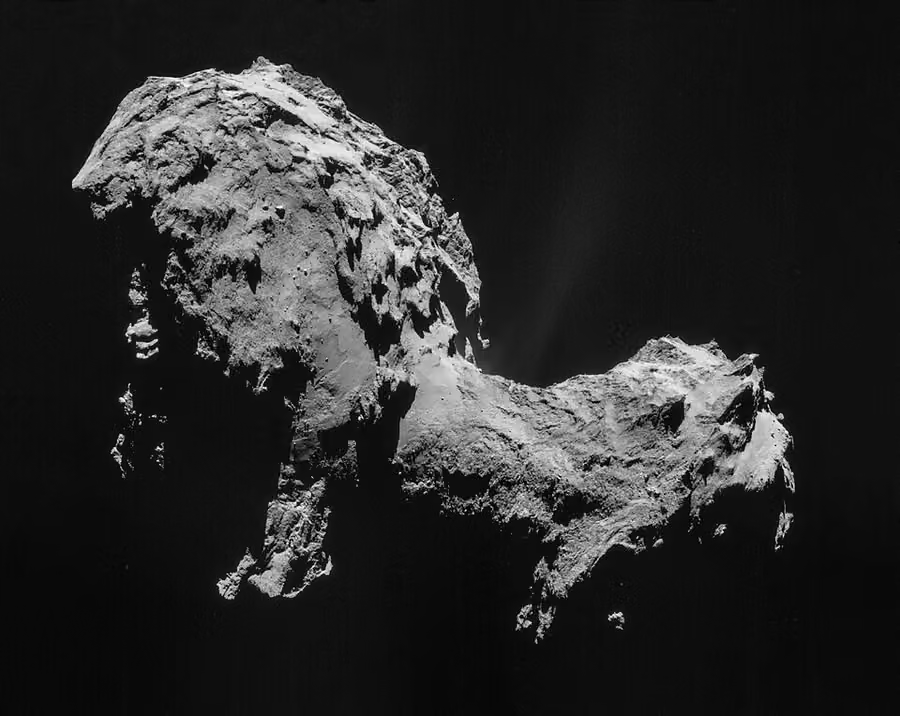
The Rosetta mission measured comet 67P/Churyumov–Gerasimenko at more than three times Earth's D/H — a Jupiter-family comet, which had been the most promising class. Carbonaceous chondrite meteorites, by contrast, have D/H ratios close to Earth's.
That shifted the consensus towards asteroids, with a possible cometary contribution of a few per cent. Sample returns from Ryugu and Bennu have since confirmed that these bodies are water-rich and chemically similar to the meteorites.
How much water, how early: estimates of the total inventory differ by factors of several, and much of it may be locked in the mantle rather than the ocean.
Solar nebula contribution: some hydrogen may have come from the nebula itself and been incorporated into the mantle, which would dilute any delivery signature.
The Moon-forming impact: a giant impact would have vaporised much of Earth's water. How much survived or was re-delivered is model-dependent.
The archive's label reflects the state of play: delivery by water-rich asteroids is the leading account, with the quantity and timing genuinely open.
Why it is in the archive
Because the question is a good example of how isotope geochemistry works as evidence — a ratio in a comet measured by a spacecraft constrains a story about the oceans.
Related: how the Moon formed, the origin of life.
Sources for this page
- Wikipedia, “Origin of water on Earth” — evidence and modelsen.wikipedia.org
- Altwegg et al. (2015), Science — high D/H in comet 67Pdoi.org
- Wikipedia, “Carbonaceous chondrite” — composition and water contenten.wikipedia.org
- NASA, Rosetta mission resultsscience.nasa.gov