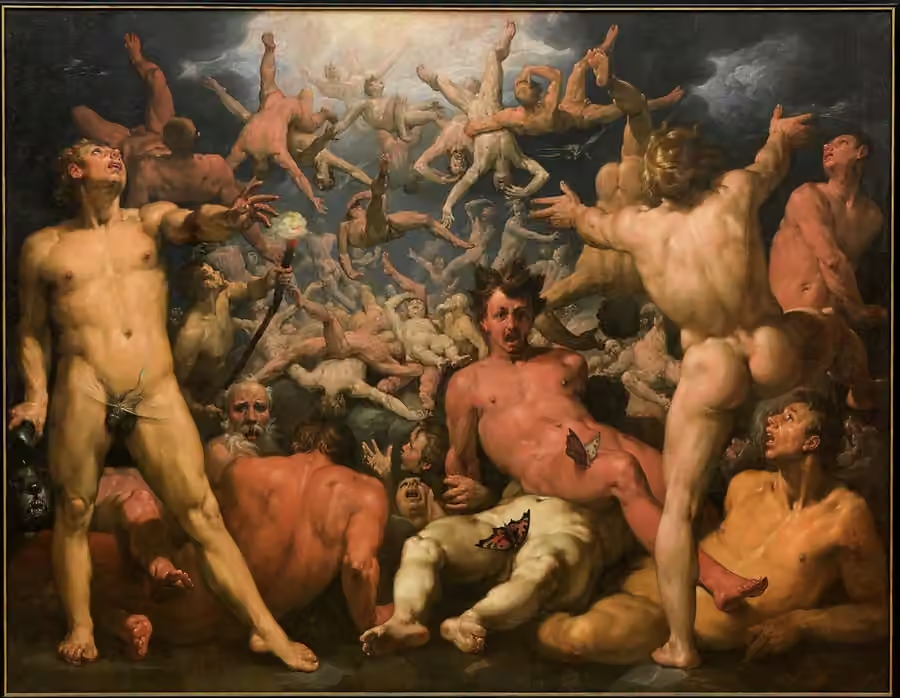
Of all the places in this archive, Tartarus has the best documentation — because it survives in complete poems that have been continuously read for twenty-seven centuries. That makes it useful: you can read exactly what the source says, and then watch what later claims do to it.
The primary sources
Tartarus appears in two roles, sometimes in the same poem. It is a place — the deepest region of the cosmos — and it is also a being, one of the primordial entities that come into existence alongside Chaos and Gaia.
Hesiod’s Theogony (c. 700 BC) is the key text. In the opening cosmogony, Tartarus is the third thing to exist, “dim Tartarus in the depth of the wide-pathed Earth.” Later, after the Titanomachy, Zeus hurls the defeated Titans into it, and Hesiod gives the geography:
“A brazen anvil falling from heaven nine nights and days would reach the earth upon the tenth: and again, a brazen anvil falling from earth nine nights and days would reach Tartarus upon the tenth.” Hesiod, Theogony 720–725
It is enclosed by a bronze fence with “night spread in triple line all about it like a neck-circlet,” sealed by bronze gates that Poseidon fitted, and guarded by the Hundred-Handers. Inside, direction itself breaks down.
Homer’s Iliad (8.13–16) uses the same geometry as a threat: Zeus says he could hang a god from a chain and drop them so far that they would land in Tartarus, “as far beneath Hades as heaven is above earth.”
The Theogony also makes Tartarus a parent: with Gaia he fathers Typhoeus (Typhon), the hundred-headed storm-monster who nearly takes Zeus’s throne and is finally buried under it — the origin, in Hesiod’s account, of the destructive winds.
Two different underworlds
It is worth being precise, because the popular retelling usually isn’t:
| Name | What it is |
|---|---|
| Hades | The realm of the dead, ruled by the god of the same name; the destination of ordinary mortals. |
| Tartarus | The deepest pit, far below Hades; a prison for gods and monsters, not a general afterlife. |
| Elysium | The blessed region; later sources make it Tartarus’s opposite. |
Over time the words blurred. Britannica notes that Tartarus gradually came to mean the entire underworld. In Virgil and later Roman writers it is a place of punishment for human sinners as well as Titans — a development Hesiod would not recognise.
Why it matters to this archive
Because Tartarus supplies the vocabulary that hidden-world theories still use. When a modern interior is described as a pit with a gate, guarded, containing giants, reached by descending impossibly far — the imagery is Hesiod’s. The transfer happens in three moves:
- Poem → place. A cosmological image is read as a literal geography.
- Place → interior. The pit is relocated into the Earth’s shell, which the hollow-Earth literature supplies.
- Interior → prison. The “fallen angels” and giant narratives of Genesis 6 and the Book of Enoch get bolted on, producing the modern “Tartarus is where they put the Nephilim” claim.
The New Testament does use the word: 2 Peter 2:4 says the angels who sinned were cast into Tartarus — the only occurrence in the Greek New Testament — which is why the term survives in theological English. That is a deliberate allusion to the Greek image, not a geological report.
Tartarus is the strongest case in this archive for a claim that is true as literature and false as geography. There is nothing to debunk in Hesiod, because Hesiod was not making a measurement. The error only appears when a poem is converted into a map — and that conversion is always the interesting moment, because it tells you what the converter wanted the world to look like.
The same pit under other names
- Sheol (Hebrew Bible) — the shadowy place of the dead, sometimes deep, sometimes simply “the grave”.
- Helheim (Norse) — the cold realm of the dead, reached by crossing a river and passing through a gate.
- Duat (Egyptian) — the underworld the sun passes through each night, with gates and guarded hours.
- Diyu (Chinese) — the subterranean courts of judgment, layered into levels.
Every one of these has been used in modern fringe writing as evidence of a global memory of a real hollow interior. The alternative, and the one folklorists prefer, is that human beings bury their dead, imagine them below, and build architecture around the same few requirements: an entrance, a guard, a depth, and a reason to stay out.
Sources for this page
- Hesiod, Theogony — the anvil passage (720–725) and the Titans (700–739), with Greek textgreekmythology.com/sources/hesiod/theogony/700-739
- Theoi Project, “Tartaros — pit beneath the earth of Greek mythology”theoi.com/Kosmos/Tartaros.html
- Britannica, “Tartarus”britannica.com/topic/Tartarus
- GreekMythology.com, “Tartarus in the ancient sources” — 19 passages from 11 authorsgreekmythology.com/sources/figures/tartarus
- Caldwell’s translation of the Theogony with commentary (PDF)classics.domains.skidmore.edu
- Burnett, “Going Through Hell: ΤΑΡΤΑΡΟΣ in Greco-Roman Culture” (PDF)clintburnett.com
- Hesiod, Theogony — full text in a teaching editionopen.maricopa.edu