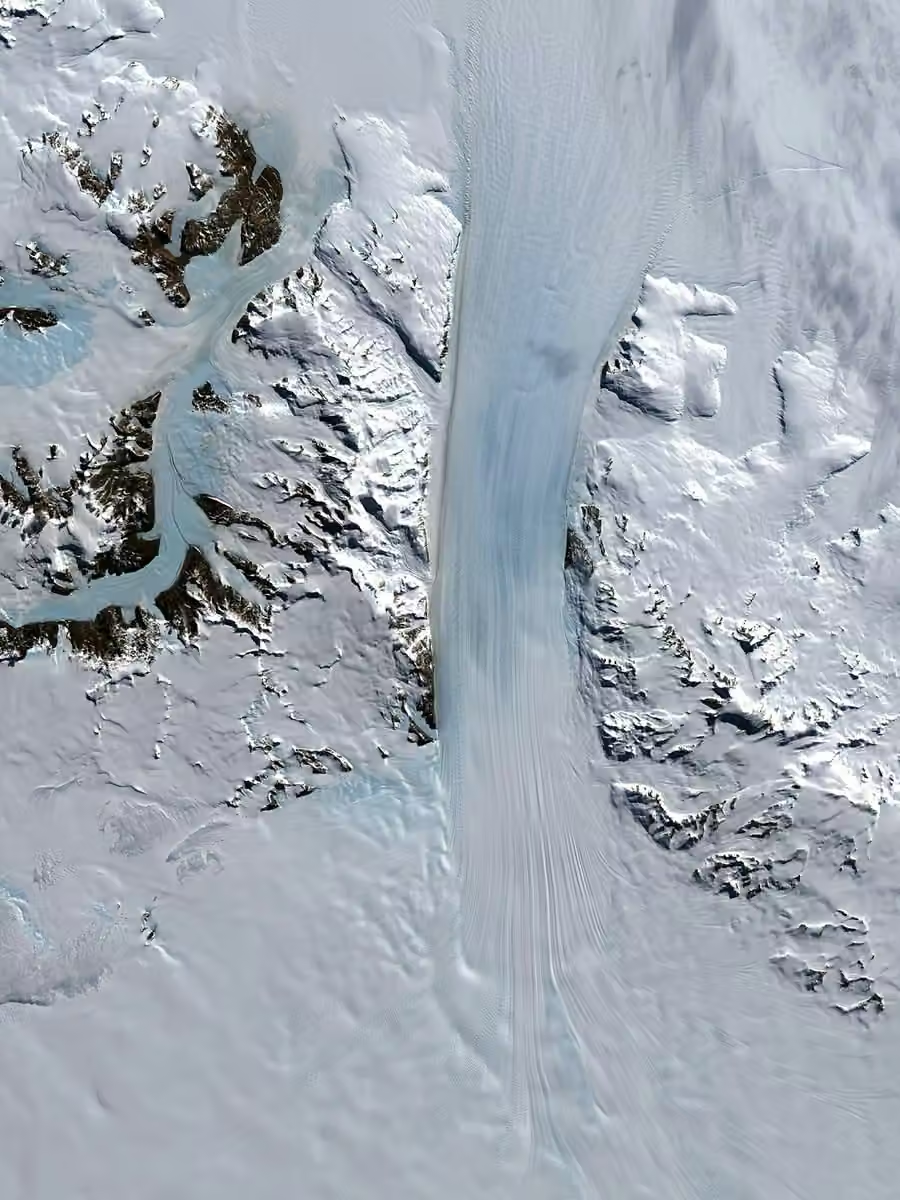
“The world beyond the ice wall” is what happens when two older theories are joined. From flat Earth it takes the rim: Antarctica as a circular wall enclosing the known continents. From hollow Earth it takes the doorway: the wall is not an edge but a gate, with more land behind it.
Neither half is new. The novelty is the composite, which spread through short-form video after roughly 2020 and now functions as a complete alternative geography.
What the claim says
- Antarctica is not a continent at the south pole but a wall encircling the known world.
- Beyond it lie additional continents, sometimes inhabited, sometimes ruins.
- Ordinary people are not permitted to go and verify this.
- The Antarctic Treaty of 1959 exists to enforce the prohibition.
- Admiral Byrd’s 1947 expedition encountered what is back there, and a suppressed diary records it.
The Byrd story, checked
Richard E. Byrd is the central witness, and the claims about him have a documented paper trail — just not the one the videos cite.
Operation Highjump (1946–47) was real: the largest Antarctic expedition ever mounted, with thirteen ships, aircraft and roughly 4,700 men. Its stated purpose was to establish a research base and conduct aerial surveys — Little America IV. USA Today’s fact-check states plainly that historical records show no evidence it was sent to investigate an ice wall. Contemporary coverage exists, including the documentary The Secret Land.
What Byrd actually discovered that feeds the legend is the Bunger Hills — an ice-free oasis of dark rock and meltwater lakes surrounded by the ice sheet, which he described as “an island suitable for life … in a universe of death.” A real, strange, genuinely beautiful place. Add a mythical wall, and an oasis becomes a tropical hidden world.
The diary is a separate problem. The Missing Diary of Admiral Richard E. Byrd describes flying into the interior and meeting an ancient civilization with advanced technology. Researchers tracing its publication history place it with Raymond Bernard’s The Hollow Earth as twentieth-century occult fiction; the Byrd Polar and Climate Research Center at Ohio State holds his actual papers and reports no evidence for the flight. Byrd’s real quoted line — “I’d like to see that land beyond the Pole” — is a remark about unexplored territory, which is how exploration works.
The treaty, checked
The Antarctic Treaty was signed in 1959 by twelve nations and now has over fifty parties. Its provisions: the continent is used for peaceful purposes and scientific research; military activity is prohibited; territorial claims are frozen; nuclear testing is banned; and inspections are allowed.
It contains no restriction on visitors. Tourism is a substantial industry — tens of thousands of people land in Antarctica each year, mostly via the Antarctic Peninsula, under IAATO guidelines. National programmes run annually, and the US Antarctic Program alone staffs three year-round stations.
The Long Now Foundation’s essay on the subject makes the sociological point well: Antarctica is genuinely hard to reach, access really does run through government logistics, and that bottleneck is readable as secrecy even though it is a function of distance, weather and cost.
Antarctica is a continent. It has bedrock, mountains, subglacial lakes and a geological history continuous with Gondwana; it is not a ring. Satellite imagery shows its actual shape — a roughly circular landmass offset toward the Atlantic, with the Antarctic Peninsula reaching toward South America. Reuters and USA Today have both fact-checked the rim claim against this imagery and against circumnavigation records.
It has been crossed and circumnavigated. The continent was first reached in 1821, the pole in 1911, crossed overland in 1957–58, and circumnavigated by ship and by ski. A wall has no interior to cross.
The famous map is an illustration. The most-shared image of concentric ice walls ringing the continents was traced by Reuters to a post on an online art forum, not to any survey.
Why the composite is so durable
It solves three problems at once. It explains why nobody has photographed the extra land (it is forbidden). It gives the flat disc an edge without requiring anyone to fall off it. And it provides a physical location for everything else — the inner sun’s light leaking through, the giants, the surviving dinosaurs — without needing them to be nearby.
That is the signature move of a mature conspiracy cosmology: one unreachable place absorbs all the unruly evidence. The same structure appears in the hollow Earth’s interior and in the “classified” files of real proven conspiracies, which is part of why the real ones matter — they demonstrate what actual suppression looks like, with documents, and it does not look like this.
Reading list
- Long Now Foundation, “The Truth About Antarctica” — ice wall, access, and the Symmes lineagelongnow.org/ideas/the-truth-about-antarctica
- USA Today, “False claim Operation Highjump was to explore Antarctic ‘ice wall’” (2024)usatoday.com
- Reuters, “Map featuring Antarctica ‘ice wall’ is an art forum creation” (2023)reuters.com
- Reuters, “Earth is not flat or surrounded by an ice wall” (2023)reuters.com
- Swoop Antarctica, “Why does Antarctica attract so many conspiracy theories?” — Bunger Hills and Byrdswoop-antarctica.com
- All That’s Interesting, “What did Admiral Byrd discover in Antarctica?”allthatsinteresting.com
- Ohio State University, Byrd Polar archives — on the missing diarylibrary.osu.edu