First, the word
In genetics a mutation is simply a change in a DNA sequence. Most are neutral; many are harmful; a few are useful. Every difference between any two people is the result of mutations, which means the comic-book sense of “mutant” — a separate species with powers — is a category error with a very long shadow.
The webbed-up version is still worth taking seriously, because the real variants are stranger than the fiction and, unlike the fiction, they are published.
1. Bones that do not break: LRP5
In 2002, a paper in the New England Journal of Medicine described a family with a striking trait: exceptionally dense bones, a wide and deep jaw, and a bony ridge on the roof of the mouth, but otherwise normal. The cause was a single amino-acid change — valine for glycine at position 171 — in a gene called LRP5, part of the Wnt signalling pathway that regulates bone formation.
The mutation is gain-of-function: bone formation markers are markedly elevated while resorption is normal. Carriers are, in effect, resistant to osteoporosis. A 2023 review counted 19 such gain-of-function variants across 113 patients in 33 families, causing a rare condition called autosomal dominant osteosclerosis.
This is the closest thing in the literature to a real “unbreakable” trait. It also comes with costs: thickened skull, nerve compression, headaches, facial paralysis in some cases. Biology rarely gives anything for free.
2. Living where the air is thin: EPAS1
Tibetans live and work above 4,000 m, where visitors develop headaches, breathlessness and dangerous swelling. The adaptation is genetic and it is unusually well documented.
A 2010 Science paper sequencing 50 Tibetan exomes found the strongest signal of natural selection at EPAS1, a hypoxia-response transcription factor, with a 78% allele-frequency difference between Tibetan and Han samples — described as the fastest allele frequency change observed at any human gene. The favoured version keeps haemoglobin from rising too high, avoiding thick blood.
Then the plot thickened: the beneficial EPAS1 haplotype came from Denisovans, an extinct human relative, by introgression — a 2016 Human Genetics paper traces a 32.7 kb Denisovan haplotype across Himalayan populations, correlating with altitude. Andean highlanders have a different, convergently selected variant, reported in Science Advances in 2024.
So “superpowered highlanders” is real, and the power was inherited from a species that no longer exists.
3. The sickle-cell bargain
A single change in the beta-globin gene produces sickle-cell trait. Two copies cause serious disease. One copy confers substantial resistance to malaria — which is why the allele is common in regions where malaria is endemic. It is the standard textbook example of heterozygote advantage, and of a mutation that is simultaneously protective and dangerous depending on dose.
4. Seeing a fourth colour
Most people have three types of cone cell. A small proportion of women carry four distinct cone variants — tetrachromacy — and behavioural tests suggest some of them discriminate colours that trichromats cannot. The effect is subtle and contested in degree, not in mechanism.
5. Gigantism is not a superpower
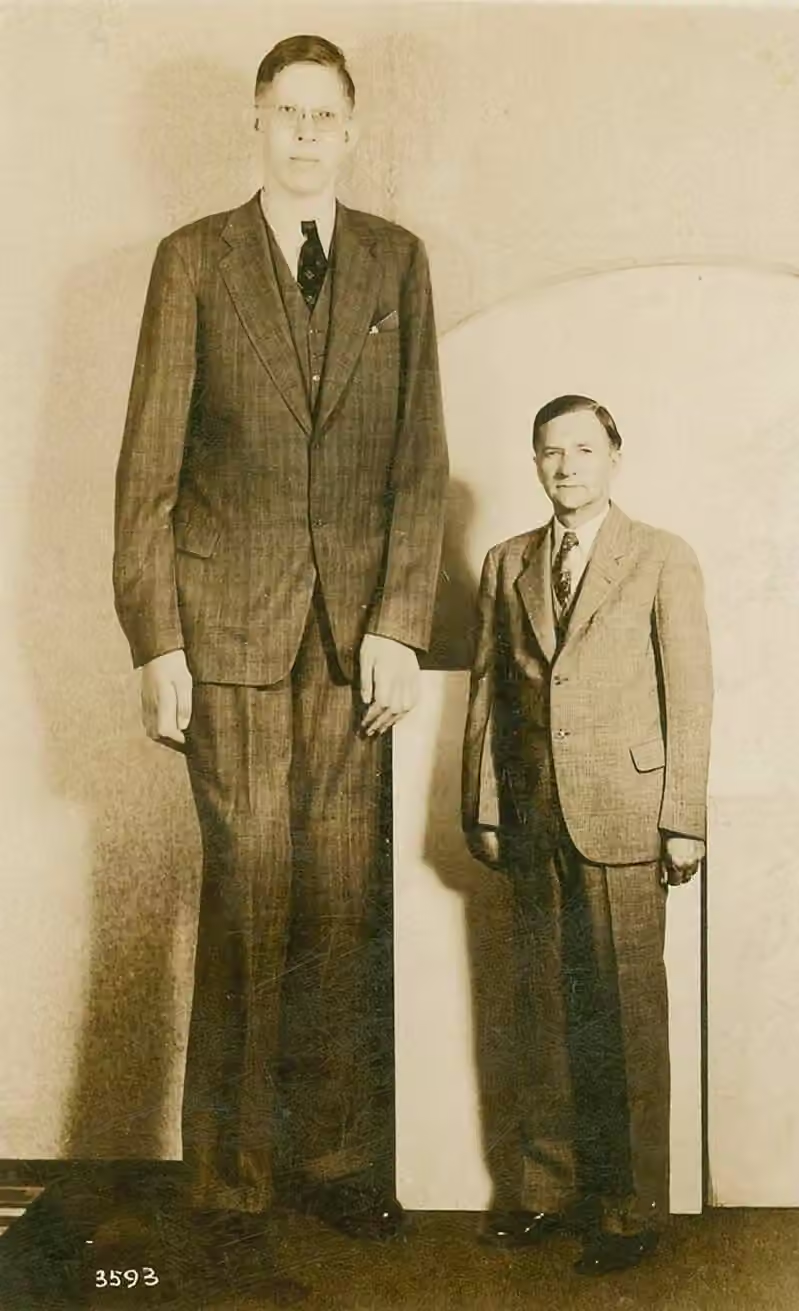
Robert Wadlow reached 2.72 m (8 ft 11 in) and is the tallest person in reliable medical record. His height came from pituitary gigantism — a tumour driving excess growth hormone — and it killed him at 22, from an infection related to a brace he needed in order to walk. The tallest humans in history were, without exception, people with a serious endocrine disease.
This matters for the giants dossier: the maximum plausible human height is set by the square-cube law — bone cross-section grows with the square of scale while mass grows with the cube — and by the circulatory system. A ten-foot human is possible. A twenty-foot one is not, and the fossil record shows no hominin that tried.
Radiation raises mutation rates; it does not grant abilities. The wildlife around Chernobyl is a real natural experiment — populations of birds, insects and mammals show elevated mutation and some adaptation — but the findings are about damage, tolerance and species composition, not about animals acquiring new powers.
The fiction gets one thing right, though: mutations are the raw material of evolution. The difference is that evolution selects on populations over thousands of generations, and it does not have a plot.
Why this dossier belongs here
Because “mutants” and “superpowers” are the last stop of the same argument that runs through the giants and dragon pages: that the natural world must once have contained something categorically beyond us. It did not. It contained variations, most of them costly, a few of them extraordinary — and all of them documented in journals anyone can read.
Sources for this page
- Boyden et al. (2002), “High bone density due to a mutation in LDL-receptor-related protein 5”, NEJMpubmed.ncbi.nlm.nih.gov
- Van Wesenbeeck et al. (2003), “A mutation in LRP5 results in the autosomal dominant high–bone-mass trait”, AJHGsciencedirect.com
- Molecular Genetics and Genomics (2023), “Novel mutation in LRP5 gene cause rare osteosclerosis”link.springer.com
- Yi et al. (2010), “Sequencing of 50 Human Exomes Reveals Adaptation to High Altitude”, Sciencescience.org
- Huerta-Sánchez et al. (2016), “Wide distribution and altitude correlation of an archaic high-altitude-adaptive EPAS1 haplotype”, Human Geneticslink.springer.com
- Science Advances (2024), “Functional EPAS1/HIF2A missense variant … in Andean highlanders”science.org
- Beall et al. / Simonson et al. (2010), “Genetic Evidence for High-Altitude Adaptation in Tibet”, Sciencescience.org
- PLOS One (2012), “Genetic Variants in EPAS1 Contribute to Adaptation to High-Altitude Hypoxia in Sherpas”journals.plos.org