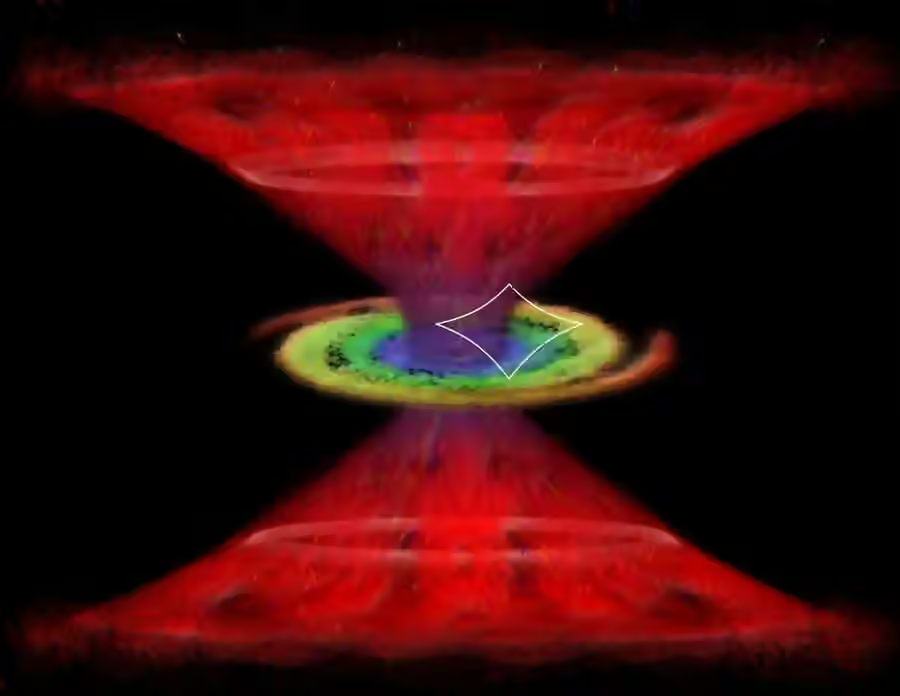
The argument
Quantum mechanics requires that information is not destroyed, which for a black hole means the radiation it evaporates must carry it out — and that late radiation is entangled with early radiation.
But the late radiation must also be entangled with the interior, for the horizon to be smooth in the way general relativity says. Entanglement is monogamous: a system cannot be fully entangled with two different things at once. So either the horizon is not smooth (a 'firewall' burns the infalling observer), or information is lost, or one of the assumptions is wrong.
The proposed escapes
Complementarity: the interior and exterior descriptions are not simultaneously valid — no observer can check both. Attractive, but hard to make precise.
ER=EPR: entangled particles are connected by wormholes, so the early radiation and the interior are the same thing described differently. Elegant, still conjectural.
Nonlocality or state-dependence: the radiation's decoding depends on the observer, or the horizon physics is not local. Both break assumptions physicists would rather keep.
Remnants and baby universes: the information stays in a leftover object. Most of these struggle with entropy bounds or with producing observable consequences.
At stake: whether black holes preserve quantum information — the 'information paradox' in its sharpest form — and therefore which of quantum mechanics or relativity must give way.
Not at stake: anything measurable soon. The effect is at the Planck scale, and no experiment can probe a horizon's interior.
Progress: the debate has produced real results — holography, entanglement-wedge reconstructions, and the replica trick for entropy — even without resolving the paradox.
The archive labels it live debate because it is an active, unresolved argument in theoretical physics, and because popular versions routinely present one camp's conjecture as settled.
Why it is in the archive
Because black holes attract more confident nonsense than almost anything else, and the real debate is a useful antidote: careful people disagreeing about assumptions, not mystics announcing that physics has proved the universe is a hologram of your mind.
Related: the holographic principle, white holes.
Sources for this page
- Wikipedia, “Firewall (physics)” — the paradox and responsesen.wikipedia.org
- Almheiri, Marolf, Polchinski & Sully (2013), arXiv:1207.3123arxiv.org
- Maldacena & Susskind (2013), ER=EPR, arXiv:1306.0533arxiv.org
- Wikipedia, “Black hole information paradox” — backgrounden.wikipedia.org