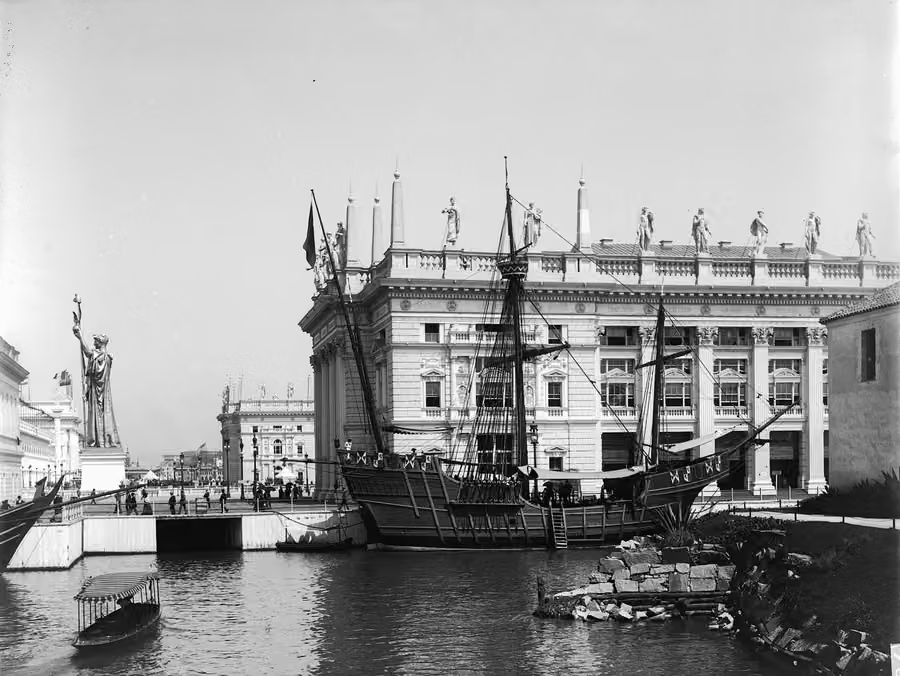
This is the newest theory in the archive and the fastest-growing. It has no founding text, no named authority and no agreed model — which is exactly why it has spread: anyone can add a building to the list.
Its nickname is exact. Architectural Digest-style coverage and the design press have both called it “the QAnon of architecture”, and the phrase fits: a loose set of visual hunches, endlessly recombined, with an unnamable enemy at the centre.
What is claimed
- A technologically advanced worldwide empire — Tartaria — existed before the modern era, with free or wireless energy.
- It built the grand classical and beaux-arts buildings now attributed to the 18th and 19th centuries.
- A global catastrophe, the “mud flood”, buried the lower floors of these buildings in metres of mud.
- A reset followed: the survivors rebuilt over the ruins, rewrote history, and demolished the remaining buildings to hide the evidence.
- Famous demolitions are therefore cover-ups — the Singer Building, the original Penn Station, the temporary exhibition halls of the world’s fairs.
- Some versions add giants, as in other dossiers; the “orphan trains” of the 19th century become children stolen from Tartarian families.
Where it actually comes from
The name is real and so is the confusion behind it. “Tartary” or “Great Tartary” was a European label for the vast interior of Asia — Siberia, Central Asia, Mongolia, stretching toward Afghanistan — used on maps by people who had no interest in distinguishing the many cultures living there. It was a geographical shorthand, not an empire.
The conspiracy version has a traceable lineage in Russia. Anatoly Fomenko’s “New Chronology” from the 1970s and 1980s argued that conventional ancient history was largely fabricated; Nikolai Levashov’s occult-nationalist writing popularised a lost Tartaria as the “real” name of Russia. The Russian Geographical Society has publicly rejected the theory, and has responded by publishing maps of Tartary from its own collection — showing the word as a regional label.
Since about 2016 the idea has been detached from that Russian nationalist frame and rebuilt in English-language video, where it merged with the older “mud flood” motif.
The three pieces of “evidence”, examined
1. Buried ground floors and half-windows
The single most persuasive image in the theory: an old building whose basement windows sit half below the modern pavement, as though the street had risen around it. The Tartarian reading is a flood of mud.
The documentary answer is that streets really did rise — deliberately, in cities all over the world, in exactly the period the theory points at. As horse-drawn traffic gave way to streetcars and then automobiles, steep grades were cut down and low ground was filled up; Seattle’s regrade projects buried many first floors so thoroughly that the old street level is now a tourist attraction. Skeptoid’s episode on the subject identifies at least one photograph used in the videos as Seattle’s street-raising, repurposed as global evidence.
The second half is simpler: basements have windows because cellars need light and ventilation, and a window that is half-sunk is what you get when a pavement is raised by a few courses of stone. No flood is required.
2. World’s fair buildings
This is the theory’s strongest-looking case, and it collapses on a single fact: world’s fairs were temporary by design. The 1893 World’s Columbian Exposition in Chicago — the “White City” — was built in plaster, staff and timber over a few years, intended from the start to be demolished, and it was. The 1915 Panama–Pacific International Exposition in San Francisco was likewise a temporary installation, and the Palace of Horticulture in it is one of the buildings most often posted as Tartarian.
Expositions were the era’s biggest architectural commissions. They were photographed relentlessly, planned in published drawings, reported in the trade press, and their demolition was news. The claim requires all of that to be forged, which is a far larger conspiracy than the one being proposed.
3. Star forts
Star-shaped fortifications — Palmanova, Bourtange, the trace italienne across Europe and the colonial world — are offered as an energy grid. They are actually the solution to a specific military problem: bastions angled so that no wall can be approached without being swept by flanking fire, which became necessary once cannon could knock down a straight curtain wall. The geometry is a firing solution, not a circuit diagram.
Buildings have architects, contracts, payrolls, photographs, newspaper accounts and municipal records. In Australia, AAP FactCheck checked the Tartarian claim against two of Sydney and Melbourne’s best-known buildings and found their construction fully documented — the Queen Victoria Building’s statues, for instance, were carved in the 1890s by a named sculptor, William Macintosh.
There is no geological, sedimentary or archaeological evidence anywhere on Earth for a global mud flood of the kind described. A worldwide event that buried cities on every continent would leave a distinctive layer; it does not exist.
And the chronology fails in the opposite direction too: the theory needs the 19th century to be a fiction, while the 19th century is the best-documented century in human history — censuses, birth registers, tax rolls, photographs, ships’ manifests, telegraph records.
Why it works so well
Because it asks you to look out of the window. Most conspiracy theories require you to accept a claim about a place you will never visit; this one points at your own high street. High ceilings, deep basements, ornate stonework, a building older than its neighbours — all of it becomes evidence, and the evidence is free.
That is also its weakness. The same observations have unglamorous explanations that anyone can check: ceiling heights follow heating technology and status display; basements follow storage needs and street grades; ornament follows the availability of cheap skilled labour and the Beaux-Arts fashion. The theory is a machine for converting ordinary urban fabric into proof, and it runs on not knowing how buildings work.
How it connects
- Giants — the Tartarian population is often said to have been enormous. See Giants.
- Free energy — the same claim as the “suppressed technology” strand in Proven Conspiracies, where you can compare it with what documented suppression looks like.
- Reset history — a softer version of the “much bigger Earth, hidden continents” argument in The Larger Globe: the past is not unknown, it is withheld.
Sources for this page
- The Spinoff, “Inside the wild architecture conspiracy theory gaining traction online”thespinoff.co.nz
- Discover, “Tartaria: The Mystery Behind the Lost Empire and the Mud Flood Conspiracy”discovermagazine.com
- Skeptoid, “Tartaria and the Mud Flood” — Seattle’s regradeskeptoid.com/episodes/765
- AAP FactCheck, “Ancient empire’s link to historic buildings is a delusion” (2024)aap.com.au
- Bloomberg CityLab, “Inside the ‘Tartarian Empire,’ the QAnon of Architecture”architexturez.net (reprint)
- Brewminate, “Star Forts and the Tartaria Myth”brewminate.com
- All That’s Interesting, “Tartarian Empire: The Civilization Allegedly Scrubbed From History”allthatsinteresting.com
- Wikipedia, “Tartarian Empire” — Fomenko and Levashov lineage, Russian Geographical Society responseen.wikipedia.org
- University of Wales Trinity Saint David, “The World That Was” (MA thesis on pseudoarchaeology online)repository.uwtsd.ac.uk (PDF)