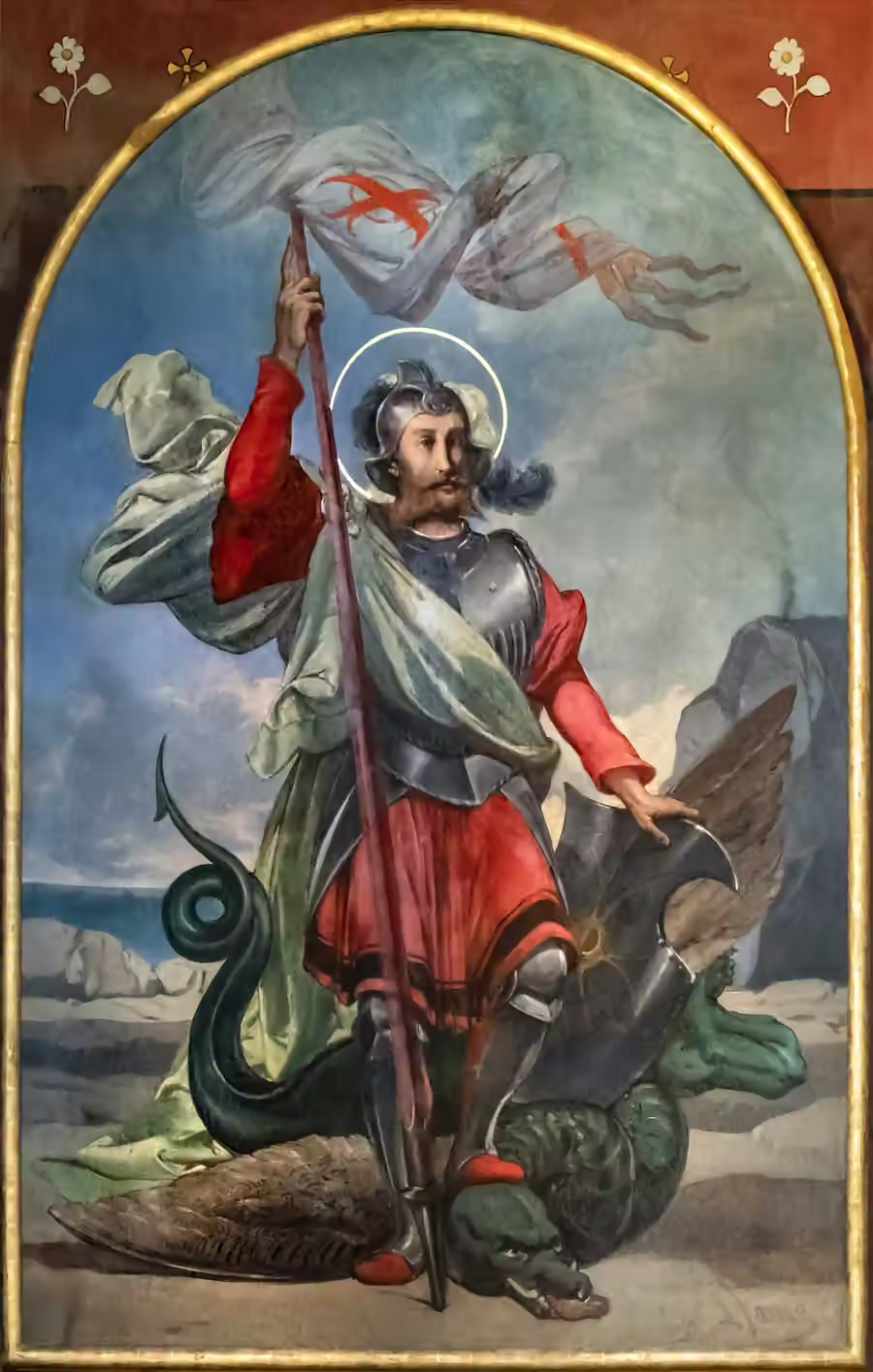
The puzzle
Dragons appear in China, in Mesopotamia, in Greece, in Wales, in Mesoamerica, in Aboriginal Australian rock art and in San rock painting in southern Africa. The specific creature varies — serpent, four-legged firedrake, rain-bringing spirit, hoard-guarding worm — but the family resemblance is strong enough that the question “where did dragons come from?” is a real academic question, not a fan question.
The phylogenetic answer
In 2013, Julien d’Huy and colleagues applied the methods of evolutionary biology to mythology. They coded dragon motifs from 23 regions, built phylogenetic trees the way you would for species, and looked for the tree most consistent with the data.
The result, as the University of Bristol’s palaeontology blog describes it, was a very high likelihood that the dragon myth has a single origin, and that the patterns fit human migration unusually well — “stronger than those produced by most biological data.” On their reconstruction, the first dragon story was being told perhaps 75,000 years ago in southern Africa, and it travelled with people as they dispersed.
That is a striking result, and it is also contested — phylogenetic analysis of folklore depends heavily on how you code a motif, and a single origin is not the only reading of the data. But it moves the question from “dragons must be memories of dinosaurs” to “dragons are a story that spread.”
Fossils in the ground
The other major strand is Adrienne Mayor’s work on fossil knowledge in the ancient world. The argument: ancient people found enormous bones eroding out of the ground, had no concept of extinct species, and reconstructed the animals from the skeleton up. Her best-documented case is the griffin: the gold-guarding griffin of Scythian legend closely matches Protoceratops, whose fossils — complete with nests and eggs — are abundant in the Gobi Desert where the Scythians mined gold.
The same logic runs through Chinese “dragon bones”, which were collected, sold as medicine and eventually recognised as fossils; Peking Man was found at a well-known dragon-bone site outside Beijing.
Ronald Hutton’s 2024 Gresham lecture proposes a three-stage model that fits all of this together: a basic human fear of apex predators, then the visual evidence of fossils and rare sea creatures like giant squid, then regional literary traditions (the benevolent Chinese dragon, the Christian firedrake).
The creationist reading
A completely different explanation is argued by young-Earth creationist organisations, and it should be stated in their own words rather than paraphrased:
If dinosaurs were created on Day Six and survived the Flood on the Ark, then people groups after the Flood would have lived alongside them until they died out. Those people would not have used the word “dinosaur” — coined in 1841 — but “dragon” or “monster”. Therefore ubiquitous dragon legends are exactly what the creation model predicts, and the dating methods that place dinosaurs 65 million years ago are the thing that is wrong.
The argument is internally consistent, and its appeal is obvious: it turns a global folklore pattern into evidence. Apologetics Press makes the same case at length, and Creation Ministries’ article on “dinosaurs and dragons” is the most complete version.
The stratigraphy is not ambiguous. Non-avian dinosaurs disappear from the fossil record at the Cretaceous–Palaeogene boundary, about 66 million years ago. The earliest hominins appear in the last several million years; Homo sapiens in the last 300,000. USGS states it directly: “After the dinosaurs died out, nearly 65 million years passed before people appeared on Earth.”
The specific “dinosaur” identifications fail on inspection. A 2013 paper in Palaeontologia Electronica went through the Greco-Roman material case by case: the dragons of Pliny and Aelian are snakes — the epithets are ophis, serpens, anguis; the “theropod” in the Nile Mosaic of Palestrina is a mammal, possibly an otter; the “dinosaur” in a Pompeii fresco is a crocodile; the “pterosaurs” on an Alexandrian coin are winged snakes.
Birds are dinosaurs. The one way in which humans do live alongside dinosaurs is the one creationists do not need: avian dinosaurs are everywhere, and the lineage is well documented in the fossil record.
The living-dinosaur claim
The same logic produces Mokele-mbembe, the sauropod said to inhabit the Congo Basin, and the Lake Champlain and Loch Ness “survivors”. These are covered in Cryptids. The pattern is consistent: a large unexplored region, a local tradition, a Western expedition, no specimen.
What dragons are actually good at
They are the most successful monster design in human history, and the reasons are practical: a serpent body reads as dangerous from any angle, wings add threat, fire explains destruction, and a hoard gives it a reason to be somewhere. You do not need a dinosaur to invent that. You need a story.
Sources for this page
- University of Bristol, “Darwinism & Dragons” — d’Huy’s 2013 phylogenetic studydinoproject.blogs.bristol.ac.uk
- Palaeontologia Electronica, “Dinosaurs in Greco-Roman art?” (2013)palaeo-electronica.org
- BioLogos, “Dragons and Dinosaurs: The Surprising Link Between Folklore and Fossils”biologos.org
- USGS, “Did people and dinosaurs live at the same time?”usgs.gov/faqs
- Creation Ministries International, “Dinosaurs and dragons: stamping on the legends”creation.com
- Apologetics Press, “Historical Support for the Coexistence of Dinosaurs and Humans”apologeticspress.org
- Prof. Ronald Hutton, “Dragons: A History” (Gresham College lecture transcript, 2024)gresham.ac.uk
- HISTORY, “Why Dragons Appear in So Many Cultures”history.com/articles/dragon-myths