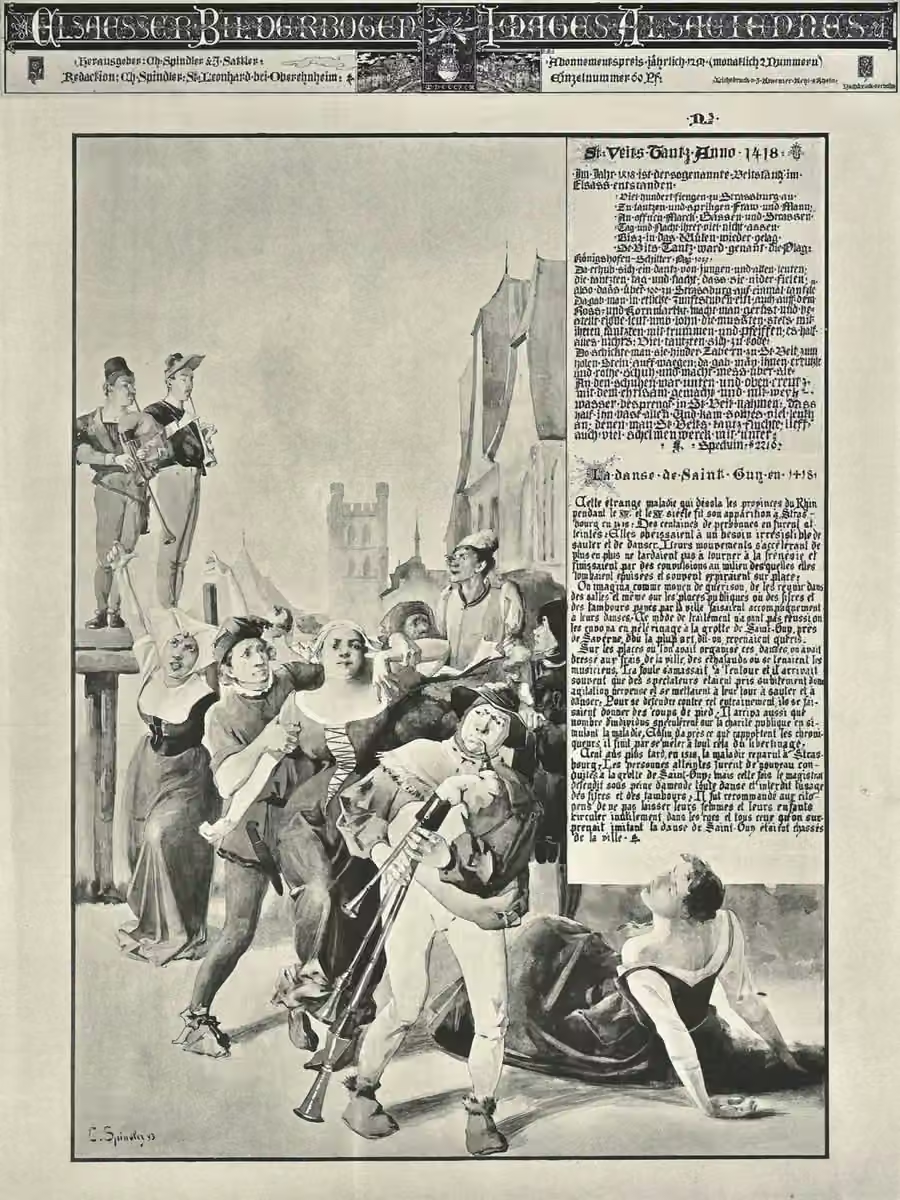
Mass psychogenic illness — the older term is mass hysteria — is a real, medically recognised phenomenon: genuine physical symptoms, spreading through a group, with no toxic or infectious cause. It is not faking. The symptoms are involuntary and the distress is real. What spreads is the form the distress takes.
Strasbourg, 1518
In July 1518 a woman in Strasbourg, known as Frau Troffea, began dancing in the street and did not stop. Within a week others had joined; within a month, according to the chronicles, some 400 people were dancing. Some collapsed; some died of exhaustion, stroke or heart attack.
The response of the authorities is the detail that makes the case so valuable. They did not treat it as a poisoning or a plague. They concluded it was “hot blood”, and prescribed more dancing — hiring musicians and clearing a stage, in the belief that the afflicted must dance it out. The intervention made it worse.
John Waller, who has written the standard history, notes that the outbreak is documented independently by scores of physicians, chroniclers, monks and priests, and that for 1518 the municipal orders themselves survive. There is no serious doubt it happened.
The favoured chemical explanation — ergot poisoning from mouldy rye — is weak, as Waller and others argue: ergot causes convulsions and gangrene, not endurance dancing, and it would not explain the geographical spread across the Rhineland in 1374 or the localised pattern in 1518.
The Tanganyika laughter epidemic, 1962
In a mission school in what is now Tanzania, three girls began laughing and could not stop. The laughter spread to classmates, then to other schools and villages; around a thousand people were affected over months, and schools closed.
It was not a joke and not a virus. The standard analysis — including a 2007 paper in Humor — classifies it as a motor-variant outbreak of mass psychogenic illness: laughter as the symptom, in a population under real stress, at a moment of social change. The popular retellings exaggerate the laughter and drop the distress.
Salem, 1692
The Salem witch trials began with afflicted young women — convulsions, contortions, reports of invisible tormentors — and ended with nineteen executions and one man pressed to death. It is the classic case of a psychogenic outbreak fused with a social mechanism: once the symptoms were interpreted as witchcraft, accusation became a way to settle property disputes and local grudges.
The lesson historians draw is not “they were stupid”. It is that a community under stress, with an explanatory framework that names a culprit, will find the culprit. Change the framework and the same symptoms produce a different history.
- A real stressor — famine, war, epidemic, dispossession, social change.
- A visible first case, often someone of low status, whose symptoms are dramatic.
- A shared explanatory frame — demons, witches, poison, radiation, a “challenge”.
- Transmission by attention, not contact: sight, rumour, and in the modern era, the screen.
- Symptoms that resolve when the group is separated and the frame is changed.
Those five features are also a good description of how a creepypasta panic spreads, and of why the UAP file keeps producing clusters of reports after publicity.
Why the phrase is out of favour
“Mass hysteria” carries an implication of female weakness that was built into 19th-century medicine — the whole diagnosis of “hysteria” was, literally, a theory about the womb. Modern literature prefers mass psychogenic illness, and the point is not semantic: the old framing blamed the sufferers, and the modern one asks what the group was under.
The uncomfortable modern cases
Mass psychogenic illness is not historical. Documented outbreaks include factory fume scares, school illness clusters, and the wave of reported “Havana syndrome” symptoms among diplomats — where the debate is precisely whether there is a physical cause or a social one, and where the answer remains contested.
That last case is why the topic belongs in this archive: it is an active scientific argument, not a closed file. And it shows that labelling something “hysteria” is itself a claim that needs evidence — sometimes symptoms are environmental, and dismissing them has its own body count.
Sources for this page
- John Waller, “Dancing plagues and mass hysteria”, The Psychologist (BPS, 2009)bps.org.uk
- HISTORY, “7 Mysterious Mass Illnesses That Defied Explanation”history.com
- Provine, “The laughter of the 1962 Tanganyika ‘laughter epidemic’”, Humor (2007)degruyterbrill.com