Two different things
A placebo-controlled trial compares a treatment against a sham. The placebo response is everything that happens in the sham arm — including the disease getting better on its own, regression to the mean, and the reporting behaviour of people who know they are being watched. The placebo effect is only the part caused by expectation, and it is the smaller of the two.
Most popular writing on placebos conflates them, which is how a natural recovery becomes evidence that the mind heals the body.
Where it is largest
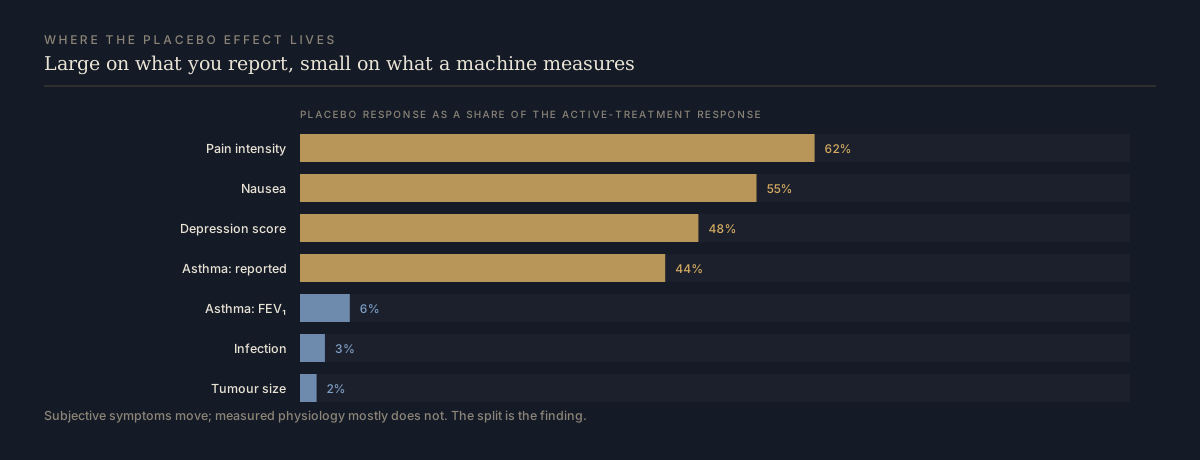
Pain, nausea, fatigue, depression scores, asthma symptoms — anything measured by asking the patient how they feel. In these, sham treatments reliably beat no treatment, and the size is often a fifth to a third of the response to the real drug. The mechanism has been partly mapped: expectation of relief releases endogenous opioids, and the effect is reversed by naloxone in some experiments.
Where it disappears
A 2001 meta-analysis of 114 trials found little evidence of a placebo effect on binary or objective outcomes — blood pressure, infection, tumour size, blood counts. Patients felt better on placebo, but their bodies did not measurably change. Later reviews have argued about the size, not about the direction: the effect is real for experience, thin for physiology.
Asthma gives the cleanest demonstration. In a 2005 study, sham inhalers and sham acupuncture produced large improvements in what patients reported and almost none in forced expiratory volume, the number the machine measures.
Open-label placebos work, slightly. Kaptchuk and colleagues gave irritable bowel patients sugar pills in a bottle labelled “placebo” and told them so. Symptoms improved more than in the no-treatment group. The effect is small and the mechanism contested, but it means the effect is not simply deception.
Nocebo is the mirror. Expectation of harm produces real symptoms — nausea, headache, pain — and accounts for a measurable share of the side effects reported in trials of statins and vaccines.
What it is not: a treatment for cancer, infection, fracture or anything with an objective trajectory. A placebo can change how a disease feels. It has never been shown to change what a disease does.
Why it belongs in this archive
Because it is the honest version of the claim that belief shapes the body. Something real is happening, it is measurable, and it is far smaller than the claims made for it — the same shape as half the material on this site, except that here the phenomenon survives the test.
Sources for this page
- Wikipedia, “Placebo” — definitions, history and trial designen.wikipedia.org
- Hróbjartsson & Gøtzsche (2001), NEJM — is the placebo powerless?doi.org
- Kaptchuk et al. (2010), PLoS ONE — placebos without deceptiondoi.org
- Wager et al. (2004), Science — placebo-induced opioid activitydoi.org